
A note to the reader: Rather than focusing on individual adoption experiences, this essay concerns the statutory mechanisms and justifications the state uses to annex and replace a legal identity permanently, without consent.
PART ONE:
To truly understand the level of commitment required to pursue justice for adopted people, it is instructive to read the chronology of inaction that has been successive governments’ response to reforming New Zealand’s adoption laws. Assembled by Adoption Action, a New Zealand collective working for law reform, the chronology spans 44 years and runs to 18 pages.1
One of those entries is by the New Zealand Law Commission, which, in 2000, was tasked with reviewing the legal framework for adoption. They produced a preliminary paper titled Adoption: Options for Reform and a final report, Adoption and Its Alternatives: A Different Approach and a New Framework.2
With a focus on adopted people, the commission’s recommendations were wide-ranging, addressing inequalities, such as whether an adopted person may cancel an adoption order and the scope of information available from the courts. They declared:
“Nowadays, these issues are seen through a lens of human dignity. The status of illegitimacy has been abolished, children are acknowledged to have rights, and blood ties are a recognised fact that no legislation can alter”.3
That was twenty-six years ago. Successive governments ignored the findings, implementing none of the recommendations. However, in 2021, the Ministry of Justice released its first round of public engagement as part of its preparation for law reform.
I was optimistic in the way only a person with few options can be. The adopted adults community was likewise hopeful that this discussion document marked the start of a new era.4
But as I read through the seventy-two pages of statements and questions, I remember the sense of a hand on my throat. The document begins with an overview:
“Adoption is often described as a ‘triangle’ of relationships.”
They even employ an adoption industry logo showing an equilateral triangle woven with a heart, representing the adopted person, birth parents and adoptive parents.
But there is nothing equal about this triad. A more accurate version would include the legislation that enables the adoption of nonconsenting people, the facilitating organisations, such as successive iterations of Social Welfare departments and historically faith-based maternity homes, and the adopters who drive market demand. The mother produces the product; her child is the product the system is set up to provide.
When describing the creation of the Adoption Act 1955, Keith Griffith said that representation was a mixture of legal adoptive parents and welfare officers: “Input from the 19,000 birth parents and 11,000 adult adoptees of 1955 was neither sought nor obtained”.5
The hope that the law reform discussion document might begin to resolve the issues that adopted adults must grapple with daily is undermined by the specific use of language, embedded assumptions, and predetermined outcomes.
It is a masterpiece of strategic ambiguity, employing deliberate and intentional obfuscation.
While the terms “child” and “children” are used in the documents to refer to a person under twenty years old, they are also used to describe all adopted people, regardless of age, 663 times. The term “adult” is used seven times. Of these, five refer to adopters or adults who may wish to be adopted.
Not once is the term used in the context of an adult adopted as an infant. “Adopted person” is used once. Like other adopted adults who responded to the discussion documents, I had expected the establishment of grounding questions, such as “In what ways does adoption fail to meet the needs of adults adopted as infants?” or “What adoption-related processes represent discrimination?”
Instead, one of the stated objectives of the proposed law reform is:
“To modernise and consolidate Aotearoa New Zealand’s adoption laws to reflect contemporary adoption processes, meet societal needs and expectations, and promote consistency with principles of child-centred legislation”.
Let’s deconstruct.
“Contemporary processes” refer to surrogacy and intercountry adoption. “Meeting societal needs” is code for market demand. And “child-centred legislation” at least partially refers to international human rights treaties to which Aotearoa is a signatory.
Another objective of law reform is:
To ensure that children’s rights are at the heart of Aotearoa New Zealand’s adoption law and practice and that children’s rights, best interests and welfare are safeguarded and promoted throughout the adoption process, including the right to identity and access to information.
The phrase “the best interests of the child” appears twenty-seven times in the document. The reform process clearly regards adoption as a form of welfare, a way to ensure that a child from a disadvantaged background is cared for.
The document doubles down by stating:
“The system would place importance on the voices of the children affected by adoption decisions and ensure they have support to navigate such a significant time in their lives”.6
But adoption is not a “significant time” in an adopted person’s life. It is lifelong. Adoption is marketed as a one-off event, when it is a lifetime statutory process.
As we will see, provisions in other legislation, including enduring guardianship, are available to care for a child with welfare needs. Utilising existing guardianship structures ensures that the rights to identity and to access information are not issues.
Adoption is so embedded in language that supports its social and legislative orthodoxy that we often fail to recognise how that language is weaponised.
Consequently, if terms such as ‘throughout the adoption process’ were not enough to raise doubt about the Ministry of Justice’s reform intentions, twelve months later, a second discussion document, ‘A New Adoption System for Aotearoa New Zealand’, removes all doubt.
A first clue is in the heading, “What this document doesn’t cover”.
“This discussion document doesn’t have options that directly address the harms of past adoption practice”.
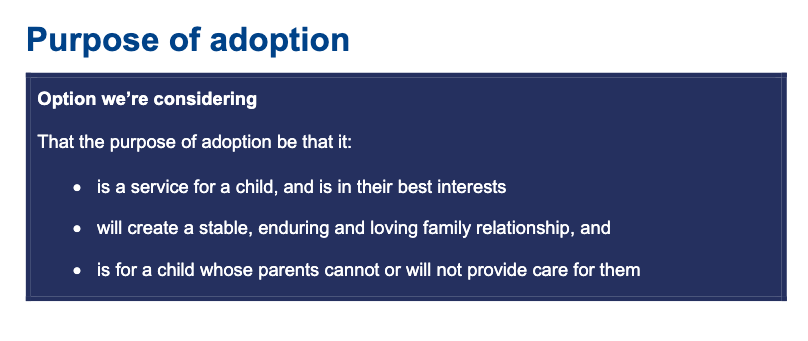
I know I should stop reading at this point, but the heading “Purpose of adoption” is too compelling. There are three statements. The first is that adoption is:
1. “A service to the child, and is in their best interests”.
The Ministry of Justice’s Consultation Options for Adoption Law Reform also presents service as its preferred purpose because “recognising adoption as a service for the child supports children’s rights by focusing on the individual needs of the child”.7
The ministry claims that this focus:
Provides clarity when adoption is appropriate, as it focuses on the child rather than the other people involved in the process. It provides equity for the child because it does not focus on the needs of adults, e.g. birth parents or adoptive parents.
I request evidence from the Ministry of Justice on how adoption might be of service to the child. They respond:
The option is a proposed purpose to guide the practice of adoption in the future. Your request for the empirical evidence, studies, research, or measurements behind the proposed purpose for adoption suggests that it is statements of fact about current or historical adoption practice that could or should have a demonstrated factual basis. As explained above, the option being considered is a guiding purpose rather than a statement of fact. As a result, I am refusing your request.8
But surely a guiding purpose must be grounded in evidence, given how much is at stake in such a permanent, life-altering action.
Statement two in the ministry’s definition of the purpose of adoption states that adoption will:
2. “Create a stable, enduring and loving family relationship”.
Again, the ministry provides no evidence or research to support positive adoption outcomes.
While it appears that family preservation is not mentioned as an effective strategy for avoiding adoption, it is the kind of environment that the Strengthening Families programme was designed to support.9
Strengthening Families is an individualised support system for families at risk of separation. As part of this programme, Oranga Tamariki commissioned Dr Iain Matheson to conduct a literature scan of overseas programmes similar to Strengthening Families.
Dr Matheson is a child welfare researcher and, at the time of writing, a member of the All-of-Government Consulting Services Panel for Policy, Research and Development, and Operations Management and Risk. His scan report focuses on family preservation.10
Under the heading “Relevant Overseas Programmes, Services, and Strategies More Closely Aligned to New Zealand’s Strengthening Families”, Dr Matheson provides an extensive four-page list of research materials, complete with all links; the kind of references that might be expected from the adoption law-reform team. He includes Homebuilders Family Preservation Service, an American scheme that provides:
“…an intensive, round-the-clock family support of four to six weeks to prevent children coming into care – odds of a positive net present value are 97%”.
However, Dr Matheson later notes, more generally, that family preservation services per se have not been a strong feature of New Zealand society.11
The third statement of purpose in the discussion document is that adoption is:
3. “For a child whose parents cannot or will not provide care for them”.12
But the child whose parent cannot or will not care for them is covered by welfare legislation. The Oranga Tamariki Act 1989 and the Care of Children Act 2004 address these needs.13
While neither is a perfect instrument, both guarantee older children a voice in all important matters affecting them. Individuals and families are supported, pathways to visitation or return to family care are outlined, and guardianship options are enabled.
Both recognise a person’s human right to their name, heritage, and whānau, and both place family preservation at the centre.
Human adoption is the opposite.
A complimentary copy of Adopted Therapists’ Global Directory is available to all paid subscribers. Please do message me if you’d like to receive this.
Comments
Nothing yet. Say the first thing.
Sign in to join the conversation.