
Note: Deception comes after The Seven Criteria of Assessment in The Art of War, but we cover it first because the data we have for assessments has often been falsified. It’s best not to lose sight of this.
All warfare is based on deception (兵者, 詭道也).
In this post, we will look only at tactical deception. Our goal is to fool the enemy into thinking what we want them to think.
Later in The Art of War (Chapter 13, the final chapter), Sun Tzu deals with the use of spies. We will face the issues of loyalty and the willingness to be deceived.
Deception is partly a matter of appearances:
故能而示之不能,用而示之不用,近而示之遠,遠而示之近。
Hence, when able to attack, we must seem unable; when using our forces, we must seem inactive; when we are near, we must make the enemy believe we are far away; when far away, we must make him believe we are near.
However, our goal is create an impression in the mind of the opposing General, so the false appearances must be chosen to create wrong impressions and wrong actions:
利而誘之,亂而取之,實而備之,強而避之,怒而撓之,卑而驕之,佚而勞之,親而離之。
Hold out baits to entice the enemy. Feign disorder, and crush him. If he is secure at all points, be prepared for him. If he is in superior strength, evade him. If your opponent is of choleric temper, seek to irritate him. Pretend to be weak, that he may grow arrogant. If he is taking his ease, give him no rest. If his forces are united, separate them.
In our earlier post on the Five Factors of Warfare, we quoted U.S. General Douglas MacArthur (Wikiquote).
The history of failure in war can almost be summed up in two words: 'Too late.' … Victory in war results from no mysterious alchemy or wizardry but depends entirely upon the concentration of superior force at the critical points of combat.
MacArthur emphasizes speed because true surprise is difficult. A good General can infer his opponent’s plan from what he observes in the field. Spies and traitors are almost always present. The deceiver must always be in motion.
In a previous post on Heaven and Earth, we looked at the importance of "difficult ground”, where moving an army is not easy. We used the salt marsh as a concrete example.
攻其無備,出其不意,此兵家之勝,不可先傳也。
Attack him where he is unprepared, appear where you are not expected.
These military devices, leading to victory (勝), must not be divulged beforehand.
Some devices are divulged by their use, and to illustrate this we turn again to a concrete example.
Dazzle camouflage was a military device used on ships in the First World War. It illustrates the concepts of far (遠) and near ( 近) in a well-defined tactical situation.
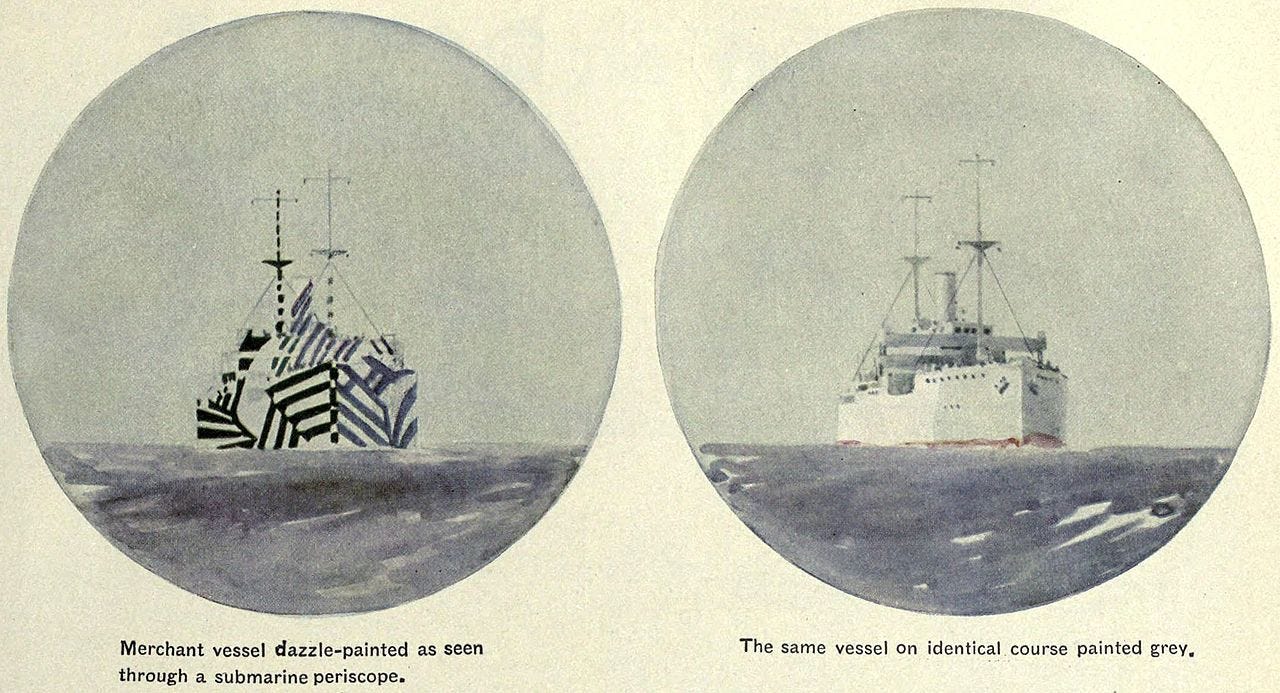
The deception is applied against the submarine officer observing the target vessel through a periscope.
At the time, the distance from the submarine to the target was measured with a prismatic rangefinder, where the images from two separate lenses are combined in the viewfinder of the periscope. The officer at the periscope adjusts the relative angle of the lenses until two halves of the target image have been aligned. The range can then be read manually from the adjustment mechanism. Removing the strong horizontal and vertical lines from the target makes it more difficult for the submarine officer to estimate the target’s range and bearing.
Dazzle camouflage was soon made obsolete by advances in submarine and torpedo technology. It was not used in later wars.
We can expand our focus from this tactical problem to larger tactical problems and then to strategy. How did the submarine find the target ship? Why were submarines used against merchant shipping? Who made the decision to paint the ship, and so on.
At one level this is simply a matter of logistics and probabilities, but this would ignore the other factors of warfare. Acts of deception are subject to Heaven and Earth (including the oceans!), as well as leadership (the Commander) and the unity of purpose felt by the people and their Emperor (the Way).
Men will not go willingly to their deaths in merchant ships if it’s all just a matter of numbers kept by people who are safe on shore. Grand strategy cannot be assembled from a collection of tactical details that belong more to Method and Discipline than anything else.
Deception can sometimes be countered with openness. This applies when one’s own supporters can be swayed by deception emanating from the other side – something to bear in mind as we move deeper into the book.
For the organizer of a Sun Tzu Reading Project, Deception can be a challenging topic. People often have strong feelings on this subject, especially if they have been the victims of deception.
Here are some ideas expressed by participants in earlier iterations of the Sun Tzu Reading Project
Valuation for investors:
Articles that compare the competitive state of various startups can be helpful.
Even at the M&A level, valuation is based on revenue streams, which are disclosed if not publicly, then in due diligence.
Special cases these days, more than a general principle. Starting up in stealth mode, planning to enter a new market.
In sales, deception should apply to competitors, not to customers and employees.
How does this fit in with "radical transparency"? Even the strongest proponents of radical transparency don't expose the company’s key information.
Ray Dalio example. At Bridgewater, the inner details of the trading strategies were not shared.
Omission and "keeping quiet" are acceptable. Knowingly false statements are not.
Dealing with car salesmen - important to not get emotionally carried away. [None of the participants in our first Sun Tzu Reading Project were car salesmen. Some did not own cars.]
The world is more connected now. It's very difficult to maintain "two dialogs"
Perceptions:
Being first to market makes you the example for others, and they have to react. Maintaining a fast pace can demoralize competitors.
Going into markets where there aren't others. Sun Tzu deals with red ocean strategies, not blue ocean.
Not reading too much into the translated text. The non-Chinese term may have different connotations than the Chinese term.
Attack where your enemies are not prepared; go to where they do not expect.
The Chinese text is not "capture" but "take". Idea is "attack", "engage".
In the Warring States period - was it common for strong states to capture smaller states for tribute? More of a "swallowing". But this may be too "high level" since we are thinking here about battlefields, not war as a whole.
This strategy leads to victory in warfare, so do not let the enemy see it.
Relate this to the idea of "omission", i.e. don't share the most valuable info.
In the Chinese text: do not expose your intentions beforehand. Don't telegraph your move.
Our primary source is the Chinese Text Project (中國哲學書電子化計劃), edited by Dr. Donald Sturgeon (Chinese: 德龍).
https://ctext.org (for the project main page)
https://ctext.org/art-of-war (for The Art of War specifically)
Dr. Sturgeon has used the Giles translation, which is in the public domain, and available on Project Gutenberg at http://www.gutenberg.org/ebooks/132
English translations of individual kanji are from Jisho.org.
For more information on language resources, see [Week 1] We begin reading The Art of War.
For background on Drawing Legs on a Snake and the new Sun Tzu Reading Project, see our guide to starting your own reading project.
Comments
Nothing yet. Say the first thing.
Sign in to join the conversation.