

When Sir Robert Peel established the Metropolitan Police in 1829, the main objective of the new force was crime prevention based on the assumption that, if professional, uniformed police officers patrolled the streets of the capital, during the day and at night, then the crime rate would decrease. This did not quite turn out as the home secretary expected, particularly in relation to murder.
Between 1829, and 1842 – when the detective department at Scotland Yard was created – there were 22 murders in London, seven of which remained unsolved due to the perpetrators having ‘escaped…either from having left the Kingdom, or from a want of sufficient legal evidence to obtain a conviction’, according to a memo from the Metropolitan Police commissioners to the Home Office, written in June 1842.
Four of these unsolved homicides were particularly sensational at the time, and became symbolic of the Met’s inability to investigate crimes that had been committed after their attempt to prevent them had obviously failed.
On 16 February, the body of 15-year-old John Brill was discovered in a wood in Ruislip, near Uxbridge, about 13 miles to the west of central London. John worked for a local farmer and, two months earlier, he had given evidence in court against two men accused of poaching, which had led to threats of violence against him. At the time of his murder, Uxbridge fell outside the jurisdiction of the Metropolitan Police but, due to the publicity surrounding the case, one of the London magistrates sent an officer from the capital to assist with the local investigation. This action spurred Metropolitan Police Commissioner Richard Mayne to send a man of his own as well, and he selected Sergeant James Otway, from A Division (Whitehall) to help.
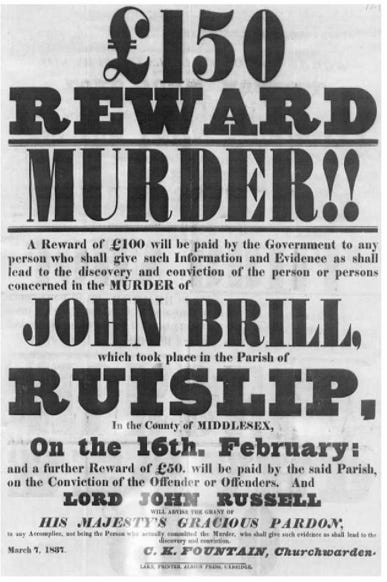
Unfortunately, the combined efforts of the local parish constables, and the two officers sent from London did not lead to the apprehension of John’s killer – three suspects were detained but there was insufficient evidence to press charges. However, the case is important because it set an early precedent for the Met sending expert individual officers with detective skills outside the capital to investigate crimes, which was an integral part of Mayne’s plan to form a detective department.
Three months later, in May, another horrific murder came to the public’s attention. Eliza Davis, a 21-year-old barmaid, was discovered at the King’s Arms public house near Regent’s Park, just before the bar opened at 6 am – her throat had been cut. A blood-stained knife was found near her body, and there were bloody fingerprints on the door leading out to the street. On the bar counter, there were a penny and a half-finished glass of ale. Eliza, who originated from Wales, had been working in the pub, which had been previously owned by her uncle, for seven years. Also on the premises, at the time of her death, were the cook, two pot boys, a kitchen maid, and the landlord, a Mr Wadley.
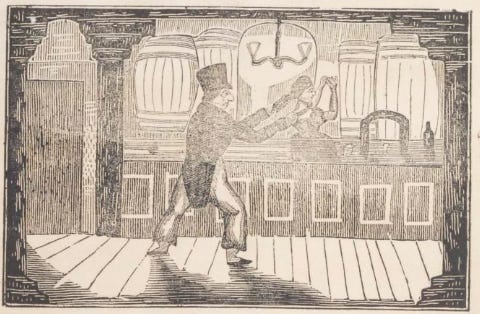
The first lead in the case was given by the publican, who described an ‘ill-looking fellow’, who came into the pub every morning to ask for a knife to cut his bread. He was tall and thin, with light whiskers, and he wore a blue coat with a checked waistcoat, fustian trousers and a white apron.
Two police officers, Inspector William Aggs and PC Samuel Pegler, both from S Division (Hampstead), were deployed to track him down. They spent the next two months travelling around the capital following possible sightings of the suspect. Several men were arrested, but they could not be identified as the perpetrator. Eliza Davis’s murder was never solved. It is generally considered that the case failed due to an over-reliance on the suspect description and witness statements.
Exactly year later, when sex worker Eliza Grimwood was murdered, two ‘unofficial’ detective officers set out to catch her killer. On 26 May 1838, Eliza’s body was discovered in a house near Waterloo Bridge, London. Inspector Charles Field led the investigation into her sudden death. Despite the coroner initially ruling it as a suicide – her throat had been cut – Field was determined to uncover the truth. He was assisted by Constable Charles Burgess Goff, who would later became one of the first Scotland Yard detectives.
Twenty-eight-year-old Eliza was well known in the Lambeth area, especially as she used to wear a feather boa when she crossed the River Thames to pick up her clients. The night before her murder, she had followed her usual routine and taken a tall, well-dressed man back to her lodgings at 12 Wellington Terrace. The pair were seen by the maid but she could not provide a description of the man.

Inspector Field examined the premises and his suspicions fell on Eliza’s live-in lover, William Hubbard, a bricklayer, who had his own room at the house – he had discovered her body. The officer found bloodstains on Hubbard’s sheets and trousers, but no obvious murder weapon. With this lead at a dead end, Field’s next step was to try to track down the mystery man who had visited Eliza the night before.
Despite an exhaustive search with many interviews with potential witnesses – cab drivers, theatregoers, and people staying in local hotels – and hanging out in gambling houses and even attending the opera, Field was still convinced that Hubbard was the culprit. He arrested him, but he was later discharged by the magistrates. After six weeks of frantic investigations and no further arrests, the case was closed, and Eliza’s killer walked free.
Less than a year after Eliza Grimwood’s murder, another killing would put pressure on the Metropolitan Police. Just after midnight, on 3 June 1839, 55-year-old watchmaker Robert Westwood was fatally attacked in his shop in Princes Street, Soho. He had taken to sleeping on the ground floor of the premises due to his fear of being burgled. The following morning, his body was discovered by his wife – he had been beaten about the head and his throat had been slashed. Also, his clothing had been set on fire. Mrs Westwood had been alerted by the smoke and had rushed downstairs only to come face to face with the horrendous crime.
The police were called and, once the flames had been extinguished, they began to search the premises. Near the window of the shop, they found a heavy window weight with hairs attached to it but, as it was not possible to distinguish human from animal blood at the time, it didn’t help with the investigation. All the doors and windows had been locked, but it was possible that the perpetrator had hidden in the shop while it was open. More than 80 valuable watches were missing. The police immediately circulated route papers with descriptions of the stolen items.

There were several suspects in this case – the shop foreman, Charles Louis Serouche, who had argued with Westwood, some former lodgers whom he had asked to leave, and neighbours who regularly fell out with the victim, who was known to have an irascible character. Also, there had been a large turnover of household servants, some of whom may have held a grudge against the Westwoods. Moreover, two men had been seen coming out of the shop around the time of Robert’s murder.
The investigation was led initially by experienced officers from C Division (St James’s). But, after the inquest, Inspector Nicholas Pearce was sent from A Division (Whitehall) to manage the case – he would later become the first detective to take charge of Scotland Yard. The list of suspects was considerable, and Pearce and his officers set out to find the killer, as well as recovering the stolen watches. The police officers followed leads all over the country, and even as far as New York, but to no avail. No one was ever convicted of Robert Westwood’s murder.
These cases were followed by the sensational murder of Lord William Russell in Mayfair, in 1840, and the notorious hunt for Daniel Good in 1842, both of which were solved but led to criticisms of the investigative abilities of the Metropolitan Police, which in turn prompted the police commissioners to establish the new detective department at Scotland Yard.
Sources:
The First Detectives, Belton Cobb (Faber and Faber Ltd, 1957)
Dreadful Deeds and Awful Murders, Joan Lock (Barn Owl Books, 1990)
Comments
Nothing yet. Say the first thing.
Sign in to join the conversation.