
If you start your period early, your breast cancer risk goes up. About 5% for every year earlier you start, which adds up to roughly 20% higher for a girl whose first period comes before 11 versus one who starts at 13 (Lancet Onc 2012). The standard explanation is one word: estrogen. More periods, more lifetime estrogen, more cancer.
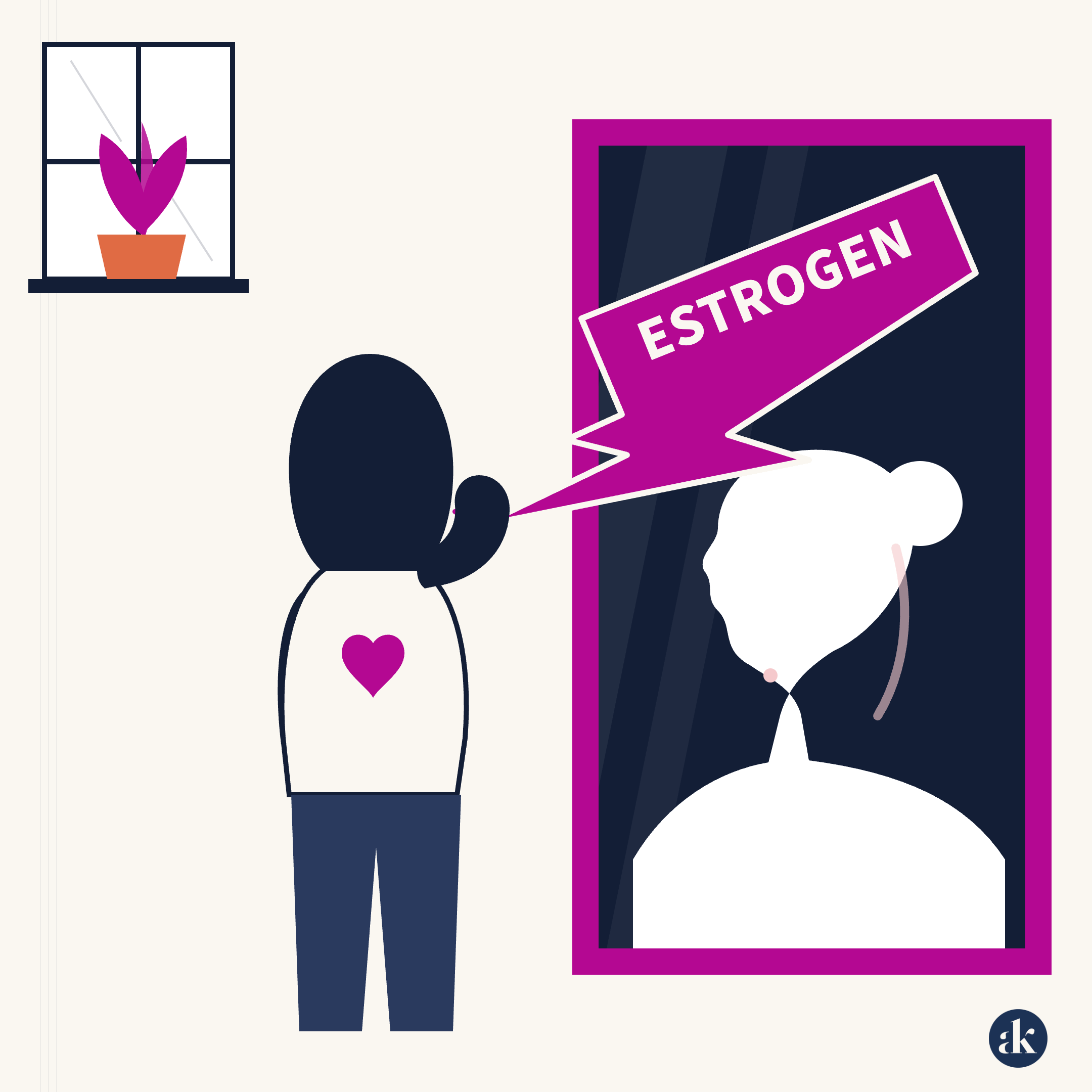
And yet a woman who starts estrogen in midlife, as hormone therapy, carries nothing close to that penalty. Estrogen by itself, in the very trial everyone treats as the cautionary tale, lowered breast cancer rates.
So here’s the real question, and it’s a good one. If early exposure to estrogen drives breast cancer, why doesn’t adding estrogen in midlife drive it too?
The question landed in my inbox last month. Janna, 52, first period at ten, estradiol now in the basement, hot flashes every ninety minutes. She wanted hormones, and she wanted someone to promise her they wouldn’t give her breast cancer. “I’ve already had a lifetime of estrogen,” she said. “Why would I add more?”
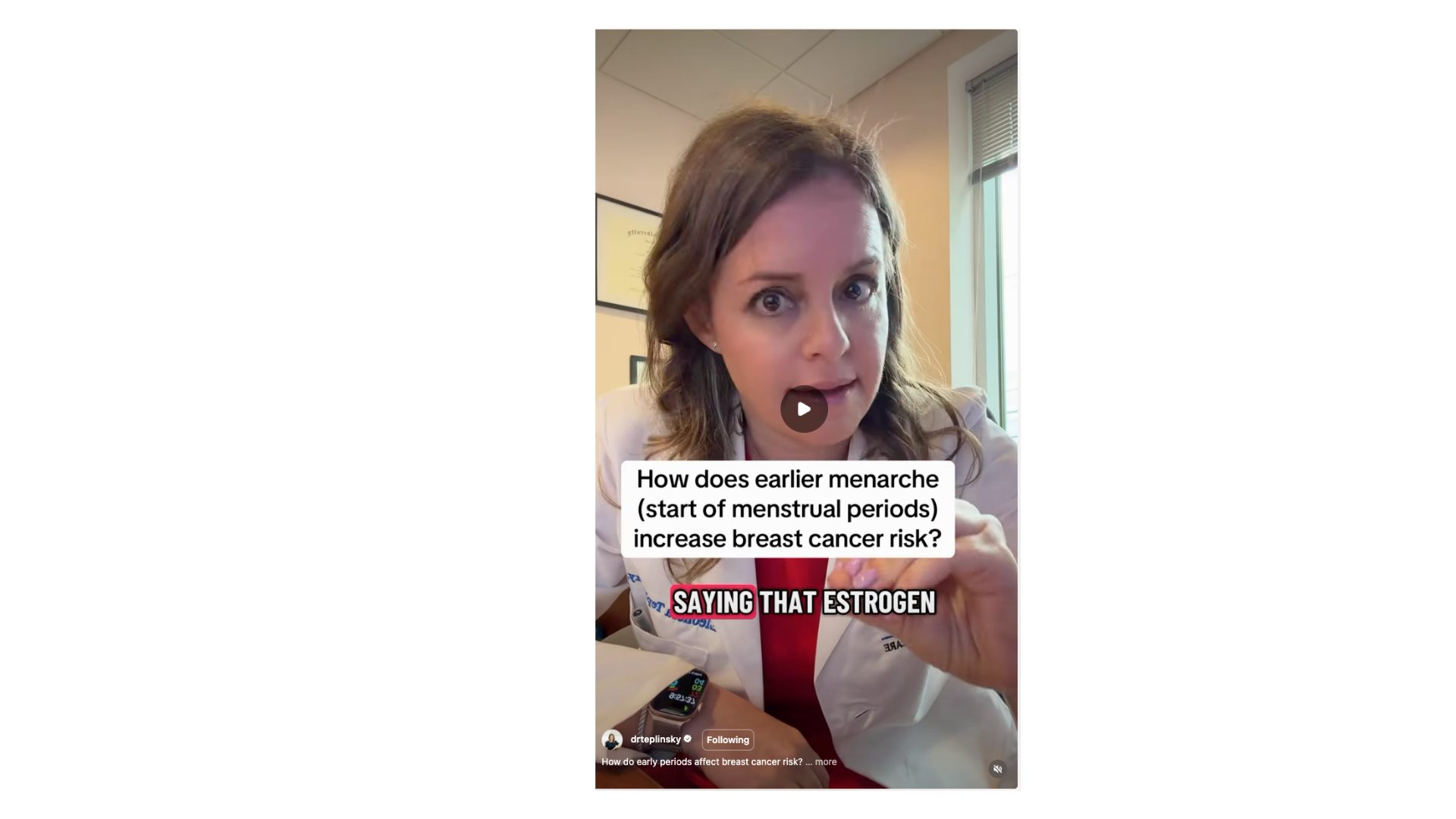
Dr. Eleonora Teplinsky, a breast medical oncologist who is very good at explaining this, recently broke down the same question in a fantastic IG reel, and I want to build on what she said. Because the answer was never just “estrogen,” and once you see the rest of what’s going on, the midlife math stops being scary.
Start with the cell.
A breast is built like a pyramid. At the top, a small number of stem and progenitor cells: unspecialized, uncommitted, able to become any kind of breast cell. At the bottom, the finished workers, the cells that line the milk ducts, the ones that make the milk, the muscle cells that squeeze it out. Until a woman’s first full-term pregnancy, the unspecialized cells run the place.
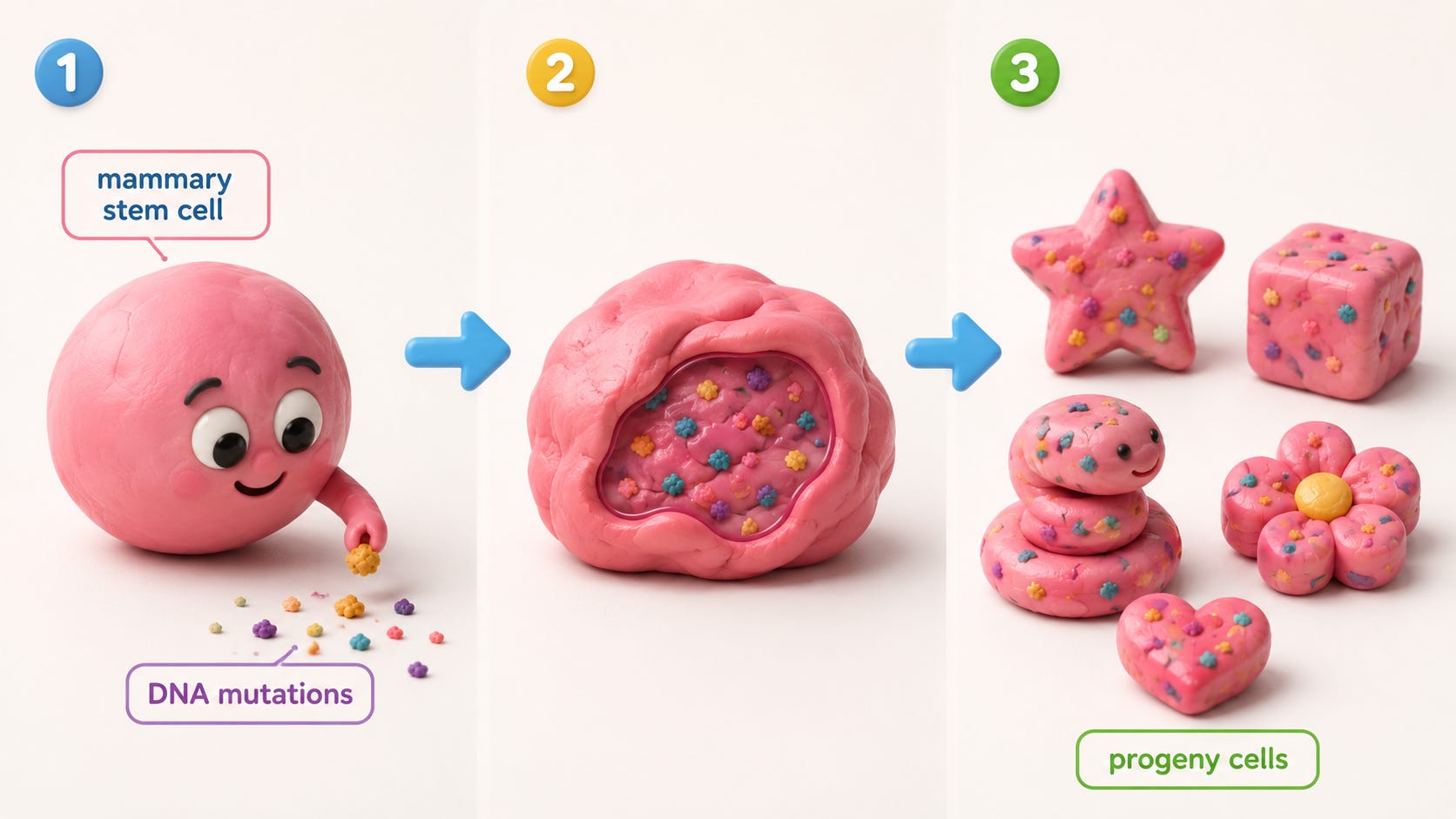
That’s the vulnerability, not the safety. When a finished, specialized cell takes a serious hit to its DNA, it tends to trip an internal alarm and bow out: it either repairs the damage cleanly or kills itself off, and whatever went wrong leaves with it. No cell is foolproof, but the finished ones hit the eject button far more often. A cell that removes itself can’t become a tumor. The unspecialized stem cell is far more likely to do the reverse. It tends to ride out the same hit without tripping that alarm, and because its whole job is to copy itself, it hands the flaw down to every cell it ever makes. It’s the difference between a fresh ball of Play-Doh and one left out to harden: grit pressed into the soft ball folds in and travels into everything you shape next, while grit pressed into the hardened one just cracks and flakes off. The dangerous cell isn’t the fragile one. It’s the durable one that absorbs a mistake and lives to spread it.
Estrogen is what tells those cells to divide, at puberty and again with every menstrual cycle. Every division is an opportunity to make a mistake. An early first period means more cycles, more divisions, more chances to make an error and keep it, in the kind of tissue that’s best at keeping it.
Comments
Nothing yet. Say the first thing.
Sign in to join the conversation.