
Stop wasting $1.2 trillion on polished confusion, audio overview, NLM)
0:00
-5:23
U.S. businesses lose an estimated $1.2 trillion a year to bad communication (Grammarly and The Harris Poll, 2024). Organizations usually respond with better tools, clearer emails, and shorter meetings. That treats the visible symptom.
Communication tools change how information moves. They do not determine whether the person receiving it can make a decision.
The deeper problem is that work is often produced without clarity designed into it.
AI did not create the absence of clarity. It gave it a production budget. Confused work can now look complete. It reads well, sounds confident, and arrives in a professional format. The cost rises while the confusion becomes harder to detect.
Why the standard explanation of the $1.2 trillion cost is incomplete, and what my three years inside organizations revealed instead about AI implementation.
One table with four structural fixes you can apply this week.
A simple prompt for each common failure.
What polished confusion is, how AI produces it, and a 30-second test for your own work.
One question that tells you whether your next meeting will decide anything.
McKinsey surveyed more than 1,200 managers worldwide. Executives spend 37 percent of their time making decisions, and more than half of that time is considered ineffective. For an average Fortune 500 company, McKinsey estimated 530,000 lost working days and roughly $250 million in wasted salary each year.
In a 100-person company, workers spend an estimated 17 hours per week clarifying communication that already happened. They are explaining again what someone already said because nobody could act on the first version.
Grammarly and The Harris Poll estimated the annual U.S. cost of poor workplace communication at $1.2 trillion. Their later research found that bad communication affects knowledge workers at least weekly, while some experience it several times a day.
The numbers describe the cost. They do not fully explain the cause.
Your teams may be communicating constantly while still producing work nobody can decide on.
Note: Sources are listed at the end of this article.
The surveys measure the cost. They do not explain the cause. Three years of putting AI into real workflows showed me where the cost comes from. AI did not create these problems. It made three recurring problems difficult to ignore.
People arrive with problems, not solutions. A department explains what is wrong but does not specify what should be done, what it will cost, or what outcome it should produce.
Decision-makers receive a diagnosis. You cannot decide on a diagnosis.
Every department improves its own numbers. Marketing brings marketing problems in marketing numbers. Operations does the same. Neither one can tell you what their problem costs the company or what solving it would earn.
Each part of work gets better. The whole gets worse.
Work is rarely translated into decision language. Decision-makers need options, evidence, trade-offs, outcomes, and ownership. Most work arrives as activity, effort, diagnosis, and commentary / complaint.
Information is present. Decision structure is absent.
Those 17 hours a week of clarification are not about wording. They are about the absence of clarity.
Work that arrives with a decision anyone can make: the solution named, the cost known, the outcome visible, the next step obvious.
One department explains a problem in its own numbers. Another department cannot use it. Both are talking. Neither is deciding.
The information is in the room. The clarity is not.
A meeting is unclear because nobody converted the work into something a decision-maker could act on. It is not unclear because people spoke badly.
Work visibility architecture is the practical structure that makes one person’s work understandable and usable by everyone who depends on it.
Communication improves the sentence. Work visibility architecture determines what the sentence must carry.
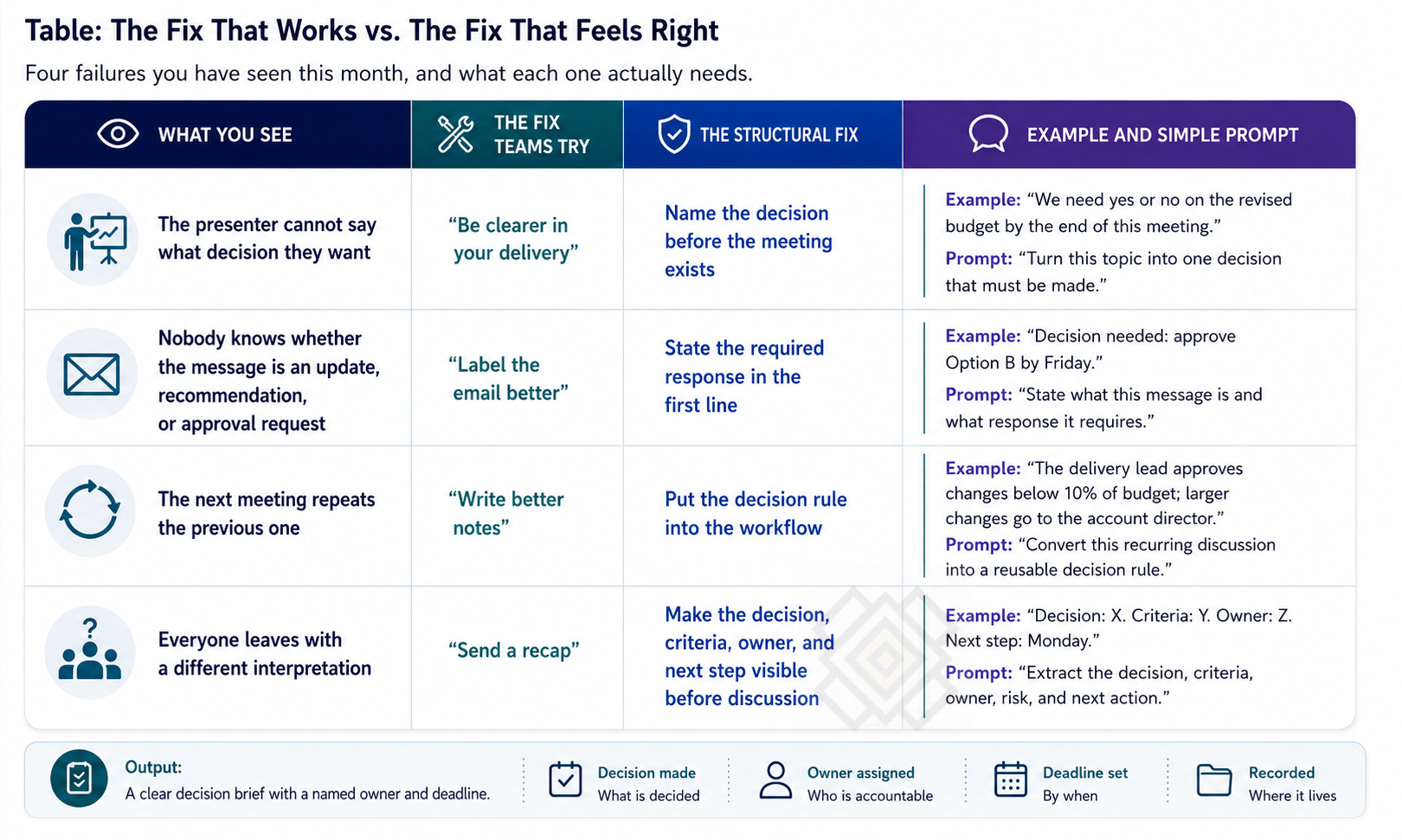
Four moves turn a meeting from conversation into decision:
Name the decision.
Set the criteria.
Name the owner.
Record the decision where future work happens.
The decision and the criteria live in the workflow, not in someone’s memory.
Do this first: Put one sentence at the top of your next meeting agenda:
The decision this meeting must produce is ______.
If you cannot complete it, the meeting is not ready. Ask for a one-page decision document first.
The trade-off is real. Structural fixes require preparation, authority, and the willingness to name an owner. That is harder than sending another recap. It is also why the improvement survives the meeting.
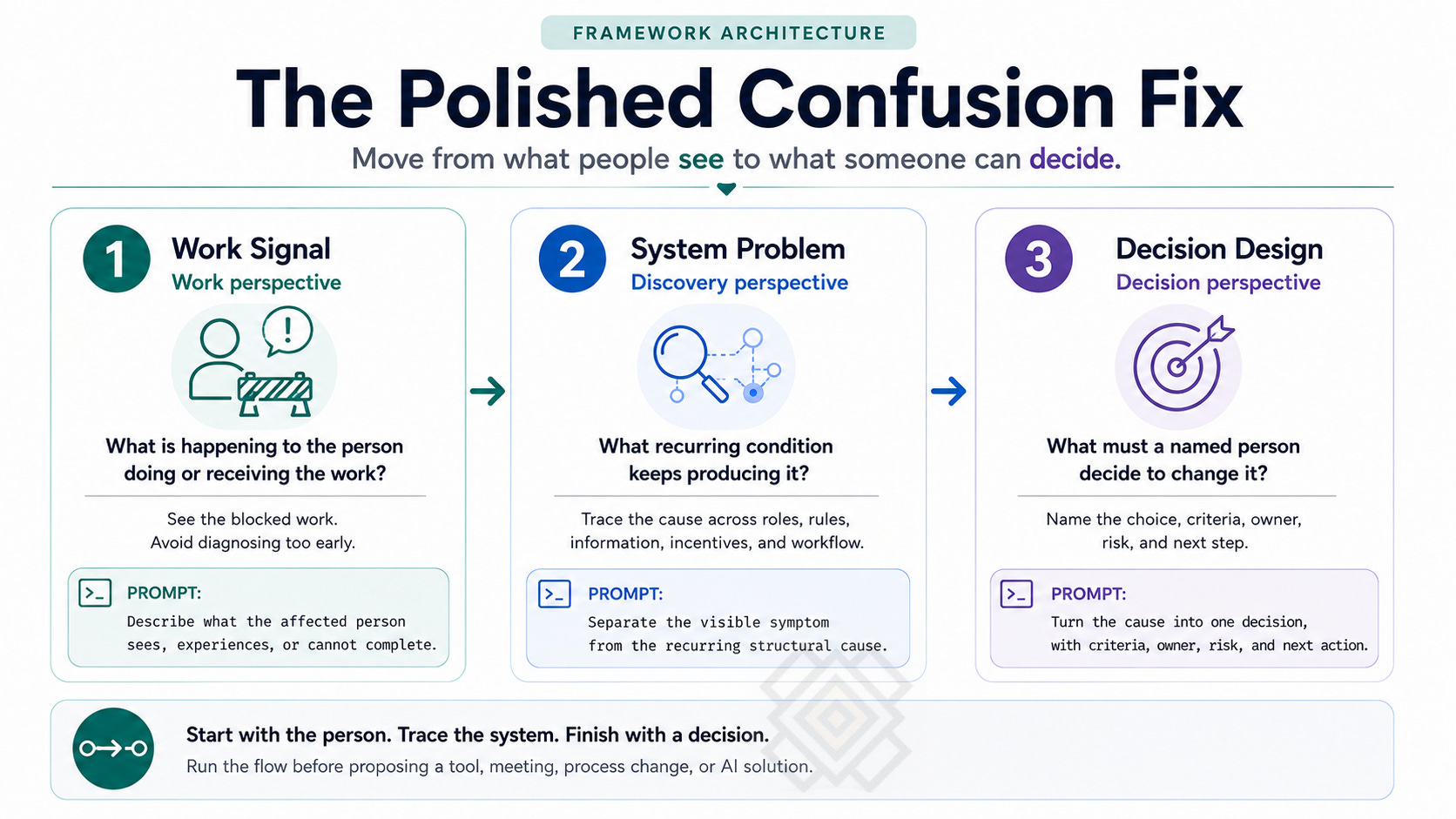
Fixing the message buys one good meeting. Fixing the structure improves every meeting that follows.
AI can help translate departmental work into options, metrics, outcomes, and impacts. It can also preserve the original confusion and merely improve its appearance.
Example: A marketing manager asks AI to explain declining campaign performance.
Polished confusion:
“Q2 campaign performance showed a 14% decline in engagement across digital channels. Contributing factors include audience fatigue, competitive activity, and platform changes. We recommend a comprehensive review of channel strategy.”
It sounds professional. It asks for no decision.
Decision-ready:
“Q2 engagement declined 14%. The same audience received six exposures in eight weeks. Proposed action: cap exposure at three per campaign. Cost: $0. Expected recovery: 8–10% within one quarter. Risk: reduced reach if the audience pool is too small. Decision needed by Friday.”
Same topic. Different work design.
Use this prompt:
“Rewrite this output so the decision, evidence, risk, owner, and next step are explicitly visible. Remove any sentence that does not help someone decide.”
That is the work visibility architecture in prompt form.
Polished confusion is work that looks impressive and makes nothing important visible. No decision. No risk. No next step.
Three signals are happening in your organization:
Reports look better and decisions take longer.
More work is produced and fewer things get finished.
Teams cite AI-generated analysis but cannot tell you which decision it supports.
Most AI output does not fail because it is badly written. It fails because nobody can use it to decide anything.
AI did not create polished confusion. It gave it a production budget.
Before sending a report, deck, email, or AI-generated analysis, ask:
What decision does this support?
What risk does it reveal?
What next step does it make obvious?
For higher-stakes work, add two more:
What evidence supports it?
Who owns the decision and the action?
An output that cannot answer these questions may still look impressive. It is not decision-ready.
Polished confusion is professionally presented work with no visible route to action.
AI made polished confusion faster, cheaper, and more convincing.
Before your next meeting, ask:
“What decision must this meeting produce, and where will that decision be visible afterward?”
If both answers are clear, the meeting has a purpose and a memory.
If they are not, you are preparing another conversation about work instead of designing work that can move.
This article focuses on meetings and decision-ready outputs. The wider problem is that many roles are still designed around completing isolated tasks rather than making work useful across the organization.
Next in this series: The One-Dimensional Job Is Over. What changed about every job in the AI age, and why doing your work well is now only one part of doing your job.
Grammarly / Harris Poll, 2024 State of Business Communication: Source of the $1.2 trillion figure. 1,001 knowledge workers, 251 business leaders. U.S. data, used as a directional benchmark for global patterns. Confirms the 2022 estimate. Source for weekly frequency and lost-business findings. Follow-up evidence on the frequency and business consequences of poor communication.
BusinessWire, Grammarly/Harris Poll press release: The original release with the method stated: online survey, October 2021, not a random sample. A number without its limits is not evidence.
McKinsey, 2019 Decision Making in the Age of Urgency: Source of the 37 percent, the 530,000 lost days, and the $250 million per Fortune 500 company. 1,200+ managers worldwide.
McKinsey, 2019 Three Keys to Faster, Better Decisions: Companion study. Only 37 percent of organizations make decisions that are both good and fast. Supporting research on decision quality and speed.
Comments
Nothing yet. Say the first thing.
Sign in to join the conversation.