
Decision-making is the bottleneck today. Most leaders I talk to already notice that. As coding becomes more scalable and “cheap,” choosing what to build quickly becomes the bottleneck. But what are people doing to simplify that?
What I see is interesting, not prominent. Some examples:
AI agents present the best options based on data analytics, synthetic user interviews, market analysis, and strategic positioning.
More meetings with more people to agree on a “direction.”
Decision-empowerment within limited scope.
For years, the second has been the most common, and of course the most inefficient. It’s kind of like the more we talk about something, the more we believe we’re right. Even when we lack evidence, we start believing in our self-made stories. Then, later, reality surprises us and we have to act to fix the unintended mess.
Today, decisions supported by AI agents are becoming increasingly popular. I don’t know yet what to make of it. I like the part of bringing options, and then people can choose what best fits their case. But I don’t like the part of you not doing the brain warm-up to fully understand the context you’re in, and what truly makes sense.
Decision-empowerment has been more absent than I’d like to admit. Product people often receive a solution scope where they can make decisions, not an outcome where they can figure out how to craft a solution that delivers on it.
For too long, we’ve endured complex decision-making approaches. Now that decisions are clearly our bottleneck, I’m bullish on those who can simplify them. I want to share my approach with you, and how you can bring it to your scenario. I hope this helps you simplify what others complicate.
If you’re in product long enough, you know how decision-making can drain your energy. Things get more complicated than necessary. A decision that’s worth five minutes of your time becomes a series of meetings that takes three hours from seven people. Or no decision takes place at all. Let me ask a few honest questions:
How many meetings have you attended that ended in another meeting?
How often did you commit to a decision that’s clearly nonsense, and yet was the only option everyone could compromise on?
How many times did you observe a necessary decision being postponed?
Answering them hurts. I know that. I cannot answer the first one precisely, but I get annoyed just by remembering that last meeting minute when someone says, “Let’s schedule a follow-up to keep discussing.” Honestly, discussing what? Everything we should talk about was already on the table. It was already about making a call.
Here’s an honest example. An organisation I consulted some time ago lacked a strategy, growth stalled, and competitors were getting their customers. The CEO came up with a strategy, which had a clear audience, a place to focus, and how to differentiate, which would require stopping some things. Guess what happened? Two months of meetings fine-tuning the strategy while struggling to convert sign-ups, reduce churn, and acquire the relevant customers.
When you make no decision, you’re not avoiding bad results, you’re not progressing.
A bad decision leads to learning while no decision leads to nothing but frustration and meetings that drain valuable energy.
I know some of you reading this now are already thinking, but what if the decision has high stakes behind it? What if a bad outcome could be fatal? You’re right to think about it, but it turns out most decisions don’t have potentially tragic outcomes, and they’re easily reversible if things turn out differently than you wanted.
You’ve probably heard about the two-door decision type coined by Jeff Bezos:
“Many decisions are reversible, two-way doors. Those decisions can use a light-weight process. For those, so what if you’re wrong?”
Most people nod in agreement when they hear it, but then ignore the framework in their daily work. Why?
In my experience, people don’t use it because they don’t know how to apply it to their situation. I love simple techniques that produce outstanding results. This is one of them. For years, I’ve been trying to simplify decision-making, and it’s anything but easy. The way out for me is having clarity on what kind of decision we’re talking about and how we make the call. Let’s start with the first now, and cover the next after.
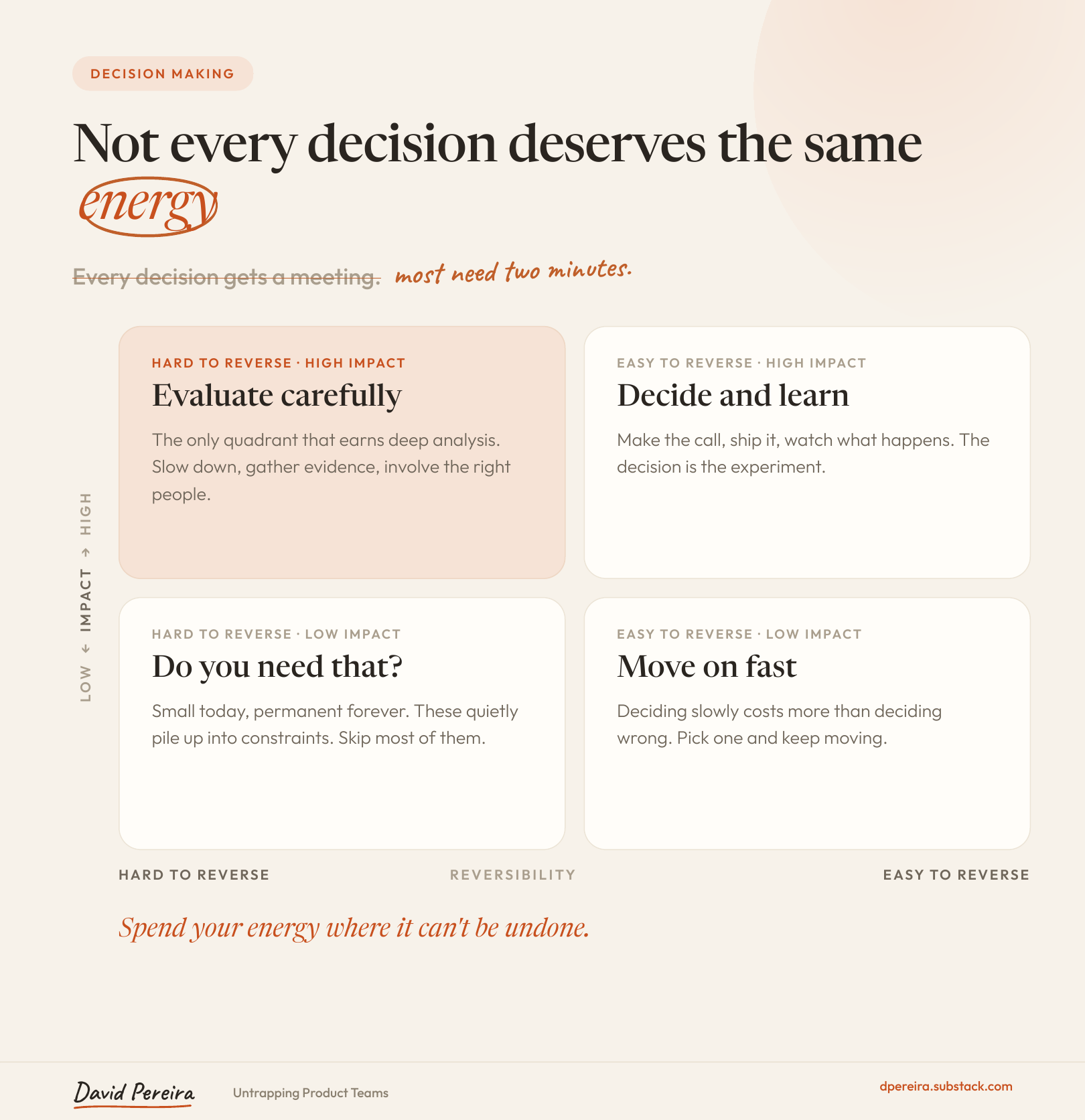
Categorising the decision is the simplest way of understanding it. I like to literally draw a two-by-two matrix with impact and reversibility (use a board if remote). Then, we come up with four categories that should help us understand what to do when.
You need speed with reversible decisions. If things go wrong, you just revert, and you will have collected the learnings from what happened.
For decisions that are hard to revert, you need to think more carefully, take more time before you commit. In life, that would be getting married, becoming a parent, and so on. The first is still reversible, but painful, and the second, irreversible.
In product, it’s unlikely for a decision to be irreversible, but given the thousands of meetings I’ve attended, we treat almost everything as irreversible. Changing the navigation layout is often as painful as killing a feature nobody cares about.
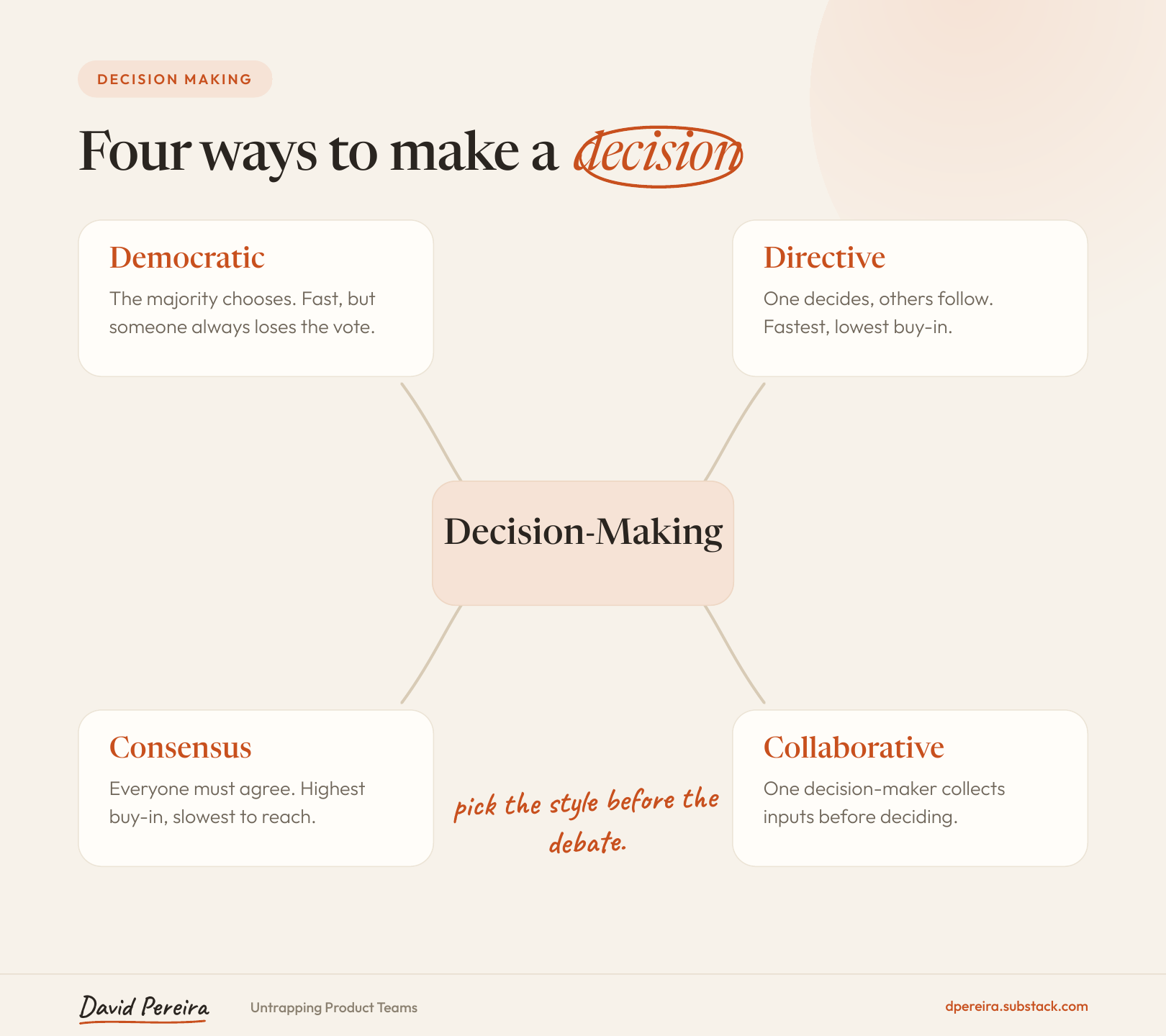
Once you know the decision you’re about to make, pick the method you’re going to use for it. Not all decisions need the same method. And companies tend to default to one method. For example, consensus is the favorite among German companies, though it’s the slowest method, and often delivers the most watered-down result. But consensus is the best method for irreversible decisions as you need strong commitment before moving on.
The four types are:
Democratic: The majority wins and the others accept. It’s good for speed, but not for quality or differentiation. Have you ever been in a brainstorming where the most boring ideas always win? In my view, use democratic decisions for low-impact choices because speed wins.
Directive: This is known as top-down. The boss decides and the others follow. Some people twist this into founder mode as an excuse to avoid explaining the why behind the decisions. Directive can work well when the person calling the shots knows the domain well and is an expert in the field. But it often hurts commitment and limits teams’ creativity. You may find good use of this when you’re in a critical situation, where you have no time to discuss.
Consensus: Everyone must agree before you move on. Until then, you will have to keep discussing. This method is exhausting because it requires compromises, extensive discussions, and often leads to options that don’t really make sense, but everyone can agree on. This is my least favorite because of the trade-offs. But as I mentioned, it’s the best alternative for irreversible decisions.
Collaborative: You need a decision maker who’s required to gather input from relevant people, and then come up with a decision. For me, this is the best balance in product. For example, the PM becomes the decision maker, listens to everyone that makes sense, and decides how to move on. It’s not about reaching consensus, but identifying the most reasonable option to move forward.
All teams will have a default method. That’s normal, not optimal. The best teams I know will first understand the type of decision (this takes 2 minutes), and then select the method for making the decision (another 2 minutes). Within that, you will get to a better outcome. And hopefully start solving the bottleneck we have today.
Direction will beat speed. And those who know how to navigate the complexity of decision-making will stand out.
Now, your homework: reflect on the default decision-making method your team has. Once that’s clear, review situations where you could benefit from other methods, try them out, and evaluate the results.
Most people won’t even try because trying is hard. But I believe you’re not like most people. Are you?
Let’s keep Untrapping Product Teams together.
Today, most people already build with AI, which I find fascinating. What I don’t find smart is renouncing decision-making. You’ve got to make that intentional. By that, I mean creating decision points where you, the human in the equation, choose where to go, and where not to.
I will run the 100X Product Builder Masterclass on the 8th and 10th of September. It’s a limited live session for those who want to build to succeed, not just to check boxes.
Join us if you want to know how to structure your development flow empowered with AI.
Let’s rock this world together.
Comments
Nothing yet. Say the first thing.
Sign in to join the conversation.