
Have you ever hear about Gröstl?
It’s a delicious dish from the Austrian Alps, which my parents tried out in Germany some time ago. And recently my mom really longed for a nice Gröstl, but she lives in Brazil, which is a dish totally unheard of.
I tried to help my mom, got a recipe, and shared it with her. In essence, it’s loads of meat, some panned potatoes, onions, fried eggs, and a mysterious dark sauce, which varies across regions. Easy right?
Apart from the sauce, yes, and the rest is kind of farm food, which is delicious. But the sauce is what my mom longed the most, which seemed complex, and some ingredients aren’t so available in Brazil. Guess what I did?

I used the latest LLMs model to simplify the sauce. And I got an unexpected recommendation, “Just add a sip of coffee.” I challenged back, and with all the confidence in the world I got, “It will be an authentic dark sauce. Simple. No BS.”
For a moment, I wondered, if this is the model that “will replace everything,” our future will be comic at least. I couldn’t stop laughing because it was hilarious. But then something clicked in my mind:
Many people are going for the shortcut and renouncing thinking.
My question for you: Are you allowing AI to add a sip of coffee to your products?
A few years back our generation complained a lot about data privacy. No more cookies! No more emails without consent. That was needed, but what about now?
Today, AI has access to your computer, e-mails, your subscriptions through MCPs, and whatever else you allow to. Interesting enough, more and more people are letting AI get access to their whole lives, and the same to the product they’re working on.
Is this bad? It depends.
Right now, too many people are using and using and abusing Agentic AI. This is happening to a point like my Gröstl story, I see people adding coffee to their strategy, roadmap, and products without even noticing. But how’s that?
The bigger the task you allow your agents to do, the more assumptions they’ll make. You may be thinking, “Bullshit! I’ve set 337 skills, 71 evals, and 5 QA agents. Nothing can go wrong!” I’d say apart from going bankrupt once you’ve got to pay the real token prices, you need to remember product is complex, and you cannot predict everything, so cannot AI.
We’re humans and we love optimising things, getting stuff done faster. That gives us dopamine and we just love that. But often, speed isn’t good at all.
For example, I could have used AI to write this episode for you, I’d get it done in less than five minutes, and you’d email me back calling it AI slop, or just silently unsubscribe. Does it mean I don’t use AI? Not at all.
I use AI a lot. The point is that I use it for means, not ends. AI is often my thinking partner, helping me sharpen my ideas. It often makes me slower, but sometimes better because I can uncover my blind spots.
Not faster, but maybe better.
I’m hearing more and more people striving to automate their product development pipeline. The same way you do with software engineering, this scares me because of the number of unchecked assumptions that will happen on the way.
As Mustafa Kapadia says, “We’re soon going to have a lot of AI-Slopware, not software.”
It’s not about speed, but the quality of your decisions.
I’m still hopeful. Software development has been a bottleneck for most of us, and now this is gradually getting sorted out. For those who learned the lesson that more features doesn’t mean more value, the future is promising. But until then, we must understand output isn’t always value.
For long, we’ve been mostly executing with little time for critical thinking. Do you remember your refinement sessions years ago? Probably you had exhausting discussions about estimates. We’re soon getting to the point that estimates don’t matter. We’re moving towards choosing what to do and deciding our time investment.
The caveat is gradually deciding instead of handoffs.
The do’s and don’ts aren’t clear yet, but I’ll share my unfiltered view with you.
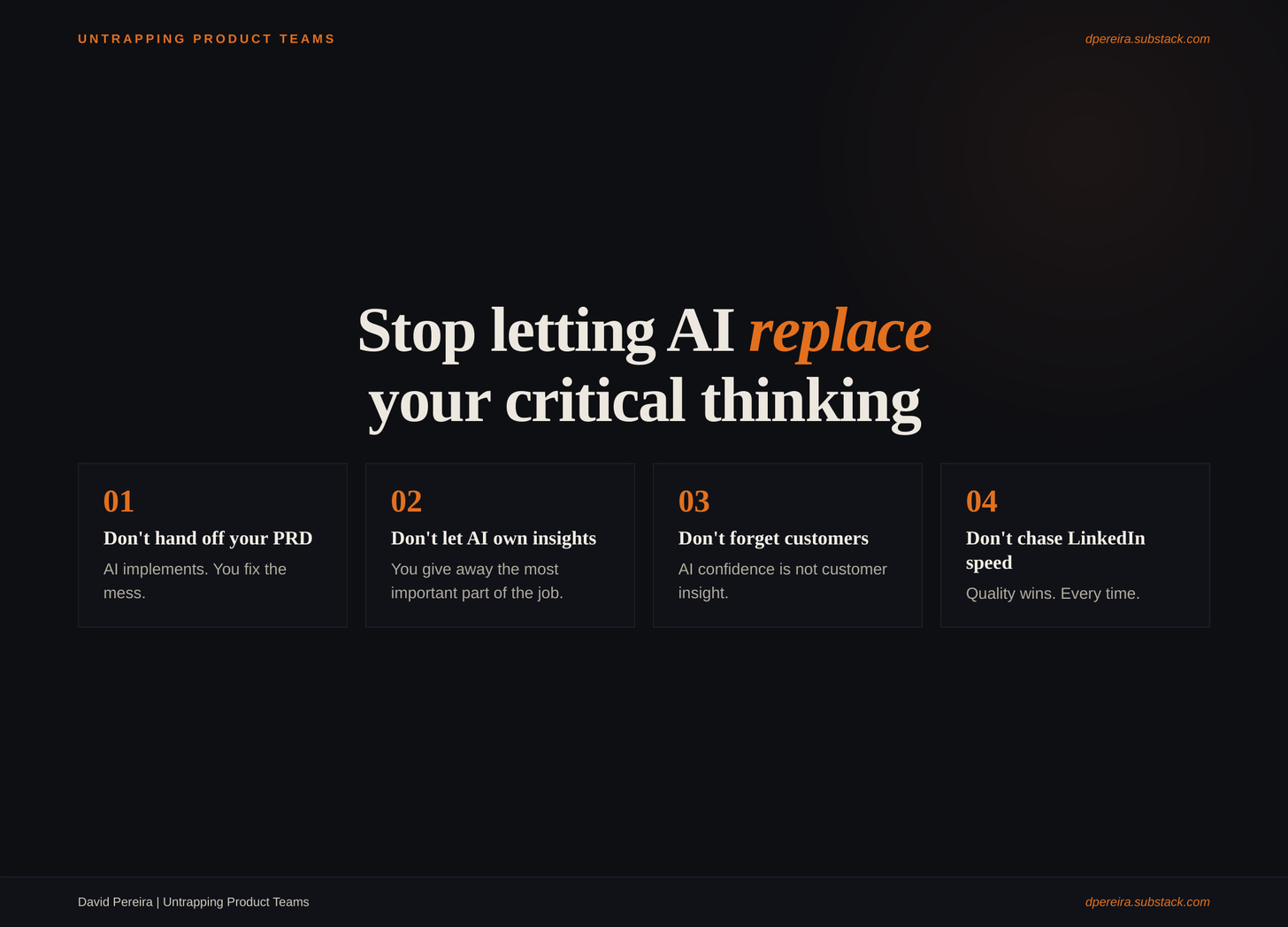
Write extensive PRDs and let AI implement all. You’ll end up fixing more stuff than you’d like to.
Let AI gather insights, prioritise, build, and you decide upon shipping. You’ll renounce what truly matters, your critical thinking. This is the dangerous product pipeline automation many are talking about.
Forget you’re building for customers. It’s easy to get excited about AI “confidence” and ignore listening and observing real customers.
Chase speed over quality. If you read LinkedIn, you’ll feel behind because everyone’s shipping at lightning speed, so they claim. Don’t let posts push you in the wrong direction. Quality will beat speed all the time.
Micro tasks with quick feedback. While most recommend agents orchestration, I believe you’ll be better off with smaller tasks and quick feedback, this way you’ll avoid adding “just a sip of coffee” to your product.
Amplify your thinking. Use AI as your sparring partner to think together, not to replace your critical thinking. Remember, you’re accountable for your decisions, not AI.
Interact with REAL customers. AI can help you with many things, but not observing customers in real life. Remember NIHITO? Nothing Important Happens In The Office. That remains true.
Be brave to slow down. Everyone wants speed, but speed without direction is meaningless. Use the time you’re gaining from execution to sharpen your thinking and decision making.
Too many people are bragging about their 300+ Claude Skills, and other stuff they created. That’s cool, and it means nothing at the same time.
I like connecting to a thought from Alex Hormozi, “Find out what people want. Give that to them cheaper than it costs. Do that repeatedly.”
Your job is still the same. Understand customers needs. Uncover problems worth solving. Build solutions worth using. Motivate people to keep using them. Collect revenue. You may use AI to help you with that, but you’re still the one doing it. If you leave AI unchecked, you’ll end up with results you won’t like, and won’t understand.
Reflect on how AI is helping you think better, do more of that. And reflect where AI is creating noise, change that. Share in the comments so we learn from you.
That’s it for now, we’ll talk soon.
David Pereira
100X PM Product Coach
Most product folks I know are sadly over relying on AI unchecked assumptions. They write great requirements, manage stakeholders, and beautifully curate their extensive backlog. Yet, they don’t own the decisions behind any of that, and cannot rally people to ship value continuously.
I’ve just updated my 100XPM mastermind to give you the system most people lack. In this 3 weeks cohort, you’re getting an end to end product leadership operating system that helps you stand out.
We will kick this off in August. And you’ll learn what it truly takes to become the Product Lead that ships value continuously, not just noise.
Comments
Nothing yet. Say the first thing.
Sign in to join the conversation.