
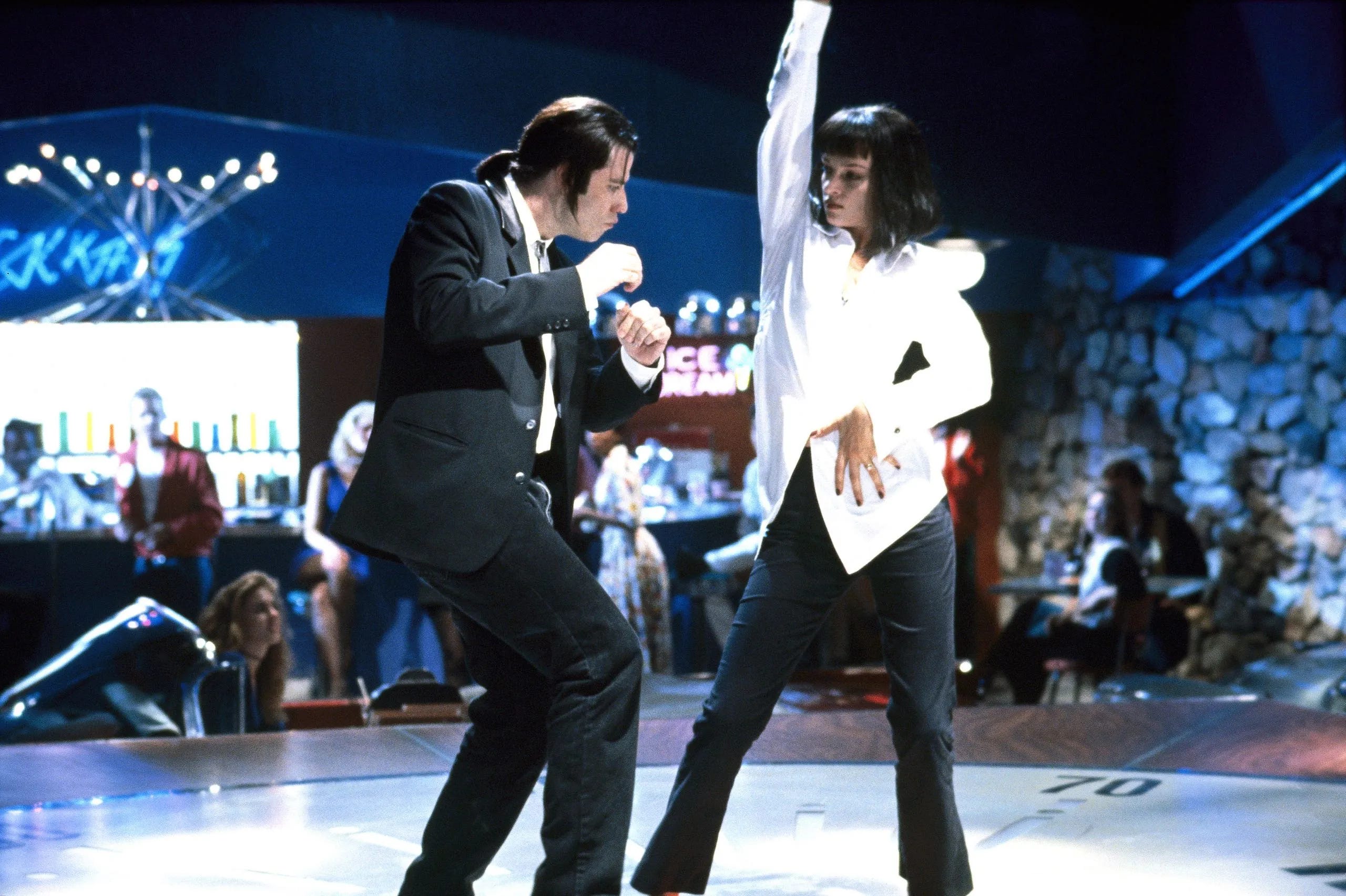
It’s amazing how even a movie you’ve seen many times at home can always be enhanced by watching it in a theater with a crowd. Last week I went to see Pulp Fiction followed by a live Q&A hosted by The IDEAS Institute here in St. Louis. Quentin Tarantino’s iconic and exhilarating remix of cinema, pop culture, and pulp fiction novels has been endlessly dissected and debated since its release. I had seen Pulp Fiction a few times in full, and many more times in pieces. Due to its distinct, almost short story-like narrative structure, Pulp Fiction is the ultimate example of the rewatchable movie that you can easily watch in chunks. However, sitting in a mostly full theater to experience it from start to finish left me with a fresh perspective on one of the most influential and ubiquitous films of my lifetime.
I was only four years old when Tarantino unleashed his second feature film to wild anticipation in 1994, so I was not old enough to ride the initial wave. Actually, I didn’t see it until freshman year of college, circa 2009, around the time Inglorious Basterds was coming out. If I recall correctly, a bunch of us gathered in a dorm room on back-to-back nights to experience Reservoir Dogs and Pulp Fiction on a small TV, most of us for the first time. It’s impossible not to have your head spun around by a first viewing of Pulp Fiction, so while I recognized its greatness immediately, it was never one of my favorites as I saw more of his films. One of my QT takes has always been that I prefer Reservoir Dogs, his astonishing, more streamlined debut.
Thanks to this recent communal Pulp Fiction viewing and the Q&A after, I was injected with both new realizations and handy reminders of what sets this brilliant work apart. The Q&A portion of the screening, led by filmmaker and instructor Jeremy Casper, featured three experts with diverse viewpoints: crime fiction author Jed Ayres, professor, actor, and playwright Greg Carr, and movie critic Janelle Brimer. Their knowledge and expertise, as well as the other moviegoers sitting around me, provided me with a few renewed points of perspective.
The parts of Pulp Fiction that I usually recall first are the most action-oriented: Mia’s overdose and revival, the sudden bursts of violence, Vincent and Mia’s dance. But seeing it with a crowd this time, the comedy emerged to the forefront. I had forgotten how funny (and terrifying) Samuel L. Jackson is in the apartment scene (“Check out the big brain on Brett!”). His performance only gets better and better every time I see it. Has anyone ever been more robbed of an Oscar?
I had forgotten how hilarious Christopher Walken is delivering each line of his “Gold Watch” monologue. The scene that the crowd at my screening really enjoyed was Lance the drug dealer trying his best to handle Mia’s OD. Tarantino’s eccentric dialogue, his blending of comedy and suspense, and the larger-than-life performances he gets from his star cast make for a much funnier film than I had given it credit for.
Similarly, I often default to thinking of Pulp Fiction as mostly a stylish, entertaining, and self-referential exercise. When I spent an evening at the theater dissecting it (with the help of the Q&A), it was nice to get a reminder of the substance and deeper themes that sometimes gets overlooked. Due to Jules’ belief that he and Vincent were saved by divine intervention in the apartment, the movie takes on a philosophical, almost theological, shape. Themes of fate and chance, as well as wrongdoing and redemption, are openly discussed among characters. Did Jules and Vincent experience a miracle or random happenstance? Pulp Fiction doesn’t give us a firm answer, but it does explore this in a deeper way than I remembered.
It’s clear why Tarantino is just better at making this type of movie than his many copycats. He has actually seen every single movie, old and obscure as they can be, that he is referencing and remixing in Pulp Fiction. From gangster and martial arts films to midcentury TV shows and the French New Wave, Tarantino spins it all up in a big blender to produce a delicious smoothie of different styles, genres, and cultures. Most of his imitators over the years have only seen Tarantino movies; Quentin has seen it all.
No posts
Comments
Nothing yet. Say the first thing.
Sign in to join the conversation.