
Welcome to this week’s edition of Weekly Pearls! In these reports, we analyze the prospects who put up the six best performances of the past seven days of MiLB action. We use all of our modeling and research work to give you no-nonsense, reliable takes on what these standout performances really tell you about the players who have produced them.
The standouts this week consist of underrated prospects who, despite their flaws and imperfect approaches, just keep on hitting. Some started the year slow and are finding the right stuff as the season nears its close, while others have been steady eddies, conquering levels that finally fully test their skill sets. There aren’t too many projected superstars in this week’s list, but with a few tweaks and improvements, a late-season 2026 or 2027 breakout could be on the horizon.

This week’s top performances by players in the Oyster Top 250. Who stood out?
Top three weekly performers in the Oyster Top 100
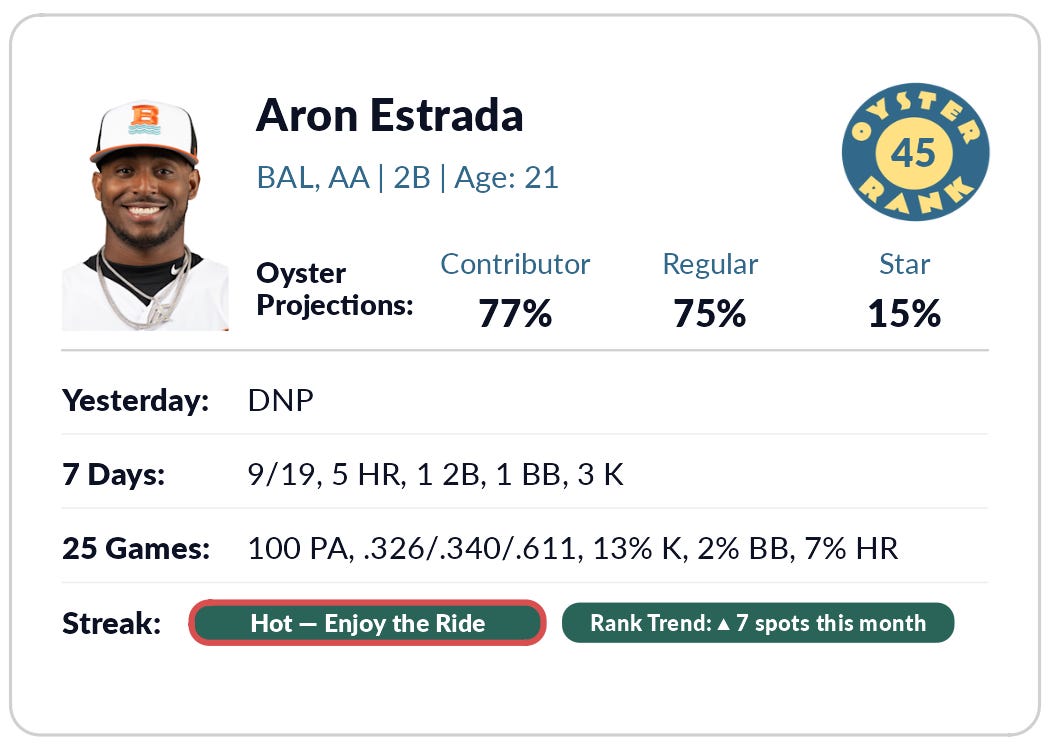
Estrada has been an oyster dandy all season, spending the year firmly in our top 100 despite an underwhelming Double-A campaign. The past month and a half has been fantastic for the second baseman, as he has a 117 wRC+ with his trademark power and average combo. He’s in a rare 20+ HR at under-age-21 club, and is one of only 10 players in this group to do their work in Double-A or higher. He’s also hit his 21 bombs with a rather low 29.4% fly ball rate, opening the possibility for launch angle changes to further improve his profile.
Estrada’s major flaw is a minuscule 4.8% walk rate, lower than last season’s already low 9.9% figure. With high swing rates (53.1%) and good contact rates (77.5%), we can assume that there’s a great deal of chase in Estrada’s profile. Normally, some chase is okay, as long as the strikeouts aren’t building up; however, a sub-5% walk rate is a massive detriment to a player’s overall production. He will absolutely need to find his way into more walks to become a solid MLB regular.
Estrada reminds us of the Cubs’ breakout Pedro Ramírez, as both are small-stature non-SS infielders with solid contact and power but a penchant for chasing. A path to improvement for Estrada may be reducing his swing rate and adopting a more passive approach. Ramírez ran a mid-40s swing rate in the upper minors, and Estrada has enough pop to force pitchers into avoiding the heart of the zone, even in plus hitter’s counts. If a more measured approach resulted in a ~10% walk rate, then his path to MLB productivity would be much clearer. Being a second baseman only (and not an elite one) also negatively impacts his projectability, and the promise that he showed in 2025 as a basestealer (34-for-40) has mostly evaporated this season (7-for-10 in around the same amount of action).
Estrada’s future path is an interesting one: he clearly has promising tools, but his lack of discipline at the plate and poor lift massively reduce his ceiling. Our model is similarly bearish on his ceiling, giving him nearly a ¾ shot at big-league regular status but a small 16% chance of hitting 3+ peak WAR per season. Regardless, not many overleveled prospects are capable of mashing out five jacks in a week, and if he can fix one or both of his problem areas, his low ceiling has the potential to rise rapidly. It happened when Ramírez added power; can Estrada make his own improvements?
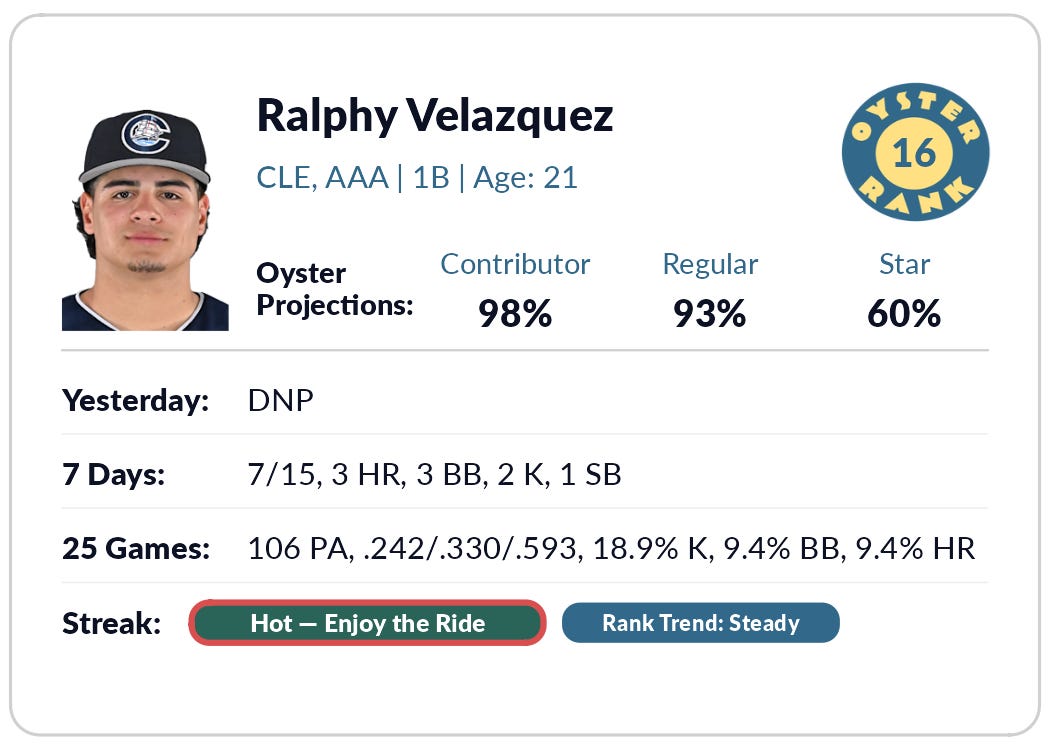
Velasquez earned an unusually high spot in our preseason rankings for a first baseman. At number 43, we said this about our model’s projection of him at the time:
Our model tends to hate first basemen with limited positional upside, but Velazquez’s contact and power combo is too enticing! We think this projection is just right.
Since then, Velasquez has climbed substantially higher still, and is now comfortably in the teens of our rankings. It’s tough to make it as a 21-year-old already firmly assigned to first base, but hitting as well as Velasquez has will certainly make it happen.
Velasquez swings hard and fits the stereotype of a slugging first baseman. This is not a guy you want to leave anything belt-high or lower on the inner half of the plate; he will punish you emphatically if you do. The Guardians’ farmhand swings hard and clearly with an intent to pull when possible, but he doesn’t cheat in the way that some guys dedicated to driving the ball to their strong side do. Velasquez is explosive with fast enough hands and a short enough bat path that he can bring his back hip through late and whip his hands around, tight to his body, just after while still being right on time. It’s tough to spot on broadcasts, but if you get a chance to see a side view of Velasquez swing, he immediately pops as a guy who would be really good at the fence drill designed to keep hitters from casting (if you’re unfamiliar, here’s A-Rod with an explainer).
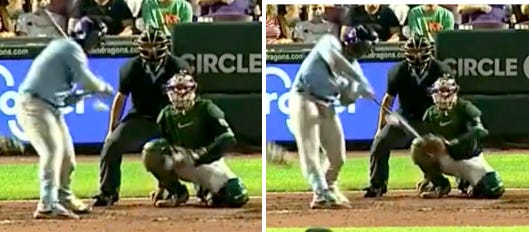
Throughout most of his career, the speed and compactness of his swing have been enough for Velasquez to avoid the kind of sacrifices in the contact department that often go with his kind of power production. Velasquez has never run a strikeout rate over 21%, and until his promotion to Triple-A, his lowest contact rate was 73.8%. Those are not remarkable figures, but for a highly over-leveled, power-first player, they are impressive feats.
Velasquez has been hot lately in Triple-A, but his overall time at the level has shown a jump in struggles in the contact department. His strikeout rate climbed about three percentage points between Double-A and Triple-A, paired with a nearly four percentage point reduction in his contact rate. Those changes on their own are not significant, but considered in tandem with his well-below-average in-zone contact rate and chase rate at the level, they signal a player who is still in the process of adapting to tougher competition.
The good news is, none of this new info changes what we think about who Velasquez is likely to be at his peak. He has the makings of a middle-of-the-order bat, and his strong past week and month suggest the day he makes his impact in the show is rapidly drawing nearer. But, we don’t think that day will come this year. Velasquez has a profile right now that MLB pitchers could deftly exploit, working him away a lot more effectively–especially in the case of RHP–than what he has seen in MiLB and inducing too much chase for him to be immediately effective. We pencil in some time next year for the true Velasquez experience to come to fruition in Cleveland, whether or not he makes a late-season cameo this year. We can’t wait!
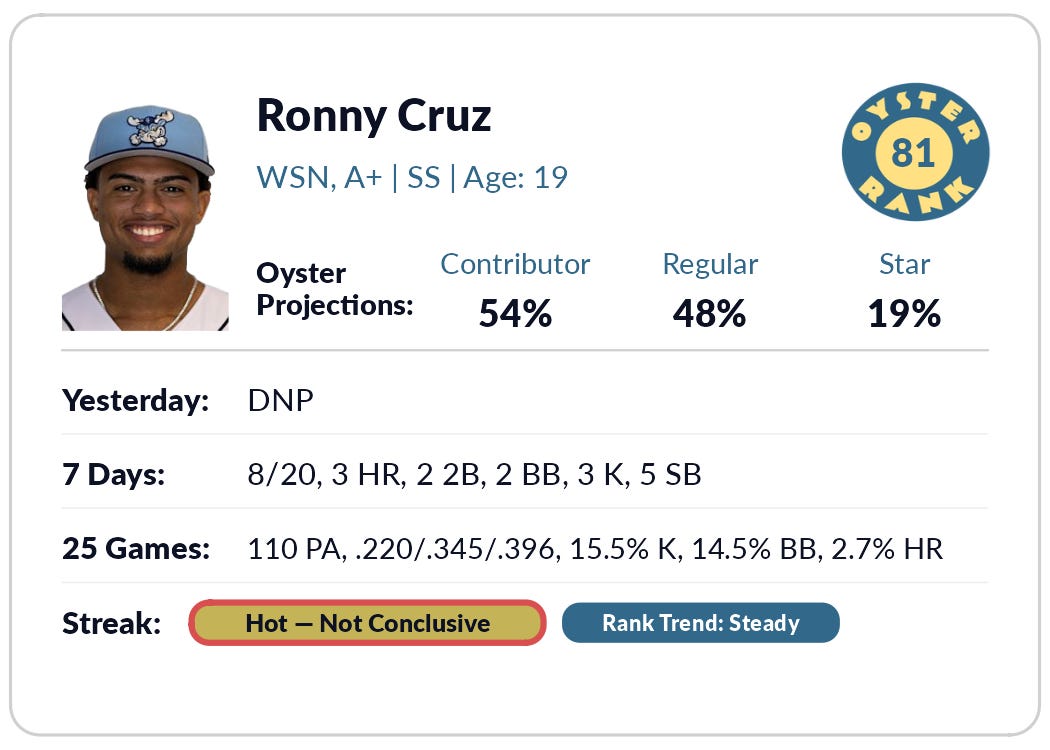
Cruz is one of the more eccentric inclusions in our top 100. He’s right near the back, so probably wouldn’t make the list if we included pitchers, but still: he’s ranked 14th in an unremarkable Nationals system by FanGraphs and even lower by Baseball America. Readers will also be able to quickly ascertain that Cruz is currently in the process of putting up a 76 wRC+ in High-A this year, after earning a promotion with a very strong start in A-ball to start the year that floats his overall production this year up to a 91 wRC+.
We would not personally have Cruz so high, but the fact that the model does means something. This is an interesting one where, strictly from his statistical profile, the model has seen an upside in Cruz that you would also pick up on by watching him in person without access to the numbers: this guy has the potential to produce serious power numbers.
Cruz is 6’2” and looks like he could put on 30 pounds and still be lean. His swing right now has a few bells and whistles, but it’s fairly snappy and has produced 12 home runs in 100 games so far this year. That is a major upgrade from just two in 48 games down in the Complex for the Cubs last year, before his trade to the Nationals. Despite the underwhelming performance overall this year, most of Cruz’s key indicators are in decent shape. He avoids striking out, hits the gaps, and smacks home runs at rates slightly better than average (using a weighted average of his time across all levels). Right now, Cruz seems just a little overmatched by the competition. He’s popping the ball up a ton (28.7% infield fly ball rate in High-A) and his contact rates across both A-ball levels are down in the 60s, after sitting up at 76.4% in the Complex in 2025.
All that to say: it’s exciting to see Cruz get hot over the past week, but he’ll need more than a strong six-game stretch to get more mainstream recognition. We would have Cruz closer to 150 or 200 in our rankings, but that’s still far higher than most would. That is because Cruz will enter 2027 at a career inflection point that could shoot his career off into two very different directions: either the hit tool is there, and after being overwhelmed at too high a level, he finds his footing on the contact foot as a repeater in High-A. Or, this is Cruz’s immediate ceiling in the hit department, and even 60-grade power won’t be enough for the shortstop to carve out a big league career. We don’t know which way it will go, but the very fact that Cruz poses the question (in our view) suggests he deserves serious consideration as a sleeper.
The top three other weekly performances in the Oyster top 250
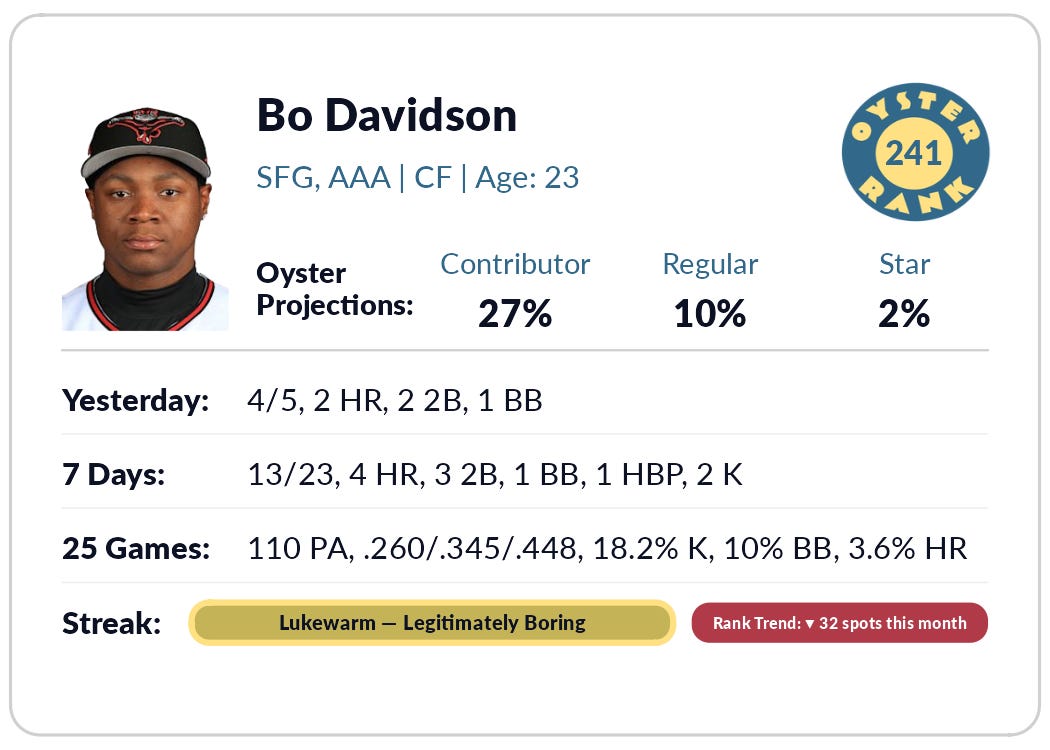
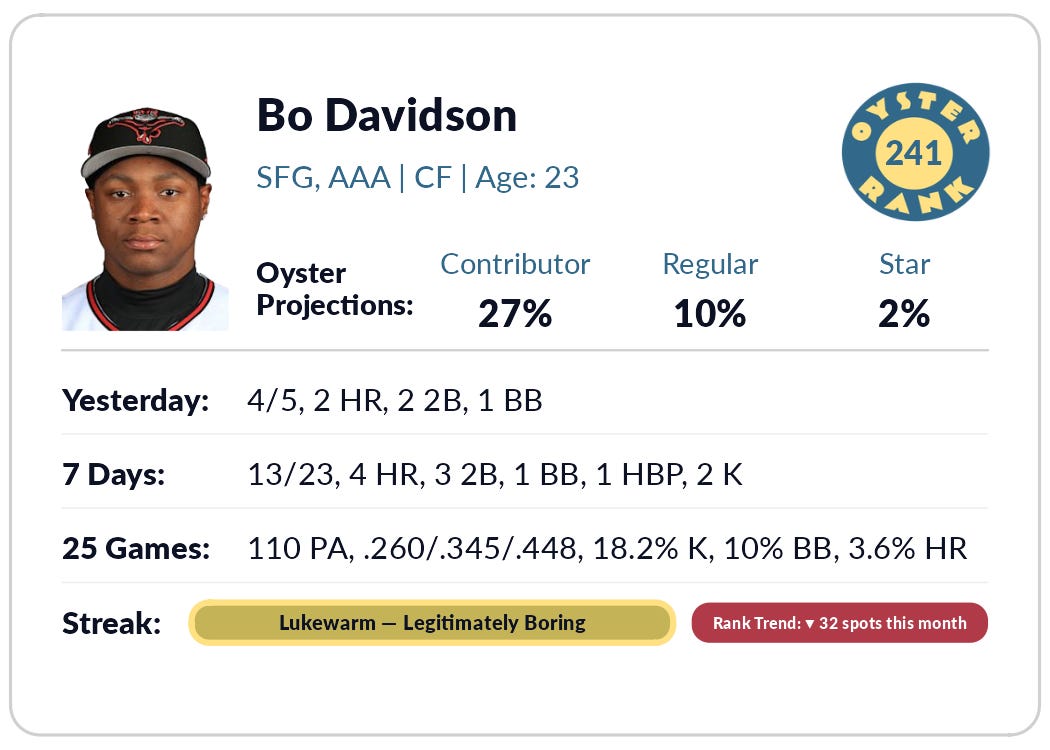
Davidson keeps on hitting! Entering the year as an overleveled hitting stud, it was challenging to project Davidson: were his stats a sign of a late-bloomer emerging, or was he just more developed than his peers? Our streaks model liked his late 2025 work, and we wrote this heading into the season:
At his more age-appropriate Double-A level, Davidson took his power with him, and he clubbed six of his eight Double-A homers in the final 25 games of his 42-game Double-A stint. His low average was also a bit unlucky: a .239 BABIP was not befitting his strong fly ball, line drive, and exit velocity numbers. Just as vital was the preservation of his strong High-A walk and strikeout rates in Double-A, a level where players with high chase rates are often exploited.
As an undrafted free agent signing in 2023, Davidson has an unconventional (and rather slow) development path given his relative success. His end-of-season streak shows us that he’s not a mere “level bully,” but is carrying his trademark power to the upper minors. The question is, will the hit tool similarly develop?
This year, Davidson has displayed improved bat-to-ball prowess with a career-high 75.5% contact rate while simultaneously adding power and reducing infield fly balls. He still looks like the well-balanced hitter that he was in the lower minors, even if he gets some boost in Triple-A’s hitter-friendly PCL. Our model still isn’t all in: being a now 24-year-old likely corner outfielder with some real chase in his profile (27.3%) isn’t exactly the blueprint for MLB productivity. Personally, we’re higher on Davidson than our model. His early EV’s (and other reports on his power) look good; he’s still a solid defender, and no level has deterred his hitting rampage. If he stays hot like he did this week, maybe he’ll see the bigs in a late-season cameo.
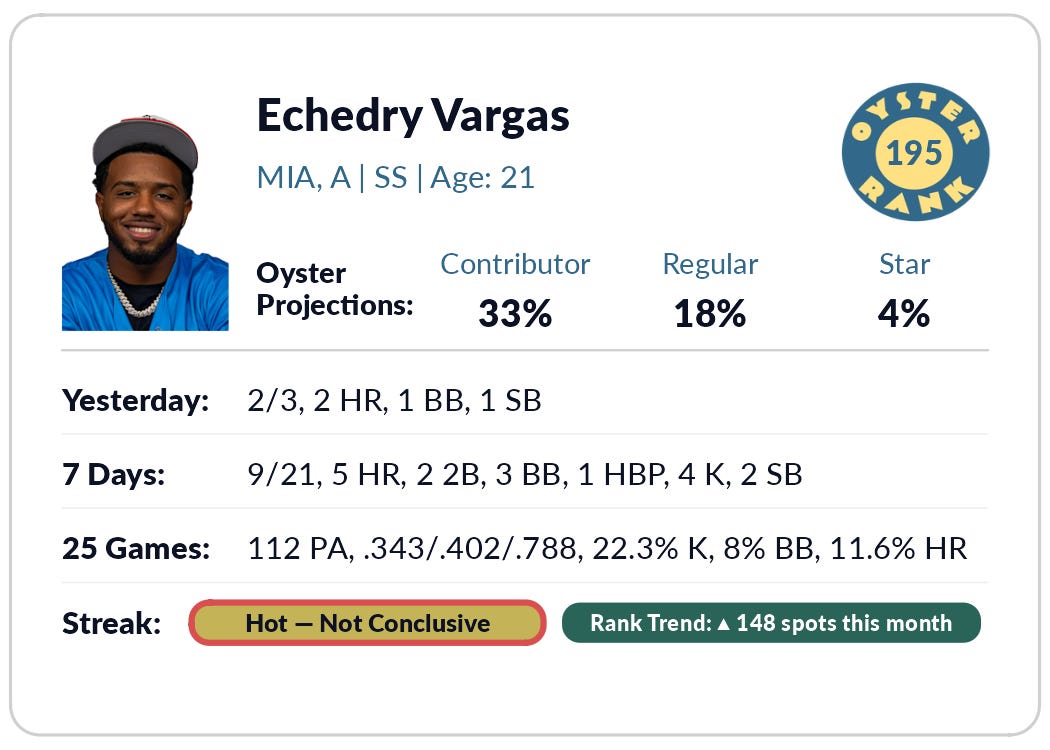
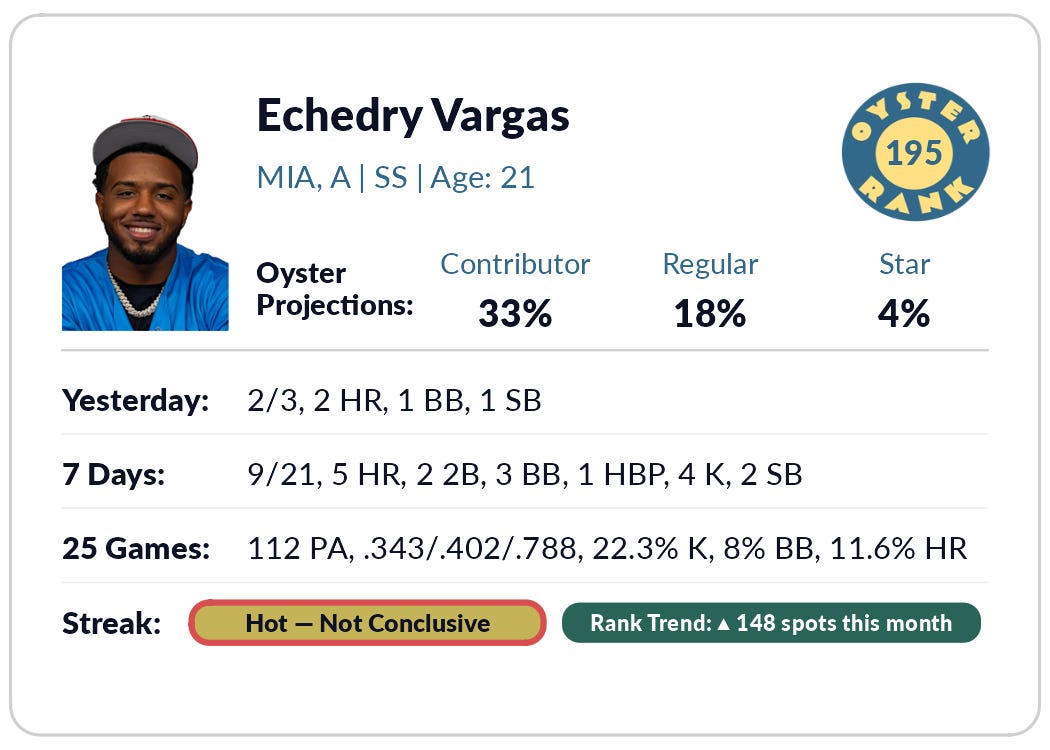
Vargas is down near 200 in our rankings and likely far lower on any other list you’ll encounter, and has an odd career trajectory that doesn’t immediately inspire confidence. He spent all of 2025 struggling to a 66 wRC+ in High-A, before being demoted to Single-A before the season. From there, however, things have started looking up for the Marlin farmhand. He’s smacked 21 home runs in just 88 games so far this year, and is walking marginally more than he has in the past. Overall, he’s produced a 141 wRC+.
We get Statcast metrics on Vargas, and they indicate exactly what you might expect from a profile like this on our site:
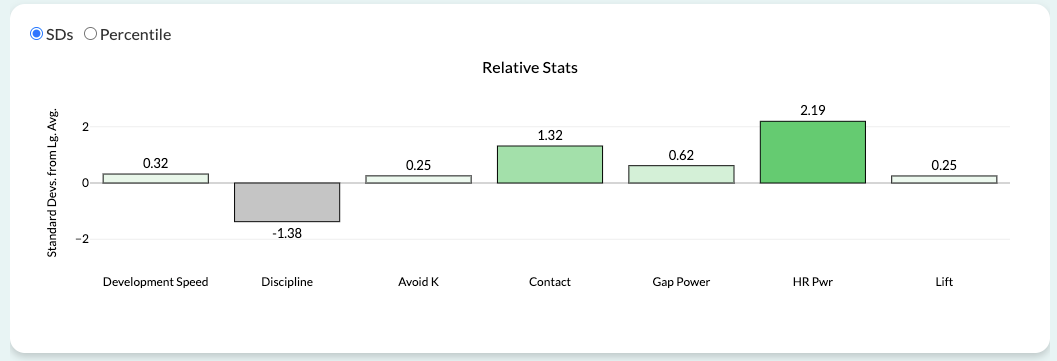
Vargas is a chase machine. He swings at 42.5% of pitches outside the zone. He makes contact with an impressive amount of them (61.3%), which keeps his strikeout rate in check, but the result is a really low OBP for a guy with such a good hit tool and a lot of weak contact.
He gets good reviews in the field and has legitimate pop, but we worry that he won’t be able to adjust to stronger pitching. That’s already been proven to be the case once. On the bright side, however, Vargas has a nearly 1.200 OPS in his past 25 games (though he has still walked just 8% of the time in that span). The power is legitimate, and the raw bat-to-ball ability is strong; the question now is whether the approach is beyond saving. We’ll find out for certain next time he is promoted, but it will be a tough road ahead. We’ll be hoping he makes it happen and gives us a great slugging shortstop in Miami for the first time since Hanley!
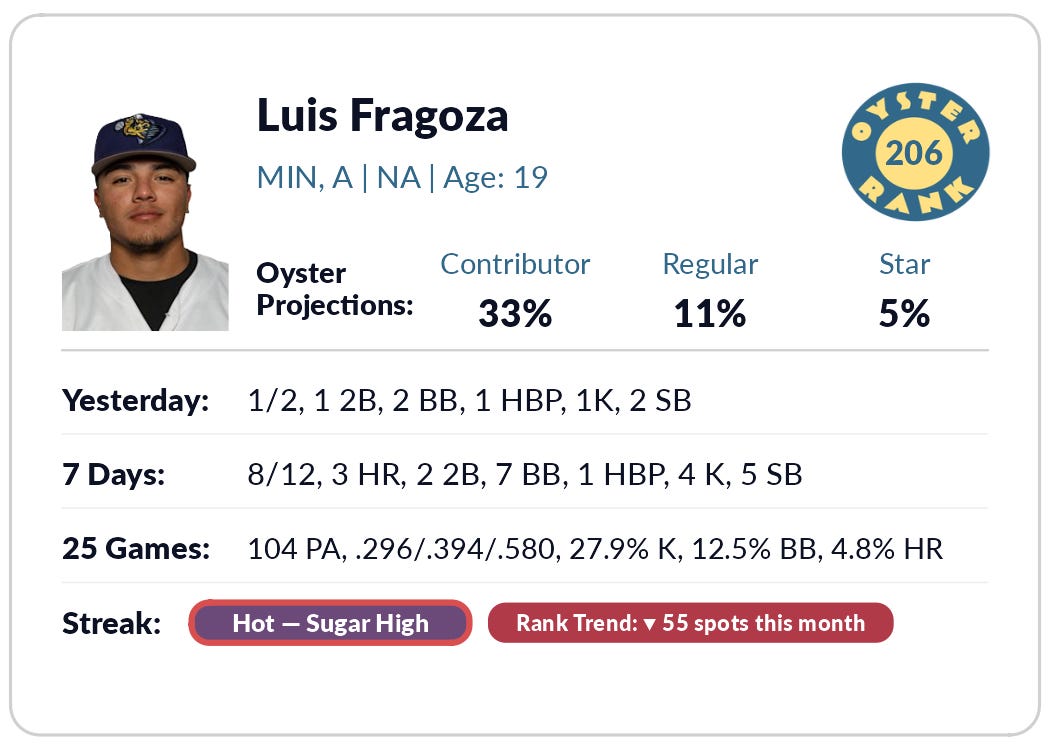
Fragoza is a big swinger, and he hit big this week with three bombs and eight hits. He’s one of 25 players 19-or-younger with at least 14 homers, and his power ceiling is likely even higher: he has an absurd 35.9% HR/FB rate, but his homer output is hampered by a 27.3% fly ball rate. While his lack of lift is a negative, he does well to pull the ball in the air (22.5% pull air rate), allowing him to find his pop reasonably often.
Since he’s in the Florida State League, we have Statcast data on his current work. According to Prospect Savant, Fragoza has solid EV’s and finds the sweet spot well, but struggles with chase and whiff:
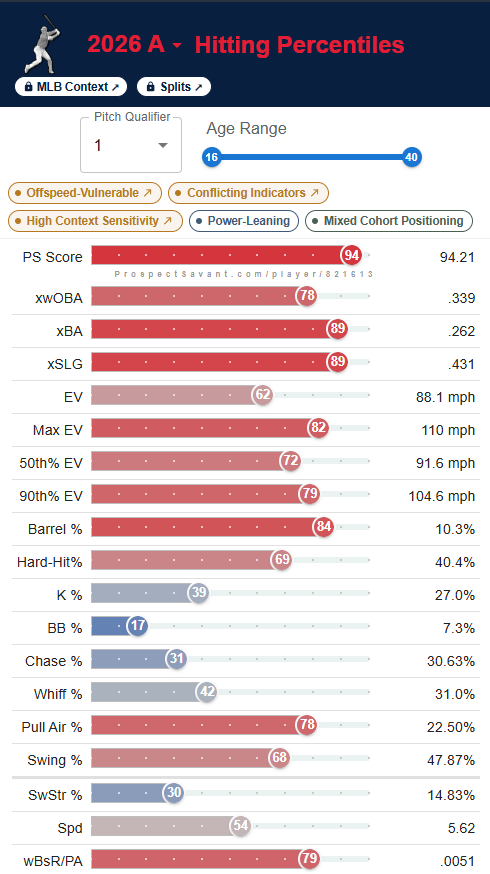
He particularly struggles to hit offspeed stuff, posting whiff rates of over 30% against sliders, and over 40% against curveballs and changeups. Overall though, he’s still able to find his pitch and crush more often than not, and his contact rates are still not too far from average. In fact, of those 25 players with 14 homers mentioned above, Fragoza tops all but one of them in average (and #1 Wilberson De Pena (NYY) is hitting .183 so far in Single-A).
Fragoza faces similar questions as Aron Estrada: can Fragoza avoid the pesky chase enough to tap into his power/contact combo? Fragoza’s lower ranking befits the difficulty of his task, as a ~70% contact rate with tons of chase in Single-A can be tricky to improve. However, a decent 82.3% in-zone contact rate gives us some hope that, if he begins to pick up off-speed pitches better, he can maintain his contact rates and build his power as he ages. For a guy who remains outside of FanGraphs’ Twins’ top 50, we think he has a non-zero shot at being a big leaguer one day.
Which prospects lit up MiLB yesterday?
The top three performers in the Oyster top 100
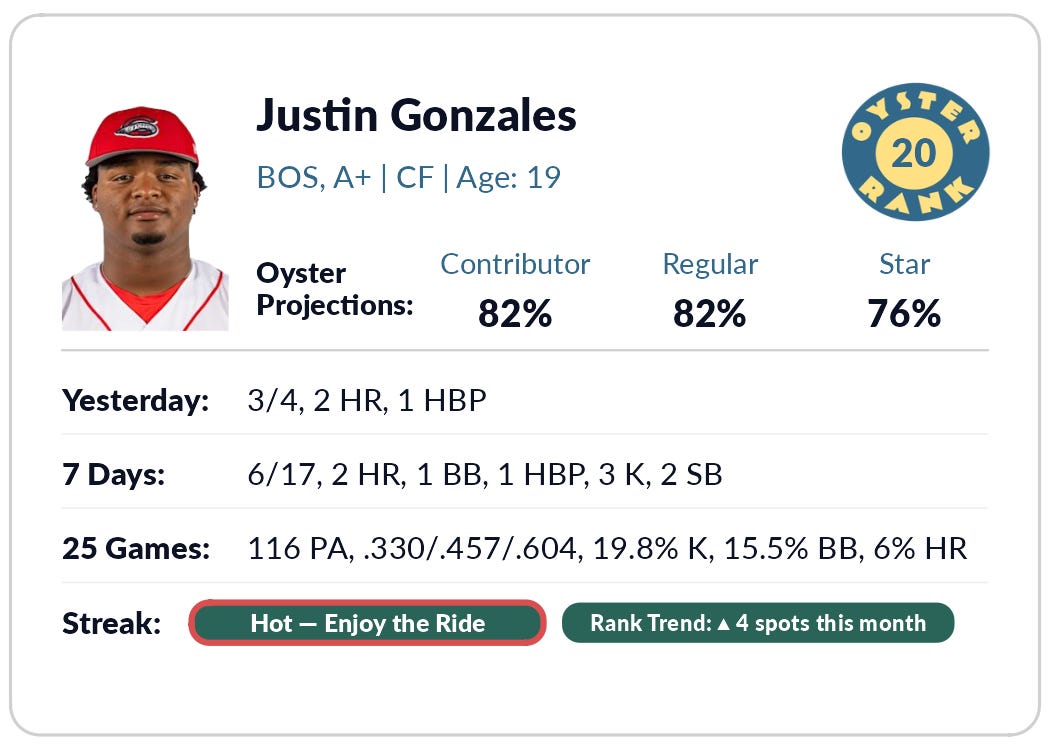
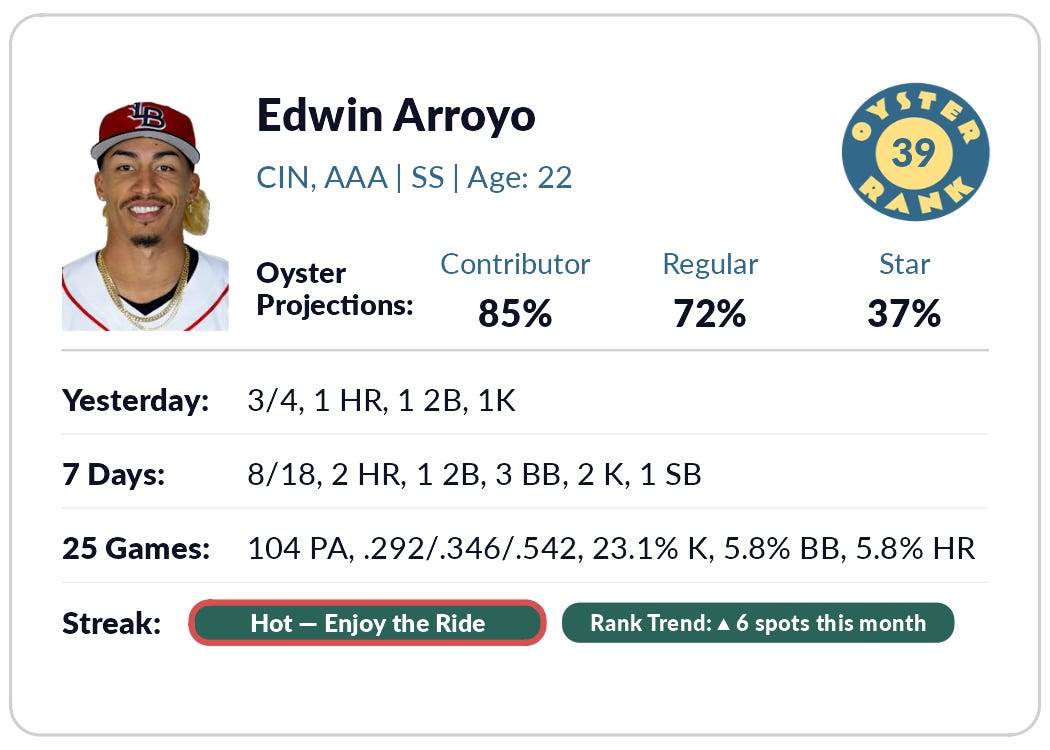
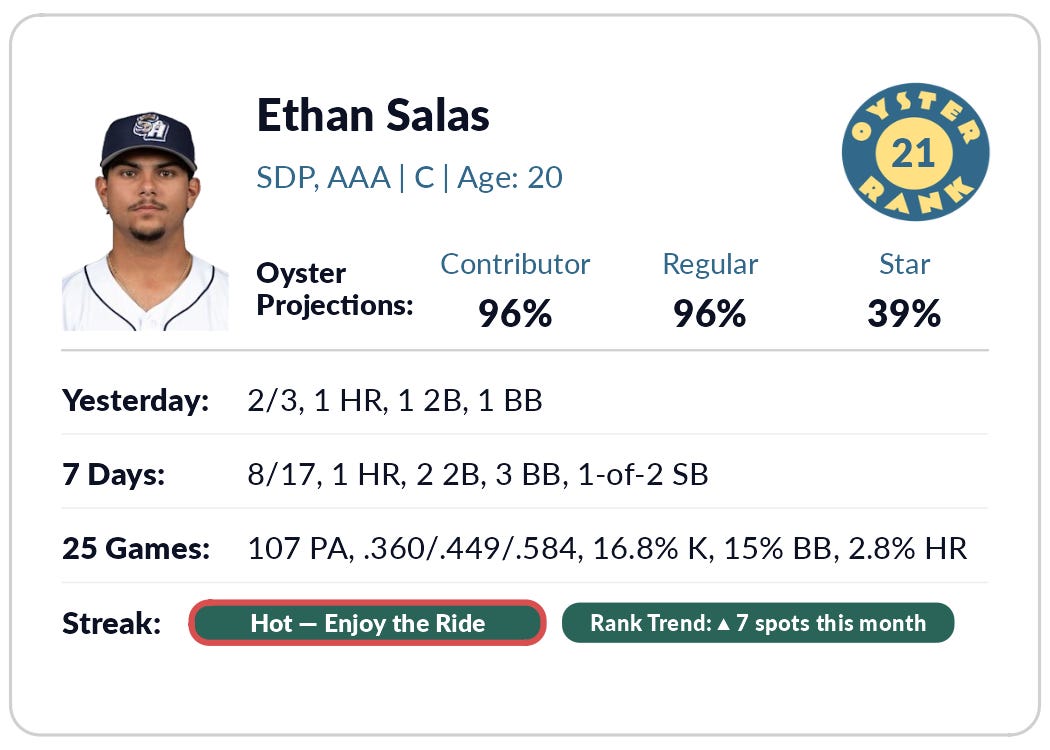
The top three other performances in the Oyster top 250
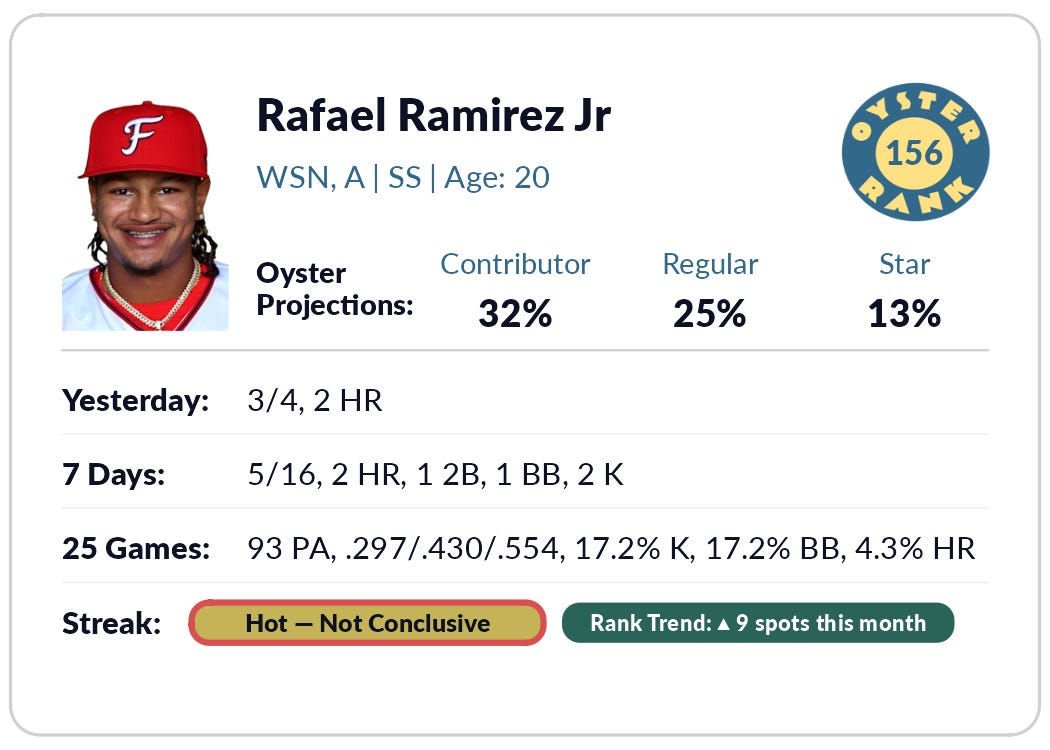
The best Triple-A hitters from the last seven days
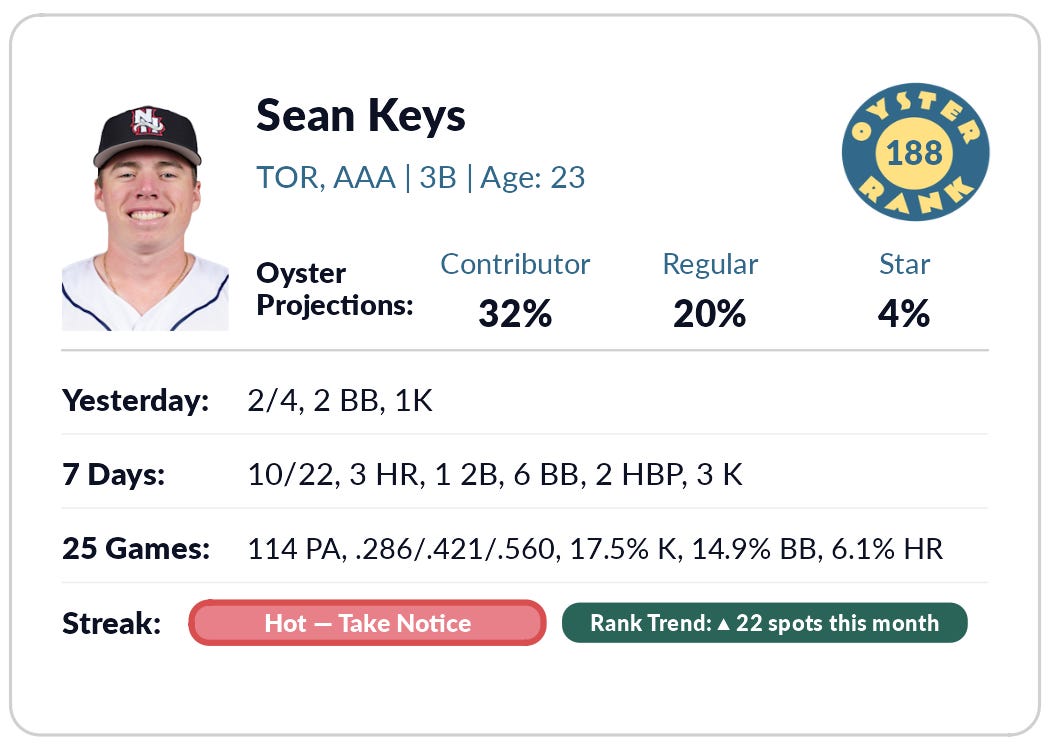
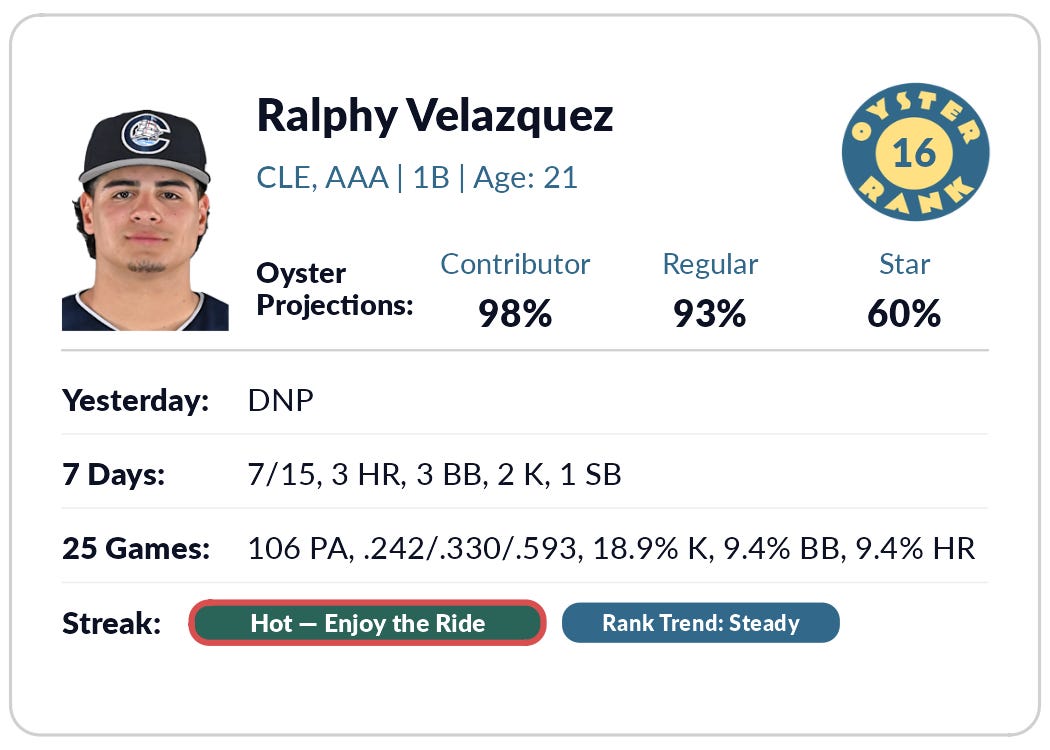
Contributor: A player with an average fWAR of at least 0.5 per 600 plate appearances in their three-season peak. A player who can at least hold down a spot on an MLB roster.
Regular: A player with an average fWAR of at least 1.5 per 600 plate appearances in their three-season peak. A middle-of-the-road or better starter in MLB.
Star: A player with an average fWAR of at least 3.0 per 600 plate appearances in their three-season peak. An All-Star candidate.
Rank Trend: The pill on the bottom row of the card shows how many spots the player has risen or fallen in the overall Oyster rankings over the last month. Green with an up arrow means he is climbing; red with a down arrow means he is falling. Small moves are not shown.
Streaks: Each player receives a two-part streak label. The first part (Hot / Lukewarm / Cold) compares their last-25-games OPS to the league average at their level. The second part reflects whether the Oyster Streaks Model thinks the streak has true predictive value, or if it is just noise in the data.
If a player is Hot:
Take Notice (model agrees, this could be real), Not Conclusive (model is neutral), or Mirage (model doesn’t back it up).
If a player is Lukewarm:
Better Than You Think (model sees more than the stats show), Legitimately Boring (model agrees, performance is fine), or Worse Than You Think (model sees less than the stats show).
If a player is Cold:
But He’s Actually Good (model likes the peripherals), Don’t Worry (model agrees it’s temporary), or Get Worried (model agrees with the slump).
Prospects inside the Oyster top 50 are held to a different standard, as our model’s belief in them outweighs any 25-game sample. They receive: Enjoy the Ride (hot, but somehow hotter than their lofty projection), Business as Usual, or Buy the Dip (cold, but the model still sees massive upside). The lone exception is Even We’re Concerned, which is reserved for elite prospects who remain in the top 50, but are in an overall decline.
Players outside the top 50 whose model outlook has dropped sharply over the past month are flagged as declining regardless of their recent box scores: Sugar High (hot right now, but the overall model isn’t buying the hot streak), Quietly Slipping (performing decent relative to their current rank, but their overall projection is trending down), or Falling Fast (cold and trending worse).
Thanks for following! — Oyster Analytics and Down on the Farm
Comments
Nothing yet. Say the first thing.
Sign in to join the conversation.