
If the theme of the first half of our tour around MiLB was toolsy hitters, in the second half, it was stud American League shortstops having breakout seasons. We got a chance to see Franklin Arias (BOS) (who did not disappoint), Jaiden Lo Re (BAL) (one of our favorite sleepers), Yolfran Castillo (TEX) (well inside our top 100), and Bryan Rincon (PHI) (our pick for a new entry into 2027 top 100s) all in the span of a few days. Whether you’re in the business of real-world or fantasy baseball, a rabid MiLB fan, or looking to learn a bit more about the game’s most exciting prospects, we’ve got you covered below with our full reports on some of the most exciting hitting prospects the Eastern Seaboard has to offer!
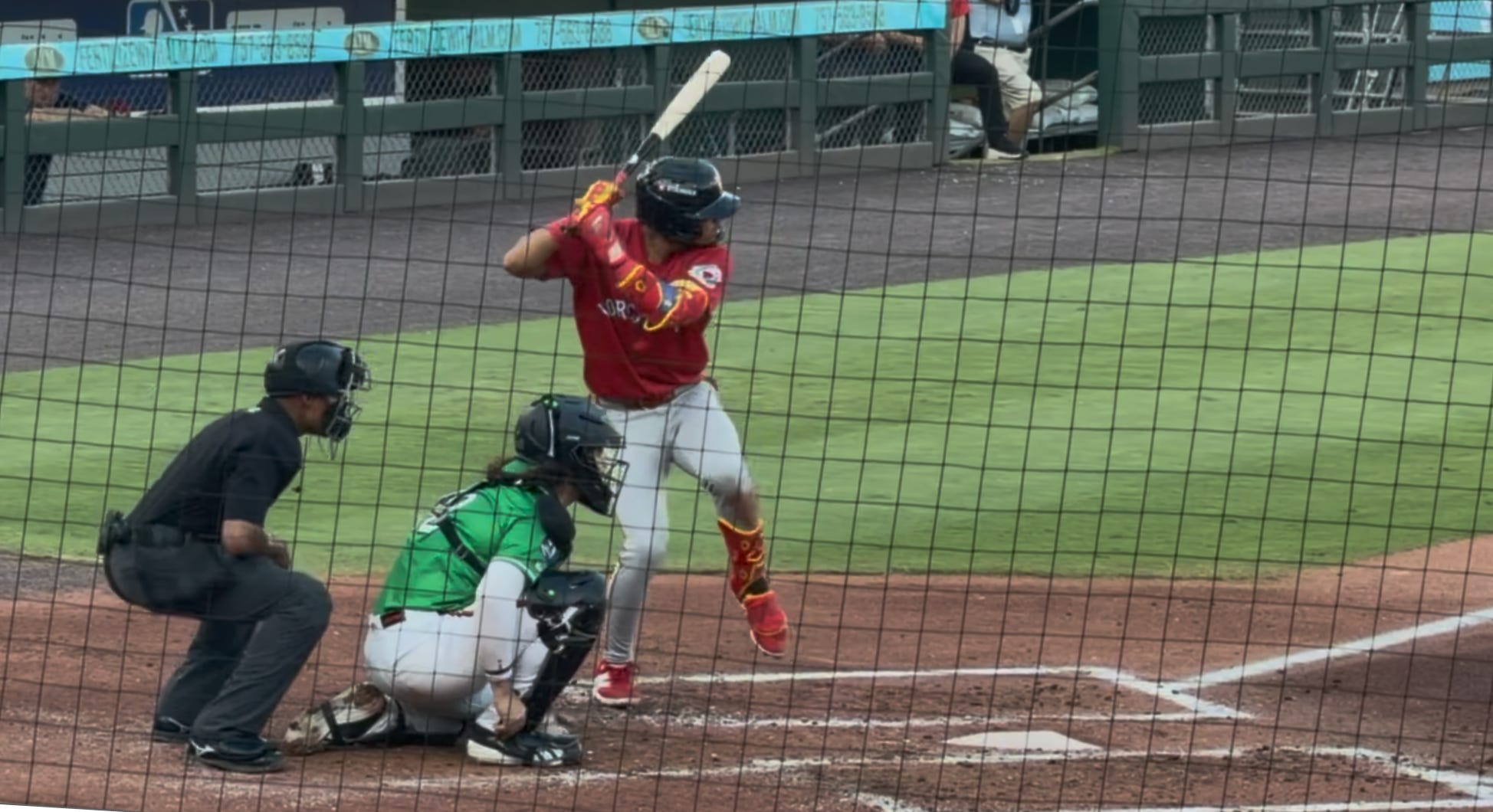
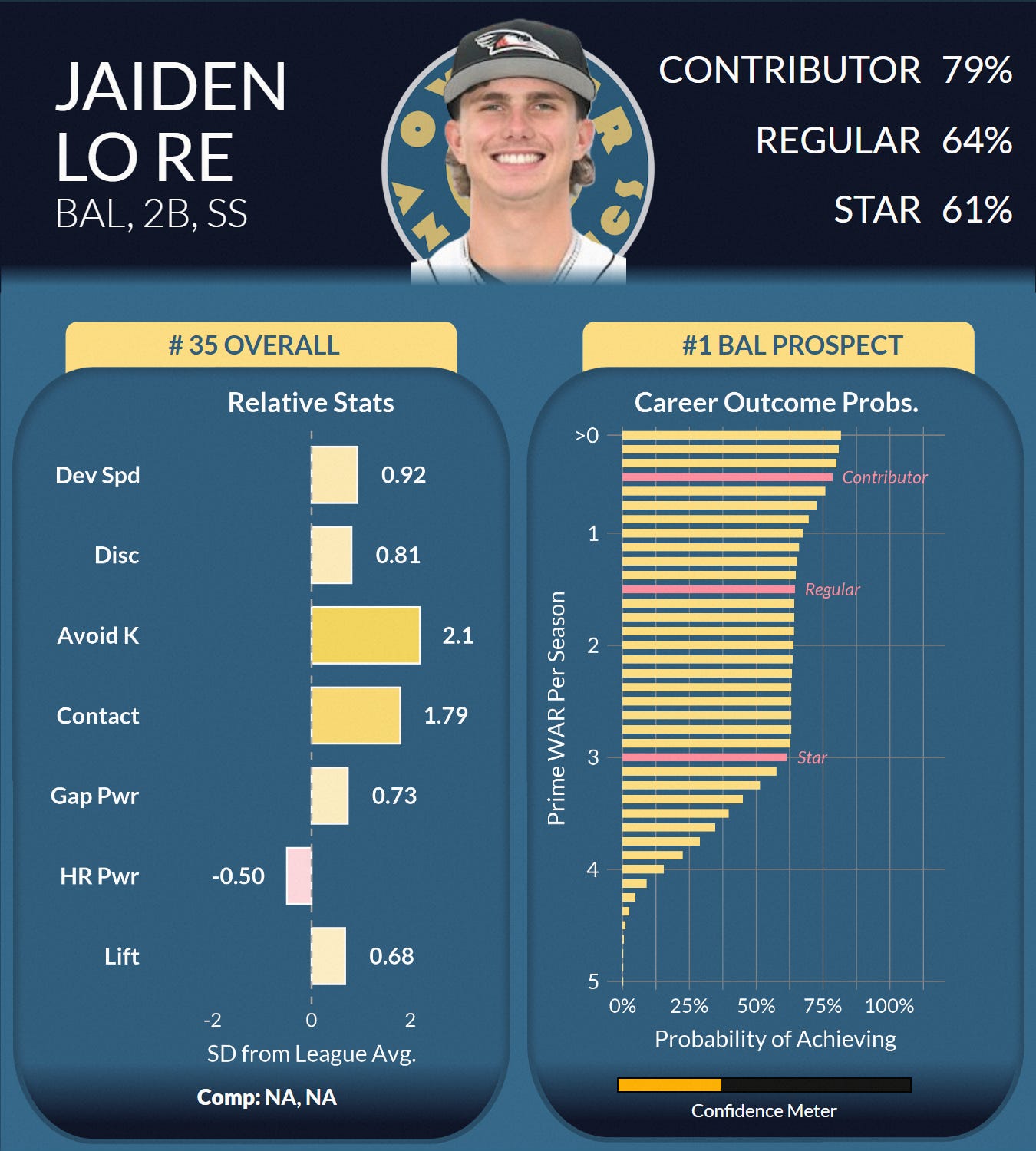
Lo Re is a classic of the Oyster-favorite genre: an over-leveled, slightly undersized shortstop with an elite contact tool. Like many of the less heralded guys in this class, Lo Re is yet to demonstrate much home run power in game, but lifts effectively and hits the gaps enough for us to have faith that the fence-clearing power will be non-negligible by the time he reaches the show. The Orioles’ Single-A shortstop is right in the middle of our top 100 right now, which might seem ludicrously aggressive given FanGraphs ranks him 33rd within the Orioles system, but what we saw in Delmarva gave us faith that our model is onto something.
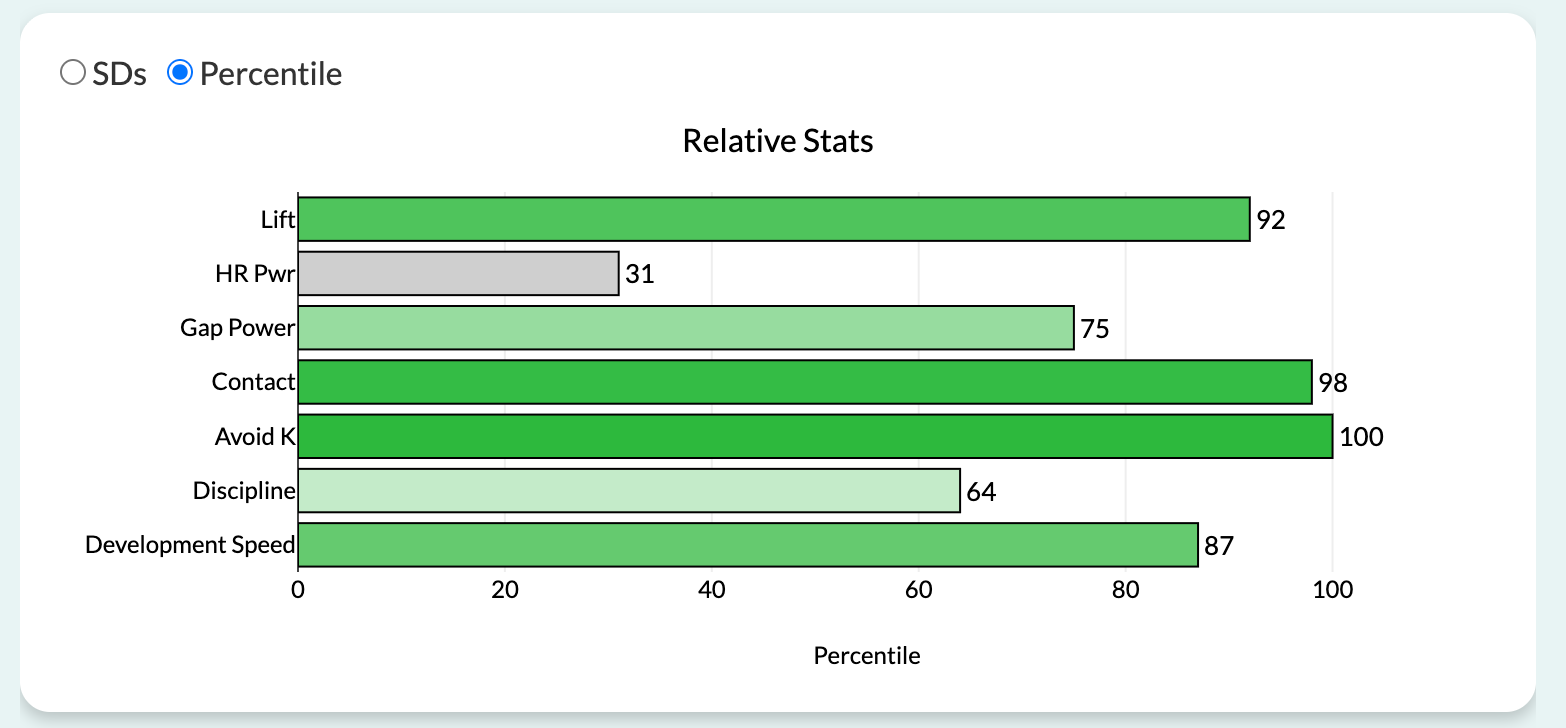
Let’s set the scene with the numbers on Lo Re as of August 6th (the time of writing): he is striking out just 8.0% of the time, walking nearly twice as often as that, and overall putting up a 145 wRC+ as a 19-year-old for the Shorebirds in the Carolina League. That’s especially impressive when you consider that this is his first professional season straight out of high school, and that prior to his time in A-ball he had just 20 games in the Complex under his belt. Even though he’s more than a year younger than the average player at the level, Lo Re’s ability to put bat on ball grades out about two standard deviations better than average—or, if you’re more of a percentile person, he’s in the 99th percentile of contact hitters across the level, if you consider his Avoid K and Contact ratings in our model in tandem:
Watching Lo Re, it was immediately obvious that he really was the guy the numbers make him out to be. He was far from perfect at the dish, but his ability to put barrel to ball is clearly exceptional. Below is an example of an off-balance Lo Re swing that results in a ground out, but where he still manages to hit the ball on the sweet spot with some authority:
The next step on pitches like this for Lo Re is to avoid reaching so far out in front and instead barreling the ball with more force to the opposite field.
We also saw Lo Re swing and miss once, a rarity for a guy with a 90.7% contact rate:
We show these two poor outcome swings not to suggest that Lo Re is struggling, but to illustrate what a strong foundation he is working from. In the first, despite being out of time, he still gets bat to ball and e even barrels the pitch. In the second, in a hitter’s count, he rightly takes a big hack at a pitch in his happy zone and whiffs—exactly the kind of aggressiveness and violent swing you want to see in that situation from a guy who is always going to need to swing hard to put the ball out of the yard. It won’t always lead to good outcomes, and the room for improvement on his timing and ability to avoid being in between the fastball and soft stuff on some pitches is certainly there. Nevertheless, Lo Re’s combination of approach and contact ability is a winning combination in the long haul. As he adjusts to professional pitching, we should see less of the B and C swings and more of his A hacks. And, Lo and behold, we managed to see it all come together on a no-doubt home run:
The Lo Re Bottom Line: Lo Re has a strange setup (one oddly mirrored, less dramatically, by two other Oriole farmhands on this team), but the swing is efficient and smooth. He looked good at shortstop in the opportunities we saw him get, with good instincts and confident glovework. The arm strength is not all it could be (again, just from what we saw), but it increasingly seems that having a cannon should not be a prerequisite for playing short. Lo Re probably won’t be a true five-tool player with plus power and a howitzer for an arm, but just about everything else is there. Based on our model and what we saw in person, we think Lo Re is more likely than not to be a multi-WAR-per-season player for the O’s in a few years’ time.
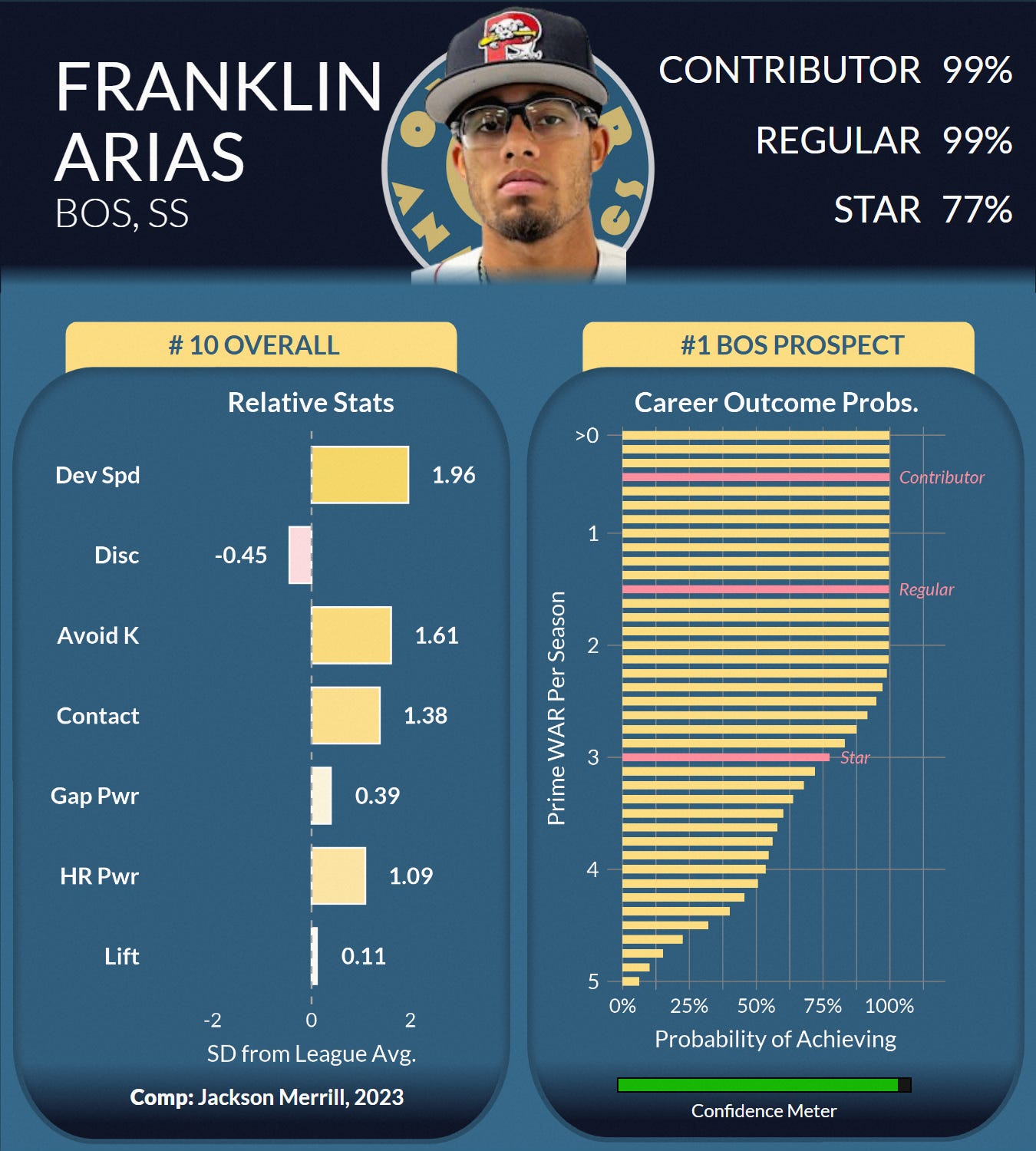
Arias was probably the prospect that we were the most excited to see in our journey; he’s our 10th overall hitter and perhaps the most complete prospect in the minors. It isn’t a coincidence that he was the prospect who impressed us most! Arias’ swing is what you’d want every Little Leaguer to emulate: direct and smooth. Even on this pitch that he got out in front of, his balance is evident:
Most guys (especially minor leaguers) who take that swing softly fly out to short center field, but Arias maintains enough balance to power the ball out to deep center field. His upper half stays back well, even when he is way out front like he is here, and he does a fantastic job of getting into his lower half to generate power. Arias’ added pop has catapulted him into the upper echelon of prospects: he went from eight in 526 PA last season to 21 in 362 in 2026. A guy who makes as much contact as Arias (80%+ contact rates in 2025 and 2026) is a scary player with added pop.
Arias’ walk rates have also improved considerably in 2026: he’s walking at an 11.3% clip after a 7.2% mark in 2025. We saw him take a walk, finishing the PA with a good “yes-yes-no” approach to two three-ball pitches not to his liking:
The lower vid shows exactly what you’d like to see from a hitter. He’s on the attack, but can bring his swing to a stop to avoid chasing the low breaker. Watching games at the higher levels, we consistently saw the best players do the same: Andrew McCutchen, Rowdy Tellez, and traditionally good-eyed Tre’ Morgan showed this last-second decision-making for the Triple-A Braves and Rays. Arias’ skill here is great given his age, and gives us added faith that he’ll have a decent approach.
The Arias Bottom Line: His incredibly mature swing gives us faith that he’ll remain a solid contact bat in the show and a prospect with an incredibly high floor. The power will determine if he can be an elite-level MLB talent.
We’ve never fully been on the Campbell train. Going into 2025, our model had him ranked #69th, shying away from his ground-ball-happy approach and potential lack of stickiness at shortstop.
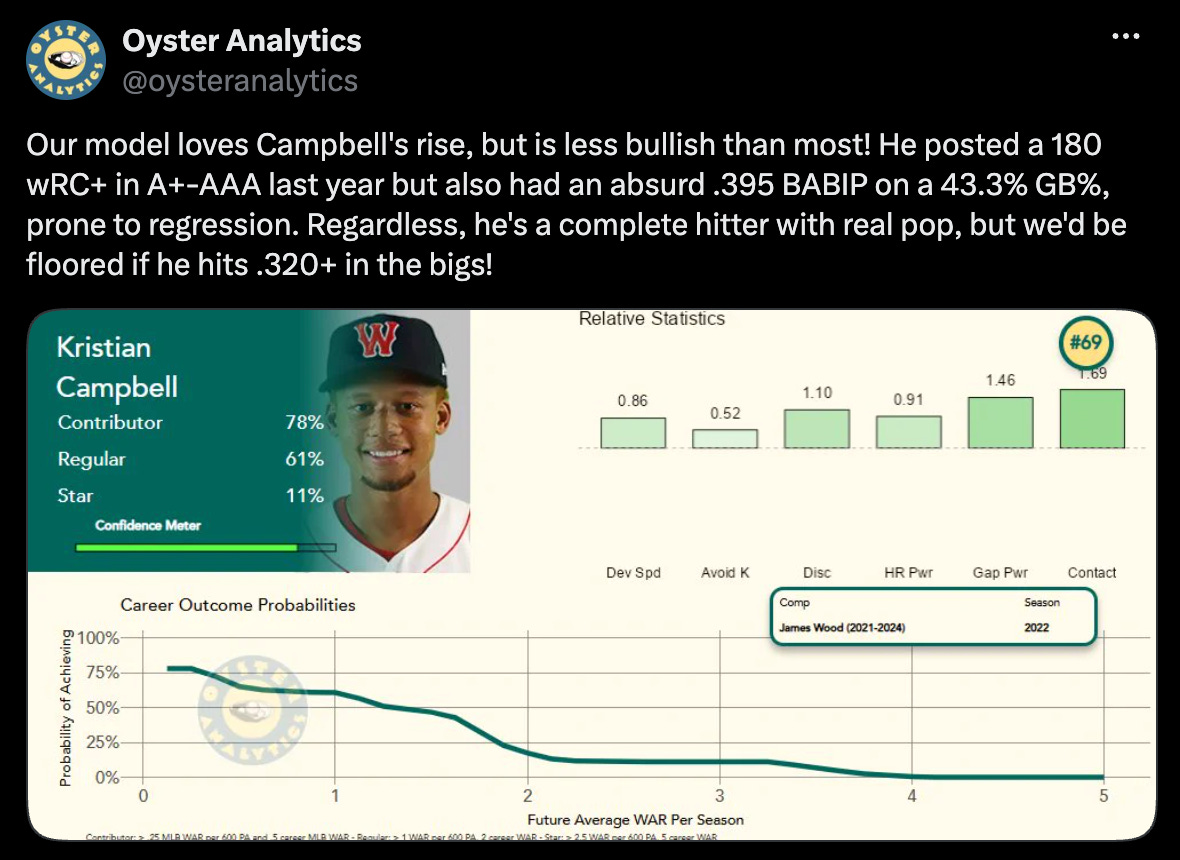
We (like the Red Sox) were still wowed by his balanced approach, but since earning his 8-year, $60 million contract, Campbell has struggled to produce. His flaws have centered on contact quality: he hits the ball on the ground far too frequently and has difficulty barreling up the ball while being a minus-glove infielder. Campbell has spent his entire 2026 in Triple-A, and his hitting woes have continued, with a 98 wRC+ overall on the season. Looking at his swing, he lacks the balance that we find in other prospect bats:
Unlike Arias, who leads with the hips and keeps the upper body back and balanced, Campbell struggles to keep his weight back, making it a lot trickier for him to adjust when he’s fooled. Strength helps him compensate for the lack of timing: he actually hit this pitch quite hard up the middle for a single, but it’s not difficult to see why premium contact has evaded him in the show.
On the bright side, Campbell was fantastic in July and August, hitting .345 with a 161 wRC+, but like 2025, it came with an outrageous .448 BABIP. Even though the good numbers are generating some hype for his MLB return, we’re a bit skeptical that Campbell has made enough mechanical improvements for the solid Triple-A run to stick at the top level. He has also been playing the outfield exclusively, perhaps giving him some positional upside that he lacked in his MLB debut. He made all the easy plays in the game we attended, and wasn’t forced into any tricky opportunities.
The Campbell Bottom Line: Campbell’s swing flaws persist in Triple-A, and while he’s still clearly hitting the ball hard when he’s comfortable, MLB arms are professionals of discomfort. As a minus glove player, he needs to be a consistent bat to be a standout player, and his stick still seems to be a work in progress.
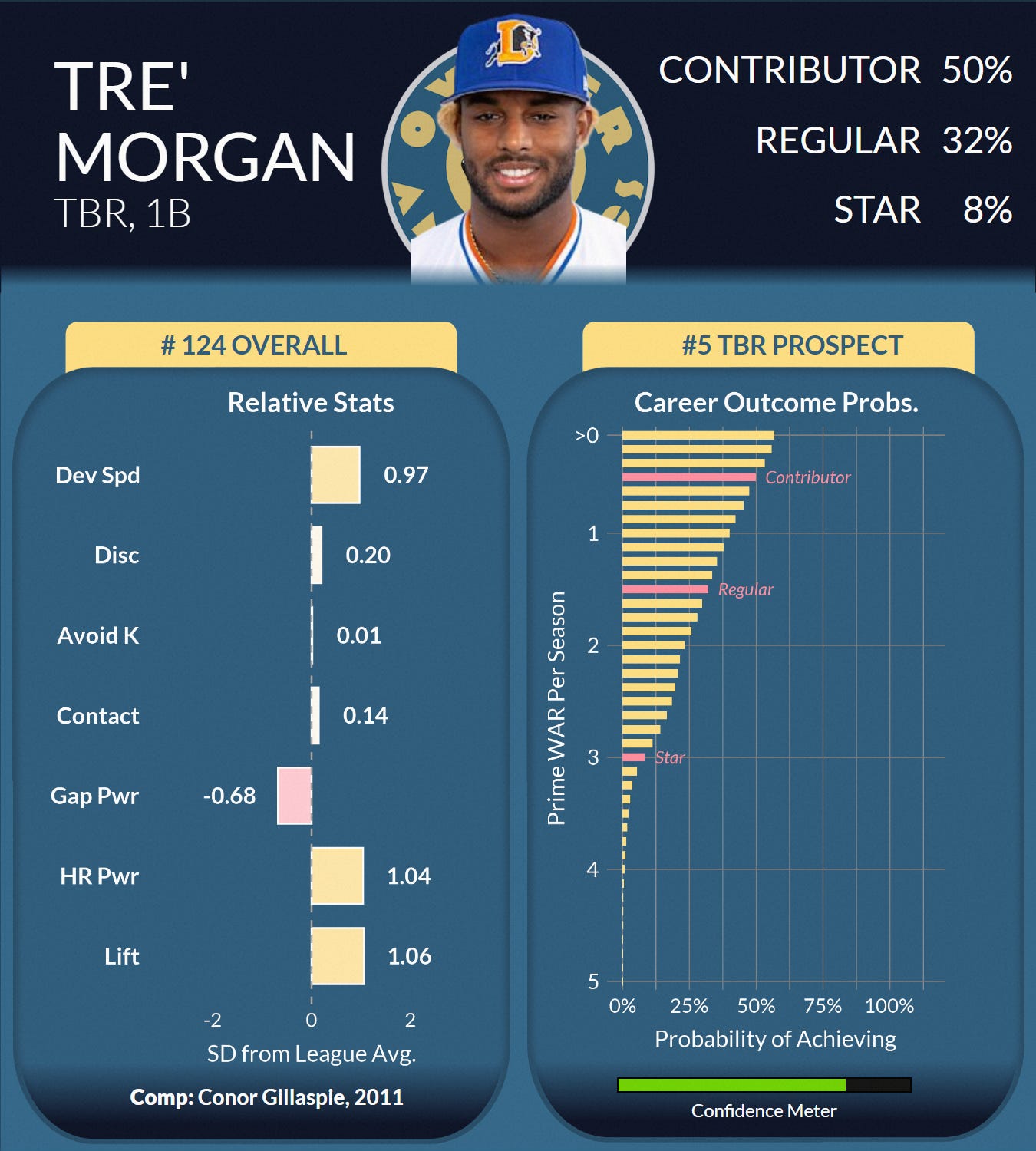
Morgan has had a tricky time over the last few years. The elite-glove, contact-first first baseman has constantly battled injuries that disrupted his rhythm and development. This year, it’s been a quad injury, and after a May return, Morgan had a poor May and June. In July, though, he seems to have burst back into form: a 180 wRC+, six homers, and a sub-20% K rate brought him back to an above-average wRC+ overall. We got to see Morgan in his peak form, and his swing looked quite good:
He keeps a solid, balanced posture throughout the swing, and does a good job of keeping his top half back, even when he whiffs at the high cheese on a comically big cut. He loads and finishes taller than a ton of hitters, and we wonder if he could add a bit more pop if he finds a way to better engage his glutes and legs in his load without compromising his top-end contact.
Morgan also takes a unique two-strike approach, spreading out his stance, minimizing his load, and eliminating nearly all extra movements:
He put alright wood on this ball despite being ahead of it, an improvement over a potential strikeout, but his load was also somewhat weak, and it’s hard to see him hitting XBH or homers with this approach. The two-strike approach is one of the hottest topics of hitting analytics, with much of the new-age analyses casting doubt on the timeless practice.
Approach-wise, Morgan appears to be taking more of those all-out top-video swings with a tangible power payoff, as he is posting career highs in homers and ISO. However, his contact rates are way down, his chase is up to a career high, and he’s striking out over 30% of the time. Morgan is at an interesting crossroads now: can he find a way to marry his old, contact-first approach with his higher-effort swings? Or will he be forced to dial back his swings to be successful? Even for a defensive wizard like Morgan, he needs a plus bat to be a productive MLBer at first base, and his search for improved power is a reminder of just how high the bar is for bats at the cold corner.
He also looked good at first base, mostly living up to his 80-grade defense, making all the plays (but failing on a tough scoop) and pulling a sneaky deke move on a ground ball to the left side that, while creative, failed to deceive the hustling runner. If he can remain healthy through the rest of the season, he’ll likely get a shot at the show.
The Morgan Bottom Line: One of MiLB’s most interesting prospects, he’s a rare glove-first first baseman who is still exploring the best way to be a productive bat. His overall level of play is tricky to assess, as injuries have altered much of his last two seasons. Development can only happen when healthy, and if he can stay off the IL for a prolonged period, he’ll be better able to fine-tune his approach to take on the game’s best arms. Lots of others have moved on, but we still believe in Morgan’s upside.
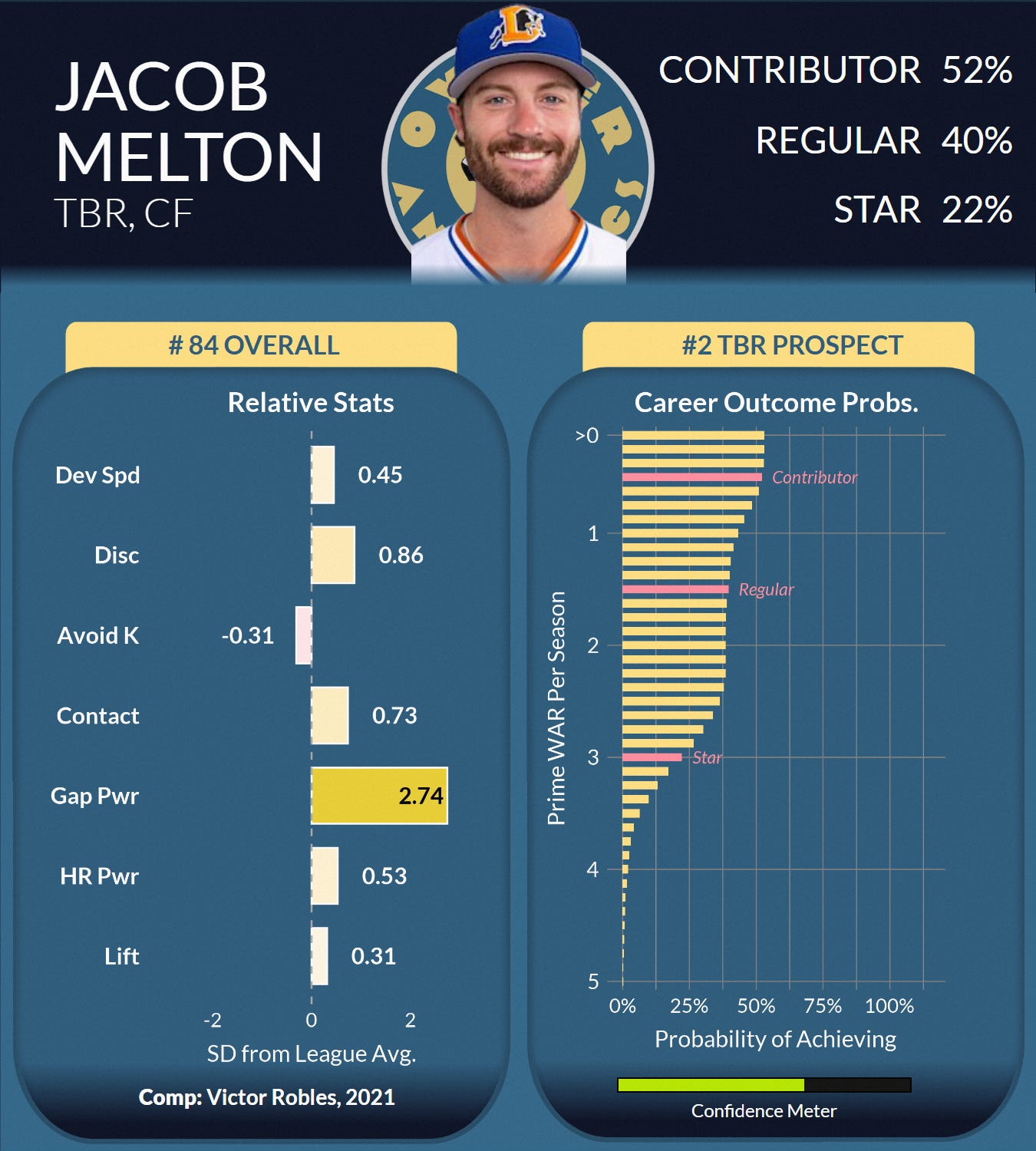
Melton has been on a moderate downturn in terms of the public’s appreciation of his game (recall he was Baseball America’s Astros top prospect back in 2024), but his stock in our model has held fairly steady. At the start of the year, we ranked Melton 94th overall; he now sits at 85th in our rankings.
Back when he was at his prospect peak, he was lauded as a player with elite athleticism and a good enough approach at the plate to compensate for mediocre bat-to-ball skills. A lot of that has panned out as expected. Melton seems to be able to stick in center, and continues to steal bases at a good clip with a phenomenal success rate (as of writing, he’d stolen 25 this year without being caught, in Triple-A where he has to run on a lot of pitchers and catchers with MLB experience).
The problem for Melton has been the whiffs. He’s striking out 30.4% of the time this year, up from 20.0% at the same level last year. His contact rates have seen a similarly sharp decline, down from a strong 80.8% last year to a borderline concerning 70.9% this year in Triple-A. Perhaps most striking is the magnitude of his in-zone contact rate decline: last year, it stood at a good clip of 89.1%. Now, it’s down to 77.5%, among the worst at the level. Interestingly, Melton is also an equal-opportunity whiffer, missing heaters and offspeed at similar rates.
When we saw Melton, he looked a little off balance at the plate. It was, of course, a small sample to see a guy who is unquestionably an accomplished professional hitter, but he did not make the kind of adjustments to breaking stuff that would have given us more faith that the swing-and-miss is likely to dissipate. The swing below is illustrative of that point. Melton here catches himself before he loses all his weight onto his front side, but he’s not able to keep his hands back and ends up taking an early swing with only upper-body strength behind it:
Melton is also fairly upper-cut oriented. We weren’t able to get video of his approach to high heaters, but he’s got that typical down-first hand action that guys who struggle with those pitches tend to show (the stats also back up the notion that he has trouble with upper-cut fastballs). Likely partly as a result of the combo of being too frequently a little off balance and having that swing path, Melton also struggles with infield fly balls, which account for 26.1% of his total fly balls this year.
The Melton bottom line: If he were 22 rather than 25, this would be an extremely exciting profile of a guy who is simply in the natural adjustment period to the challenging pitching of the upper minor leagues. As it stands, Melton is still a guy who we stand by, including at the back end of our top 100, thanks to a strong defensive floor, plus baserunning, and power that can probably turn him into a positive WAR contributor of some kind. It just doesn’t look likely anymore that he’ll be competing for All-Star selections.
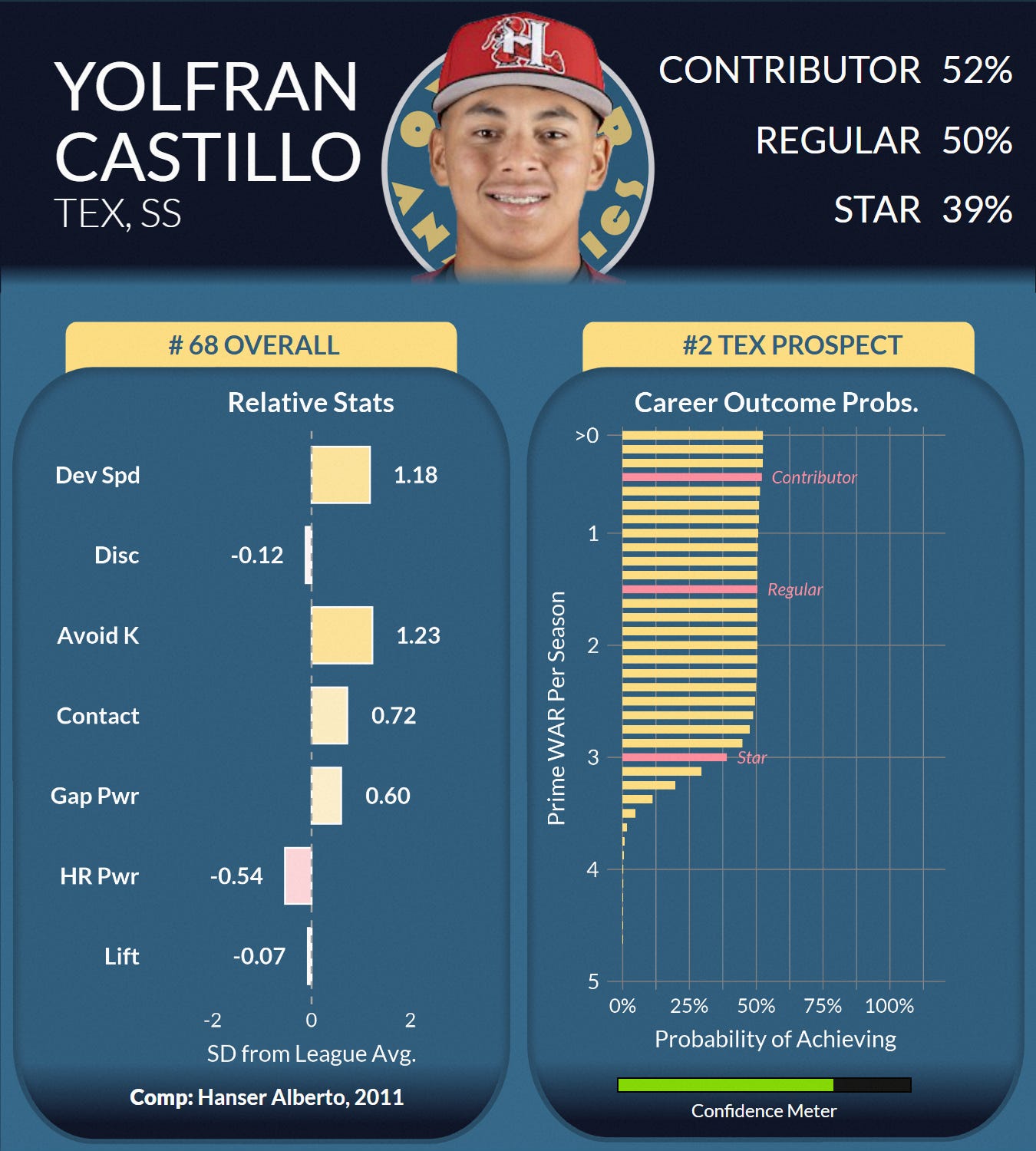
We mentioned Castillo back in our mid-season evaluation of Baseball America, FanGraphs, The Athletic, MLB Pipeline, and our own pre-season prospect rankings. There, we gave FanGraphs props for a gutsy inclusion of Castillo in their top 100, a take that has aged well since, as Castillo has climbed in most rankings and put up a ~120 wRC+ in Single-A at just 19 years old.
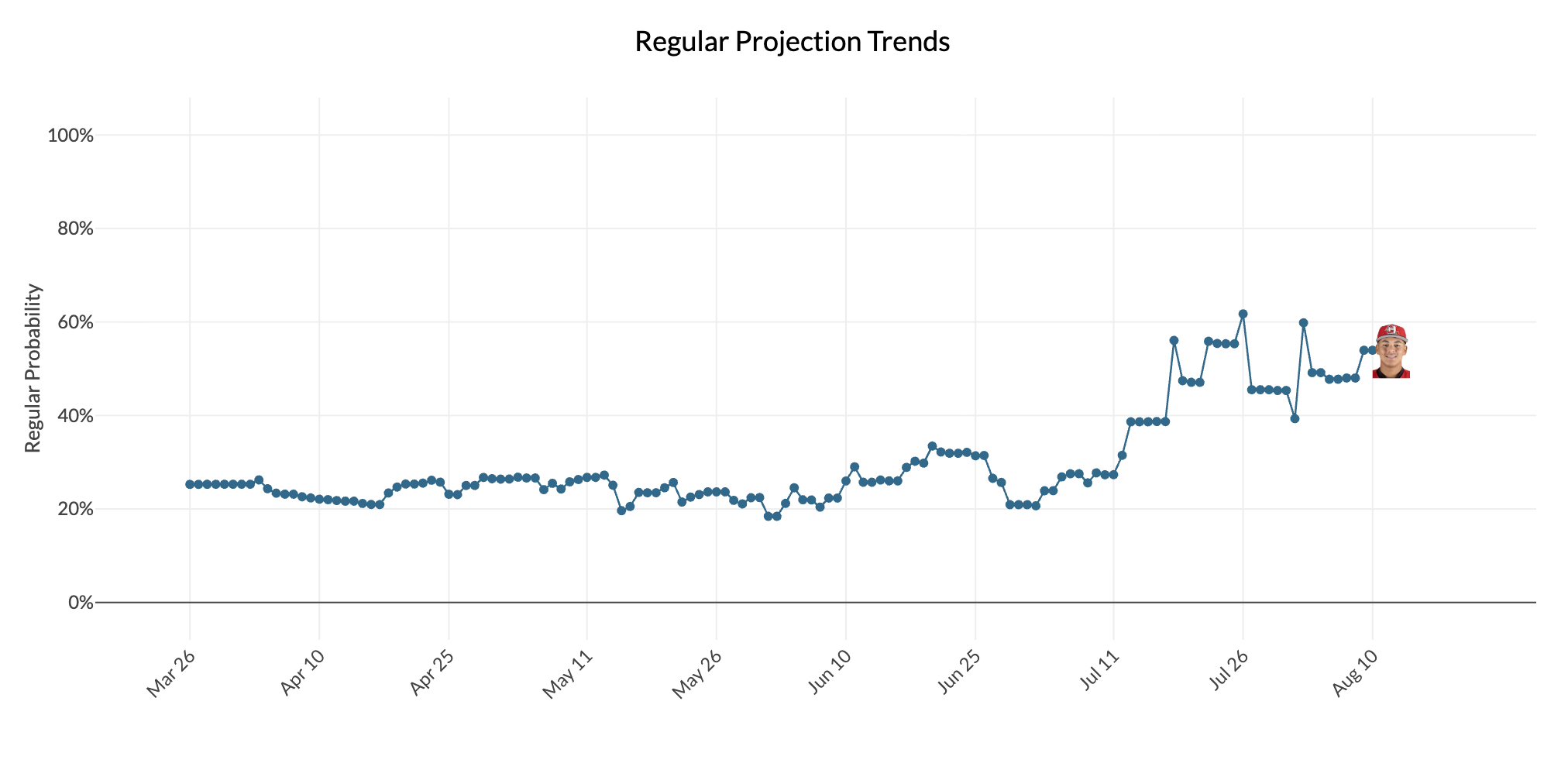
Castillo has now made his way into our top 100 as well. As of writing, we have him 59th overall, with a 50/50 shot to be a regular in the show (defined in our model as a peak of three seasons with at least 1.5 fWAR per year).
Although Castillo may seem like a similar player in a way to the aforementioned Jaiden Lo Re, he’s got a very different swing that gives you different reasons to be excited. Whereas what stands out with Lo Re is a big load and clearly high-effort swing that can still almost always find contact, with Castillo it’s the compact mechanics and adaptable approach:
With two strikes, he almost entirely eliminates even that fairly modest leg lift and load, and instead just lifts his heel and ever so slightly rocks back onto his back hip before swinging:
For us, the very top tier of exciting prospects to see are those who make a ton of contact while also taking swings with the shape and power potential geared toward eventually hitting a good number of long balls. Castillo, lifting less effectively and swinging with a bit less intent, might need more than just a weight room to find his power stroke, and so doesn’t quite make that upper echelon for us.
The Castillo Bottom Line: Castillo is a guy who we think deserves to be in any top 100 list, but he’s also not our top candidate to make a surprise jump into the top 10 any time soon.
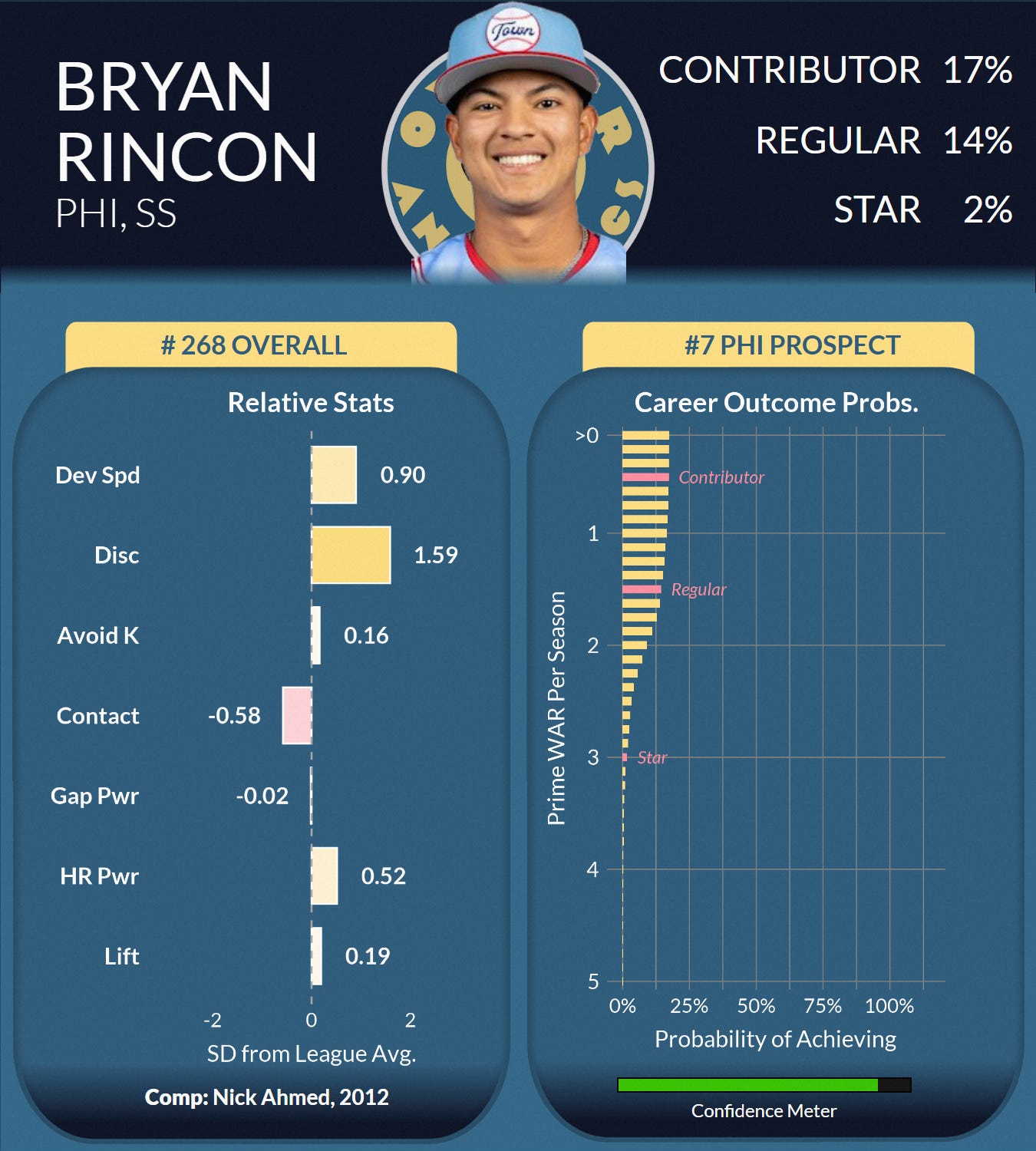
Rincon has improved the swing-and-miss, which has been his issue so far as a prospect. We have him down at 348 in our rankings, but that’s in large part due to a strikeout percentage that until recently had typically been in the high 20s. In his past 25 contests coming into the doubleheader we saw on Saturday, however, Rincon had struck out just 17.6% of the time. In fact, overall this season, despite the fact that Rincon is in Double-A for the first time this season after spending all of 2026 in High-A, he’s managed to cut his full-season strikeout rate down from 28.7% to 20.3% going into the doubleheader we saw.
Something has clearly changed in a very good way for Rincon. Last season in High-A, in addition to striking out too much, he produced virtually no power numbers and ended the season with an 89 wRC+. This year, he’s a level higher, striking out less, and hitting home runs at a much better clip (17 in 83 games). So, we set out to figure out what’s going on with the Phillies farmhand and how seriously we should be taking this offensive explosion.
The first important factor to consider is that in Reading, where we saw Rincon and where he’s played half his games, the ball absolutely flies, and the fences are short. When we were there, the Fightin’ Phils and the Rumble Ponies combined for seven home runs in the first seven-inning game of the doubleheader. We hadn’t checked out the park factors before we arrived, but very early on in the game it was clear something slightly strange was happening. First of all, the fences are close in both gaps. Then, the Mets’ D’Andre Smith, he of one 2026 home run, hit a ball out to nearly dead center field that went 459 feet despite registering a comparatively pedestrian 104 EV. More blasts followed, including one that cleared the right-field fence, the pool and seats out there, and the advertisements above them, leaving the ballpark entirely. Even leaving the actual batted balls aside, it was notable that the flags were all blowing out strongly to left-center all game.
A dive into the numbers confirmed that what we saw was no fluke. Reading boosts home runs between 20-30% depending on the year and batted handedness, fourth in all of Double-A behind only Amarillo, Rocket City, and Chesapeake. That’s why although Rincon is on pace for over 30 home runs this season, his home run power score in our model remains just over 0.5 standard deviations better than average. So while the power surge has turned Rincon from a slap-happy contact-only guy to a more complete hitter in the eyes of our model, it’s hardly transformed him into a power-first masher.
Rincon passes the eye test. He gets good reviews at shortstop and has a swing with little wasted movement:
The Rincon Bottom Line: Rincon is a sleeper pick of ours to be a top 100 prospect heading into next season. He’s a complete player who showed progress in his flaws and has the glove chops to be a top fielder.
Some of the players we scouted were Oyster darlings: we’ve always ranked Jaiden Lo Re and Tre’ Morgan higher than consensus. Who is one prospect that you’d rank higher than mainstream prospect outlets?
Which prospects lit up MiLB yesterday?
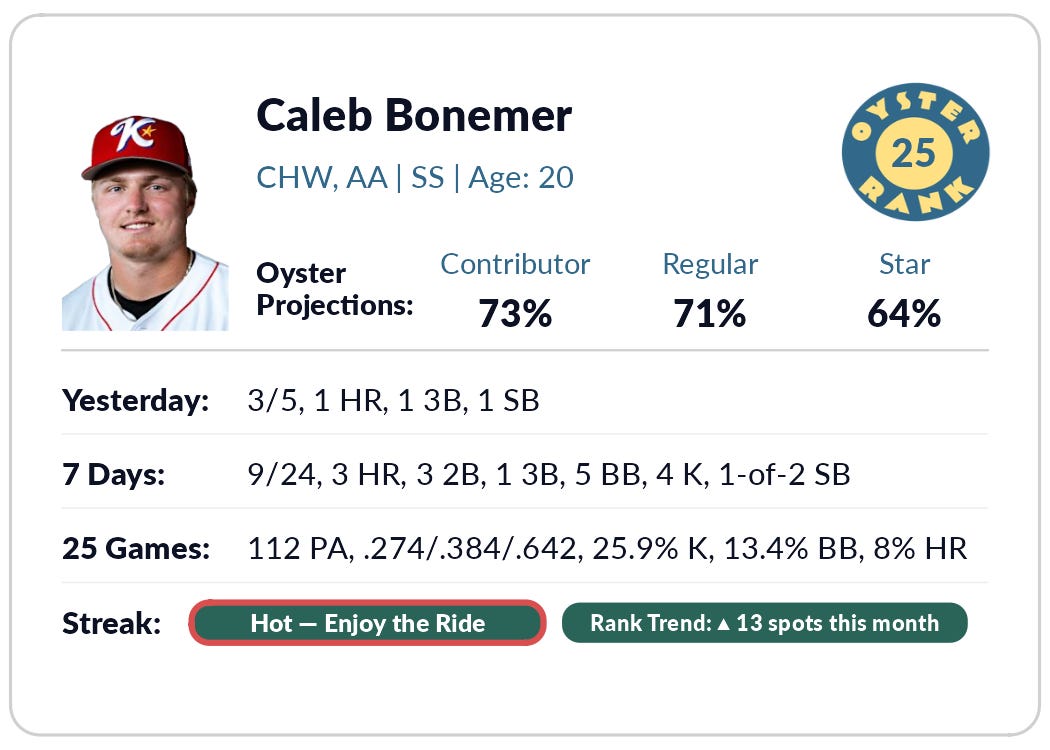
The top three performers in the Oyster top 100
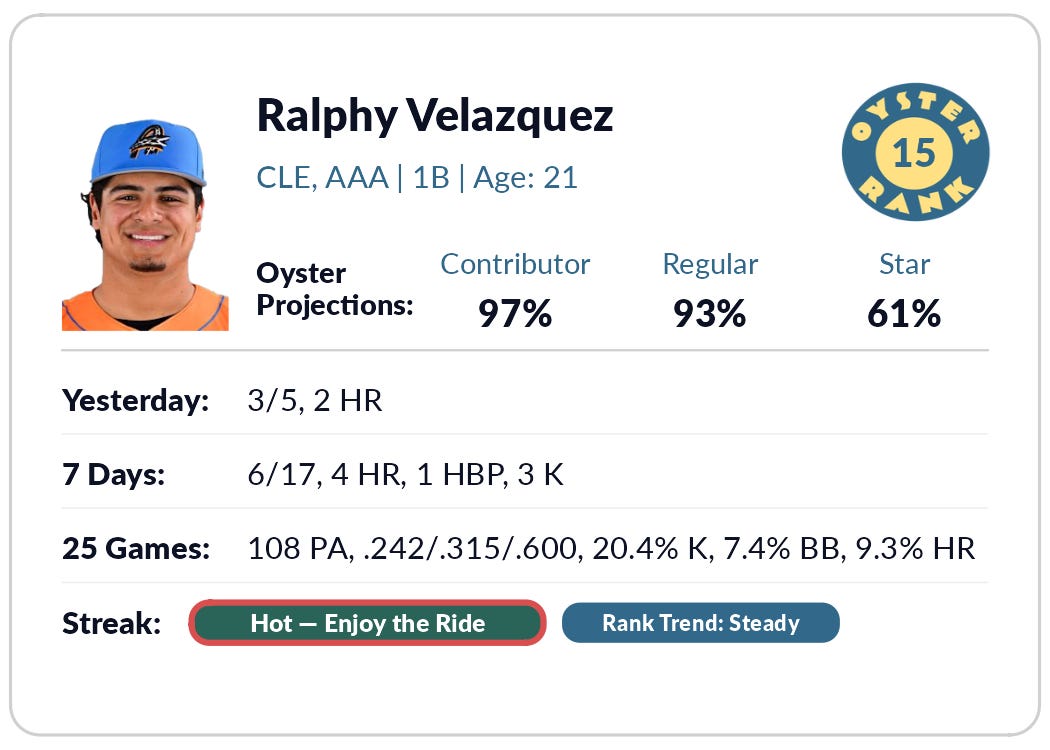
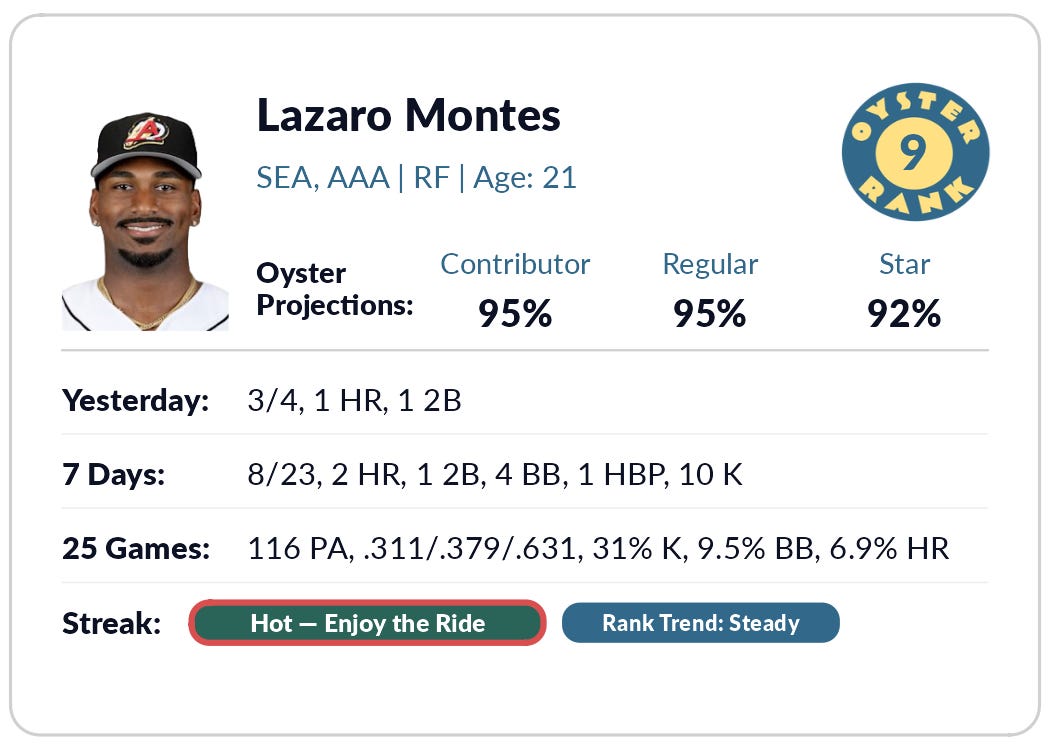
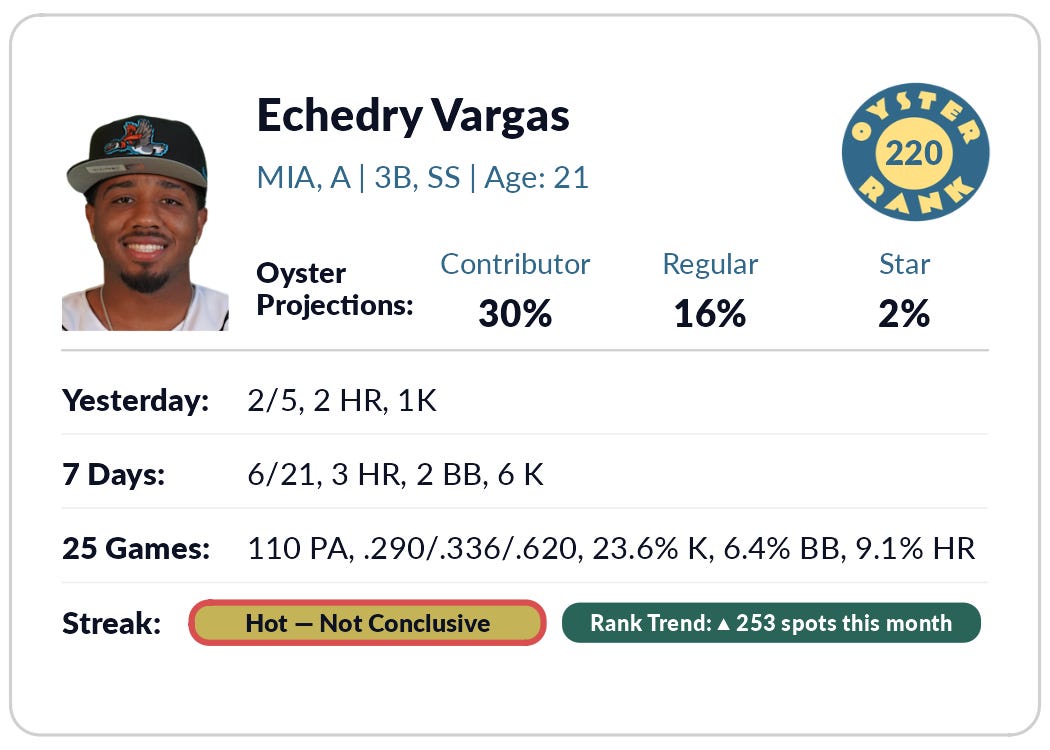
The top three other performances in the Oyster top 250
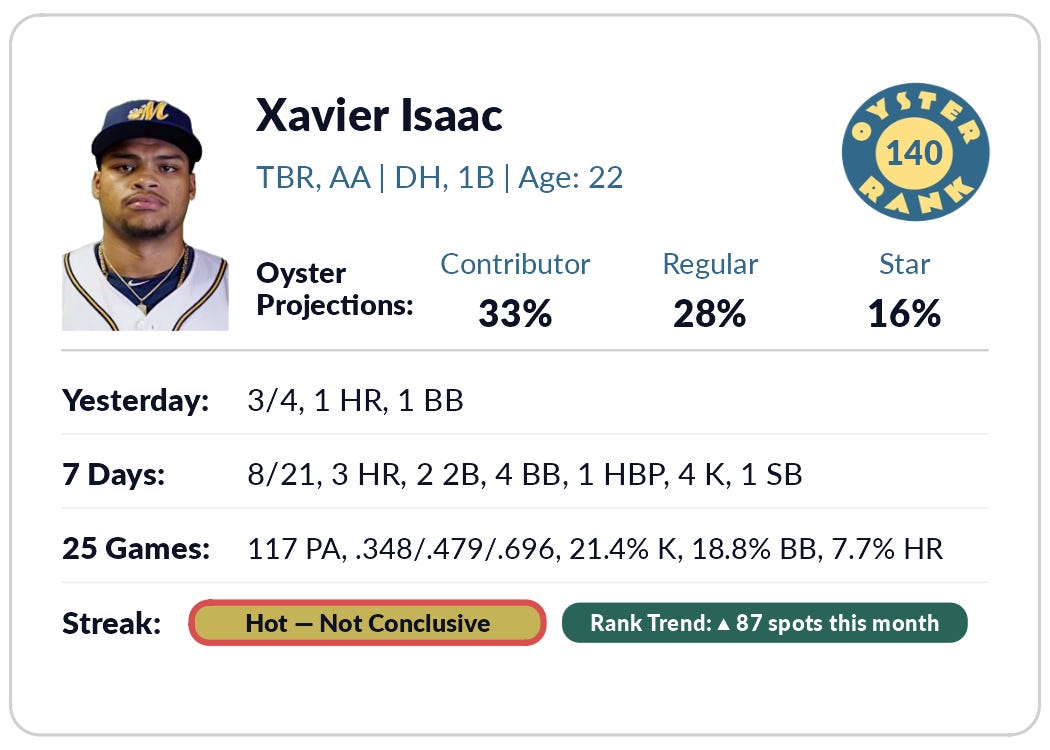
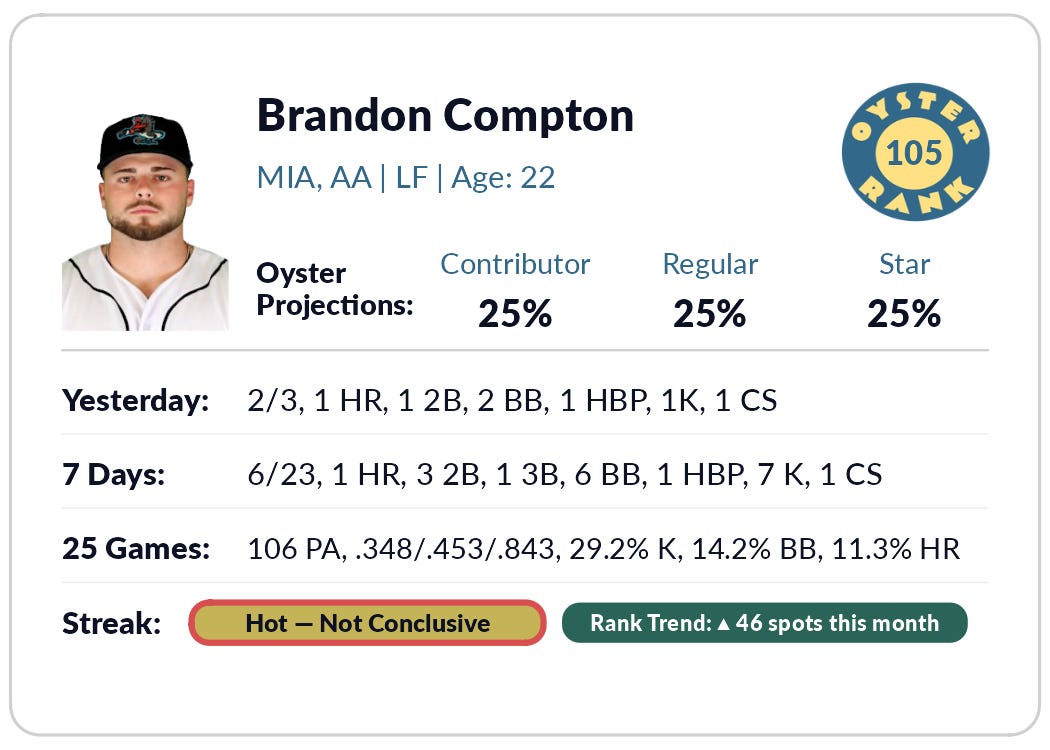
The best Double-A hitters from the last seven days
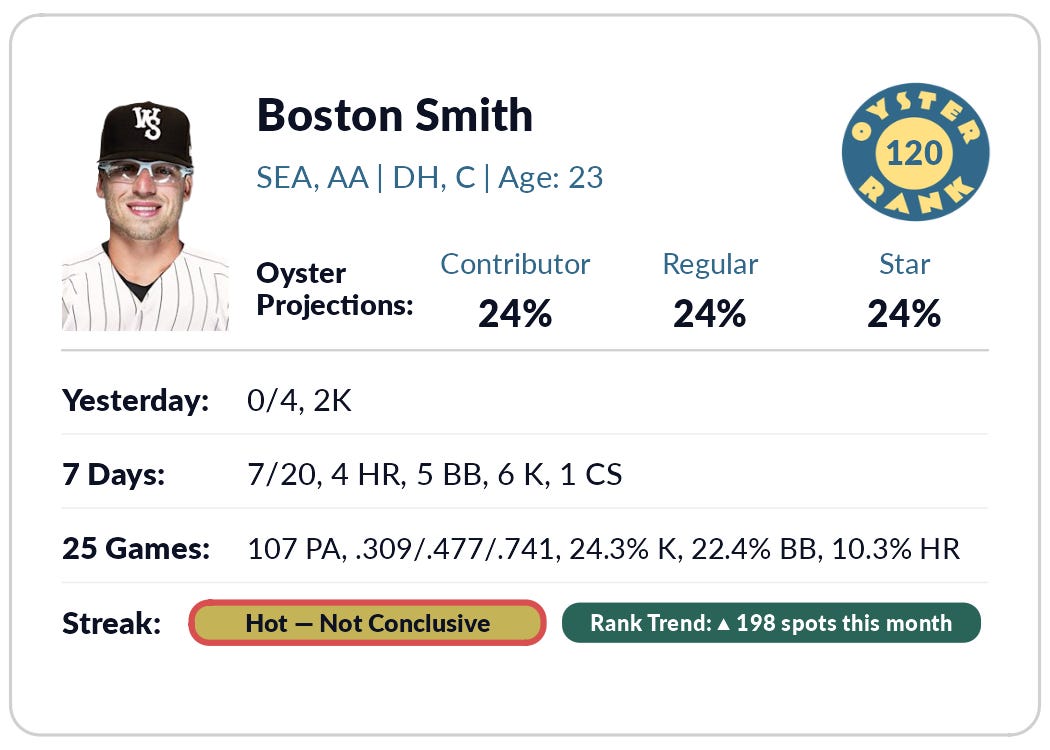
Contributor: A player with an average fWAR of at least 0.5 per 600 plate appearances in their three-season peak. A player who can at least hold down a spot on an MLB roster.
Regular: A player with an average fWAR of at least 1.5 per 600 plate appearances in their three-season peak. A middle-of-the-road or better starter in MLB.
Star: A player with an average fWAR of at least 3.0 per 600 plate appearances in their three-season peak. An All-Star candidate.
Rank Trend: The pill on the bottom row of the card shows how many spots the player has risen or fallen in the overall Oyster rankings over the last month. Green with an up arrow means he is climbing; red with a down arrow means he is falling. Small moves are not shown.
Streaks: Each player receives a two-part streak label. The first part (Hot / Lukewarm / Cold) compares their last-25-games OPS to the league average at their level. The second part reflects whether the Oyster Streaks Model thinks the streak has true predictive value, or if it is just noise in the data.
If a player is Hot:
Take Notice (model agrees, this could be real), Not Conclusive (model is neutral), or Mirage (model doesn’t back it up).
If a player is Lukewarm:
Better Than You Think (model sees more than the stats show), Legitimately Boring (model agrees, performance is fine), or Worse Than You Think (model sees less than the stats show).
If a player is Cold:
But He’s Actually Good (model likes the peripherals), Don’t Worry (model agrees it’s temporary), or Get Worried (model agrees with the slump).
Prospects inside the Oyster top 50 are held to a different standard, as our model’s belief in them outweighs any 25-game sample. They receive: Enjoy the Ride (hot, but somehow hotter than their lofty projection), Business as Usual, or Buy the Dip (cold, but the model still sees massive upside). The lone exception is Even We’re Concerned, which is reserved for elite prospects who remain in the top 50, but are in an overall decline.
Players outside the top 50 whose model outlook has dropped sharply over the past month are flagged as declining regardless of their recent box scores: Sugar High (hot right now, but the overall model isn’t buying the hot streak), Quietly Slipping (performing decent relative to their current rank, but their overall projection is trending down), or Falling Fast (cold and trending worse).
Thanks for following! — Oyster Analytics and Down on the Farm
Comments
Nothing yet. Say the first thing.
Sign in to join the conversation.