
Welcome to this week’s edition of Weekly Pearls! In these reports, we analyze the prospects who put up the six best performances of the past seven days of MiLB action. We use all of our modeling and research work to give you no-nonsense, reliable takes on what these standout performances really tell you about the players who have produced them.
Many of this week’s stars are knocking on the door of the big leagues. From a power-hitting first baseman to a pair of outfielders, several standouts might get their shot in the final month of the season. Our mother of pearl this week is a different sort of prospect: one of the few players who could make a legitimate case as the best prospect in all of baseball.

This week’s top performances by players in the Oyster Top 250. Who stood out?
Top three weekly performers in the Oyster Top 100
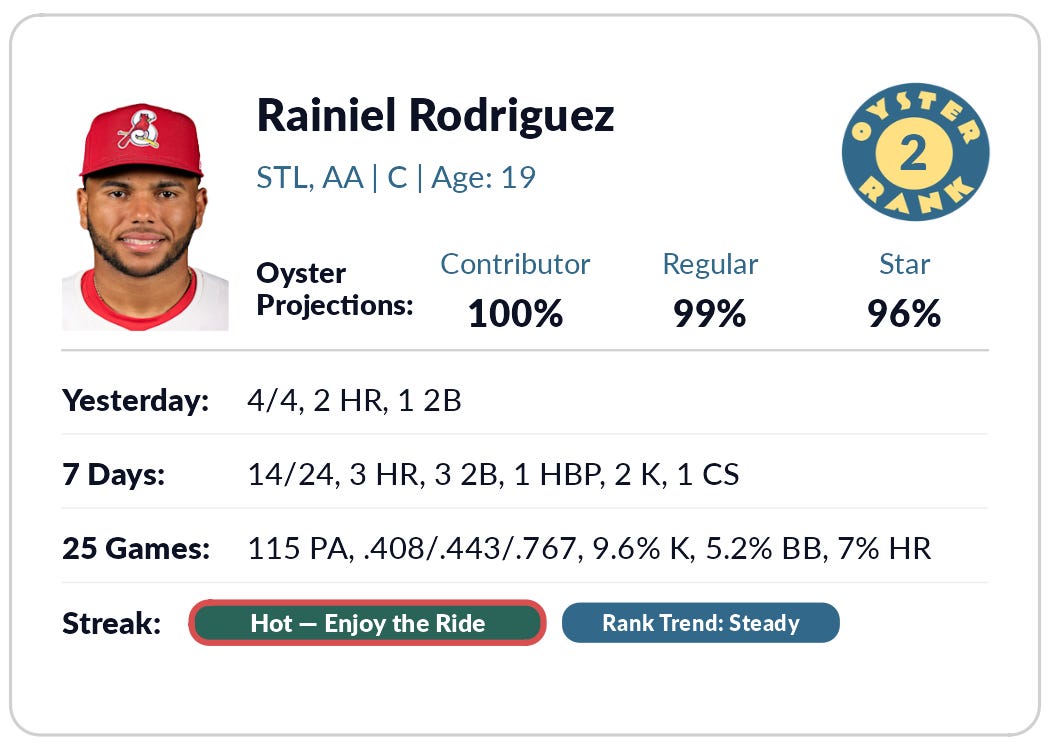
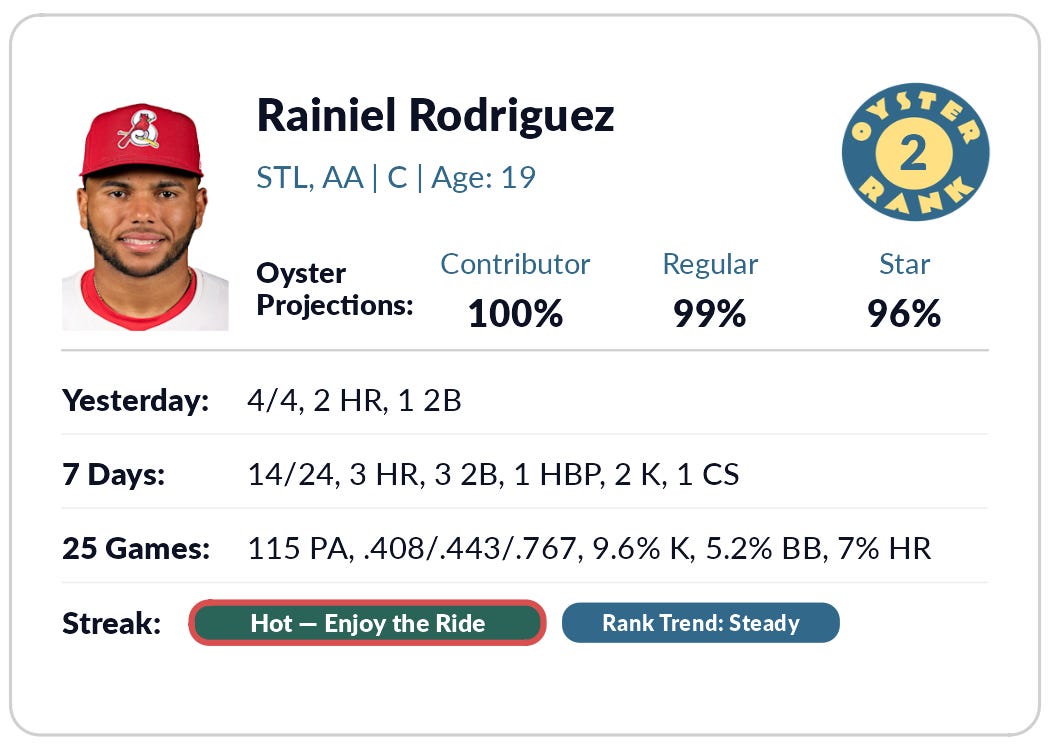
Remember a few months ago when Rodriguez was struggling in his call-up to Double-A? That period is now in the distant past, as Rodriguez has dominated July and August, hitting .373 with 11 bombs in 168 PA. Our model is at attention, pumping him up to number two overall, displacing Jesús Made (MIL) as the best prospect not named Leo De Vries (ATH). This week was particularly wild for Rodriguez, as he had hits in over half his AB, hit three bombs, and struck out only twice.
Rodriguez entered the year as a great but not elite-tier prospect, but after this season, he’s entered the pantheon of mega-upside backstops. Comparing Rodriguez to the most recent catching super-prospect, Samuel Basallo (BAL), showcases just how good the young Cardinal has been in his 2026 Double-A run:

Both players have shockingly similar discipline stats, but Rodriguez actually has the edge over Basallo in power and overall hitting production. Unlike some breakouts, Rodriguez isn’t riding an unsustainable BABIP heater, giving us faith that his .315 average isn’t too far from his “true” hitting level. Since 2010, Rodriguez and Basallo are the only 19-year-old catchers with an ISO of .170 or higher in Double-A: Rodriguez’s run is truly that special.
Here’s a side-by-side comparison of the two (Basallo’s is in Triple-A, too many behind cameras in Double-A)
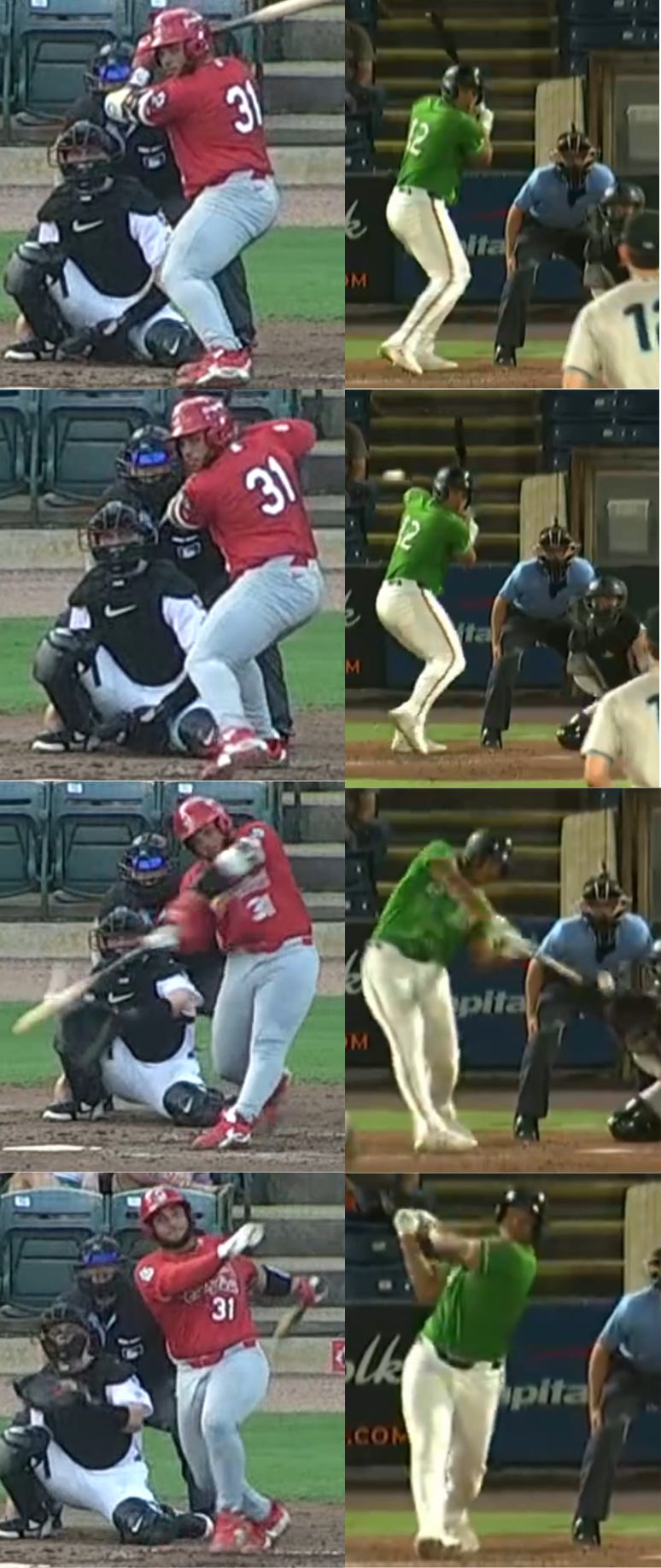
We’re most interested in the fact that both players have rather minimalist loads. They don’t have the big leg kicks that some sluggers have, yet you can still see how effectively they get into their backsides. The violence of the swings is evident, and they’re not lunging forward in their finishes. These are a pair of composed yet aggressive swingers possessing true plus-plus power in a position where it’s difficult to do so.
Rodriguez’s arm is also an asset, as he’s nabbed 16 of 59 base stealers (27.1%) this season, and he projects as a decent MLB defender. He’s also been playing first base on off-days in Double-A, potentially providing some roster-flexibility when keeping his bat in the lineup. His last two months have convinced us that it wouldn’t be absurd to anoint him the number one prospect in all of baseball, and even if he isn’t number one, he fits into a class of all-star-level prospect talents.
One yellow flag in his profile is a somewhat low walk rate, which could signal chase (which has hampered the still-only 22-year-old Basallo in the show). Rodriguez may be the guy we’re most excited to get Statcast data on once he reaches Triple-A, and if he can continue his HR mashing and make respectable contact, he’ll be primed to seize the big-league role. He’ll also have to face the challenge of being a young and unseasoned catcher on a team with many catchers but few to no clear number one options. If he hits the way he has been, he’ll be given all the time he needs to find his stride in the show.
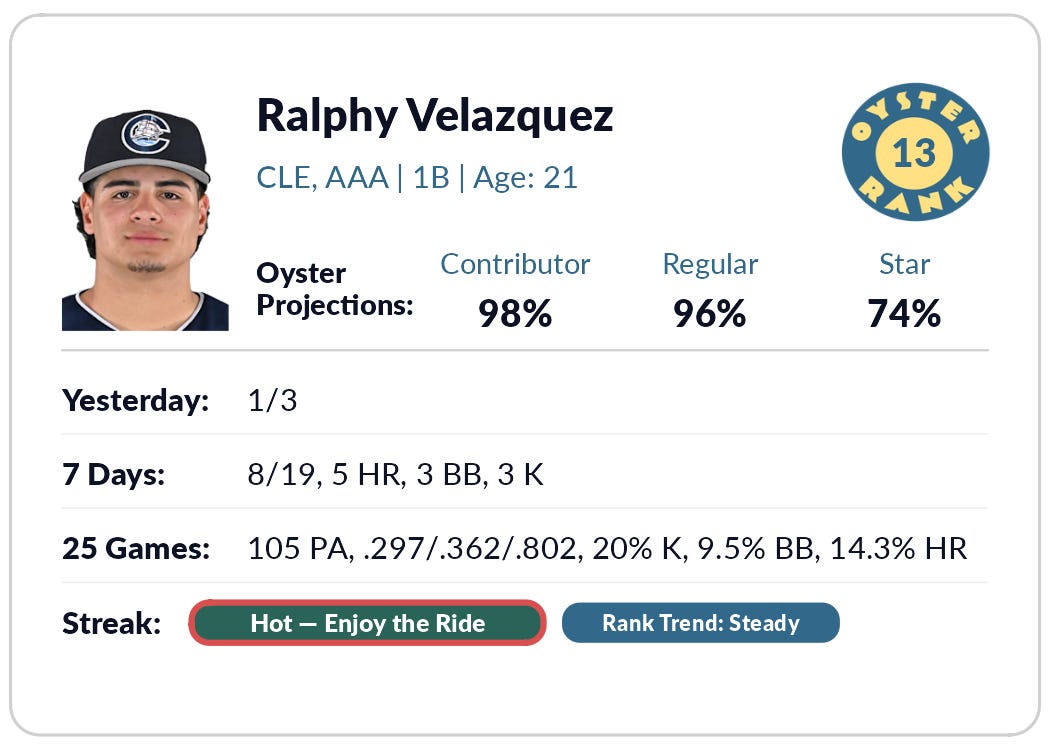
Five homers in a week will indeed land you on this list! The young first baseman and Oyster dandy hit the 20-HR mark in his 69 Triple-A games, with his massive power being especially notable as a young 21-year-old. Only nine other players have 20 bombs in Triple-A at 21 or younger:
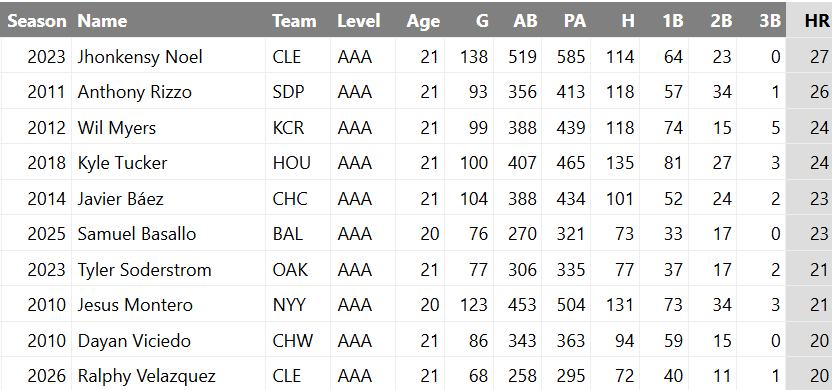
That’s a pretty good list to be on: three of the nine have 25+ career WAR, one has 10+ WAR, two have promising career trajectories (Soderstrom and Basallo), and three struggled to make their mark (at least domestically; Viciedo had a big-time career in Japan). Guys this young rarely produce power this huge, and Velazquez’s under-the-radar season is truly a standout. Looking at the dark side of power bats (poor contact), Velazquez grades out pretty well:
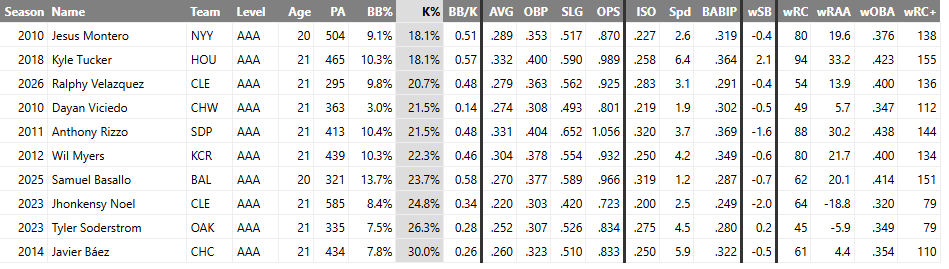
His K rate is the third lowest of the bunch, and his walk rate is middle-of-the-pack. These supplemental tools keep him afloat even when balls aren’t flying out of the yard, and he’s not a free-swinging problematic chaser like some others on this list. Velazquez’s lift profile also perfectly complements his power, with a tiny 33.8% ground ball rate and a satisfactory 17.2% infield fly ball rate maxing out his chances to do damage. Coincidentally, the three players who failed to make a big-league splash had the three highest ground ball rates of the bunch, a reminder of how lift can make or break a profile, especially in Triple-A.
We talked about Velazquez extensively on last week’s podcast, with Owen highlighting him as a player with big upside, but one who might struggle a bit with chase upon promotion, and is therefore not an immediate “must add” in redraft fantasy leagues. I (Max) disagree a bit: while players with chase like Velazquez do often take a while to find their big-league legs, weeks like this one prove that he can combine multi-HR pop with a low strikeout rate, ultra-rare for someone his age. If you’re going for fantasy upside this late, you might as well shoot for the moon, and Velazquez could ease the landing. One thing we both agree on is Velazquez’s promising future, and he may be our biggest MLB-ready sleeper for the 2027 season.
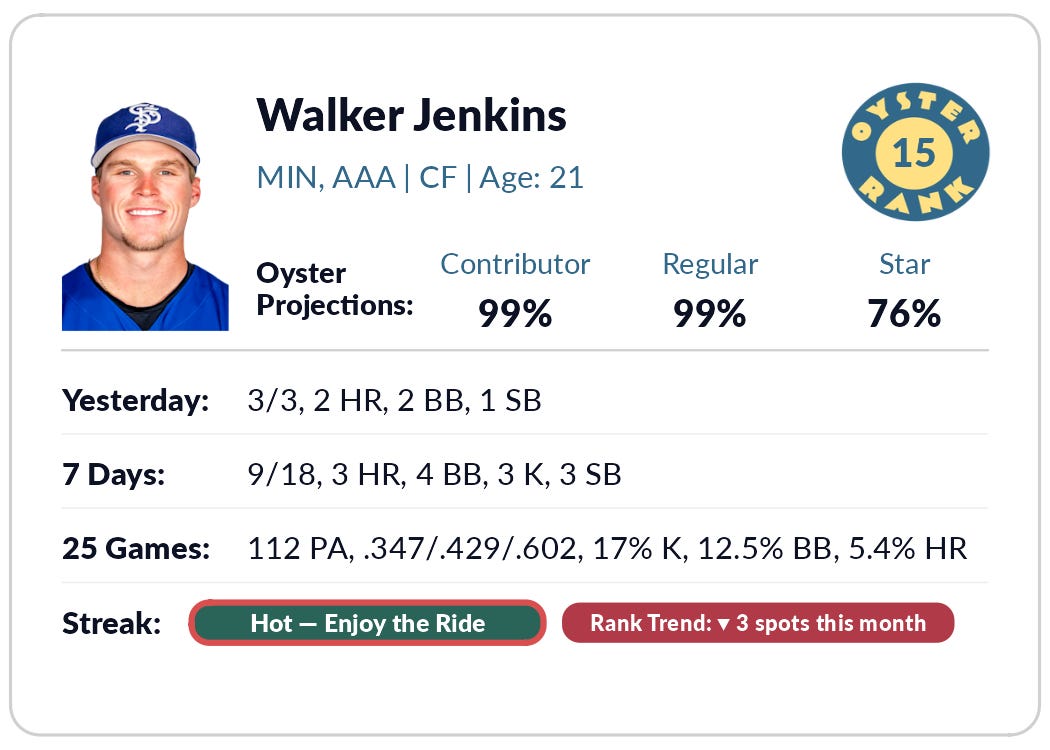
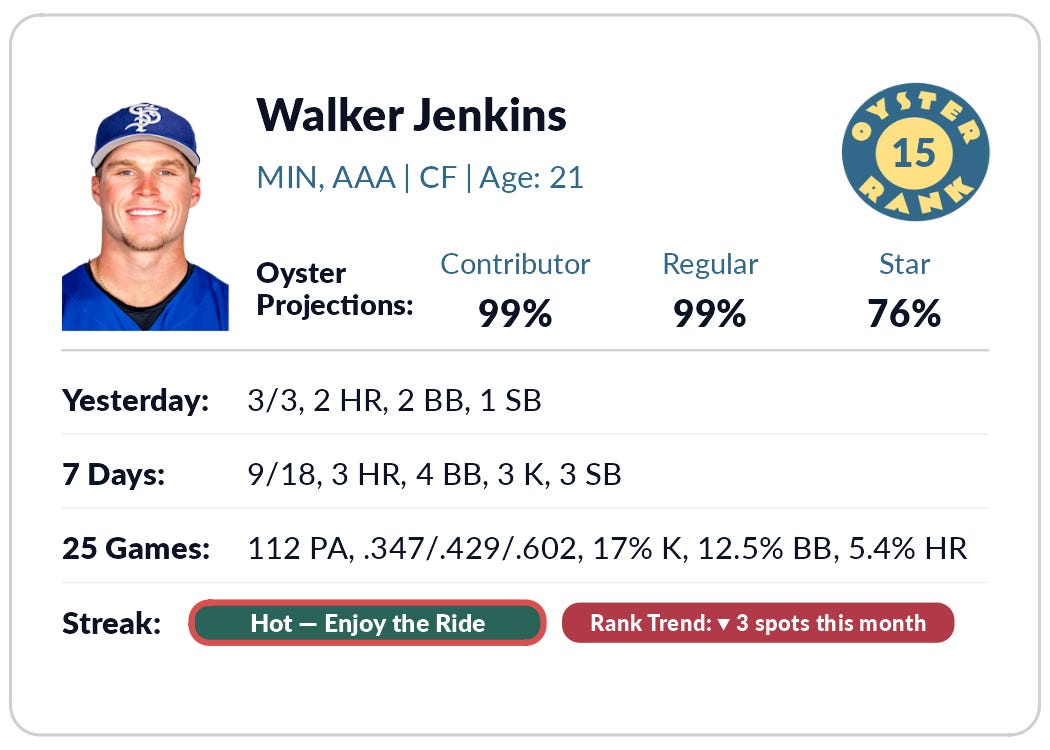
What is there left to say about Jenkins at this point in the year? He’s a frequent feature in these reports and has the mainstream plaudits to go along with his long-time Oyster-approved status. These days, we actually manage to be a bit low on Jenkins relative to consensus, but that says less about Jenkins (who we still assign a 76% star probability to) and more about some breakout seasons by guys already highly favored by the model that have seen him overtaken (George Lombard Jr (NYY), Caleb Bonemer (CWS), Juneiker Caceres (CLE) etc.). If we had to pick a prospect to plug into our favorite team’s playoff lineup right now, Jenkins very well might be the guy. There are no sure things in prospect projection, but right now this is about as close as you can get.
The top three other weekly performances in the Oyster top 250
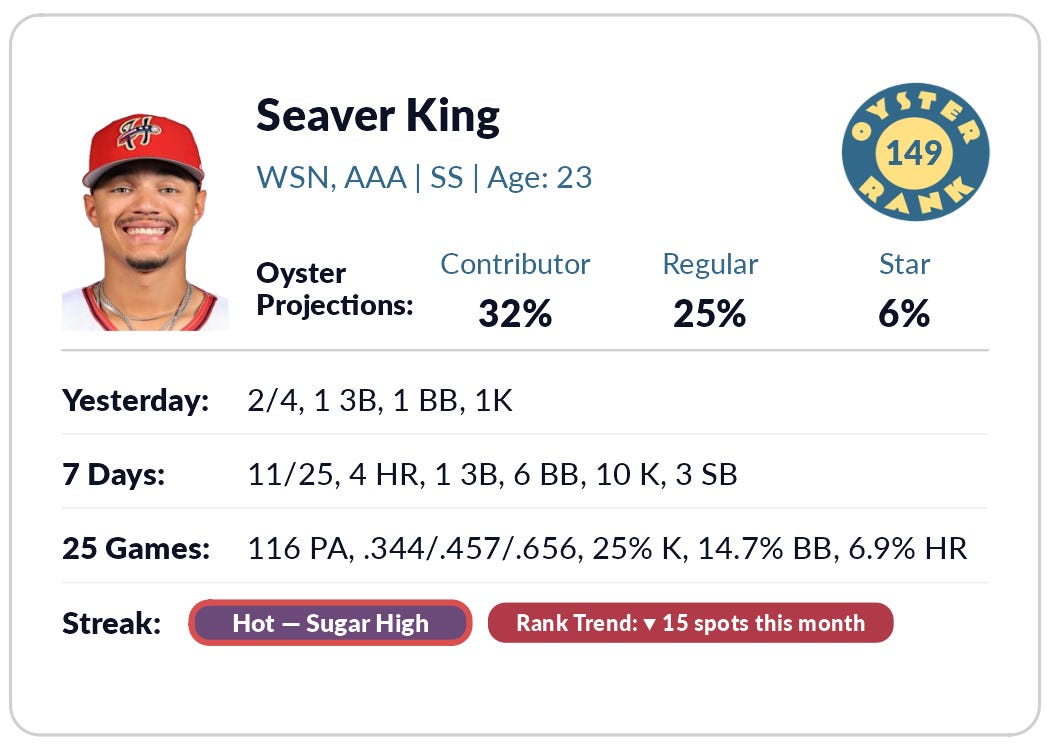
It’s more of the same from Seaver King this week. Can he hit homers? Yep. Can he maintain a high average and take his base? Mmhmm. Is he still manning shortstop? Indeed.
But, vitally, does he still maintain high chase and K rates? Also yes. With King, our model is less likely to forgive his struggles in this area given his age (he is a young 23), and it’s worried that he’ll regress to his sub-7% walk rates in the show. King also has a pretty high BABIP (.383) given his decently high ground ball rates (44.1%). His high line drive rate (29.1%) gives us some faith that he’ll remain an above-average BABIP guy, but there’s the potential for some regression there.
We see King as an Edwin Arroyo-lite (CIN). Both players have pop and chase, but Arroyo’s better lift and pull profile gives him a greater chance to tap into power in the show. King’s key, like Arroyo’s, will be avoiding productivity-demolishing levels of chase. Even if the Ks stay down, chase can lead to poor ground ball contact in the show, and if King’s line drive rates drop, he’ll struggle to be productive. King is chasing slightly less and hitting the ball harder than Arroyo in Triple-A, but King’s lower lift and pull make the pair similar in terms of batted ball outcomes. Arroyo is also likely the better fielder.
King has a clear path to playing time on the left side of the Nationals’ infield, and if he can continue to improve as he did this season, he may unlock new levels to his game in the upcoming seasons. Even though he’s not the most flattering model-endorsed candidate, we think it’s meaningful that he emerged from a very poor 2025 to show all-around improvement in 2026.
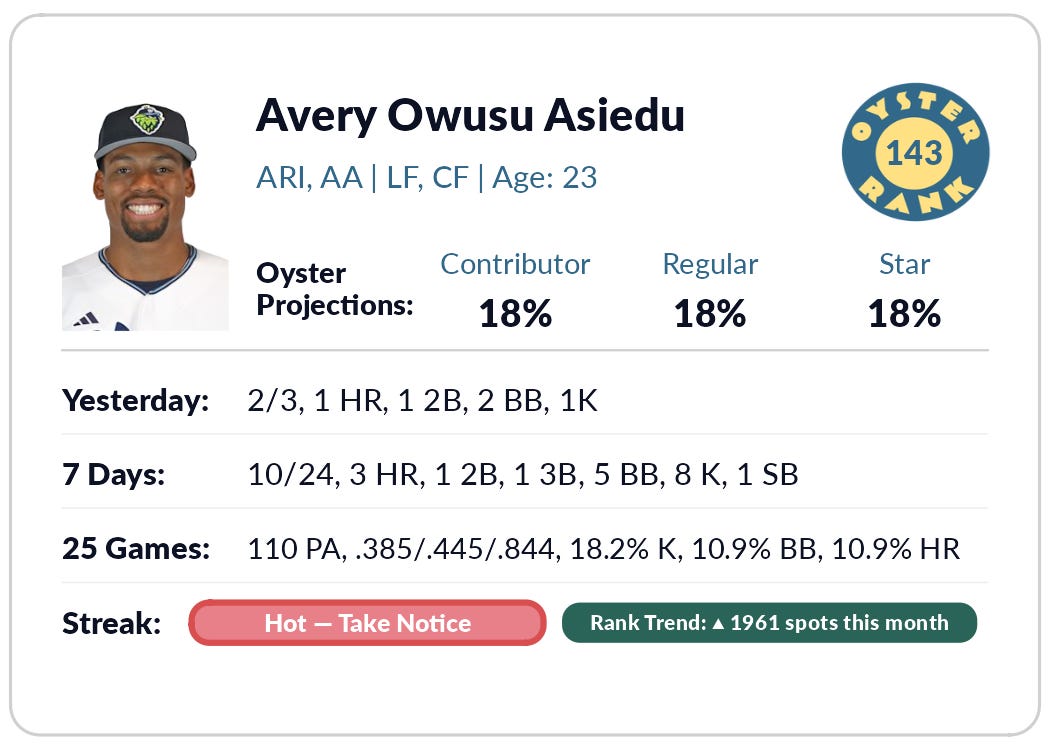
Well then! We have never before had a player in these weekly reports who our projection tracker shows has climbed almost 2,000 spots in our rankings in the past month. For context, we only rank about 2,500 players.
Owusu-Asiedu has come from the abyss to establish himself as an Oyster-relevant player in an 11th-hour push. To move the needle this month, especially for a player in his fourth professional season and only 12 games into Double-A, something really remarkable has to happen, and indeed it has: Owusu-Asiedu has managed to crank eight home runs in his first 12 Double-A games! This comes after he struggled to a 70 wRC+ in High-A for the first 92 games of the year!
We are reaching our exclamation quota here, so let’s get serious. Owusu-Asiedu is off the radar, but he’s not off off the radar. The Diamondbacks liked him enough to bother to acquire him in a low-level trade last year, when he was described as “a classic lottery ticket” with power upside. Contact has always been a struggle, as it is for most power-focused lottery tickets, as Owusu-Asiedu struck out more than 34% of the time his freshman year of college and his first season of pro ball. Encouragingly, in both cases he’s managed to significantly reduce that figure: by his junior year, he was striking out just 21.3% of the time, and his pro ball K rate has generally been about 10 points lower than that original figure. He’s got decent discipline and a fairly good batted ball profile that includes a ton of fly balls (44.4% this year), too many of which (24.6%) stay on the infield. Owusu-Asiedu got reps in center through 2025, but is now firmly positioned in the outfield corners, though he’s still got enough speed to steal bases with decent frequency and good efficiency (23 in 27 tries this season).
No human will ever hit for a .638 ISO in a serious sample or mash the 120 home runs that Owusu-Asiedu is on a 162-game pace to demolish. He has a fairly long swing that includes what looks like a minor hitch between the load and launch. Even in his ridiculous Double-A stretch, his contact rate has been below 70%.
And yet…maybe there is something here? His High-A struggles were exacerbated by an incredibly unlucky .238 BABIP, and Owusu grades out in our model as an above-average on-base man with power and lift rates more than a standard deviation better than his peers:
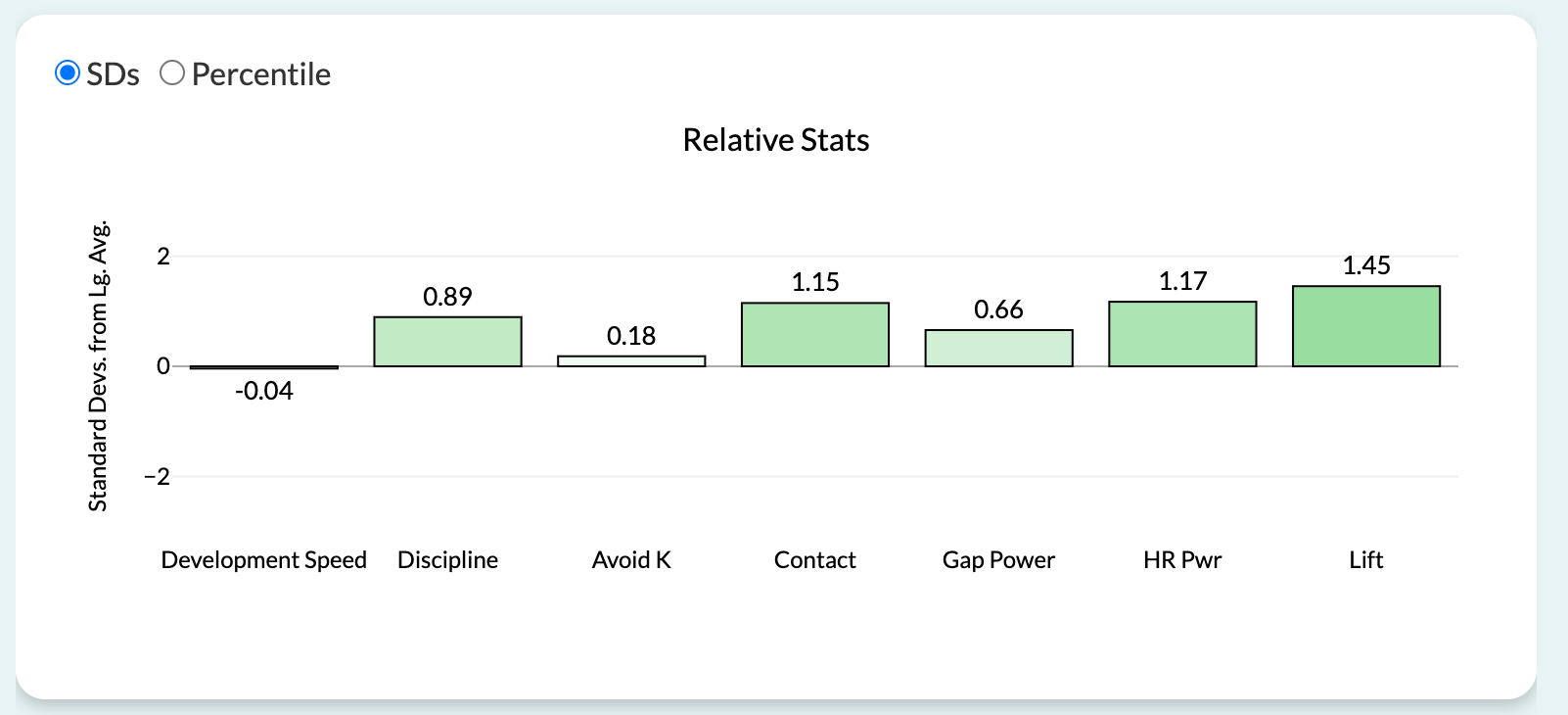
In his past 25 games, he’s working with an OPS near 1.300 and striking out less than 20% of the time. Our streaks model is excited, and our main model thinks he’s more relevant than he’s been so far in his career. He’s still not a likely MLB contributor, but he has legitimately elevated himself from pure lottery ticket status. Anybody on earth who can come into Double-A and hit a home run every six at-bats while batting over .400 for two weeks is a top 250 prospect, end of story.
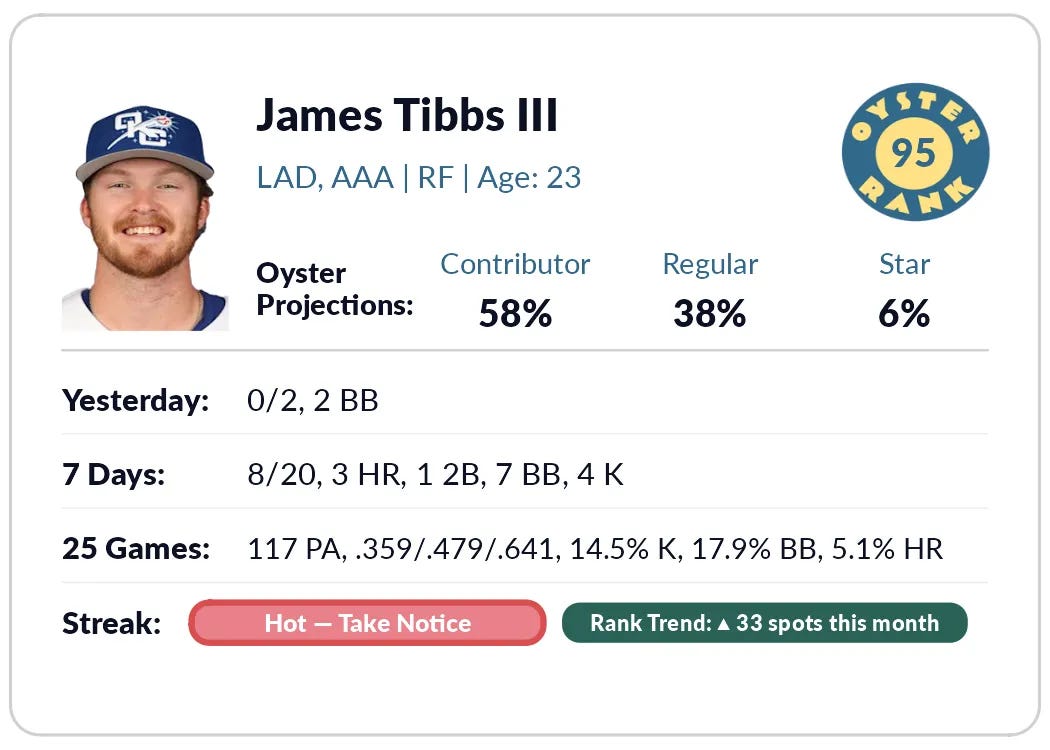
Tibbs has been a hot topic of discussion around the game throughout this season, and it’s been no different here at Down on the Farm. Tibbs began the year in the depths of our rankings, and then spent the first few months seeing his projections tick up before stabilizing over the summer. There’s no doubt that even our skeptical model will end the season significantly higher on Tibbs than it started, but his trajectory has been more akin to teammate Zach Ehrhard’s than the true standout Dodger outfielder of the season down on the farm, Josue De Paula:
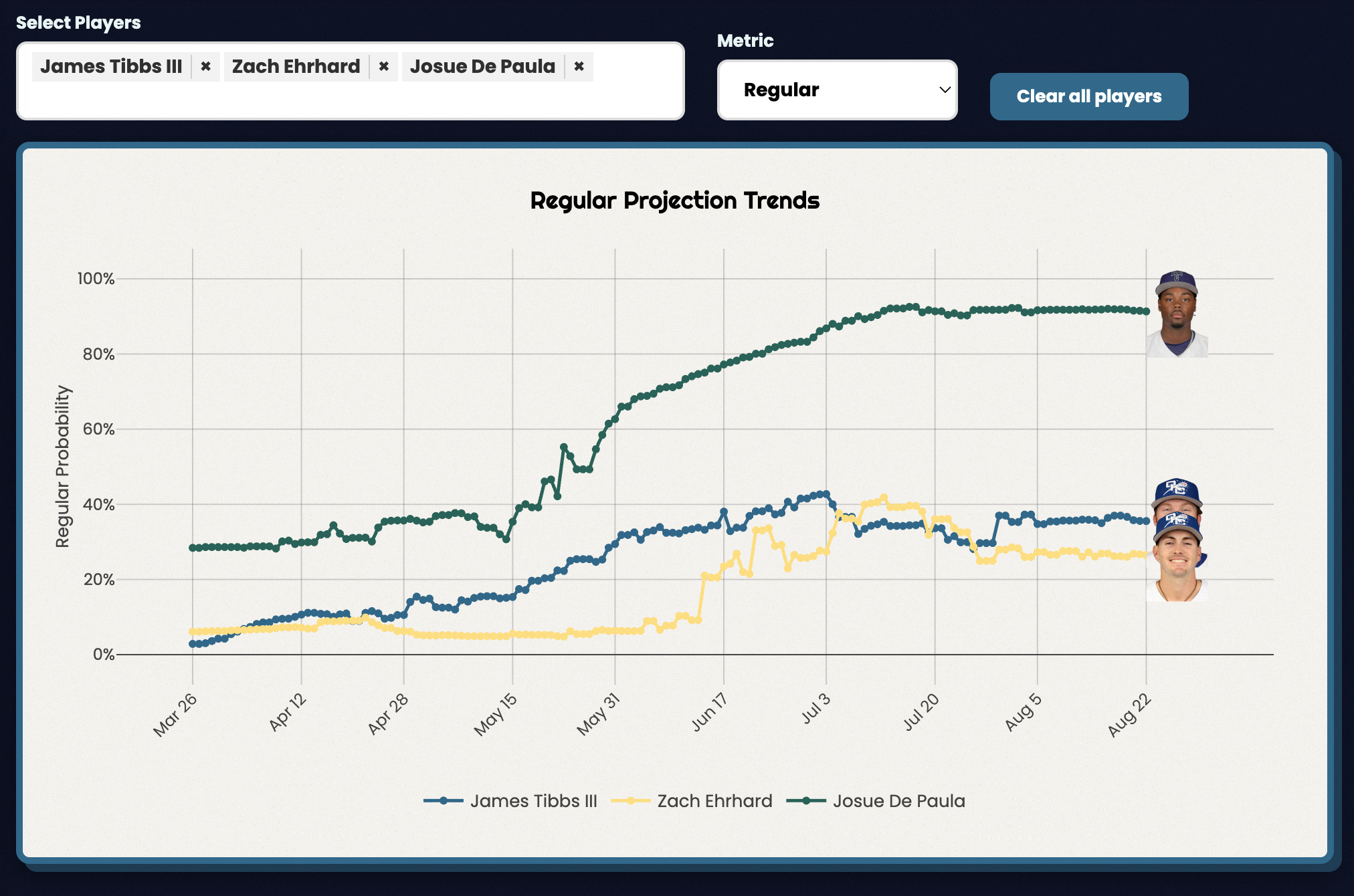
Given Tibbs has a 148 wRC+ in 118 Triple-A games this year and an OPS over 1.000 in his past 254 games, why is the model still only placing him at the back end of our top 100? Simple: Tibbs is a (by prospect standards) older player working with limited positional upside who is already firmly stuck in an outfield corner role. That is a difficult profile with which to make a push into the top half of the top 100. Being stuck in the corners puts players at a distinct disadvantage when it comes to accumulating WAR: in part due to positional value adjustments and fewer opportunities to save runs on defense, only three corner outfielders have put up fWARs over 4 so far this season. In contrast, nine infielders on the left side have managed that feat. Likewise, it is more difficult to assess just how good prospects who have been slow-rolled really are–Tibbs might be outperforming Walker Jenkins in offensive production, but few would argue that the 21-year-old Twin, even if confined to the corners, is a less exciting outfielder than the 23-year-old Dodger. In every modeling system we use, age relative to level is an extremely predictive variable of future success (when used properly in tandem with other variables).
Tibbs is nonetheless certainly a guy who could make a real impact for a big league squad. He’s not over-leveled, but he’s also not past his peak as a prospect. Our research has found a massive drop-off in the likelihood of a Triple-A breakout being legitimate if it occurs after a player turns 24; if they’re 23 or younger, it’s still far from a guarantee that it portends big league success, but the odds are far, far higher that the improvement sticks:
Percentage of Triple-A Breakouts (130 wRC+) with 10+ Future MLB WAR by Age
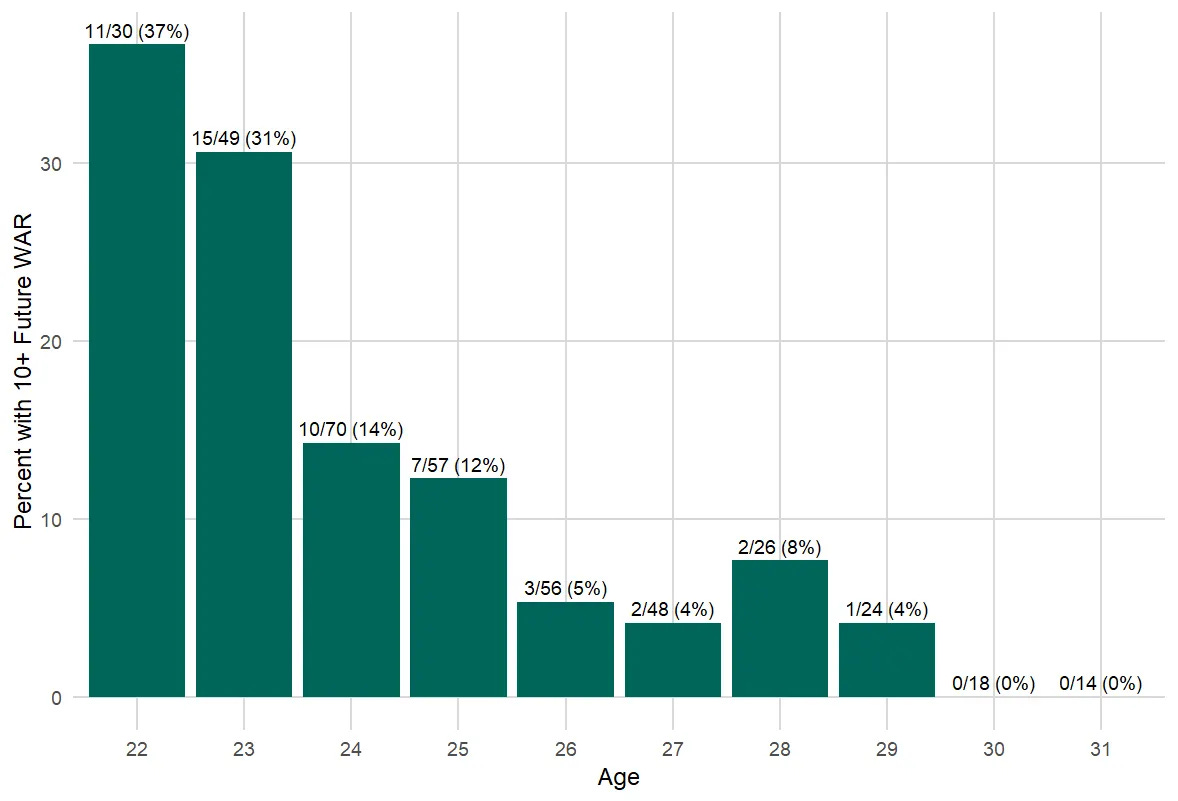
We expect Tibbs to head into 2027 as a guy who could probably do a job in the corners for a lot of big league teams, with a 50th percentile outcome of a second division regular.
Which prospects lit up MiLB yesterday?
The top three performers in the Oyster top 100
The top three other performances in the Oyster top 250
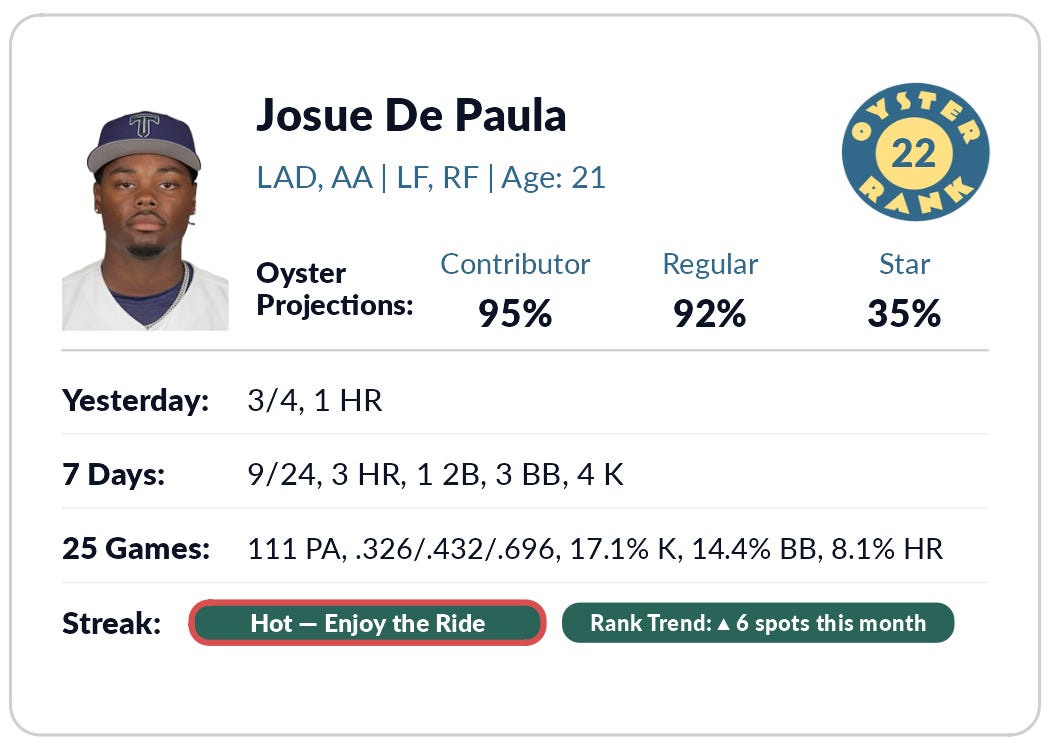
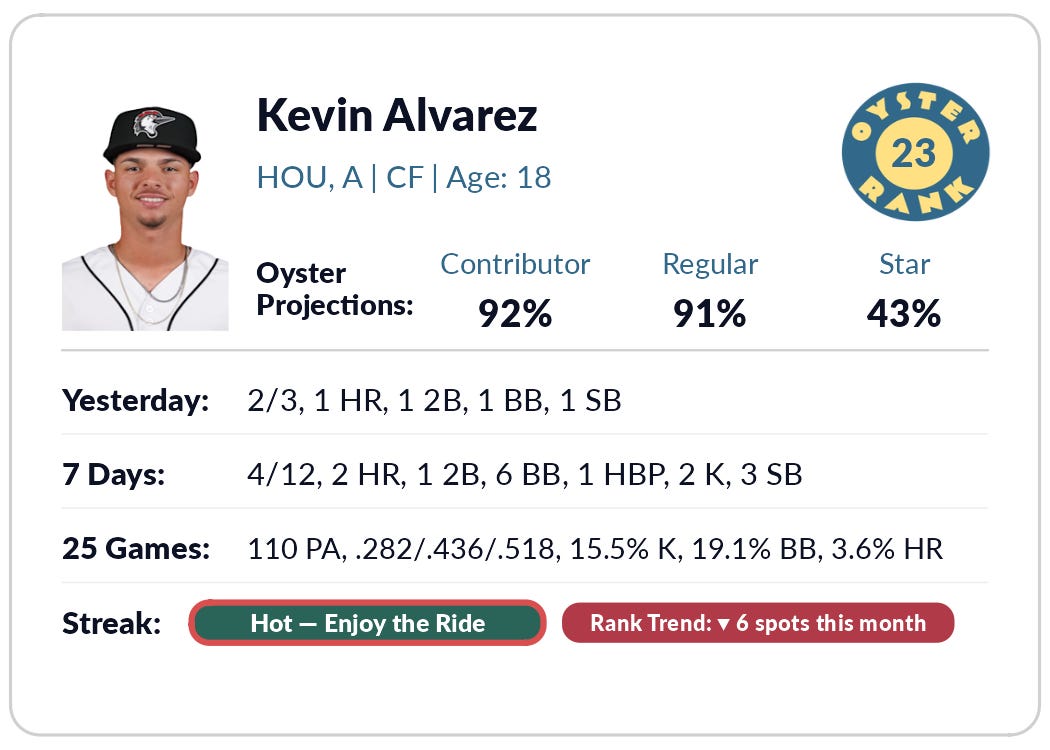
The best Double-A hitters from the last seven days
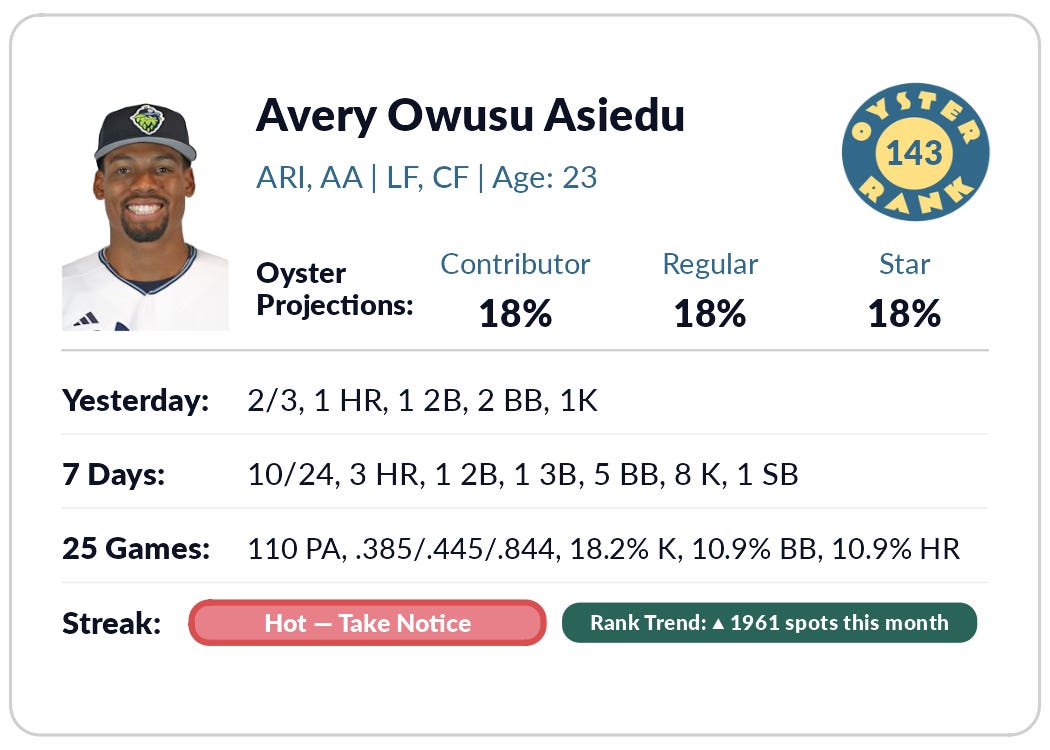
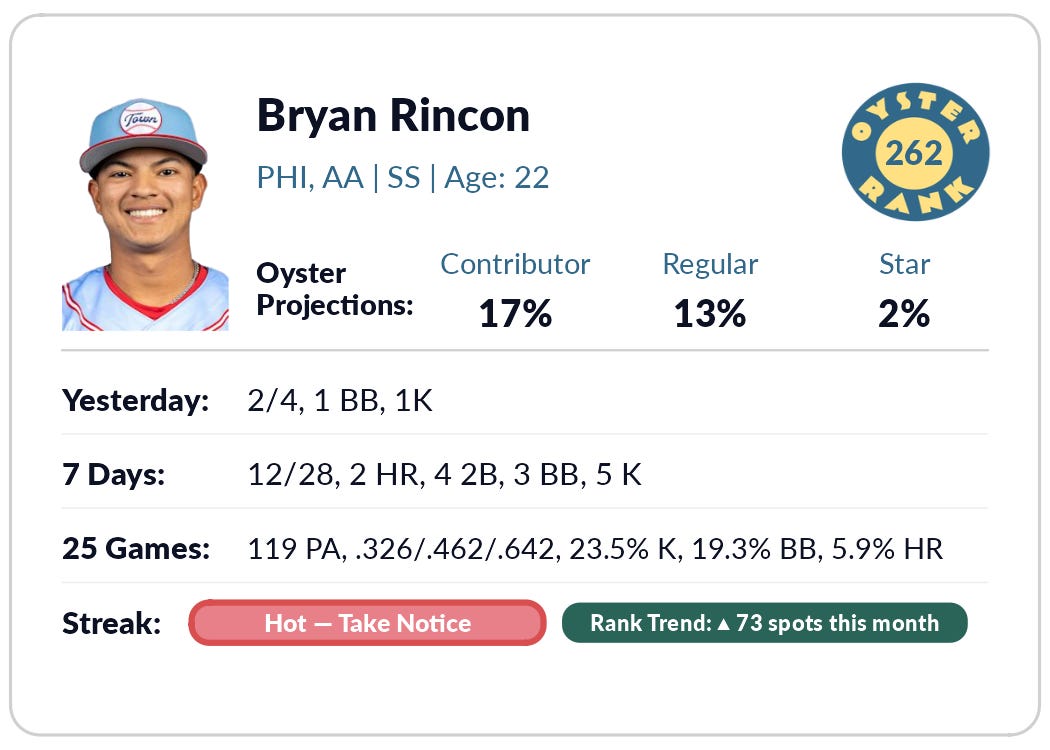
Contributor: A player with an average fWAR of at least 0.5 per 600 plate appearances in their three-season peak. A player who can at least hold down a spot on an MLB roster.
Regular: A player with an average fWAR of at least 1.5 per 600 plate appearances in their three-season peak. A middle-of-the-road or better starter in MLB.
Star: A player with an average fWAR of at least 3.0 per 600 plate appearances in their three-season peak. An All-Star candidate.
Rank Trend: The pill on the bottom row of the card shows how many spots the player has risen or fallen in the overall Oyster rankings over the last month. Green with an up arrow means he is climbing; red with a down arrow means he is falling. Small moves are not shown.
Streaks: Each player receives a two-part streak label. The first part (Hot / Lukewarm / Cold) compares their last-25-games OPS to the league average at their level. The second part reflects whether the Oyster Streaks Model thinks the streak has true predictive value, or if it is just noise in the data.
If a player is Hot:
Take Notice (model agrees, this could be real), Not Conclusive (model is neutral), or Mirage (model doesn’t back it up).
If a player is Lukewarm:
Better Than You Think (model sees more than the stats show), Legitimately Boring (model agrees, performance is fine), or Worse Than You Think (model sees less than the stats show).
If a player is Cold:
But He’s Actually Good (model likes the peripherals), Don’t Worry (model agrees it’s temporary), or Get Worried (model agrees with the slump).
Prospects inside the Oyster top 50 are held to a different standard, as our model’s belief in them outweighs any 25-game sample. They receive: Enjoy the Ride (hot, but somehow hotter than their lofty projection), Business as Usual, or Buy the Dip (cold, but the model still sees massive upside). The lone exception is Even We’re Concerned, which is reserved for elite prospects who remain in the top 50, but are in an overall decline.
Players outside the top 50 whose model outlook has dropped sharply over the past month are flagged as declining regardless of their recent box scores: Sugar High (hot right now, but the overall model isn’t buying the hot streak), Quietly Slipping (performing decent relative to their current rank, but their overall projection is trending down), or Falling Fast (cold and trending worse).
Thanks for following! — Oyster Analytics and Down on the Farm
Comments
Nothing yet. Say the first thing.
Sign in to join the conversation.