
We live in a moment obsessed with storytelling. We’ve been hearing about the need for ‘new narratives’ in politics, activism, business and culture. But what if our storytelling obsessions are symptoms of something that needs healing between us, in our shared social fabric?
I've been reading a little book by German-Korean philosopher Byung-Chul Han titled "The Crisis of Narrative" in which he makes a daring statement: the fact that we are hearing so much about the need for 'new stories' is not a sign of growing awareness of the importance of stories, but a symptom of the death of storytelling as a living daily practice between people in western cultures.
Han argues that in cultures with a healthy narrative tradition, storytelling is education, entertainment, life advice, spirituality, identity, social glue and a whole lot more, all in one fluid, living whole. In healthy narrative cultures, there is no need to ‘analyse storytelling’ because it’s simply an effortless, lively daily practice.
Han speaks of the 'informatisation' of life: we chop reality into ever granular bits of information, at the expense of meaning. Then in the context of this ‘informationalised’ reality, storytelling becomes an artificial ‘act of construction’ performed by ‘experts’, a situation far removed from the living, shared practice it once was.
Han's argument reminded me of the story of Madonna Thunder Hawk and her daughter, native Northern American activists who I saw at an event in Amsterdam a few years ago when they were touring with their impressive documentary “Warrior Women”.
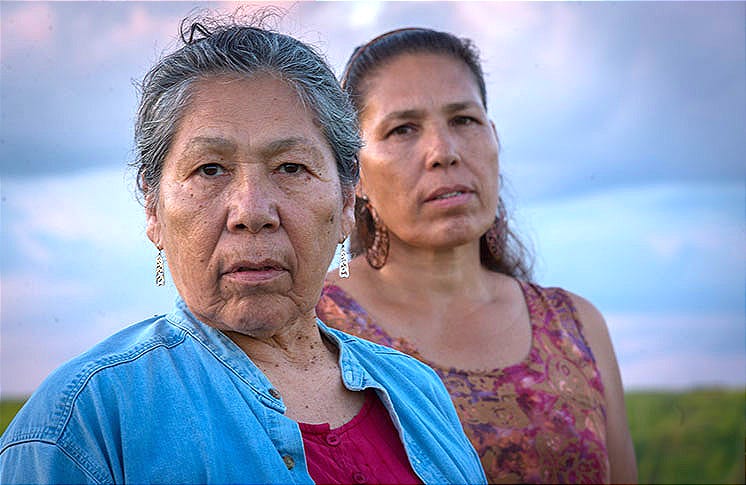
The documentary tells how hard it was for European colonisers to 'civilise' Native Americans into Christian, western culture, because their native social fabric was so incredibly skilled and strong. As a 'solution', colonisers began to abduct Native American children, forcing them into Christian boarding schools for over three generations, thereby completely stripping them of their indigenous mythologies and ancient lore, their deep knowledge on the lands, the flora, fauna, and even their native Lakota language.
Madonna told the crowd about how she and the people around her were working hard to restore the original indigenous knowledge and to revive their endangered language. When I heard that, I wondered if such a thing was possible and if yes, perhaps similar processes could help seed future cultural narratives in the relational web between people living in the same city neighbourhoods. Is it possible to see culture and language as ‘objects to be restored’, or ‘objects to create’ afresh? Can we plant and grow new shared mythologies towards full blossoming?
Isn’t it odd how the word ‘myth’ today refers to something untrue, something that we used to believe but that we now know to be false? Well, for humans, some mythological conceptions of reality are essential. Because of the way the human brain functions and the way we use language, we are always in a search for meaning and we live restless, ungrounded lives if we don’t live out of some core mapping of our shared reality.
Because reality gets simply so strange when examined deeply, to ‘us humans’, mythologies serve as essential ‘operating systems’ to our reality, structured ‘orderings of objects and concepts’ to make sense of that which might be entirely different if it were based on very different mythological interpretations and valuations.
I dare to suggest that mythological understandings of life can possibly never be truly discarded as long as the human project goes on, because without meaning we don’t know who we are as human beings.
Meaning and purpose sounds so naturally valuable to us, but none of the other animals seem to need any deeper meaning or explanation. While we’re looking for meaning, the animals ‘just are’ unless hungry, hunted or horny, driven by a proportional and relevant amount of stress hormones.
New mythologies are likely to arise out of mythologies of the past when seen through ‘meta-modern’ perspectives, through which we learn to smoothly oscillate between paradoxes, opposites and polarities in our lives, holding complexity, but never arriving at any ‘final truths’, always seeking to improve our understanding of ourselves and each other, flora and fauna, and the earth as Gaia, the super-organism that humans and all other life are the fruits of, being both hopeless and wonderful at the same time.
“The test of a first-rate intelligence is the ability to hold two opposing ideas in mind at the same time and still retain the ability to function. One should, for example, be able to see that things are hopeless yet be determined to make them otherwise”
~ Scott Fitzgerald
Before monotheism, people lived in a 360º/360º relationship with their immediate surroundings. They lived with many local, animistic, ‘many spirit’ mythologies that taught humans from one generation to the next how to best live and how to relate to the spirits of the wind, the seasons, the animals and the water, in the most pleasant and beneficial ways for our survival and wellbeing, like when to harvest and how to share.
Today we tend to view such mythologies as naive, backward superstitions, while we neglect the fact that a lot of highly useful, practical information for collective survival, shared identity and overall community wellbeing was transferred through through mythologies. Living narrative practice was essential for survival to our distant ancestors ‘living in the wild’. Given how for most people ‘survival of the fittest’ no longer matters, why can we feel so ‘boxed in’ living in the safety and abundance of modern life?
Between the 7th to 5th Centuries before Christ using the Gregorian calendar, east of the Mediterranean sea, Hebrew monotheistic ideas emerge gradually to become Judaism. Starting around the 1st Century, finally seeing serious growth between the 3rd and 5th Centuries after Christ onwards, Christianity grows rapidly and spreads from the Roman Empire outwards all over Europe and beyond , followed by the founding of Islam by Muhammed in the 7th century after Christ, which also has continued to grow all around the world.
Monotheism tells people they are now subjects to a higher power they must please and ask forgiveness to for their original sins. Everyone is now ‘born guilty’ and at risk of eternal damnation.
Millions of believers are told to pay, pray, obey, and to work hard and behave morally just, in order to be worthy enough in the eyes of the Almighty to pass through the gates guarding eternal bliss in the afterlife.
Widespread top-down monotheist religions power larger societal narratives, of many people sharing one cosmology, shared through holy writings and centralised through powerful religion based organisations.
Rapidly growing monotheistic beliefs demote old mythologies of the pagan and classical eras to a status of ‘outdated, superstitious, mythical hogwash’, sometimes ridiculed, sometimes violently eradicated, through for instance highly creative torturimg and burnings of sinners and supposed ‘witches’ all around Europe, Barbara Zdunk possibly being the last person to receive this punishment as recent as the 21st of August 1811, just yesterday evening in human history.
Around the 17th to 19th Centuries a lot happens, leading to the enlightenment.
A new, exciting myth appears, powered by science, engineering and deeper reasoning about the good life and proposed fundamental human rights that challenge the legitimacy and power of religion and monarchy. Eventually the French behead their emperor and after that, many countries gradually change from full monarchies to ceremonial ones. The new myth in a way tells us that humans are the center of a universe that is probably like some kind of a logical machine that operates on unchangeable 'natural laws’, that humans will fully decode someday in the future, after a ‘theory of everything’ has finally been found to solve the mysteries of the universe once and for all.
With the rise of physical, chemical, mathematical insights and tools, through elaborate extraction, intricate engineering and global transportation we begin to craft extraordinary things like ships, the sextant and the monocular, just a few things among a wildly growing number of human inventions. An unspoken belief emerges in some of the humans, who begin to feel a bit like gods themselves.
After mastering many of the elements into submission, science and engineering gives us airplanes, x-rays, mobile phones, and so, so much more, all the way to Amazon and Alibaba serving us right at our front door. What started as a biblically instructed stewardship of nature, turns into a kind of measuring, analytical, technical ‘logical management’ of society and the planet.
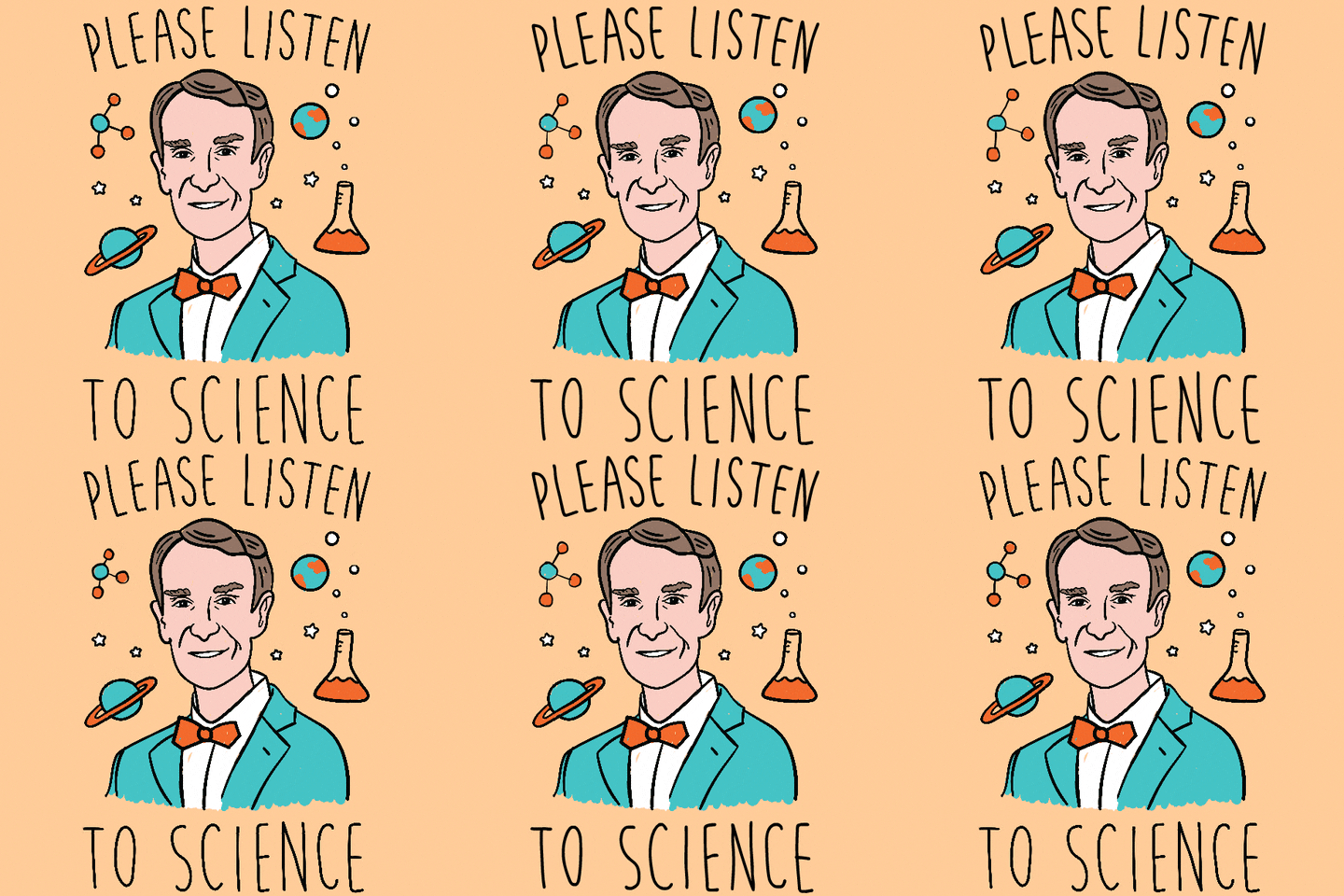
Minds that see through eyes of science, engineering and data more often than not discard or ridicule mythologies, religion and spirituality. These empirical minds, especially when high on intelligence and philosophically inclined, often at some point arrive in a reality starved of resonant meaning and purpose, a ‘dead’ universe. Albert Camus argues that nihilism is the natural result of thinking too deeply for too long, after which we must task ourselves with deliberately choosing what we ascribing which meaning and value to, like a DIY-recalibration of our world view.
Given growing nihilism today because of disturbing world events, many could use a ‘narrative calibration’. Such an endeavour takes effort, because the things we were taught about the world have become physically engrained into our neural pathways and ways of being.
Seeing from science & engineering perspectives leads quite a few towards atheism, where there’s nothing after death, so nothing really matters after this entirely coincidental and utterly meaningless existence.
It probably sounds like heresy to any true atheist when they hear this, but few non-believers realise just how specific a claim on reality it is to say that the universe lacks any purpose whatsoever. Just because the mythology of ‘the universe as a machine’ has been so dominant, doesn’t mean that humans are like machines, existing only as physical beings until death leads them towards eternal nothingness. Most of reality happens beyond where the eyes of science can see, and the best and brightest scientists are very aware of how enormous the mystery of existence always has continued to be.
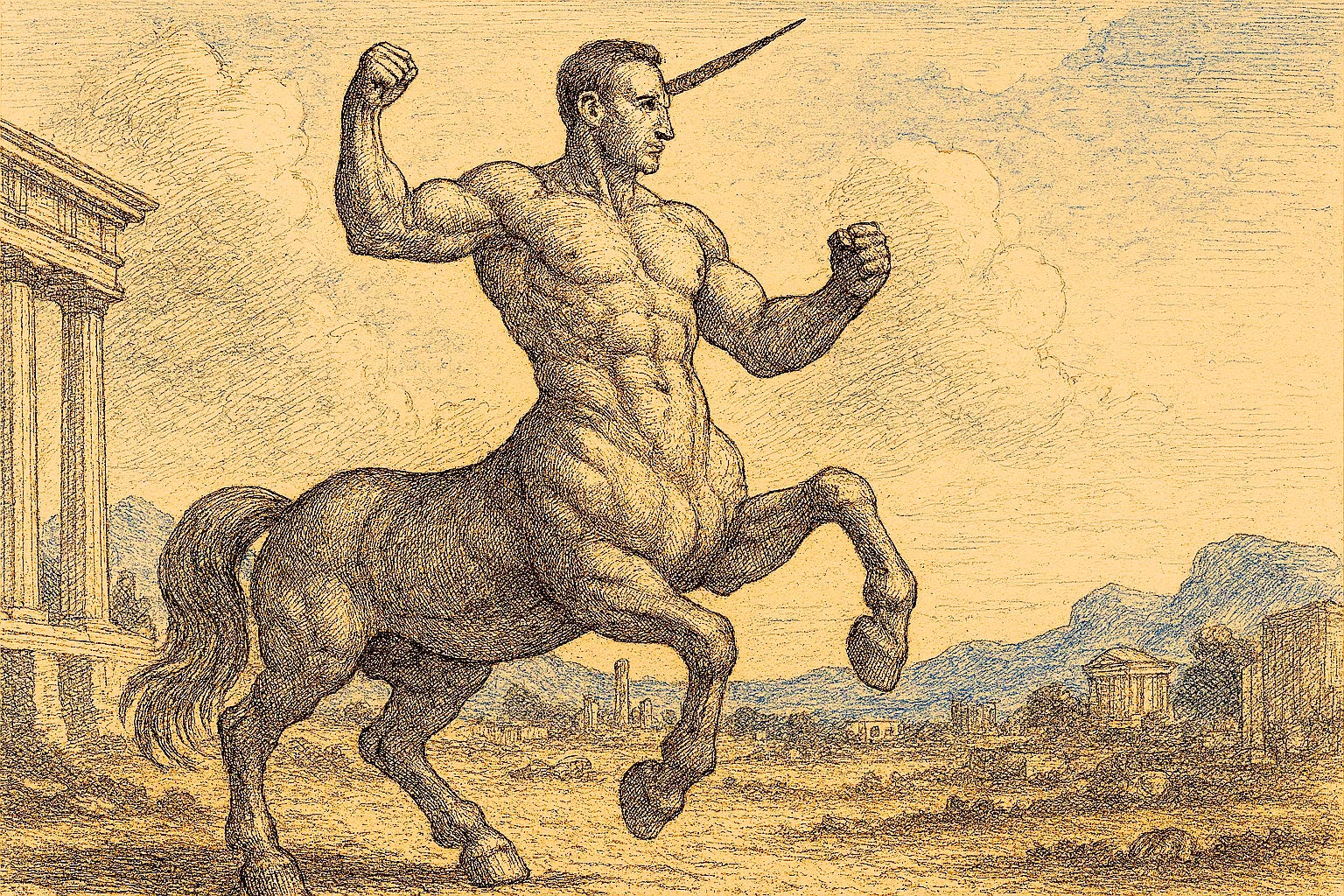
Bertrand Russell proposed that the burden of proof lies always lies with the one making an extra-ordinary claim, so no one has to go out of the prove that centaur-unicorns don’t exist. Just because the soul can’t be measured, doesn’t mean it’s not there. While bad science might say ‘the soul doesn’t exist because there is no proof for it’, good science says ‘it can't say anything at all about the soul, because it can’t be measured — yet’.
Science can only speak with ‘some degree of certainty’ about what it can measure, test and reproduce. Science can tell us how things seem to be working, but ‘hard sciences’ can’t tell us what things mean, because giving meaning is entirely up to how each person and culture values and organises things.
Now, I’m not making the case for the existence or non-existence of an eternal soul; I’m only saying we can’t really know either way.
I’m calling out the fact that being convinced the universe is a purely physical thing or even a machine, is a highly specific mythological understanding of reality that applies language and mental constructs into rather limited, specific ontological perspectives compared to the full range naturally available to us.
Perhaps predominantly seeing through technical, physical reasoning is not necessarily ‘the neutral, common sense’ way of seeing the world, as many adherents of the meaningless universe seem to believe.
Deep mystery is all around us in every single moment. Technology has not changed that and artificial intelligence might be the closest we have ever gotten to true magic, when our mad creations began speaking back to us and fully participating in shaping human culture.
The quantum sciences are gradually changing the old physicalist views of science, because it’s showing that beyond the Planck length, reality as we know it entirely breaks down into something completely different, where everything is directly connected, and space and time dissolve into other forms.
The mythology of man as god and the universe as a machine, although changing, is still incredibly dominant in the west in subconscious ways. This view sees reality as ‘consisting of’ many different separate singular parts making up larger singular objects that classify in many mutually exclusive categories: many things become ‘either this or that’.
Western PhD dissertations, like razor sharp spears, usually concern themselves only with a tiny sliver of a sub-sub-sub-category, thus too few dissertations offer us more holistic, mythological perspectives perhaps so direly needed now. Humanity knows enough, but a lot of human knowledge is still locked in esoteric language of academic papers and complicated books, often behind paywalls in non-public spaces. Science has become corrupted in some places because of shifting values, politics, and funding flows.
In many branches of science due to heavy pressure to publish unique and original findings, there is a great lack of boring but essential experiment replication. Last but not least, a rapidly growing number of AI-papers are polluting the academic world and in some countries the sciences are actively attacked, leading to a corruption of human knowledge and an even further collapse of shared truth.
Yes, we owe a lot of wonderful things and deep insight to the sciences from marvel of technology to miracle cures, but the same sciences have also enabled us to create awful things like weaponry that can kill everyone on earth, several times over. Pretty cynical stuff.
Encapsulated within the mythology of the meaningless, chemical-mechanical universe, there is a denial of itself being a mythology. Unfortunately, it’s not a life-affirming mythology, because if the universe is void of any meaning, then it just doesn’t matter what we do while we are here.
In a meaningless universe, we don’t have to consider future generations or take any responsibility for the more than human world, because we are here only temporarily, and only for ourselves. We can live as if no one will live beyond our lives and that’s exactly what humanity is doing right now.
Social media have ripped local relationships apart and replaced them with virtual, simulated ones. Physical togetherness is replaced with video calls. Theater with cinema, sex with porn, exploration in nature with open gaming worlds. In many cities, hunting for food has been replaced with 24/7 food delivery through a super easy app.
Consider for a moment how not a single thing on your phone is real. Your phone is a simulation machine that can only emulate physical reality with coloured pixels and sound waves, but never truly represent anything fully or truly resonant with how we have evolved to relate with the world as human beings. The simulations informationalise and desensitise reality to us: infinite short form video timelines flatten our sense of the world.
Tethered to the toxic breast of the internet we are fed simulations of endlessly conflicting opinions, perspectives and interpretations of reality. This alternate reality inspires many misunderstandings, tensions, conflict and violence between real people in the real, physical world.
🌎 🌍 🌏
A wide range of simulations have become indivisible parts of our lives. We now habitually exist and move between different realities, every day.
So what do we really mean in 2025 when we say ‘we need new stories’?
Do we need someone or some group to find ‘the ultimate new story vision’ and once we’ve found it, humanity will rise up from its slumber of ignorance and save the future in sweet harmony?
Perhaps, I’m not so sure. Many have tried, but no such story has yet emerged to replace harmful extreme colonialist capitalism with something more wholesome, fair and regenerative.
First of all I think no grandiose vision for the future of humanity can take hold in cultures low on connection and mutual trust and a lack embodied forms of togetherness, where the living practice of mythical storytelling is broken and stories are splintered.
Also, is it desirable to have one single story for all of humanity? ‘Singular grand visions for everyone’, no matter how wholesome they begin, always contain a danger of repression arising in the longer term, and not a single shared vision will ever satisfy everyone in all contexts and living conditions.
Can freshly emergent mythological narratives for the times to come co-exist and enrich one another in playful ways?
What if we dedicated some time to curate that which is meaningful, valuable and true to us in the now? Can we choose to make these things sacred, through embodied, lively creative gatherings? Can we interact in playful present awareness, as an antidote to solitary social media addictions?
What if we were to classify everything we encounter online as ‘just simulations’? What if we chose to reject the fragmentations of narrative the internet provides us? Can we be offline as much as possible?
I firmly believe that the only way to build new stories that stick across generations, that are helpful by serving a wide range of functions, is to create close local communities of practice, made up of dedicated people who choose to regularly get together in physical reality to support one another, in a search for shared meaning. People who are willing to sit through the discomfort that collaborations between people cause, to get to the shared successes after staying true to one another.
I don’t think the wheel needs reinventing or that we need ‘newer, better, more unique’ ideas, because many writers, thinkers and dreamers throughout history have offered us a lot of meaningful ideas that are helpful in the now, such as Maya Angelou, Rumi, Mary Oliver, María Zambrano, Léonard Cohen, Emily Brontë, Simone Weil, Alan Watts, Antoine de Saint-Exupéry and millions of other master storytellers who showed us many ‘glimpses of more’ beyond what is clear to us, or so we like to think.
As storytellers, let’s stop looking for the perfect combination of constructed ideas as the magic keys to the mythical kingdom where ‘all shall be ok’.
Maybe Byung-Chul Han is right and storytelling is dead in western culture.
No top-down framework, brilliant philosophy, powerful film, book or exciting cosmology claiming to offer all the answers can substitute for a living narrative daily practice between people.
I really hope Madonna Thunder Hawk is able to restore the beauty of her once thriving culture into a revived practice, because the processes to get there could be inspiring for the seeing of new living narratives cultures was well.
Perhaps we’re in the story gap and we can
never go back to our mythological past.
What I wonder is: can we forge renewed ways of co-being, to make us more resilient for change together? Instead of restoring the past or building the future, what are some things that are already seeded and growing that we can adopt and nurture into further fruition? How can we do things that inspire stories, rather than use stories to inspire our actions?
What could we bring together in wholesome ways?
Comments
Nothing yet. Say the first thing.
Sign in to join the conversation.