
I went to my first Cannes Lions International Festival of Creativity last month. If you’re prone to FOMO, I don’t recommend it. It’s impossible not to feel like you’re missing out. Countless panels and talks were taking place up and down the Croisette, all seemingly scheduled for the same time.
The big themes were the maturation of the creator economy, fandom, retail media, the importance of human creativity—and the elephant in every room, AI. From my unscientific sampling, the AI conversation focused mostly on the mechanics of advertising: creative generation and optimization, workflow automation, personalization, and so on. What struck me most was what wasn’t discussed: the structural implications of AI for the advertising economy.
Tl;dr:
The ad economy has never been stronger, but the spoils are accruing to a handful of platforms. It’s a Golden Age for advertising overall, though the concentration of wealth is more like the Gilded Age.
Enter AI. It threatens to disrupt advertising from three directions at once: the supply side of content and inventory (from falling creation costs); the demand side of attention and discovery (from an emerging AI intermediary layer); and the plumbing in between (from agentic advertising). Each raises the same questions: Will it expand or shrink the advertising pie? And, regardless of what happens to the size of the pie, how will it be divvied up? We don’t know the answers yet, but we can reason through them.
Falling creation costs should grow the advertising pie by pushing more content and consumption toward ad-supported models and making more media formats accessible to SMBs. But a glut of content will also commoditize the inventory in the middle that lacks trust and can’t prove outcomes.
An emerging AI intermediary layer is the biggest wildcard for advertising overall. The cost of coordination won’t go away, but whether it remains advertising or shifts to something else—commissions, GEO-related spending, direct consumer subscriptions—is unclear. Either way, it almost certainly redistributes value away from those who currently control information pathways (like search, aggregators, and some retail media) and publishers of easily summarized (and therefore easily disintermediated) content.
Even a weak form of agentic advertising should grow the pie by increasing ROAS and justifying higher budgets. But it will also shift even more power and value to the full-stack platforms and away from much of ad tech, AHCs, and traditional media with little or no addressable inventory, data, and attribution.
Taken together, two of these three dynamics—falling creation costs and agentic advertising—should strengthen the ad market and the role of advertising as an economic mechanism, while the effects of an AI intermediary layer are unclear. Whatever happens to the size of the pie, a handful of platforms (and perhaps a few new AI intermediaries) will become even more powerful and take an even bigger slice.
In coming years, the discussions in Cannes will increasingly need to focus on these questions too. The answers, as they crystallize, will determine the future of the ad economy.
The current state of the advertising economy reflects a tension. On the one hand, advertising has never been stronger. On the other, the strength is benefiting a few massive platforms as everyone else in the ad economy stares into an existential abyss. Advertising is flourishing as an economic mechanism, but many of the institutions historically associated with it are not.
Advertising is flourishing but many of the institutions historically associated with it are not.
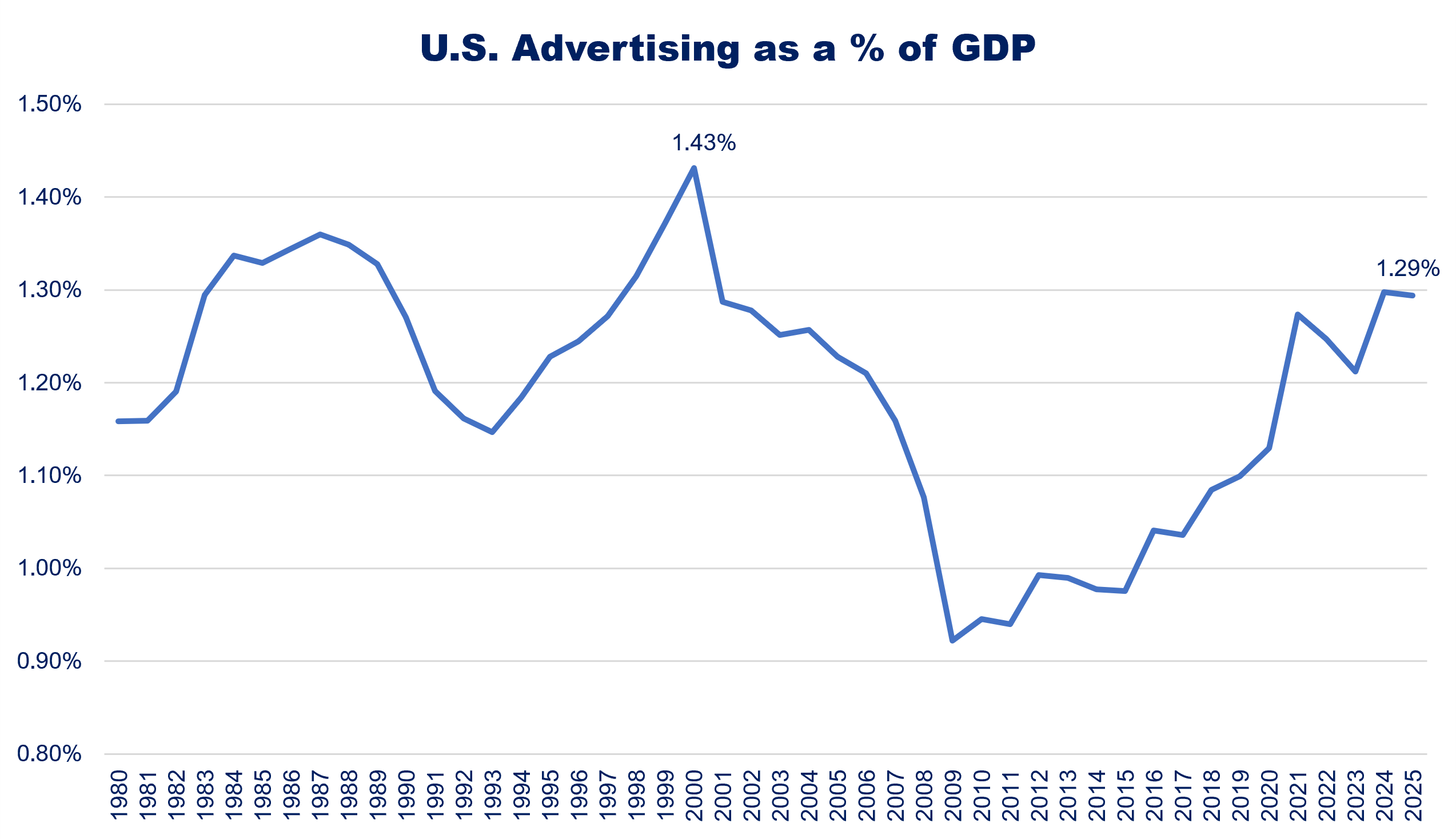
Wall Street research firm MoffettNathanson recently wrote a report called The Golden Age of Advertising. The report makes the point that in 2024 advertising grew the fastest it has in any year since 1983. As shown in Figure 1, in the U.S., advertising spend is now approaching its highest level ever as a proportion of GDP. MoffettNathanson projects that in 2026 it will exceed the peaks of the dotcom bubble, when exuberant stock market valuations funded big advertising outlays.
Figure 1. U.S. Ad Spend is Reapproaching Historical Highs
Source: MAGNA, FRED (Federal Reserve Bank of St. Louis), The Mediator.
Let’s put this in historical perspective. Over the last few decades, pundits have repeatedly falsely predicted that new technologies would diminish advertising’s role:
In the early-to-mid 1980s, the remote control and the VCR were supposed to kill TV advertising, as consumers either switched away from ads or fast-forwarded through them.
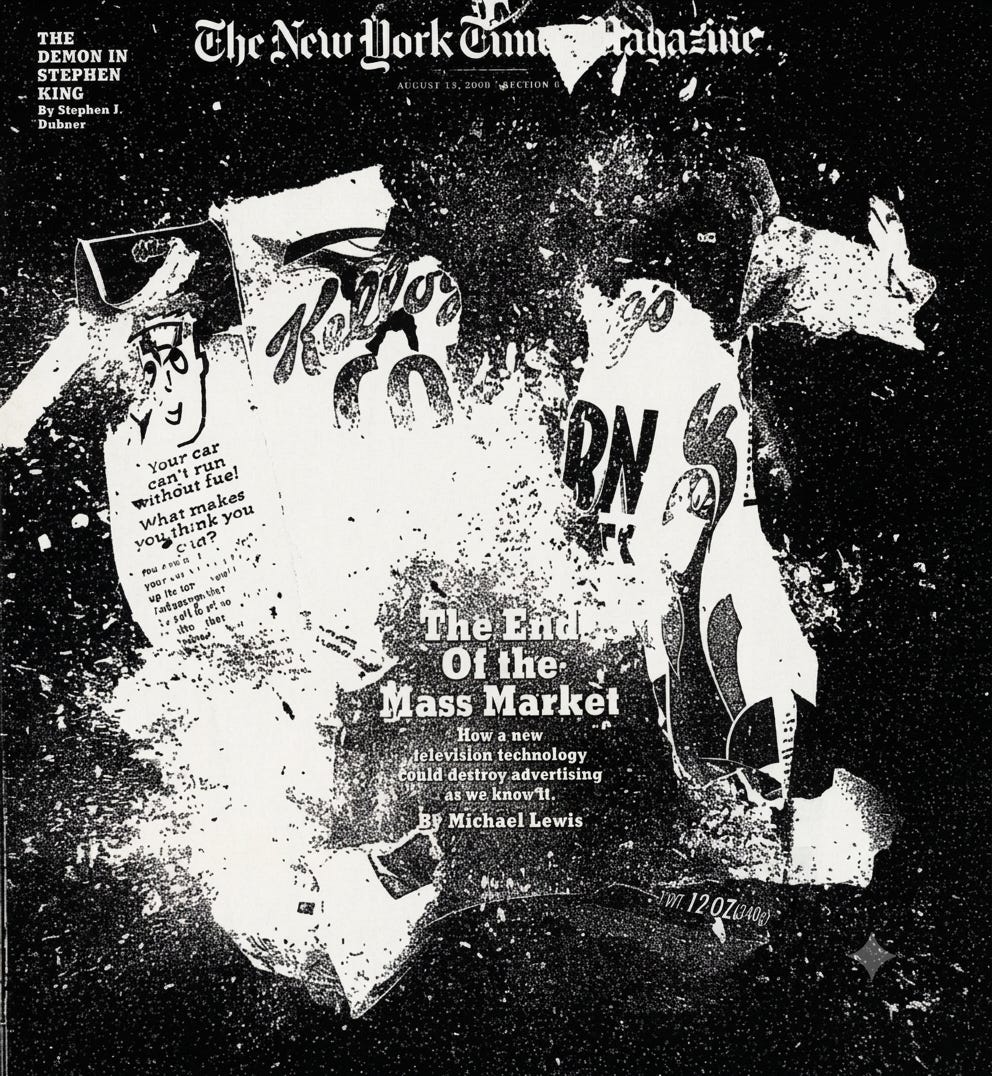
The rise of TiVo and DVRs a decade later exacerbated this concern. This was best exemplified by an article written by Michael Lewis for The New York Times Sunday Magazine on August 13, 2000, called “The End of the Mass Market: How a new television technology could destroy advertising as we know it.” (The grainy image of an exploding box of Corn Flakes below is the only one I could find online.)
In 2015, ad-blocking technology supposedly threatened to “derail the explosive growth in the digital-ad business.”
Around the same time, the migration of viewers to ad-free SVOD, especially Netflix and Amazon Prime Video, was supposed to kill TV ads too—and was held up as “proof” that consumers hate ads and the role of advertising was waning. For instance, this essay in The Atlantic claimed that ad-free SVOD and the pandemic collectively “accelerated the death of a once-crucial medium: the TV ad.”
Starting around 2017-2018, a new narrative arose online: that consumers were increasingly willing to pay for content. Newspapers and magazines instituted paywalls, Patreon and Substack emerged, and podcasts experimented with paid subscriptions. The implication was that a shift was occurring, away from advertising and algorithms and toward direct consumer payments.
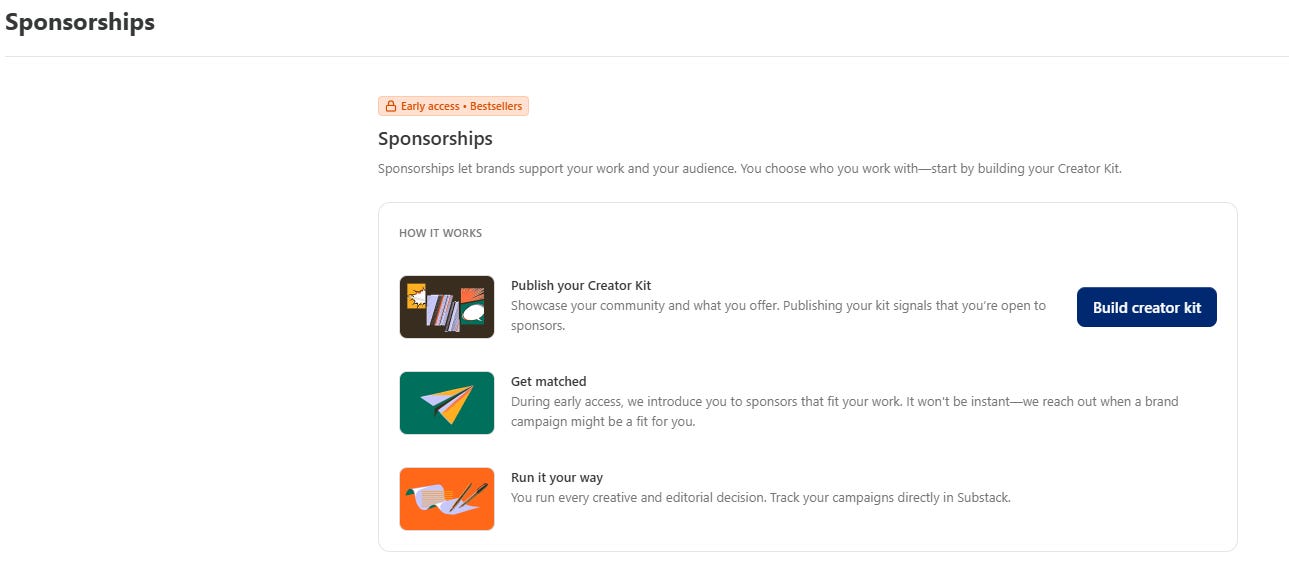
Yet here we are. Advertising has only gotten stronger. A recurring pattern is that new media that initially tries to differentiate itself by forgoing ads eventually capitulates. As one telling example, almost all the SVOD services that once purportedly heralded the decline of advertising have launched ad-supported tiers in recent years. Another example: a few weeks ago I got a notification from Substack—perhaps the purest expression of the direct-payment thesis—that it is now building tools to connect writers with sponsors.
Figure 2. Substack is Moving Into Sponsorships
Source: Substack.
As Eric Seufert, author of Mobile Dev Memo, often says, “everything is an ad network.” DoorDash, Instacart, Uber, retail media; practically everyone with access to attention and consumer data is now monetizing it through advertising.
Advertising’s resilience is not a coincidence. It is a foundational pillar of the media economy for a simple reason. It works for all three sides of the market: publishers, brands, and consumers.
Advertising is a foundational pillar of the media economy for the simple reason that it works for all three sides of the market.
Most businesses can’t extract value from people who won’t pay for their products or services. For content publishers, however, advertising enables exactly that.
For publishers, advertising is the primary mechanism for monetizing the attention of people who aren’t willing to pay directly for content.
Every market with a downward-sloping demand curve comprises customers with different willingness-to-pay (WTP). For many businesses, the solution is to offer different versions of products at different prices: inexpensive, no-frills products for the most price-sensitive customers and premium products for those willing and able to pay for them. Economists appropriately call this versioning.
Media consumers also have different WTP, but media can take this further than most businesses because digital content has effectively zero marginal cost. So, while it doesn’t make sense to give away McDonald’s hamburgers for free, it makes sense to give content away for free, even if you can only monetize the associated attention a little.
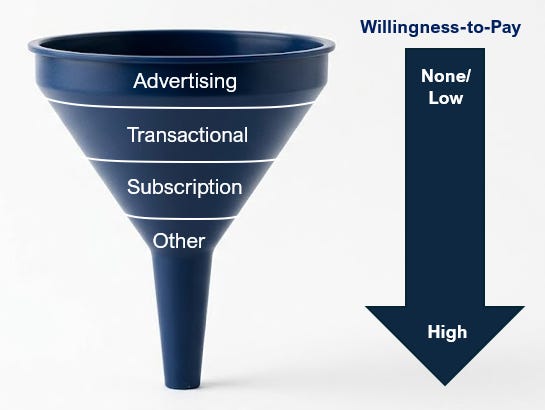
Media business models have formed around different WTP. You can think of this as the funnel shown in Figure 3. It is widest at the top, where the audience is largest and direct WTP is lowest. It narrows as engagement and WTP rise.
At the top of the funnel are all the people who consume content that they aren’t willing to pay much or anything for. This is monetized by selling access to their attention—advertising.
Then, you get the people who care enough to pay for content occasionally, by purchasing access one transaction at a time.
Then you get those who care enough that they are willing to enter an ongoing subscription relationship with the content.
And below that, at the bottom of the funnel, are those who are willing to pay ever higher amounts to engage in additional ways (they buy merchandise, attend events, pay for special access, etc.).
Figure 3. Advertising is the Primary Way to Monetize People With Zero/Low WTP
Source: The Mediator.
This is why advertising is so persistent and pervasive and why “everything is an ad network.” Eventually, nearly every business with a meaningful audience realizes that advertising lets it capture value from consumers who would otherwise generate little or no direct revenue.
Brands complain about advertising. It costs a lot and its effectiveness is often frustratingly murky. More than a century ago, John Wanamaker famously said that “Half the money I spend on advertising is wasted; the trouble is I don’t know which half.” Complaints or not, advertising performs two critical functions for brands: it creates demand and matches existing demand with supply.
From The Advertising Barbell:
…all advertising serves one of two purposes:
To make people want something they didn’t know they wanted and encourage them to enter the market. This encompasses both what marketers call awareness and consideration, but since both are intended to make people want to enter the market, we’ll call it demand creation.
To match demand with supply for those consumers who are in the market. We’ll call this coordination.
We know advertising serves a critical function because of what happens when brands stop advertising. The effect isn’t immediate, since they benefit from accumulated awareness, distribution, consumer inertia, etc. But it eventually comes home to roost.
For instance, marketing research from the Ehrenberg-Bass Institute found that brands that stopped advertising for a year saw sales decline by an average of 16%. After two years, the average decline reached 25%. A study from Nielsen similarly found that every quarter without advertising reduces future revenue.
Brands that stop advertising quickly feel the adverse effects.
So, even though the marketing function is a never-ending quest to improve (and prove) marketing effectiveness, for most brands forgoing advertising altogether isn’t a viable option either. Perhaps brands can’t live with it, but they can’t live without it either.
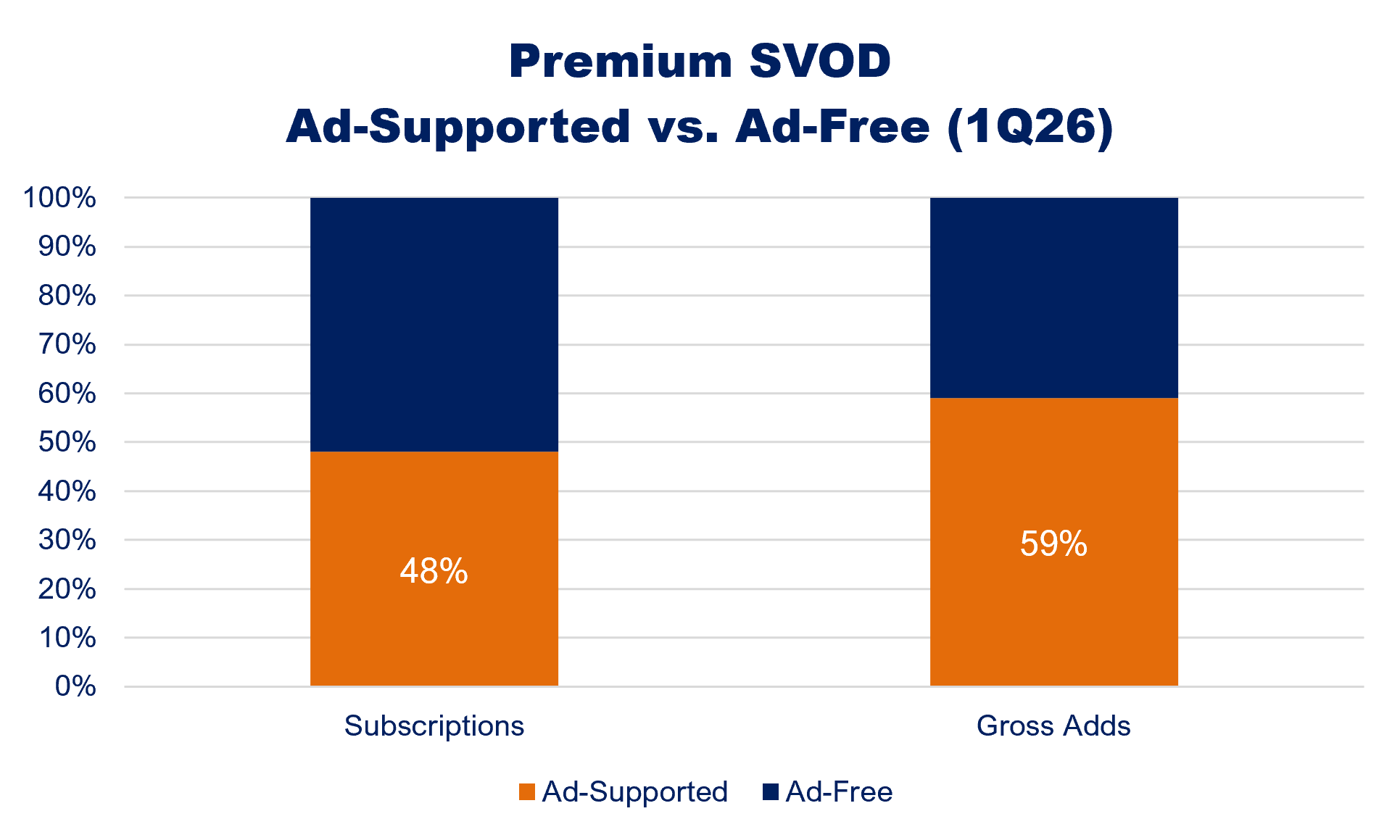
Consumers often complain about ads too, but many opt for them when it’s clear what they get in exchange. Consider Figure 4 as an example. According to Antenna, in 1Q26 almost half of all premium SVOD subscribers in the U.S. were on ad-supported tiers and 60% of gross additions opted for the ad-supported tier.
Figure 4. Most New SVOD Subs are Opting for the Ad-Supported Tier
Note: Excludes Apple TV and Starz. Source: Antenna Data.
Or, more anecdotally, consider the history of Hulu, a product that has run the gamut of pricing models. When Hulu launched in 2007, it was free and ad-supported. In 2010, it introduced Hulu Plus, moving much of its catalog behind a subscription paywall while continuing to show ads even to paying subscribers. According to Hulu management, at the time, when consumers churned off, the most commonly cited reason was their dislike of ads. Then, in 2015, Hulu launched a premium tier without commercials, priced at $11.99 per month, compared with $7.99 for the ad-supported plan. After that, roughly 60% of gross additions continued to choose the lower-priced ad-supported tier to save that $4—but ads ceased to be a commonly cited reason for churn. (How could consumers complain about ads when they had actively chosen the ad-supported option?) It’s another example of consumers willingly making the tradeoff to view advertising when the value exchange is clear.
Consumers often opt for ads when the value exchange is clear.
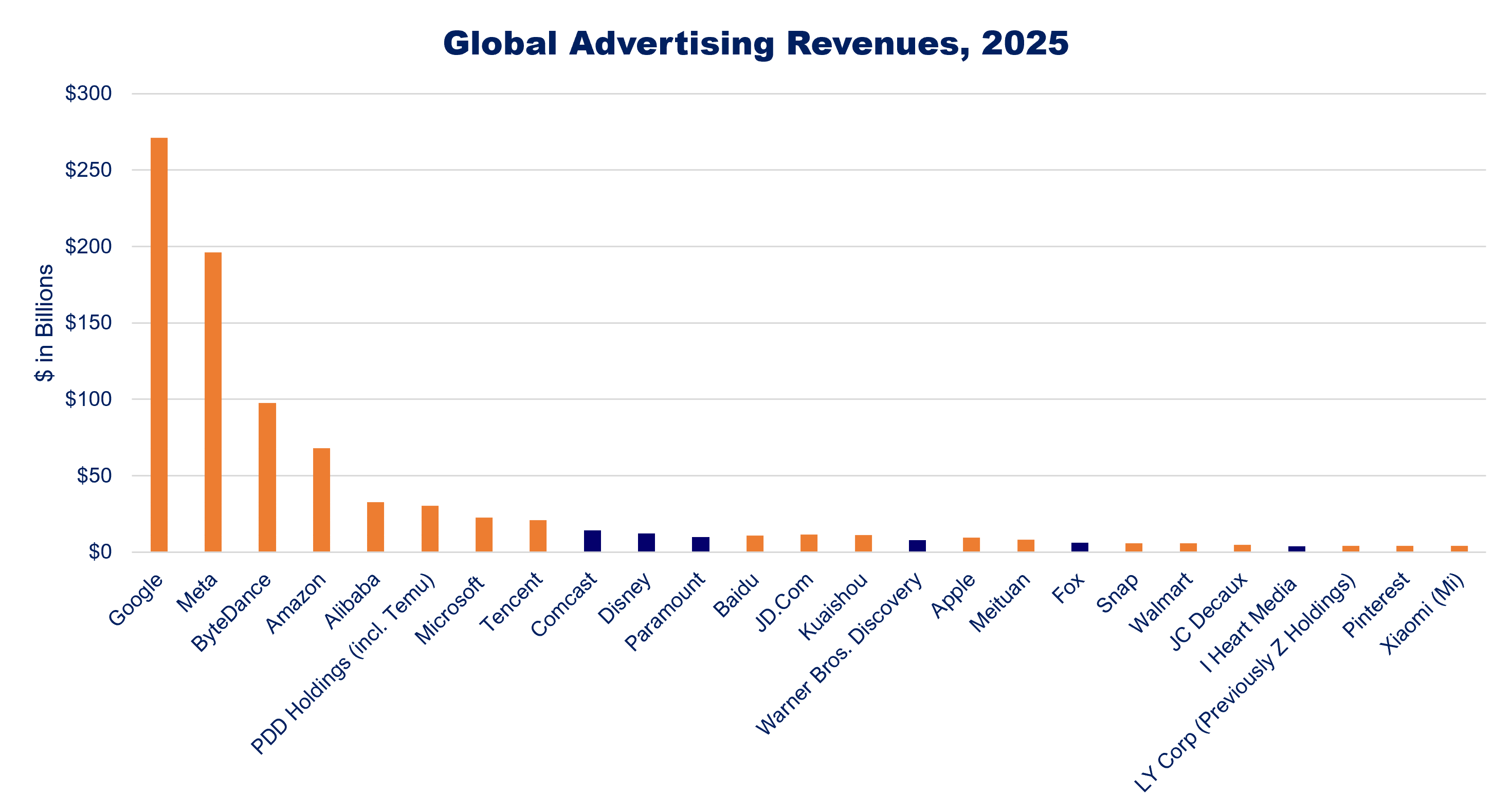
So, advertising is as strong as ever. But if you’re in the ad economy, you also know that the concentration of this wealth is more Gilded Age than Golden Age; it is accruing to the very (very) few. I won’t belabor the point, but here are a few charts. As shown in Figure 5, the advertising economy is highly concentrated in just a few companies. The blue bars represent traditional media companies; what we call “media companies” now make up a tiny proportion of the advertising economy.
Figure 5. The Ad Economy is Highly Concentrated
Source: WPP, The Mediator.
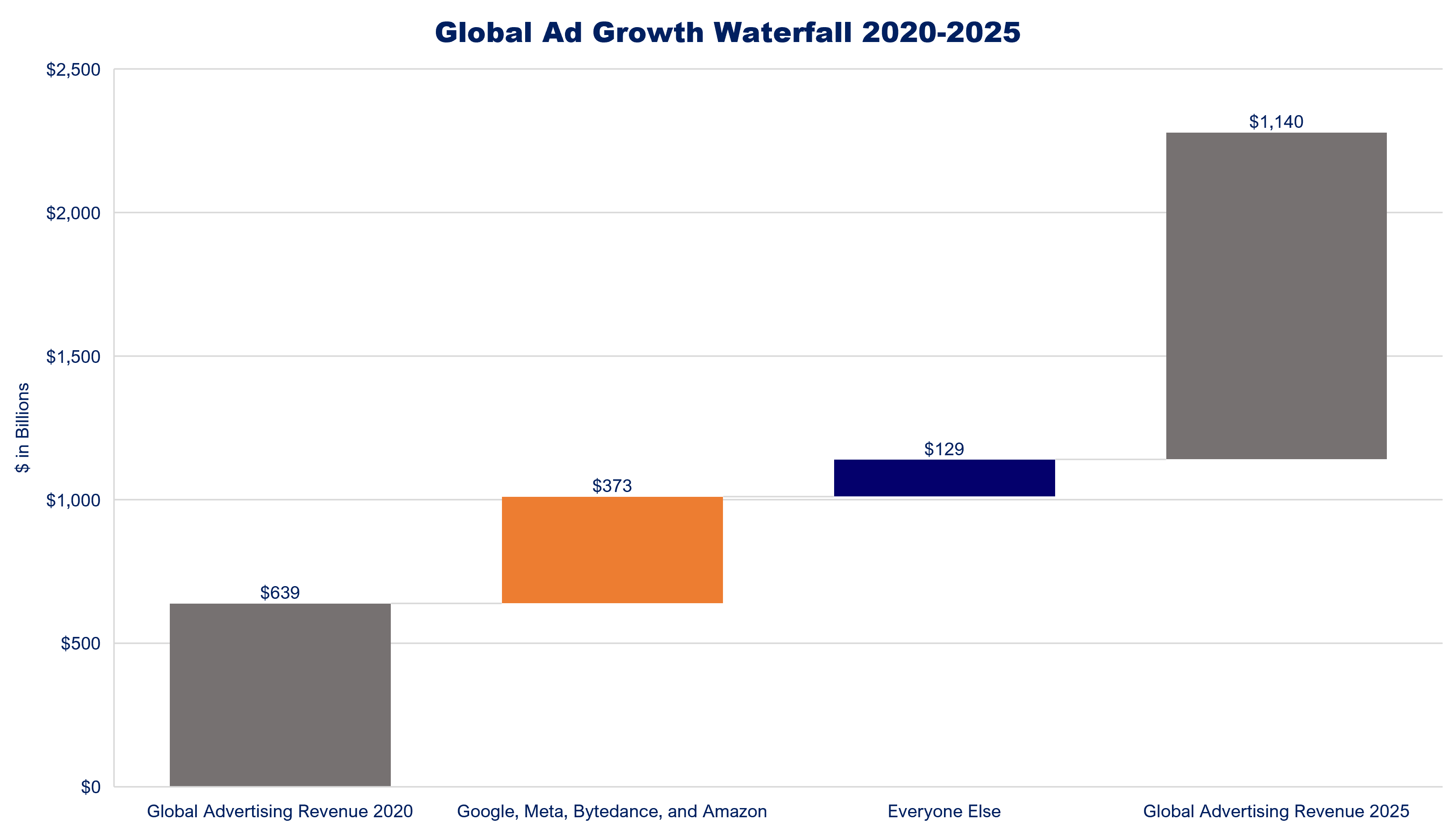
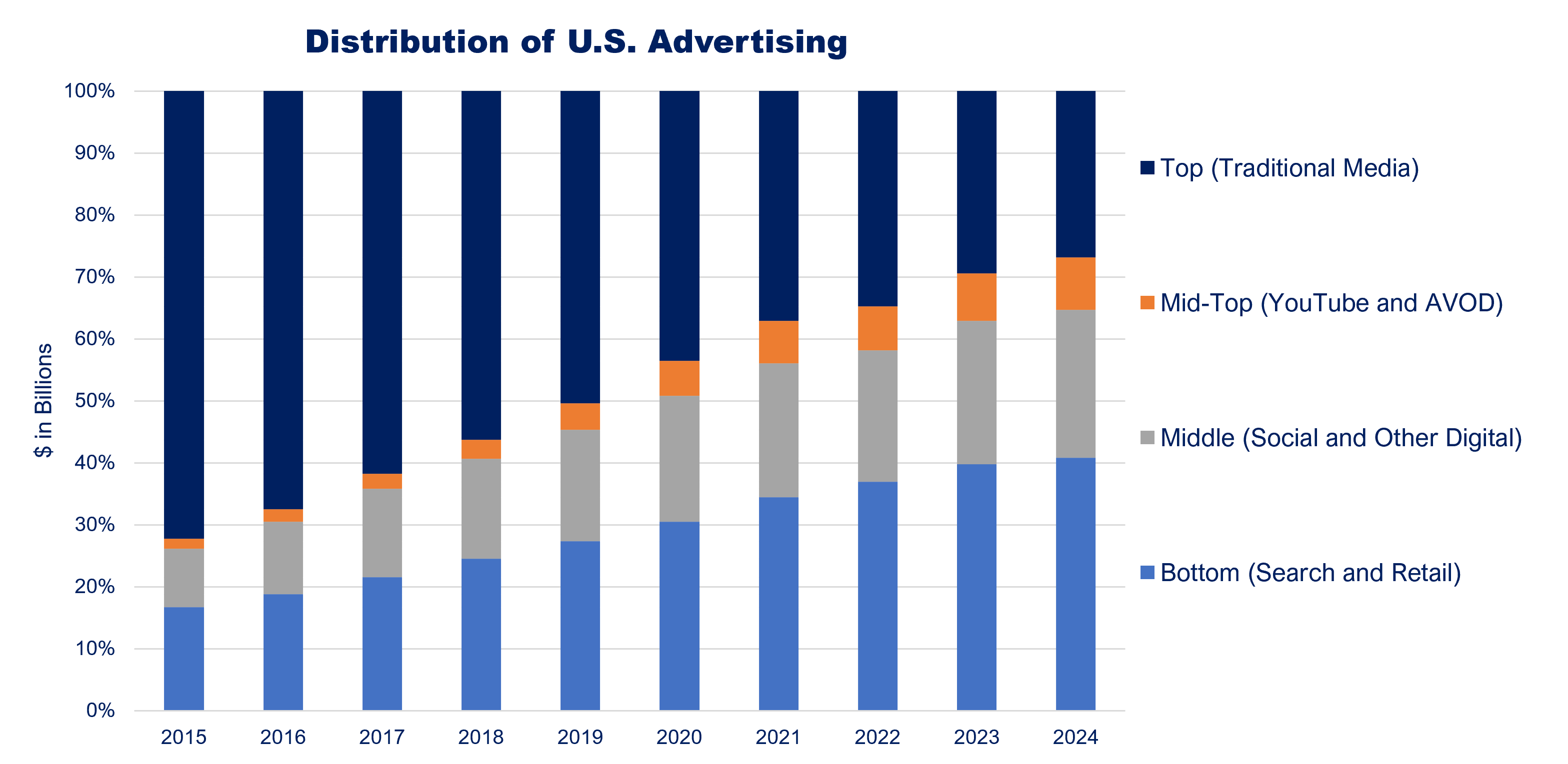
Figure 6 is another way of looking at this inequality. As shown, the global ad economy grew by about $500 billion between 2020-2025, but 75% of that growth went to the four largest platforms: Google, Meta, ByteDance, and Amazon. One chief reason is that these are full-funnel platforms that are better able to show return on ad spend (ROAS). To invoke the Wanamaker quote: everyone wants to know which half works and the platforms enable that more than most other forms of advertising. As a result, over the last decade, there has been a very strong gravitational pull toward the bottom of the so-called advertising funnel, toward media like search, social, and retail media, which are closer to the point of transaction and where it is easier to measure ROAS (Figure 7).
Figure 6. Four Companies Extracted the Lion’s Share of Global Ad Growth
Source: WPP, The Mediator.
Figure 7. Budgets are Shifting Down Funnel
Source: MoffettNathanson.
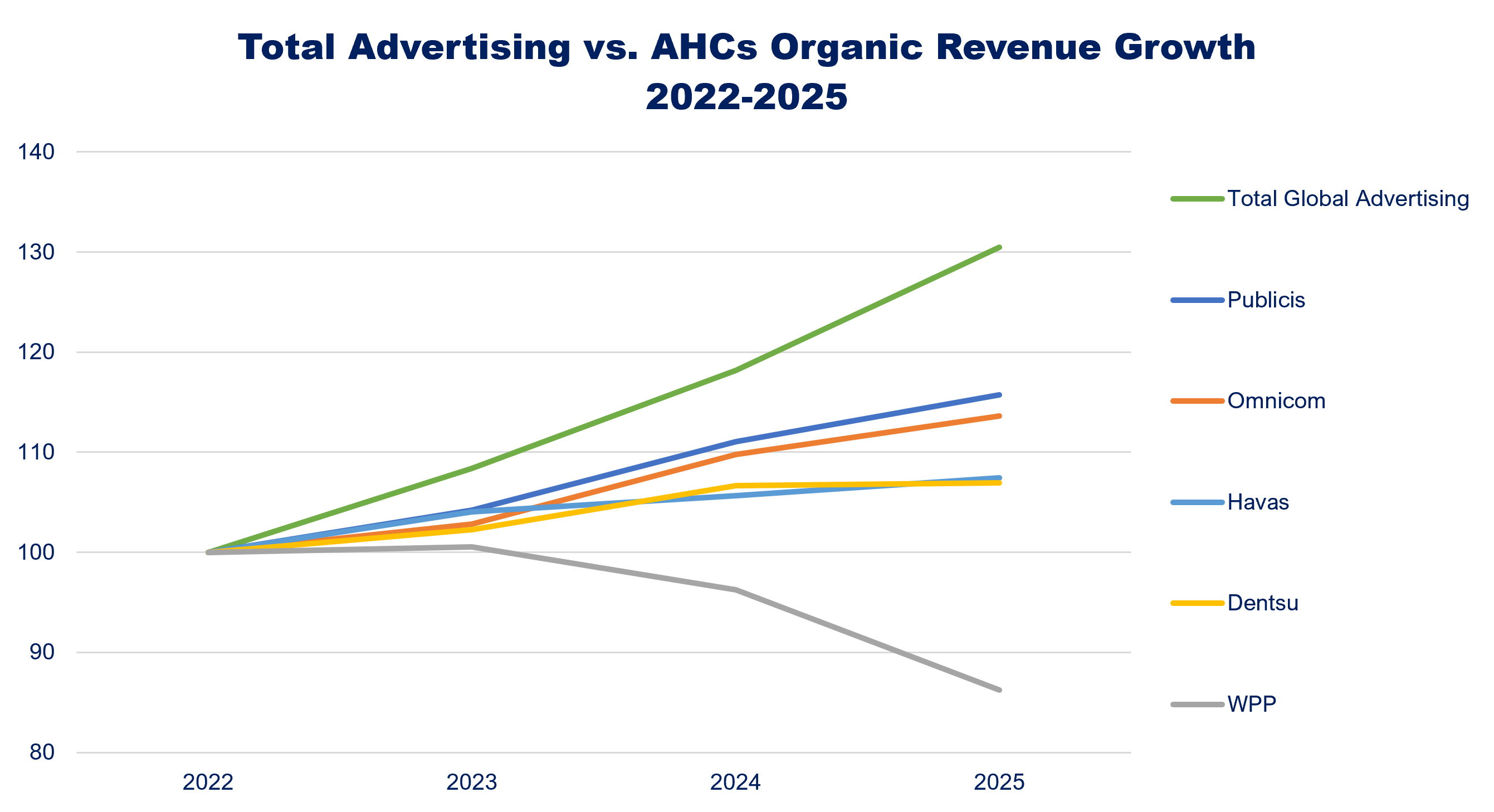
As anyone who follows the industry closely also knows, the advertising holding companies (AHCs) have not participated proportionately in advertising’s growth. Figure 8 shows this divergence. There are several reasons: the platforms are onboarding millions of SMB advertisers directly, automating functions agencies once performed, while at the same time clients continue to pressure fees and bring more capabilities in-house. As spending shifts toward full-funnel platforms, less money needs to flow through agencies.
Figure 8. The AHCs Haven’t Kept Up With the Market
Note: All AHC revenue growth calculated in native currency and normalized for acquisitions. Source: Company reports, WPP, The Mediator.
So, this was the state of play as everyone landed in the scorching French Riviera heat last month. Into this dynamic, enter AI. It has the potential to disrupt advertising from every direction: the supply side of content and inventory, the demand side of attention and discovery, and the plumbing in between. Usually new technologies attack from one of these angles—ad-free SVOD threatened to restrict premium inventory supply; TiVo threatened to divert attention; the deprecation of cookies threatened to reallocate value along the value chain—but AI attacks all three at once.
Comments
Nothing yet. Say the first thing.
Sign in to join the conversation.