
For the past three years, I’ve been writing and speaking about the likely effect of GenAI on media. I usually start out my presentations by saying something like “the last 20-30 years in media were defined by the disruption of content distribution and the next decade will be defined by the disruption of content creation, with equally profound effects.”
I say this to grab people’s attention. Everyone knows that the internet completely upended the media business. But lately, I increasingly believe that I’ve been thinking about GenAI too narrowly—and underselling it. The implications of GenAI will be more profound. Or at least more consequential. Not just for media, but the entire information economy.
You’ve no doubt heard this kind of thing umpteen times. GenAI is transformative. It will compress the cost of knowledge work. It will be the most important technological shift of our lives. Yada, yada, yada. The problem with these assertions is that…they are assertions. So, let’s not assert it, let’s derive it.
Tl;dr:
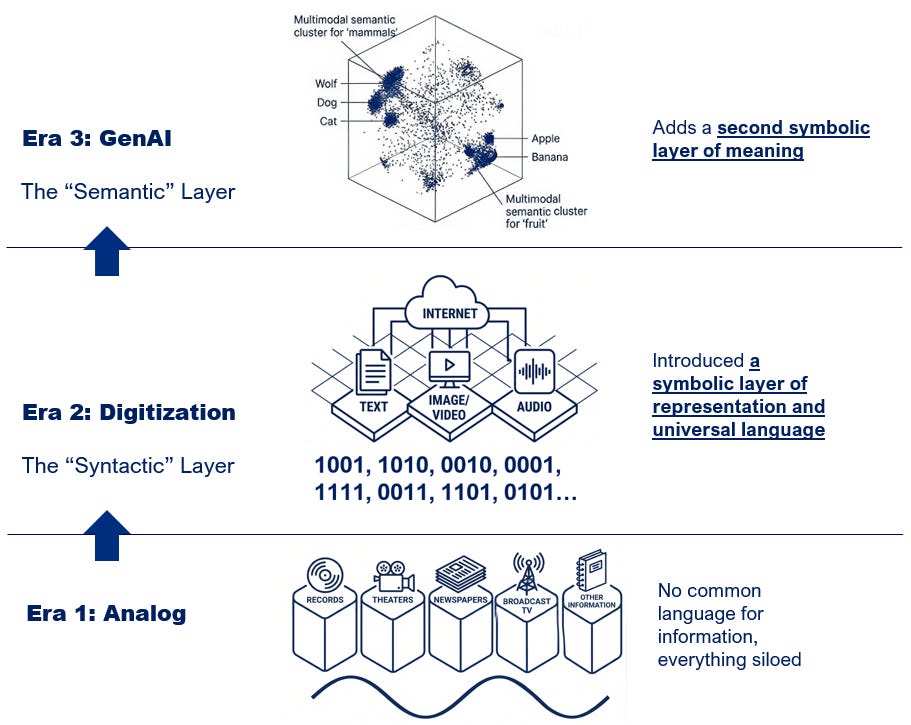
There have been three modern information eras: analog; digitization; and now GenAI.
Digitization created a universal language for information, a syntactic layer. GenAI adds a layer of meaning, a semantic layer. Put differently, digitization made information computable and GenAI makes meaning computable.
Computable information—syntactic computation—was a big deal, but computable meaning—semantic computation—is likely a bigger deal for a lot of reasons. The ultimate value of information is the meaning it conveys, not how it moves around. Also, while computable information has only a few primitives (like “read”, “write,” “copy,” etc.), computable meaning has an open-ended list and a vast number of combinations. Plus, the ability to chain those combinations together autonomously (using agents) is compounding.
To be clear, there is a critical difference in this comparison: syntactic computation is objective and deterministic and semantic computation is context-dependent and probabilistic. That places limitations on the latter that don’t exist for the former.
That’s why GenAI will automate knowledge tasks unevenly. Task by task, it will depend on two things: how high are the stakes and how objectively verifiable are the results. Humans will need to be “in the loop,” but where in the loop will differ.
Still, even partial automation of meaning is more central and likely to be more disruptive to the information economy than cheaper distribution was.
For media, it won’t only be about cheaper content creation. Create is just one primitive of computable meaning. Coordinate, translate, convert, transform, evaluate, verify, and many others have the potential to upend businesses and redistribute value.
To grasp the importance of GenAI from first principles, it’s helpful to think of the modern history of information in three separate eras, each building on the prior.
The natural world, as we experience it, is analog.
From Infinite Content, Chapter 3:
All media are representations of sound, images and/or text. In nature, sound and light waves occur over a continuous range of values. (Text is a special case. It doesn’t occur in nature, since it’s an abstraction of language, which is in turn an abstraction of human thought.)
Prior to the commercialization of digital technologies, to reproduce sounds and images, most media had to also replicate this continuous range of values. Media was analog, so called because it was analogous to the source signal.
Sound was recorded by replicating a waveform on a physical medium, like by etching the pattern on vinyl or magnetizing iron oxide particles on a cassette or reel-to-reel tape. Images were recorded by exposing light-sensitive paper to light, capturing the full range of tone (and eventually) color of the original image. Text was printed as characters on paper.
So, in 1975, the smallest parts—the atomic units—of each medium were different. For a song, it was the note or maybe a waveform; for a film it was a still frame or perhaps the individual grains on the film; for text it was the letter or punctuation mark. There was no common language between them.
With no common language, each form of analog information evolved in its own discrete ecosystem with its own infrastructure (from supply chain through the form factors used to access them), economics, and institutions. A record player couldn't play a film. A broadcast tower couldn't transmit a newspaper. Corporate records were held hostage to binders, manifests, and microfiche. This incompatibility was a structural consequence of an analog substrate.
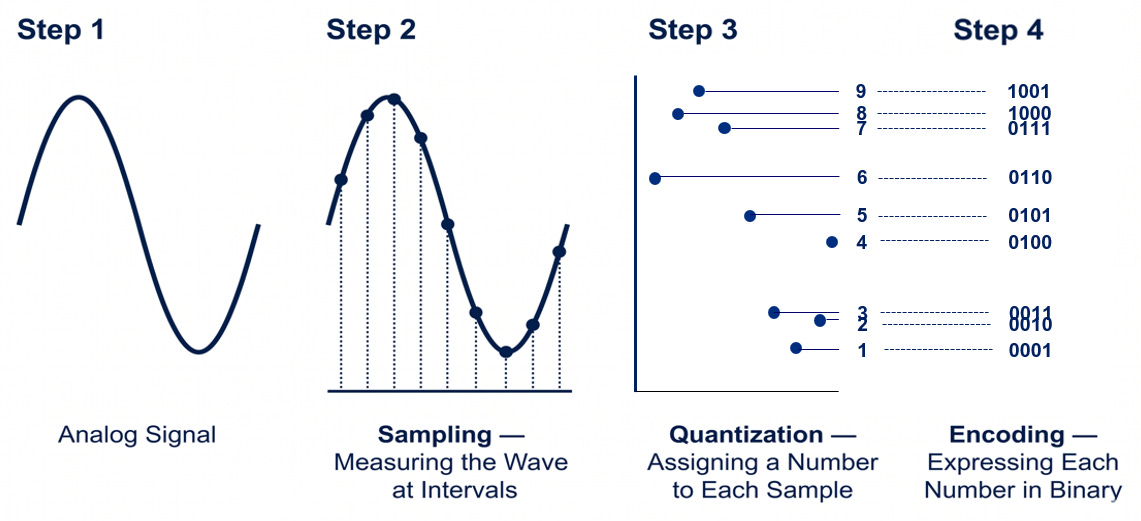
Figure 1. How Digitization Works
Source: The Mediator.
Also from Infinite Content, Chapter 3:
In 1948, Claude Shannon was toiling away in relative obscurity at Bell Labs in the West Village when he wrote “A Mathematical Theory of Communications” for the Bell System Technical Journal. The paper launched the field of Information Theory and the concept of the “bit,” or binary digit, the 0s and 1s that are the underpinning of all modern communications. [He] formalized the idea that an analog signal could be replicated using binary code, or what we now call “digitized.”
Digitization involves sampling a continuous sound wave or image at regular intervals, “quantizing”—or, equivalently, “mathematizing” it—and converting that quantity to binary code, comprising bits.
This is shown in Figure 1. Digitization was such a revolution because it made it possible to encode all information1—text, numbers, images, audio, and video—the same way, in 0s and 1s. That meant they could be copied with perfect fidelity, stored, and transmitted all using the same machines, infrastructure, and systems. Digitization built a symbolic layer of universal representation for all information, a common language, on top of the analog substrate.
Digitization created a symbolic layer of universal representation for all information, a common language.
But this new universal language was intentionally agnostic to the meaning of the information. Like any language, binary code isn’t concerned with what it carries, what it means, or even if it means anything at all. In writing the prologue to Shannon’s later book on the subject, mathematician Warren Weaver explicitly distinguished between what he called the “technical problem” of “how accurately can the symbols…be transmitted” and the “semantic problem” of “how precisely do the transmitted symbols convey meaning?” Shannon also wrote that “semantic aspects of communication are irrelevant to the engineering problem.”
Digitization is intentionally agnostic to meaning.
In other words, digitization formed what linguists would call the “syntactic” layer, the rules, structure, and grammar. Syntax expressly has nothing to do with meaning.
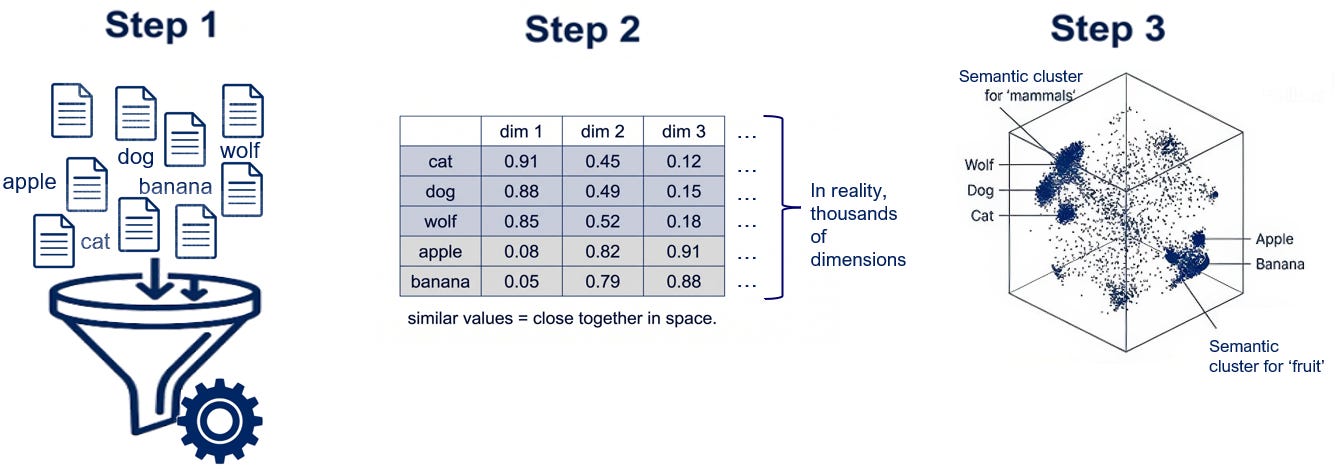
Figure 2. How GenAI Works
Source: The Mediator.
Comments
Nothing yet. Say the first thing.
Sign in to join the conversation.