
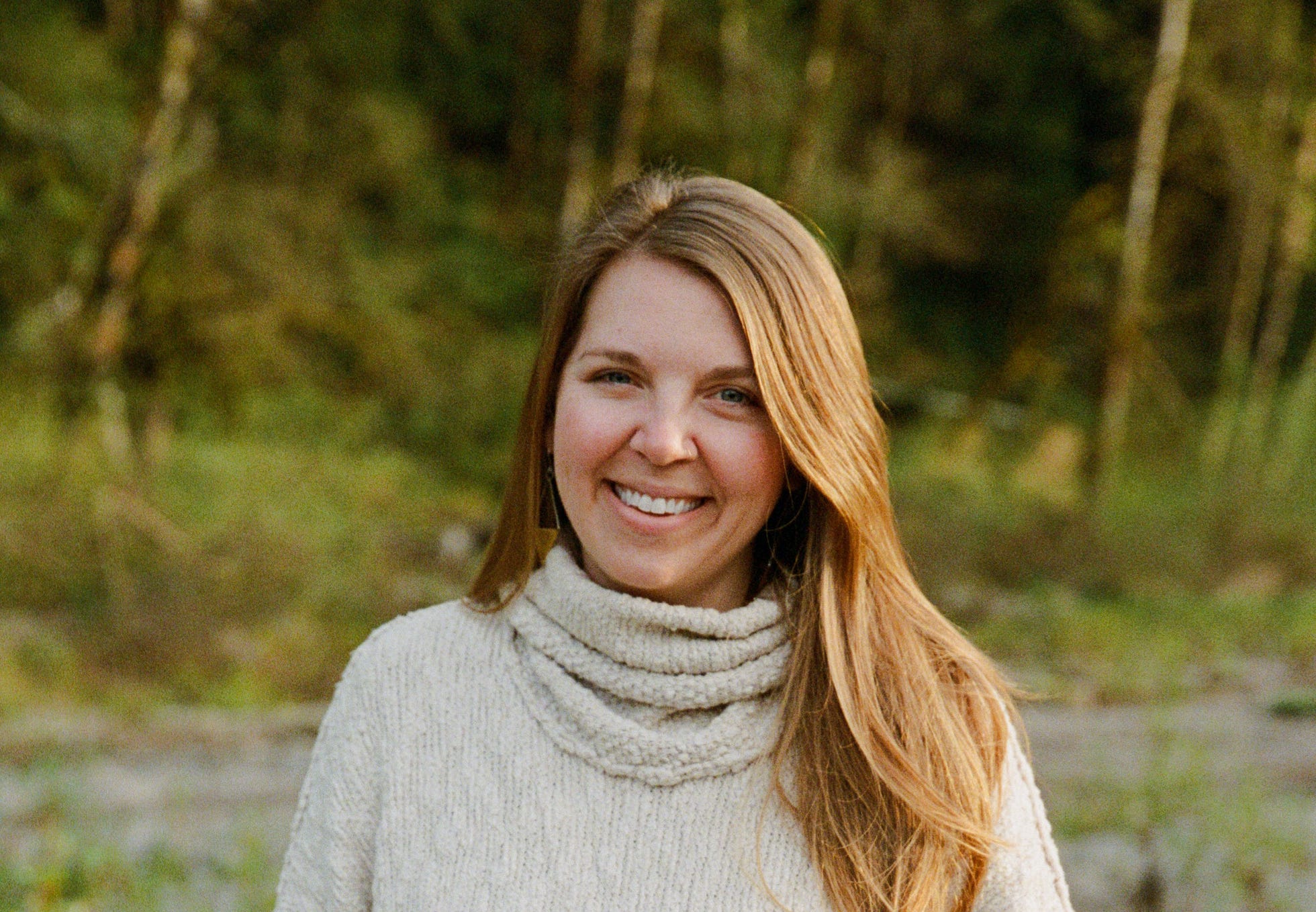
Megan Leatherman is a teacher, writer, and vocational guide. She’s the host of a podcast called “A Wild New Work’‘ and teaches classes about ancestral connection, the origins of capitalism, and how to live into your calling. She’s the author of Winter at Work and the Living the Seasons journal series and lives in Portland, Oregon with her spouse and two children. You can learn more about her at awildnewwork.com.
Sometimes when I’m at the Sea, I like to imagine seemingly powerful things falling into her great, salty jaws. I’ll picture a data center sinking to the depths, all of its electrical connections shorting on the way down. Or perhaps I’ll envision a fighter jet becoming a home to sea urchins, or imagine what an Ocean storm could do to Wall Street.
I don’t invoke these scenes because I want the Sea to be harmed, but because I need to remember what real power is.
Many of us are used to feeling the powerful effects of capitalism. In a very real sense, it has the power to shape our lives–where we live, who we spend time with, even the care we can (or can’t) afford to give ourselves. Having been conceived, born, and raised within capitalist culture, the power of this belief system makes a home in us, dictating our choices not just from the outside in, but from the inside out as well. We feel the external constraints of being forced to work for a wage but we’re also quick to shame ourselves for not wanting to work for a wage in the first place. In this situation, capitalism’s power can feel omnipresent, especially if we’re not spending time with other, more ancient forms of power.
The truth is that capitalism is powerful, but not more powerful than the Earth.
Capitalism can only exist because of the Earth–because of the land’s resources that have been privatized, commodified, and exploited since the 15th century when capitalism emerged as the dominant economic system. The Earth has been abused in order to give life to capitalism, and the Earth can give this system its death, too.
I teach a class called “Composting Capitalism,” which is both the title of the class but also a big idea: that capitalism can, like all rotten matter, be composted. On one hand, I mean this figuratively, as in the way that long-standing paradigms can die and become a part of the landscape again. Ursula K. Le Guin spoke to this possibility when she said
“We live in capitalism, its power seems inescapable — but then, so did the divine right of kings.”
Capitalism as a worldview is something that you can become aware of, digest, and give back to the Earth, again and again until its suffocating power loosens within you.
I also mean that capitalism can literally be composted. While we all know the ache of overflowing landfills and floating islands of garbage, we might also remember that across vast expanses of time, everything will become Earth again. The Earth knows how to bring what has been created into the cycle of decomposition so that balance is restored and life renewed.
When I need to remember the Earth’s power, I find it medicinal to meditate on this poem by Rilke:
Dear darkening ground,
you’ve endured so patiently the walls we’ve built,
please give the cities one more hour
and grant the churches and cloisters two,
And those that labor — maybe you’ll let their work
grip them for another five hours, or seven
before you become forest again, and water,
and widening wilderness,
in that hour of inconceivable terror
when you take back your name from all things.
Just give me a little more time.
I just need a little more time,
because I am going to Love the things
as no one has thought to love them,
until they’re real and worthy of you.
When, as Rilke writes, we Love the things as no one has thought to love them, we come back into alignment with what is truly powerful and enduring about Life on this planet. I love the idea of composting capitalism because it allows me to shift into that realignment and stop pushing against this system but allow the cycle of life, death, and rebirth to work its ancient magic.
Allowing capitalism to be composted may sound passive, but it’s not. It’s humble. If you start a compost pile in your garden, you will need to actively put material in to be broken down and monitor how things are going, but you are not doing the composting. You’re allowing the beings who know how to decompose matter and turn it into soil do what they’re meant to do. Too many people are attempting to compost capitalism themselves, when our task is a much more humble one: to acknowledge that this way of life is rotten, discard capitalist values onto the compost pile, and allow the Earth to show us what else is possible.
I spend a lot of time with the land and the more-than-human beings there, and much of that time is spent receiving their support as I metabolize what it’s like to live inside of this system and dream into something new. When I go and place my body on the ground, the pressure and tightness that this way of living can create inside of me goes back into the Earth, where it can be digested and turned into soil again. I’m empowered by the spaciousness that this practice creates, and it has become a lifeline in these challenging times.
You and I may not be able to change the existence of capitalism right now, but we can help the composting process along by remembering that we do not need to carry the weight and stench of this system inside of us. We can give it to the Earth. We can let the Earth hold us, and remember her power.
Comments
Nothing yet. Say the first thing.
Sign in to join the conversation.