
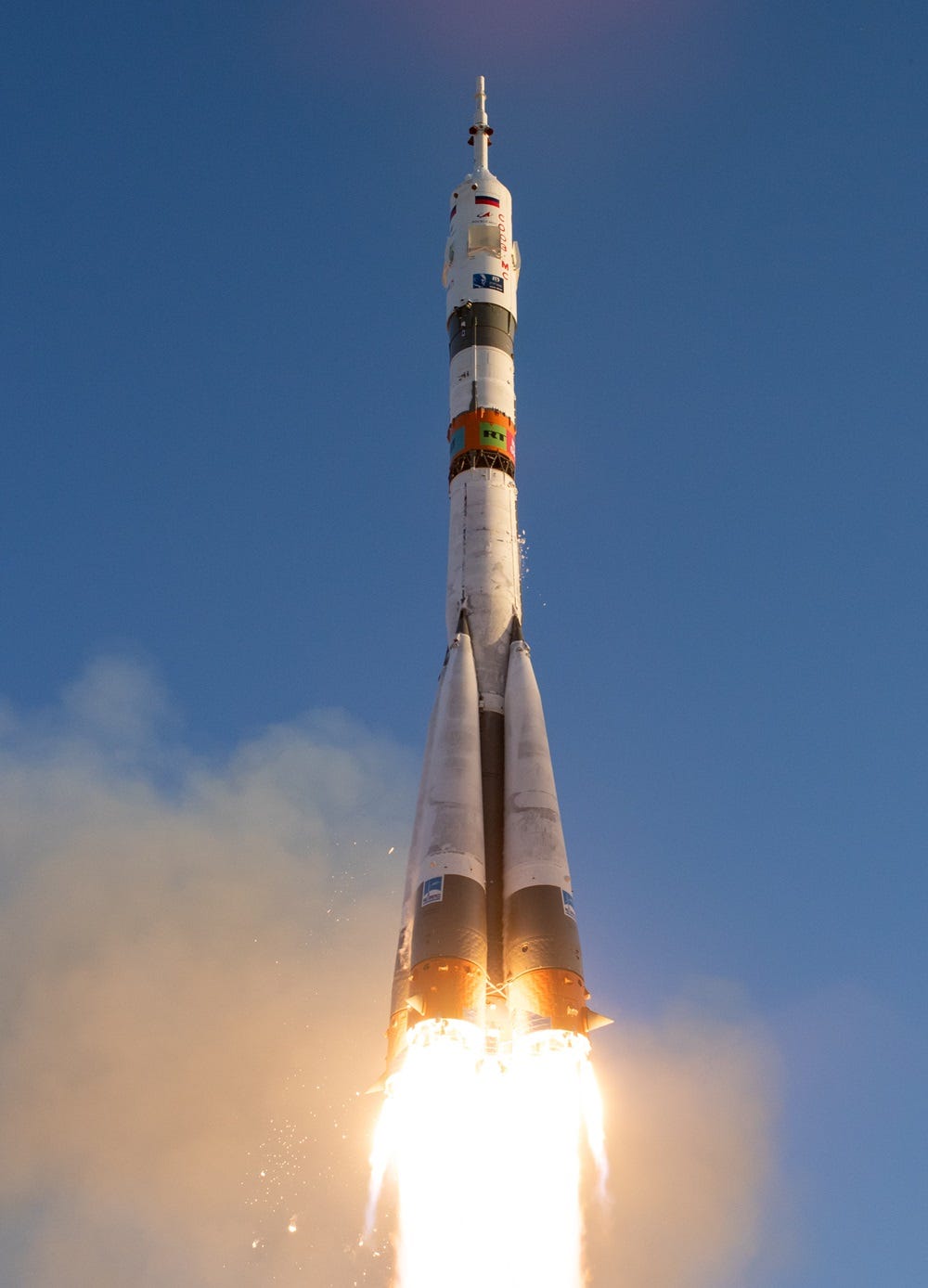
Ukrainian FP-5 Flamingo cruise missiles struck the company that manufactures Russian launch vehicles used to send crews and cargo to the International Space Station (ISS) and to orbit most of the country’s satellites, the Kiyv Post reported.
President Volodymyr Zelensky announced that missiles struck the Progress Rocket and Space Centre in Samara on Aug. 15. The company manufactures Soyuz-2 rockets that have been used in eight of 10 Russian launches this year.
The open source intelligence (OSINT) community CyberBoroshno believes that a building with cleanrooms for vital launch vehicle components was hit. The group posted an analysis on the Telegram social media site. Below is an excerpt in English via Google Translate.
The hit was probably on building 106A….It is part of the Soyuz launch vehicle production array. Building 106A operates in a high class of cleanliness: onboard electrical equipment, devices and printed circuit boards are mounted here - in fact, the “nervous system” of the launch vehicle: control system, cable network, instrument compartment. Without this stage, the rocket cannot be assembled, even when the housing and tanks are ready.
Building 106B is also located nearby, which is the final assembly building.
CyberBoroshno’s analysis has not been independently confirmed. Amateur videos circulating on social media show a large fire breaking out at what is reported to be the Progress facility.
It’s unclear what impact, if any, the attack will have on upcoming crew and cargo launches to ISS. Key factors will be the extent of the damage to the factory, if any Soyuz-2 boosters there were hit, and how many completed rockets were already shipped to launch sites in Russia and Kazakhstan.
ISS crew rotation is not an immediate concern. On July 14, a Soyuz-2.1a rocket launched the Soyuz MS-29 crew to the station on an eight-month mission. The crew included Russian cosmonauts Pyotr Dubrov and Anna Kikina and American astronaut Anil Menon.
The next crewed Soyuz launch is scheduled for March 2027. The crew will include Russian cosmonauts Dmitry Petelin and Konstantin Borisov along with American astronaut Deniz Burnham.
In the meantime, Soyuz-2 rockets are scheduled to launch two uncrewed freighters to ISS. The launch of Progress MS-35 is scheduled for September and Progress MS-36 in November.
The space station is also resupplied by American Crew Dragon and Cygnus freighters and Japanese HTV-X cargo ships. NASA and Boeing are planning an uncrewed Starliner cargo mission to the station in the future.
Soyuz-2.1b rockets are being used to launch Russia’s Rassvet satellite constellation, which is a broadband satellite constellation meant to rival SpaceX’s Starlink network.
The Progress facility is also developing the new Irtysh (Soyuz-5) launch vehicle. On April 30, an Irtysh rocket made a successful suborbital flight from the Baikonur Cosmodrome in Kazakhstan.
No posts
Comments
Nothing yet. Say the first thing.
Sign in to join the conversation.