
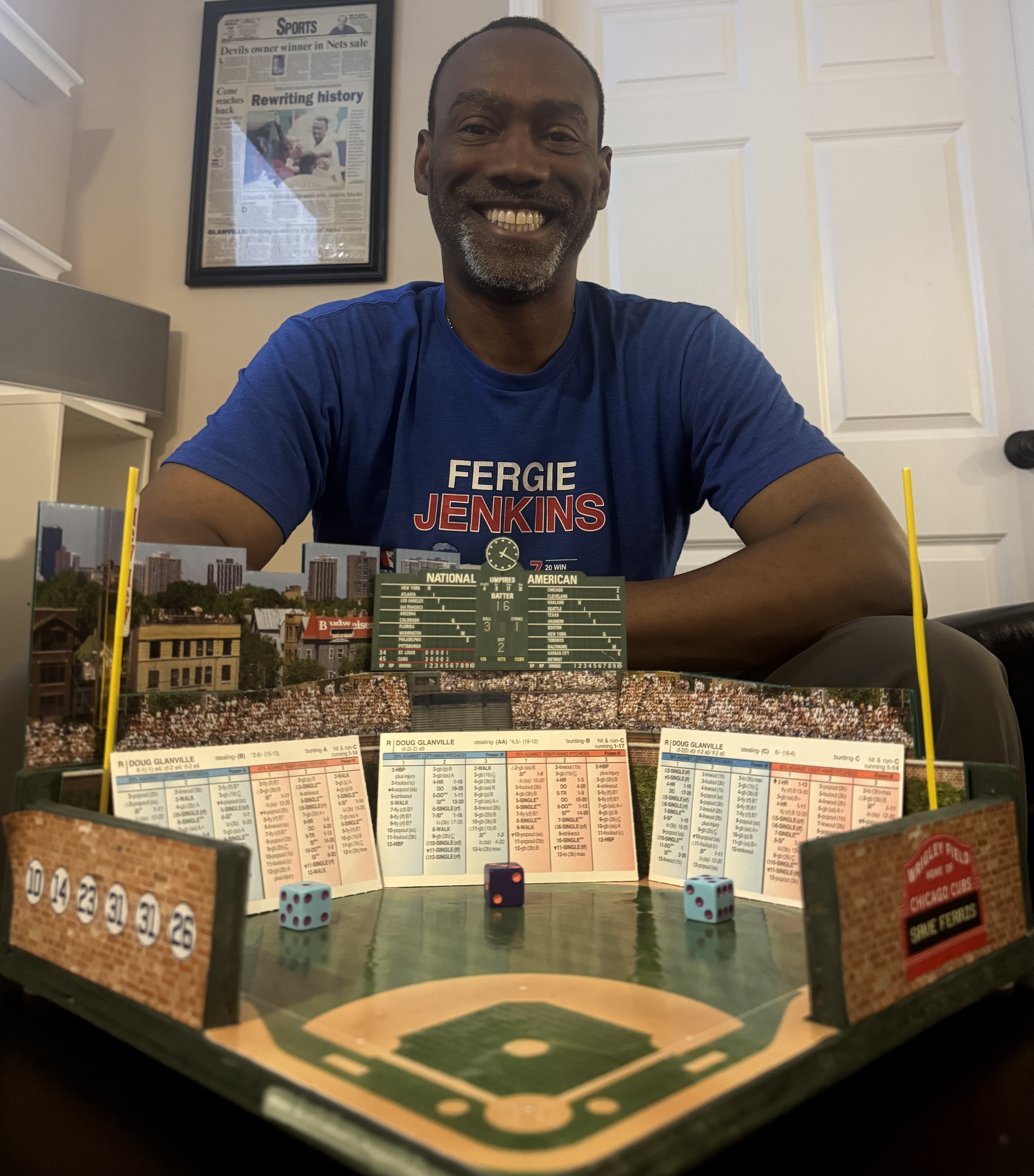
My big brother had mapped out my baseball future on the front of a spiral scorebook back in the early 1970s. It was brief, but it listed the key steps to major league glory. It included the staples of brotherly competition like Wiffle ball and stickball, and it even offered a path to street cred by playing with the Cul-de-Sac home team, CCK, aka the “Cadmus Court Killers.” But all of those steps were surrounded by the most critical element of all.
Strat-O-Matic.
He introduced me to this baseball table game when I was around six years old. I had already taken to baseball, and he knew that a key part of loving the game was loving the strategy and the numbers.
For those who do not know “Strat,” it is a game where each player is represented by a card filled with outcomes. The cards have three columns and rows that range from 2 to 12. As you can imagine, dice determine which outcome to read. One die gives you the column; add the other two together and you have the row.
Then you see what you get.
It takes you down a rabbit hole of permutations and combinations that can only be described as a planet I will call “Analytica.” The odds and possibilities abound, and you have to manage your team the way Earl Weaver would have managed the 1979 Baltimore Orioles. Although I do not think you could get ejected in Strat.
What was fantastic about this game was that it became how I learned about players from outside my geographic area. I would get the full set—plus the extra players—and experiment with teams I would rarely see unless they were in town playing the Mets or the Yankees.
We would have drafts and play for hours in our basement. I am not sure I remember eating or taking many breaks. We were so locked in. I learned at a rapid pace because, at first, I played mostly with my brother and his friends who were all seven-plus years older than me. But I caught on quickly.
Some of his friends treated their cards like they were storing rare documents in a safety deposit box. They used photo albums and slipped the cards into plastic sleeves to keep them in mint condition. People had to provide collateral to borrow cards, especially after a few came back with grape juice stains or dog teeth marks in them.
Comments
Nothing yet. Say the first thing.
Sign in to join the conversation.