
Everyone’s got their Blossom stories. Their tales of isolated madness. Those sweat-soaked visions, waiting for the rashes to fade, for lungs to stop burning from inside.
Days of idle exhaustion.
Nights of drunken solitude.
Voices from God.
On-line house parties.
Unattended funerals.
Screams from distant rooftops.
The eager optimism of quarantine.
The anger of slow emergence.
The second wave.
Then the third.
Everyone’s got their stories.
We’ve all got our theories, too, about how it got started. That bastard child of Ebola and smallpox: the thing that shouldn’t have been. As we watched it flow westward from the infectious east, the threads on Chatterbox piled up like bricks. Unsanitary meat markets, research laboratory cock-up, deliberate attempt to thin out the population. There was enough conjecture to fill a book. Or start a movement.
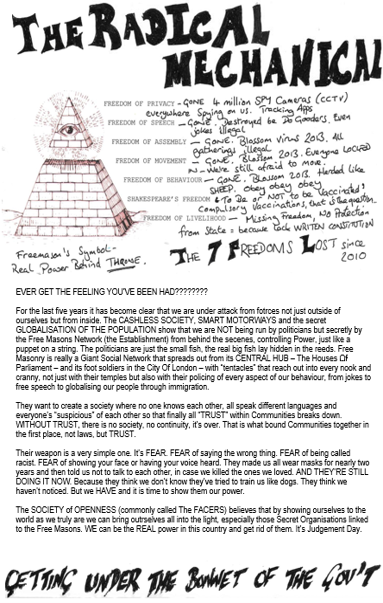
Before Blossomfall hit yours sincerely, I’d happily take me a copy of The Radical Mechanical, that ramshackle rag the slapheaded Facers would hand out while we were all standing in supermarket queues. Partly for their strapline. “Getting Under The Bonnet Of The Gov’t” tickled me for some reason. It might have been the apostrophe
.
Equally as partly for the nostalgia of corner-page staples, eyes in pyramids and RANDOM CAPITALISATIONS (even if it is like being shouted at by a printer). I can’t be the only one to miss fanzines.
Mostly, though, for the giggle. Page after page on how the entire pandemic was either a hoax or the prelude to an alien invasion. But lying on my bed with skin flaking off in lumps and a flame beneath my ribs, struggling to breathe much less laugh, I didn’t care about the cause. All that plagued me was the effect.
Everyone’s got stories. Have you noticed how no one talks about the afters? Those first twelve months once HMG announced that all was clear? Once we’d ditched the polypropylene and worked out our new-old social niceties, breaking those habits we’d formed so quickly, we all stayed schtum. Never told the tales. Never said which neighbours had been calling the bizzies. Never identified the curfew breakers they’d split on.
Just in case they were us. Or we were them. Because for all the jaw-jaw like it was war-war, despite all the death and the debt and the after-effects, Blossom changed nothing. Not jot one. It was just a mirror, revealing ourselves to ourselves. The snitches, the rebels, the sneaks and the pious – they weren’t our alternative identities, adopted in a period of crisis. They were us. We were them. And we still are. Why am I telling you this? Simple. Herman’s supplier is more than thirty-five minutes late and I do waiting even less than I do goodbyes. I am not a happy Maxie.
No posts
Comments
Nothing yet. Say the first thing.
Sign in to join the conversation.