
Welcome to Writing Home, a series of letters and essays from me, Dougald Hine, turning away from the big path, the one that was meant to lead to the future, and looking for what else is worth doing.
Among the places that has led me, I’m part of a convivial conspiracy to celebrate the 100th birthday of Ivan Illich, and here are some updates:
At the latest count, there are gatherings coming together in 67 places around the world.
Darius in Australia is wondering if there’s anyone in/near Sydney who would like to be part of a gathering?
If there’s anyone in Sheffield, England who is up for hosting a gathering, Illich’s publisher, Equinox (who are based in the Workstation) have offered to sponsor refreshments.
Drop me a note about any or all of those things, or similar queries, and I’ll pass them along as best I can.
Meanwhile, on to today’s post…
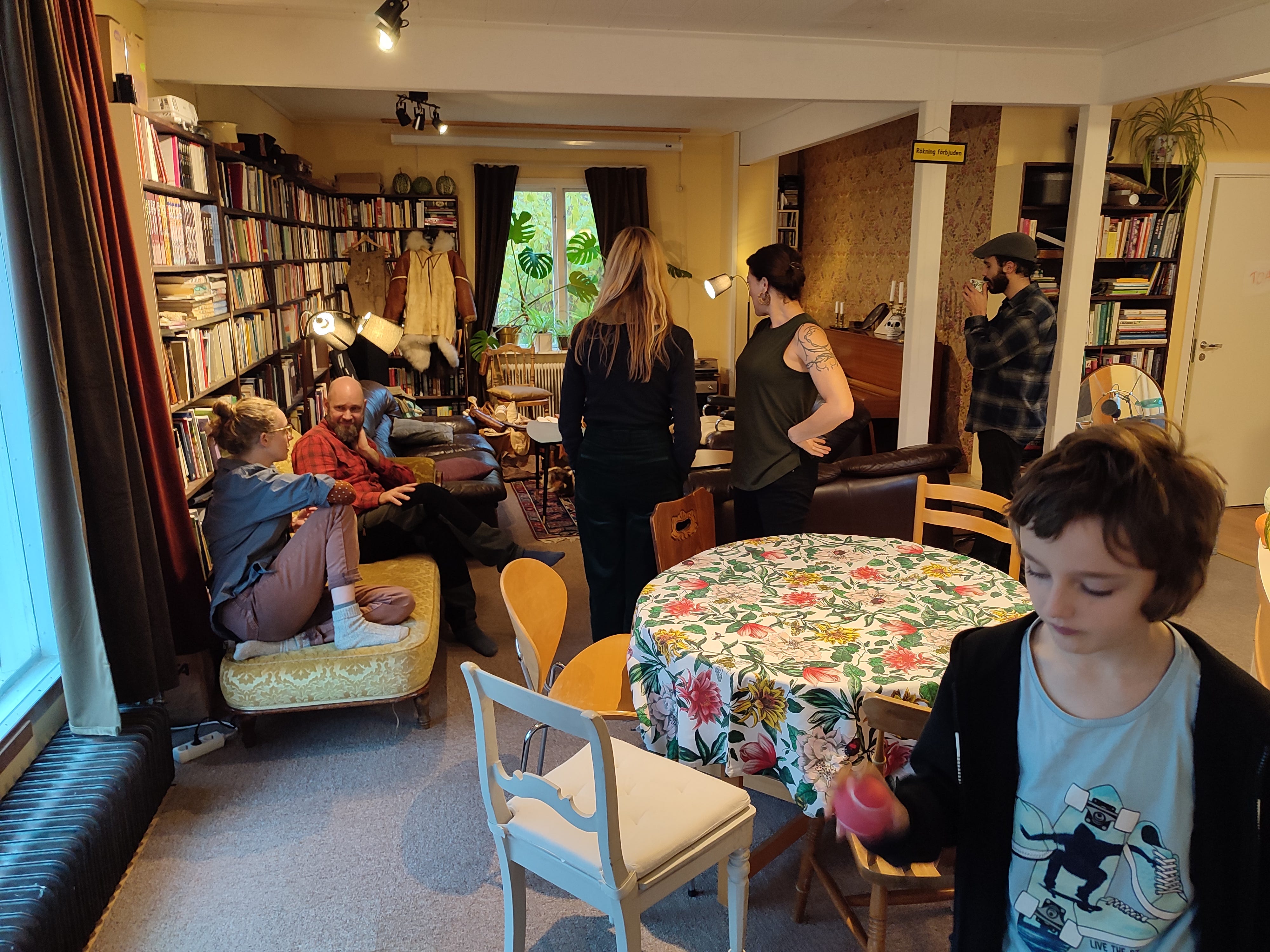
Almost as soon as Anna and I began to shape a school called HOME, we realised that we didn’t want it to be a place to which strangers make long journeys at high speed to be together for a few days with people they will never meet again.
I’ve taught at such places, I’ve felt gratitude for the encounters they made possible, but it doesn’t feel like what is called for now, or not for us.
That left the question of what shape does fit the times, with their troubles, and the longing to connect over distance while also grounding in place. We’ve carried that question through the past eight years, letting it lead us into the different patterns of work that go on under the name of this pocket-shaped school; this gathering place for those who are drawn to the work of regrowing a living culture.
Here’s something else that came home to me this summer: I’m grateful for the degree of attention that my work gets, and the extent to which I’m able to make a living from doing what I love – and I don’t envy those who get more attention than this. I’ve known enough people with bigger audiences and larger public profiles to say I’m grateful to be where I am. It’s enough.
And as I savoured that sensation, these two threads began to dance together. Because, what do you do when you realise you’ve no desire for more?
One answer would be to put a sign up on the door that says “Sorry, we’re full!” I’ve seen people make swerves in an artistic career intended to have that effect. Back when I used to hang out with stand-up comedians, someone told me that, every few years, Daniel Kitson would find himself getting disgusted at the conversations he overheard in the gents at his own gig and decide to make a show that would lose him a good part of his audience. In the fine arts world, a couple of people told me similar tales of moments in their life when they deliberately tacked away from an oncoming wave of hype that some of their peers chose to ride. I respect the confidence it takes to make a move like that. And still, I wonder about the other moves that might be available.
I’m thinking about this, all the more, because – as you may have gathered – I’ve written another book. There’s over a year to go before it comes out, which is good, since this means there’s time to think about its implications, to take care in preparing to accompany it into the world. And it may well drop without that much attention, but there’s also the possibility that it reaches, let’s say, five times as many readers as the last book – which, after all, had the least promising book jacket copy of anything published in 2023: “Middle-aged white guy you probably haven’t heard of decides he’s going to stop talking about climate change” – and that would tip me out of this sweet spot, this attention equilibrium. Which is to say, it would be more than enough.
Here’s what I’m reaching towards: if you find yourself getting more than enough attention, what are the moves by which to direct attention onwards, to keep it moving? Who are the people who do this well? I’m thinking of the moves which help readers – and those drawn to the conversations for which this work is a gathering point – to find each other, to fall into practice, to set off on their own journeys or get dug in where they find themselves. The moves which lift up those whose work picks up in the places where mine tails off, where I run into my limitations.
The other, obvious reason to ask about all this is that the stuff I’m writing about brings us up against deep trouble and deep longings. You don’t need me to tell you how scary it’s looking, to anyone giving attention to the trouble – and increasingly my part has been to speak to the side that has to do with longing, with beauty, meaning and care, and the role of these in how we came to be in this trouble and what might be worth doing now. If the work I’m part of is any help in the face of these depths of trouble and longing, then the sign on the door that turns people away doesn’t feel like the right answer to reaching saturation point for how much attention I can wisely receive.
As I’m thinking about this, it occurs to me that another word for “more than enough” is plenty. In fact, without a sense of enough, you can’t have the experience of plenty, which is part of the riddle of how we find ourselves with economies that double and double and double again, yet lives which are still bent out of shape by the experience of scarcity. And without a living culture, it’s hard to have the experience of enough.
Going back to where we started, then: having recognised that this school couldn’t be built around people getting on planes and coming to Sweden, we went looking for other paths. One that we found involved gathering international groups that meet through screens and cameras, in the series that Anna and I host a couple of times a year: groups that are large enough to give people a choice as to how they engage and a chance for serendipity, but not so large that there isn’t a sense of getting to know each other over the weeks together. Another path is the work we do on our doorstep, here in Östervåla, including neighbourly gatherings and the occasional public invitation to the old shoe shop, such as the concert with David Green this coming Friday. The most heartening consequence of hosting the online series is when people tell us later about the gatherings and collaborations that are taking shape on their own doorstep, as a consequence of the encouragement they found from their fellow participants.
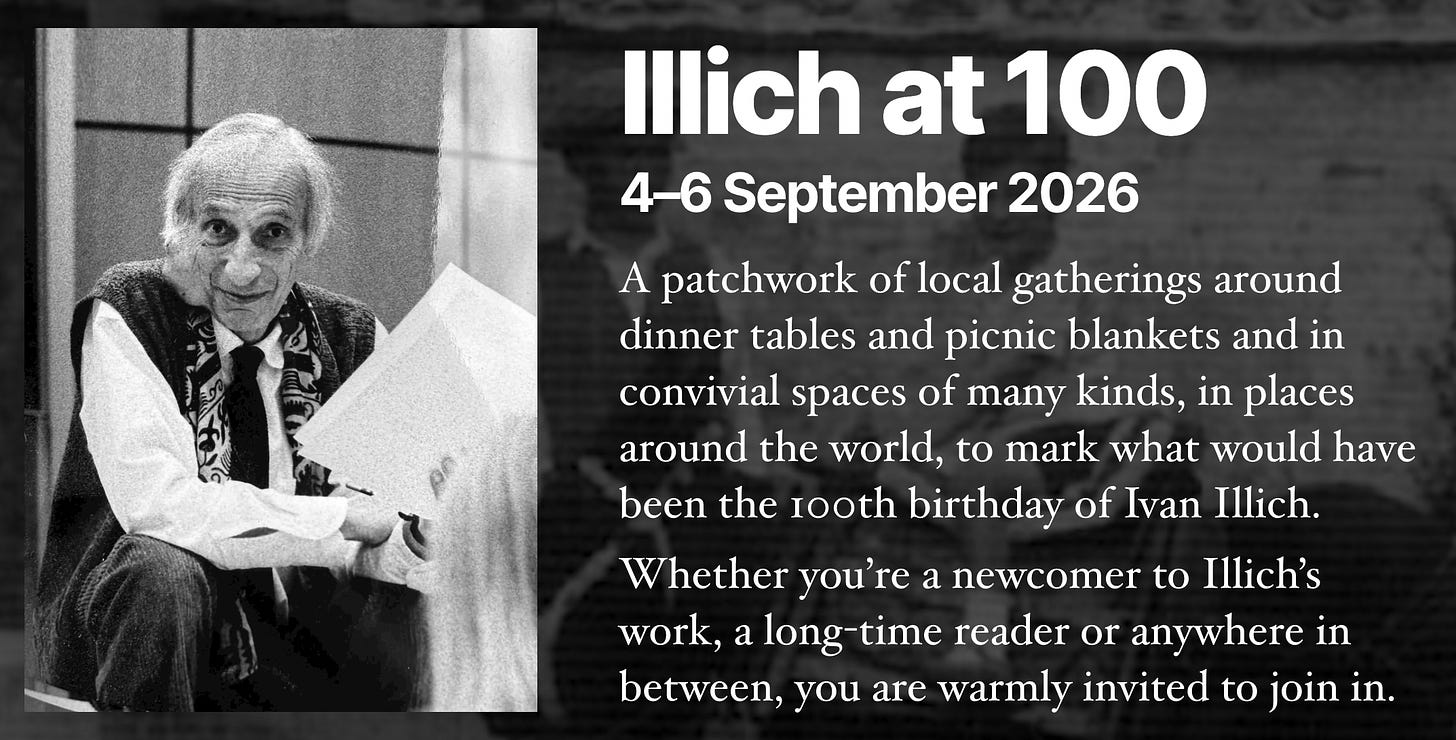
All of which goes some way to explain why our work this coming autumn involves gathering around the work of two of the thinkers whose work we steer by, and who happen to have centenaries this year. Starting in a few weeks’ time, when local gatherings are coming together in many parts of the world to mark what would have been the hundredth birthday of Ivan Illich.
To put up a statue to such an iconoclastic thinker would make no sense, but we can take the occasion as an excuse to gather, to hear again (or for the first time) some of the mind bombs that Illich would drop in passing, the single sentence that shakes assumptions you may never have questioned. (“All through history, the best measure for bad times was the percentage of food eaten that had to be purchased.”) And to meet others who are willing to be troubled into curiosity by lines like that.
Maybe this is a way to practice keeping the attention moving, creating excuses for hospitality, stitching together pockets of conviviality. Maybe this is the kind of thing we do, instead of looking for more and more followers, bigger and bigger audiences. Maybe there’s a knack here that’s worth relearning or reinventing, even in the middle of all the trouble, something like the “art of invitation” that Anne-Marie Culhane, Ruth Ben-Tovim and Lucy Neal talk about.
The invitation to be part of one of the Illich gatherings, or to put your hand up as a local contact for a possible gathering, is live and open to anyone who feels its call:
Find an Illich gathering near you
I’ll be putting together some starting points for anyone curious about hosting a gathering, or just learning a little more about Illich. And there will be further invitations coming soon in a similar spirit.
Meanwhile, the conversation about how we keep attention moving is one that I want to explore over the coming year with those who have been part of supporting my work and who resonate with some of the questions that Anna and I are carrying. As a starting point, I’d love to hear your examples of people who seem to do this well.
Thanks for reading this issue of Writing Home. My work is made possible by those who take out paid subscriptions to my Substack, a number that wobbles up and down a little over time, but has provided a fairly constant source of support for some years now.
I’d be grateful your help spreading the word about these Illich gatherings, so please do share the invitation in any direction that feels appropriate:
https://aschoolcalledhome.org/illich-at-100/
Thanks again!
DH
Comments
Nothing yet. Say the first thing.
Sign in to join the conversation.