
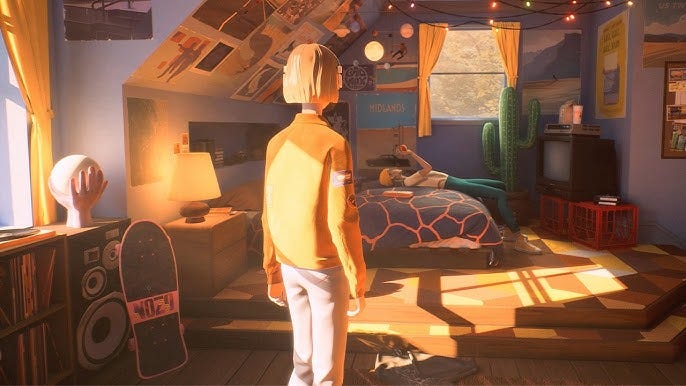
You can’t run in Mixtape.
Why I’m fixating on a movement mechanic that’s of no consequence to 2026’s most polarizing release to date is beyond me. But I found some issue with the fact that you can’t run.
It might be because the experience of Mixtape is one of complete curation. And I found a lot of artifice in this curative process.
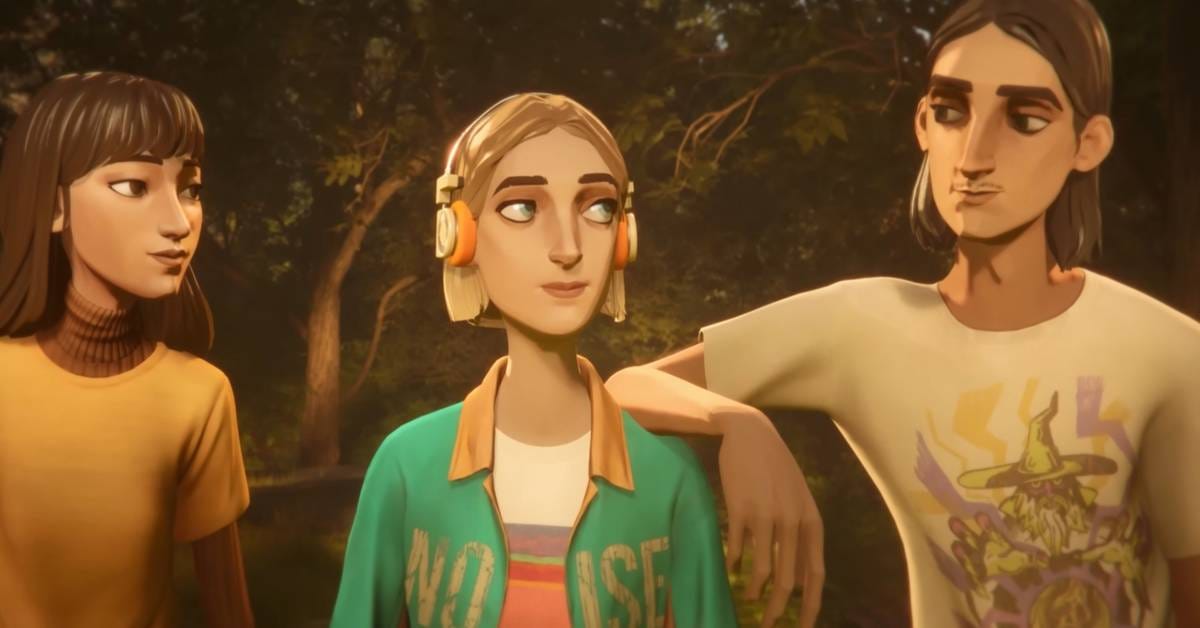
I’m definitely not the first to write a thinkpiece about Mixtape, the new narrative-driven walking simulator title from developer Beethoven and Dinosaur. Mixtape centers on teenagers Stacy, Van, and Cassie as they embark on their final day out in their hometown in Northern California before they all go their separate ways after high school. To fully take in their last few days together, they take a walk down memory lane through their highs and lows of high school delinquency. Stacy Rockford, the protagonist, controls the group’s narrative: her ultimate career aspiration is to be a music supervisor, the ultimate soundtrack and vibe curator. And it’s through this carefully curated soundtrack that we experience Mixtape’s story.
Everything about Mixtape is curated as much as Stacy curates the soundtrack to her life. Some things are quite literal, as the levels themselves are physically intertwined with songs from an elder millennial’s CD collection. Joy Division, the Smashing Pumpkins, and Portishead are lenses through which Stacey remembers each of the pivotal moments of her life. But the other curated aspects of Mixtape are more abstract: each level operates on a linear track with little room for player expression outside of each experience, we see each character only in a selected moment in their lives, and each scene moves on from one another with alarming speed.
Which brings me back to not being able to run. I’m sure that developer Beethoven and Dinosaur wanted to force players to sink their teeth into every aspect of the characters’ journey and really take in the John Hughes-ness of their hometown instead of rushing through each set piece. But it got me asking the question to myself – what is the point of a game that curates a vibe if that vibe never clicks?
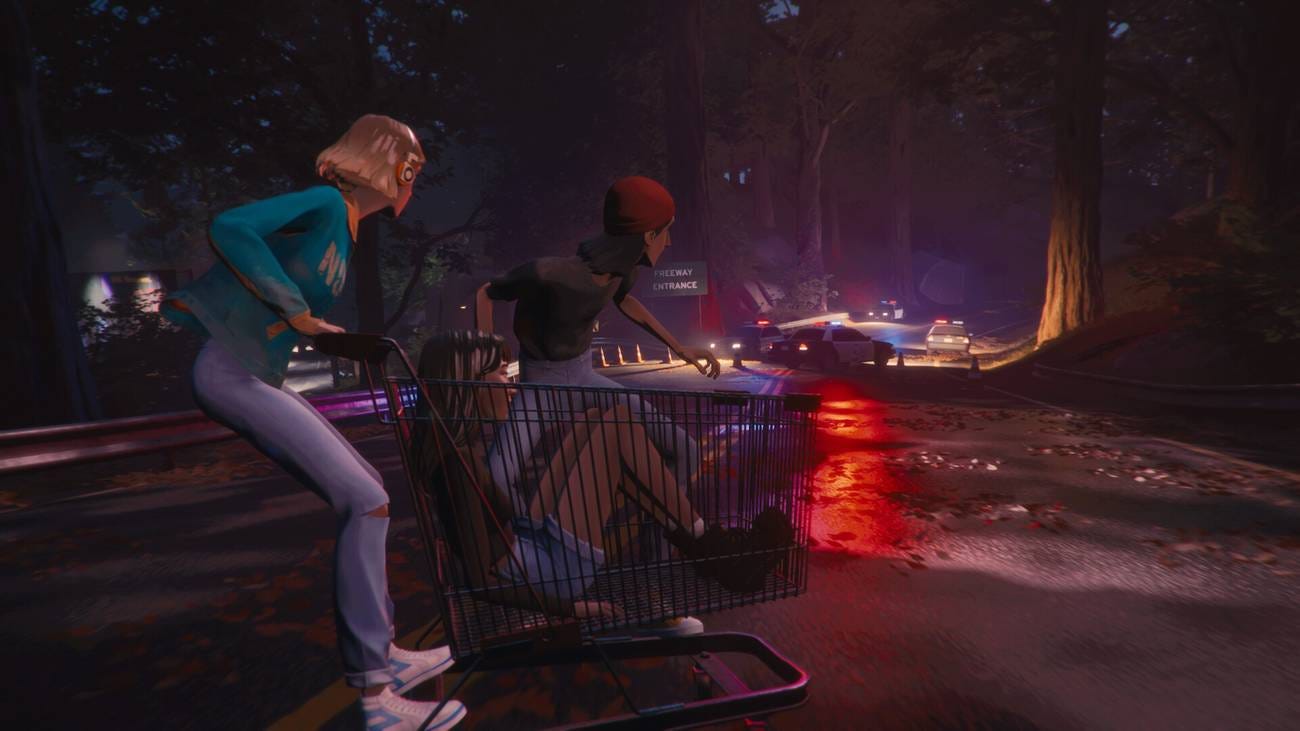
The vibe of Mixtape obviously speaks to some people. Although I rarely pay attention to this kind of news, Mixtape has one of the strangest critical receptions I’ve seen in my lifetime. On one hand there’s people calling it the greatest game they’ve ever played, while on the other it has people up in arms about what makes a game a game and why Mixtape is not one.
I think Mixtape is fine. Just fine! If I had to give it a score, and I’m not usually one to numerically rank how a game makes me feel, it’s probably around a 6.5 and a 7 for me. The game includes enough cultural touchstones that are relevant to someone from any generation, as well as the unique feeling of leaving the place you call home for the first time. But almost too many of the scenes were truly meant for someone who was in high school in the late 90s, not for me who graduated well into the late 2010s. Which is fine!
What it does not mean is that the game is an absolute objective masterpiece. I don’t subscribe to the fact that you can rate art objectively from any standpoint, but I don’t understand why people would rate it so high even if they grew up in the 90s. There are a multitude of story beats in Mixtape that are completely airless, and I think so many of the initial reactions to the game would not hold up under even the slightest bit of scrutiny. The character Cassie has a subplot in the middle of the story where she’s about to be grounded for life and forced into a gap year by her parents all because of Stacey and Van’s bad influences on her. Yet that only gets resolved by Stacey reciting some song lyrics at Cassie’s father and him reciting some back at her. I find that subplot incredibly asinine.
But at the same time there’s no reason why this game should be as panned as it is by would-be Twitter critics. It pisses me the fuck off when people try to dunk on this game because it only has a jump button instead of guns, the entire Marvel Cinematic Universe, and a fleet of microtransactions sucking your wallet dry. Games are an artistic medium, and even while some of the story beats in Mixtape fall flat on their face, that does not mean the game is not a game. One of my favorite moments during Mixtape was just throwing rocks across a pond while taking in the sounds of Monochrome by Lush. The interactivity still matters! And it works in tandem with the less interactive parts like cutscenes and walking around! In short, I’m not interested in debating the merits of walking simulators while I’m listening to this soundtrack.
Unfortunately, Mixtape is the latest in a line of games being thrust into the middle of a made-up culture war where everyone loses. As the folks over at Aftermath say: “By getting punched well above its weight, Mixtape shows that this can happen to any game—and, indeed, that engagement-hungry platforms and content creators demand it. Next week or the week after, there will almost certainly be another One Of These.”
Even though I do not want to relitigate the concept of walking simulators today, I am still annoyed about the lack of interactivity and level of curation within Mixtape. It’s stifling to me.
Trying to do something that a game won’t let you do is somewhat of a revelatory experience. It breaks the illusory wall that separates a player from the bones that support the game and the developers intentions for how the player experiences that digital world. Someone else is controlling my experience. Someone else is curating an experience for me, but I’m trying to make that experience go off its track.
Mixtape curates this experience while trying to make the player understand just how much that experience meant to its characters. Stacy Rockford theoretically is someone who lives in the moment, but is so obsessed with giving that moment a backing track that it feels like we experience an abridged version of her life. She wants us to feel the same exact way that she does, even if it’s to our detriment. And sometimes those pieces never align in the exact correct spot.
When games fail to bring you into the mind of the protagonist, you can see the holes in its infrastructure. A failed joke setup here, a flat character moment there. If an emotional beat really hits – it hits – but if it doesn’t, it fails spectacularly. But this is inevitable when you make a game where curation is the backbone of the experience. Curation in itself is an act of cultural skimming, trying to pick apart the best pieces of art to fit within a specific feeling, moment, or another piece of art. It’s an act that’s inherently artificial, and you can see the artificiality peeking out of every corner of Mixtape despite its walls being painted with a heavy coat of nostalgia.
Critic and media scholar Cameron Kunzelman calls Mixtape’s use of nostalgia like it is – a method to link experiences together through a waning link of intellectual property:
“It sees all of recent history as a thing to sample from in the same way that you would create a vision board on Pinterest or the way you would populate a fictional crowd for LeBron. There are a series of accessible, clear cultural touchstones that can be brought together in a novel formation that will produce a feeling, and if you squint you cannot see the intellectual property seams between them.”
The problem is that this web of IP, this nostalgia is suffocating me as a player-character. The problem is I could still see the gaps and seams in Stacy Rockford’s life.
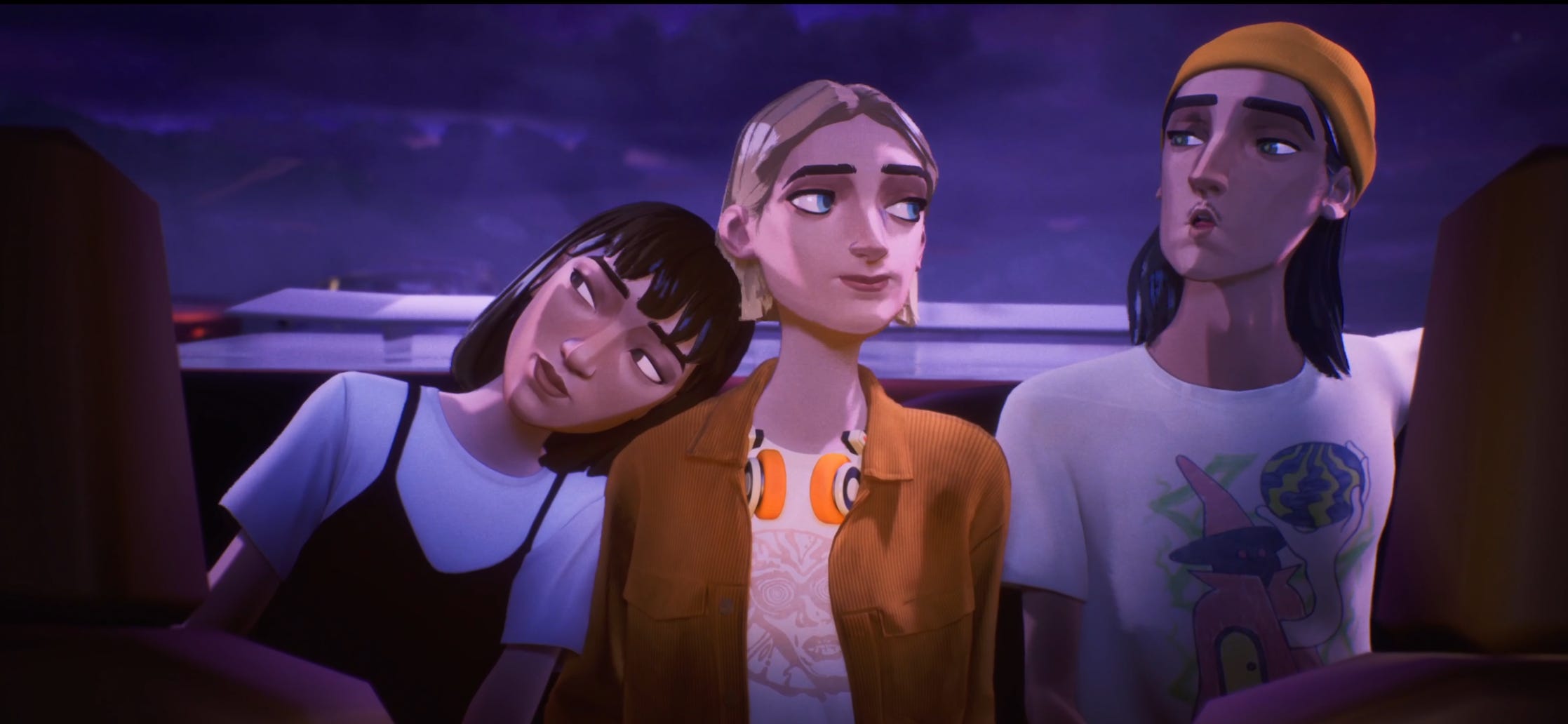
I think there’s a time and a place for curators. I think the very reason why this fake divide in between gamers is a lack of curators. The expanse between “ball and gun” and “journo slop” exists because games are the last great artistic frontier whose biggest fans are realizing that there are simply too many games to play in one’s lifetime. Videogames are expanding faster than we can keep up with, new genres are being invented out of thin air, and the volume of releases is outstripping our attention spans.
What has come out of this explosion in the art form is endless amounts of grift. Pocketwatching studios to hope that a new game from them fails. Trying to review bomb one of the most popular deckbuilder sequels ever made just because they hired a woman consultant. When people get frustrated as AAA studios around them fail them time and time again due to developer layoffs and broken videogames, they turn that rage into grift, which begets more grift, which begets more grift.
I just need people to know that when you make a game entirely centered around art curation mixed with the Breakfast Club, it might not be everybody’s vibe. And that’s just fine.
Thanks for reading Double Jump! This post is public so feel free to share it.
No posts
Comments
Nothing yet. Say the first thing.
Sign in to join the conversation.