
Amal Lalgi is a student from Kerala, India, who is preparing to move to Austria to pursue a bachelor’s degree in Computer Science and Artificial Intelligence.
He prefers clean, minimalist setups with no unnecessary redundancy, a principle reflected in his dotfiles configuration. He enjoys coding, although his academic responsibilities and personal life often limit the time he can dedicate to it.
Amal created and actively maintains Shownamer, a lightweight Python-based CLI tool that retrieves metadata for locally stored TV shows, movies, and other media files, with a primary focus on batch renaming. He is currently improving its functionality and stability while avoiding unnecessary complexity and feature bloat.
He also created Zitchdog, a purple-based Neovim theme that supports many of the tools commonly used by developers, including terminals and CLI applications. Although he has had less time to maintain it recently, it remains one of his active projects.
Amal has also worked on several private client projects through freelancing. Despite having limited time for personal development work, he continues to maintain Shownamer and Zitchdog because they are part of his own workflow. Whenever he encounters an issue while using them, he makes an effort to fix it.
For his code editor, Amal uses Neovim. He migrated to it a few years ago after becoming frustrated with VS Code. Before that, he had used Sublime Text for quite some time.
Even then, he was interested in joining the Neovim community, so he tried sideloading Neovim despite not yet knowing how to use it. He simply wanted to explore it, and it eventually became one of the best decisions he had made. Over time, Neovim gradually became his daily driver.
Amal has now been using Neovim for around three years and continues to learn new things from creators such as TJ DeVries. He is also a fan of creators like Takuya Matsuyama and Adib Hanna, particularly the way they design and organize their development workflows. He even once asked Adib for his wallpaper on Reddit.
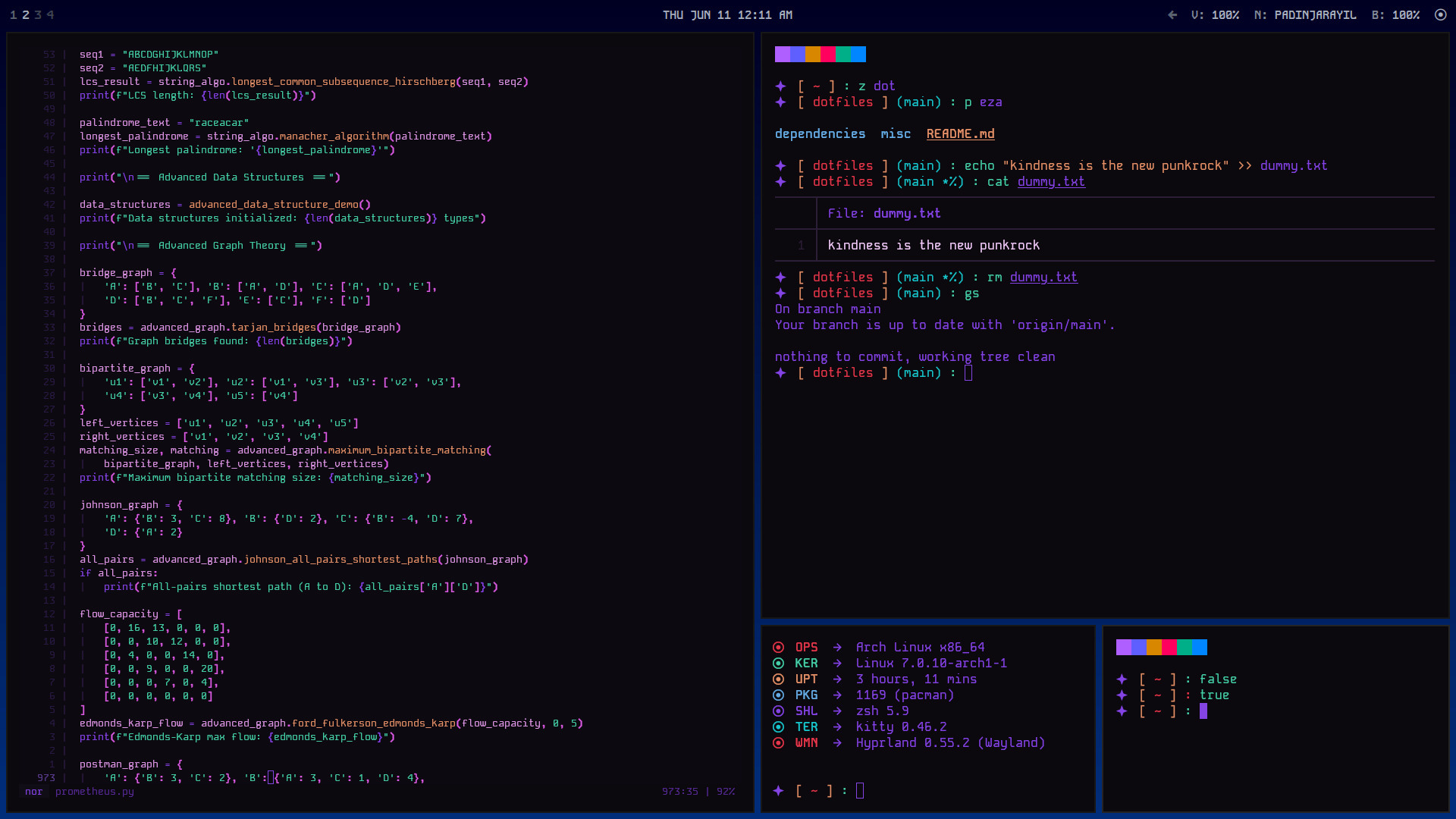
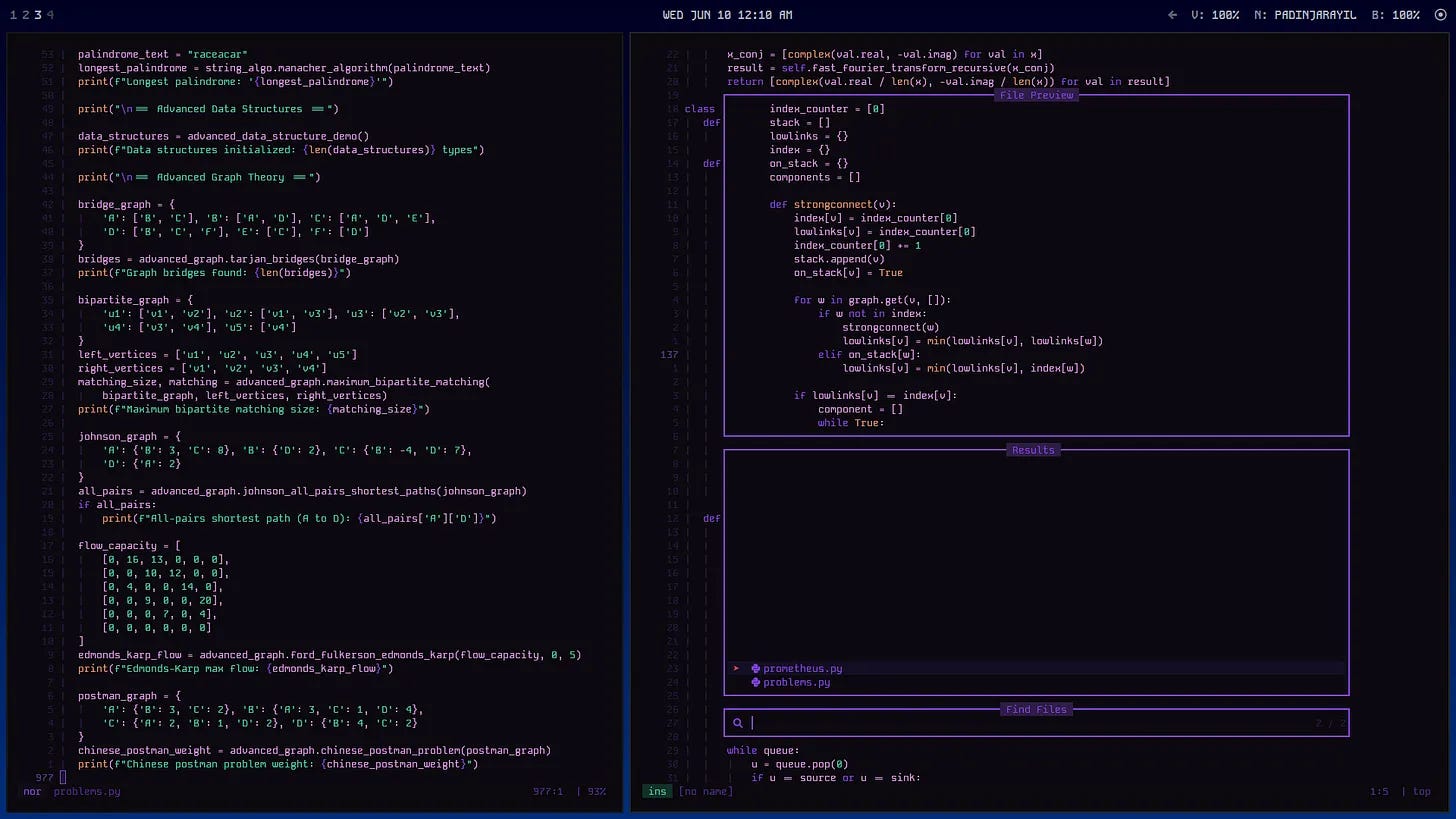
My workflow is very Git dependent, and as of late I try to shove tmux into wherever I can (I wish to master the defaults, as I will be working on a lot of servers in the future). I use lazygit for my Git workflow management as of late, as it gets the job done much faster than manually running git commit -m “foo”. I use delta for diff highlighting in lazygit, and a custom config that does not stray far from the defaults for tmux. Ever since I switched to Kitty (terminal), I had stopped using tmux, since the manual tabs and sessions in Kitty seemed to work really well for my workflow, but I am trying to go back to tmux lately.
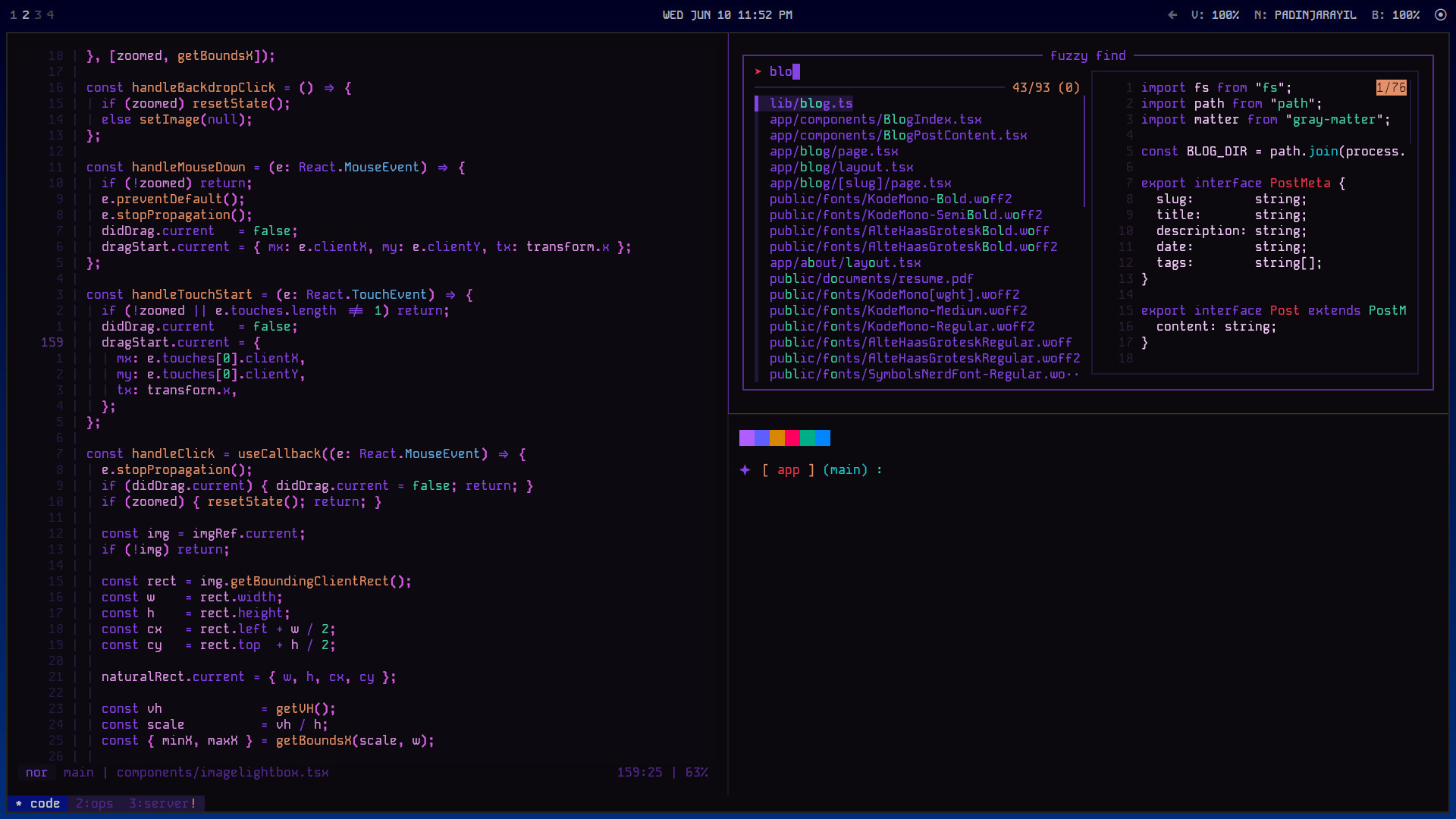
I usually only use tiled windows, which is one of the main reasons I switched to Hyprland. I cannot seem to go back to a floating setup, and I am starting to despise booting into Windows, and I guess I know why.
Still, sign in pop ups and such look too strange while being tiled, so I have also set up a fairly good looking floating setup.
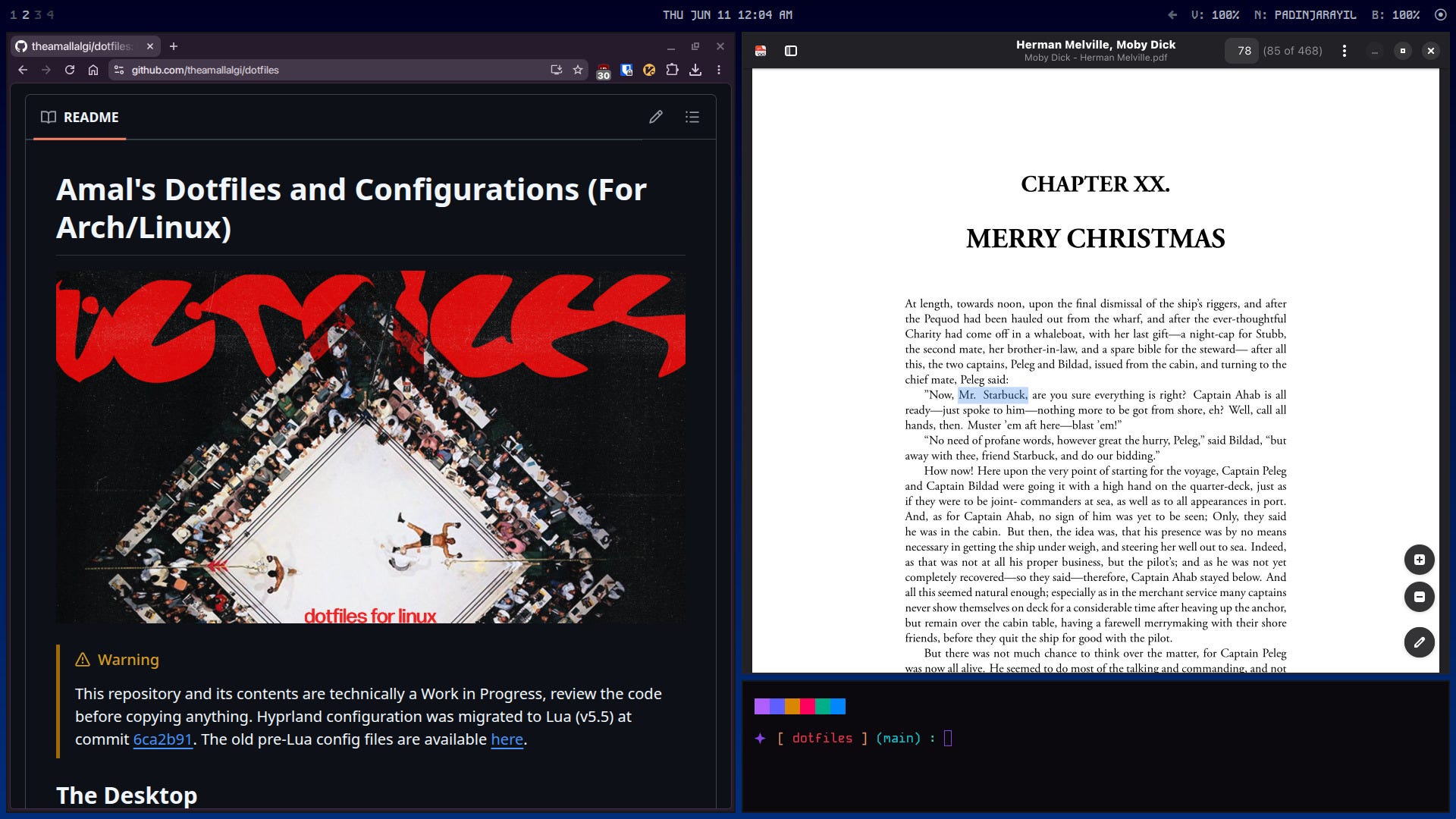
Hyprland – A dynamic Wayland compositor used as the primary desktop environment.
Kitty – The main terminal emulator, although Alacritty remains a favorite.
Nautilus – The file manager of choice; nothing quite matches the clean GNOME aesthetic.
Waybar and SwayNC – Used for the system status bar and notification center.
Helium – The browser of choice and a strongly preferred alternative to Firefox.
Zsh and Nushell – Zsh is the primary shell, with Nushell used occasionally.
Oh My Posh – Used to configure the shell prompt instead of Starship or Oh My Zsh.
MPV – A lightweight and highly configurable media player.
Neovim – The only code editor in the workflow.
KodeMono Nerd Font and the San Francisco font family – The primary fonts used throughout the setup.
More information about Amal’s configuration is available in his dotfiles repository. He has also included high-quality images of his setup with the email.
There is no dedicated installation process or setup script. The configuration files are stored using the same directory structure they use on his system. However, the repository is compatible with GNU Stow.
Comments
Nothing yet. Say the first thing.
Sign in to join the conversation.