
The following article is part of Dot Dot Dot’s ‘Pulse Check’ series that provides real-time industry analysis by connecting the dots between trends, brands, and wider cultural movements.
Earlier this week in Paris, a model named Ivy Stewart walked the finale of Schiaparelli’s “The Abyss” couture show in a bustier of white glazed porcelain-effect silicone, its mirrored fringe embroidered in a white-to-mirror sfumato gradient, lit (literally) from within. She walked it in front of Bad Bunny and a room of luxury editors, new media creators, and the house’s highest-spending clients.
Just a few hours later, the exact look was on Zendaya at the London premiere of The Odyssey, styled by Law Roach, the self-described image-architect. By evening, creators were meme-ing the turnaround itself: the dress that crossed the Channel faster than the official reviews of fashion critics did.
Which was, of course, the point. And before you object that celebrities wear runway looks all the time, yes, that is the oldest distribution deal in fashion where the house lends the dress, the star lends the fame, and the carpet amortises the sample. But that arrangement has always run product-first. A collection exists, is shown, is bought; somewhere downstream, a stylist borrows from it. The premiere promotes the dress.
Monday inverted the sequence. The show and the premiere were one production. A single continuous broadcast of sorts engineered across two capitals, with the couture clients in the Paris room, the only people alive who could actually order the look, recast as extras in someone else’s content. The dress never had a life as a product before becoming media.
Consider what that inversion tells you. In a way the dress’s first client was a camera, not a person.
Stick with me…
In 1962, the historian Daniel Boorstin coined a term for occasions staged solely in order to be reported: the pseudo-event, whose success is measured not by what happened but by how widely it’s reproduced. He was writing about American politics at the time, however the principle stands. Except fashion has improved on him. It no longer merely stages the pseudo-event as much as it manufactures the commentary, the memes, the making-of. A vertically integrated virality supply chain that has ruled our feeds.
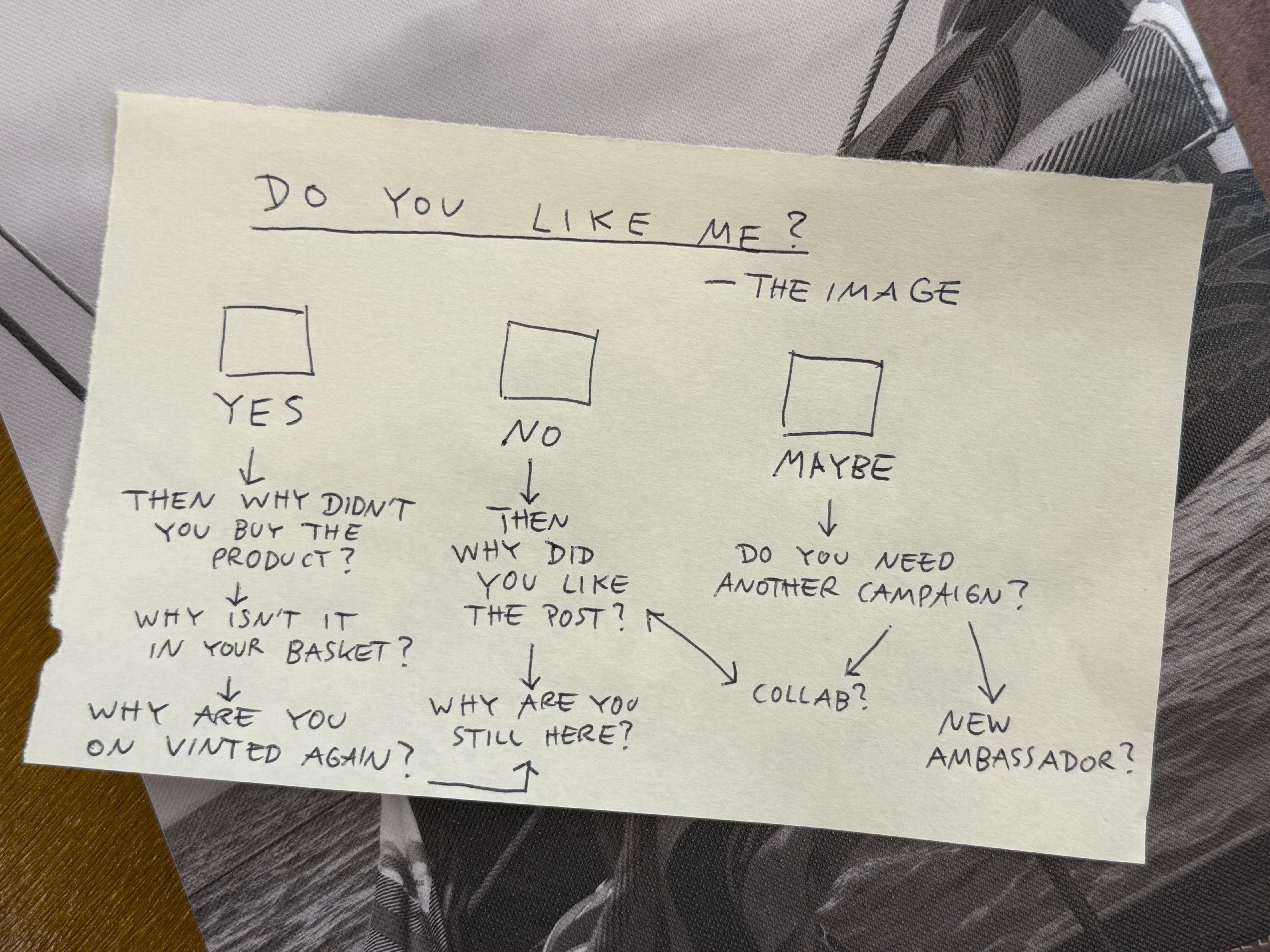
For over a decade, it worked, gloriously. That dress will be the most-seen fashion object of the month, which is precisely why the industry declines to interrogate the strategy.
Fashion provocateur BORING NOT COM interrogated it anyway earlier this week, too. In its blunt way the unknown writer who has gripped the fashion industry wrote about Jonathan Anderson’s latest Dior Couture outing: “Don’t look at the runway, look at the guests. The clothes that dazzle under styling and lights turn heavy and unflattering on real bodies in daylight. What works for the lens doesn’t hold in real life.”
And the complaint is bigger than styling. It cracks open the question this industry has spent a decade not asking out loud: when a house points its money at an image, what is that image actually for? To travel, or to sell? Those used to be the same job. Quietly, they no longer are, and deciding which one you’re paying for is about to become the defining marketing question in luxury.
Comments
Nothing yet. Say the first thing.
Sign in to join the conversation.