
Guest Post by Angel Luis Colón
I watched Brian DePalma’s 1983 version of Scarface way too early for anyone to have watched Scarface. Five years old. In the same room with my cousins, uncles, and my mom. Not a soul concerned about the gratuitous violence and sexual content (hell, how everyone laughed when I did Manolo’s little ice cream trick – again: I WAS FIVE).
The story of a man consumed by his ambition, greed, and getting high on his own supply, 1983’s Scarface is a sun-drenched tragedy. From refugee camp to palatial mansion, Pacino’s Tony Montana is a man who starts at the bottom and finds a way to go lower than the bottom by taking the long way around.
I loved Scarface earlier than anyone should really love Scarface. I can quote entire scenes of that movie by heart (only Rocky and Saturday Night Fever share those distinctions in my life, and please, ask me about how I view SNF as one of the greatest criticisms of 2nd Gen Italian Americans ever committed to film) and I literally fanboyed hard as anyone has ever fanboyed the day I met Steven Bauer; just embarrassingly so.
All that said, despite its great acting (not so much from Pacino), the incredible photography, and flawless general aesthetic – Scarface is a deeply problematic movie that is littered with stereotypes, literal brownface, and a lack of true perspective on the themes it is trying to present.
On paper, those themes stand as a pretty brilliant take on the temptation of capitalism at its arguable height. A young man broken by a communist government is exiled to a place he was taught stood as the antithesis of who he is, but his own anger and ambition allow him to be exactly the kind of person to embrace the excesses of Miami in the 80s. He becomes everything his culture had warned him about and that serves as his downfall. It’s an attractive package for an American audience. You get a story that shields itself by critiquing all systems, but it also serves as a validation: some folks aren’t built to be a true American capitalist – especially Latinos from an evil, Communist island.
I don’t believe Brian DePalma and Oliver Stone were working with any intent to actively harm Cuban immigrants and Cuban Americans in crafting this story. I believe they simply recognized that Howard Hawks’s original film translated almost seamlessly to this kind of story – and it does. What was lacking was perspective. It is impossible to create a story like this without involving the folks who represent its subject. What we got wasn’t that. What we got was a cast of good to great actors in some rough makeup playing caricatures.
As I’ve gotten older, that’s not sat well with me. I may not be Cuban, but I am of Puerto Rican descent. We share some commonalities with our fellow Caribbean Latine folks and it annoys the shit out of me that a film with a pretty great premise has zero perspective. Fortunately, I’m a writer and when you get mad at someone else’s story, it’s time to write the story you want to see your damn self.
Which leads to POP! my latest novel (dropping August 18th from Ruadàn Books). This is my answer to the story of how America tricks those of us most underfoot into the belief that unlimited ambition is the only path out of being under that stupid fucking foot. There’s a lot one is forced to sacrifice; your culture, your moral compass, those who have supported you most, in the name of success. What’s worse: that success is often defined not by ourselves, but by the very same people who have no vested interest in our success.
POP! follows Poppy Leathers, a down on her luck assistant working in two very distinct, but often connected worlds: art and crime. When her assassin boss begins planning a retirement, Poppy realizes she needs to start making moves to gain what she’s been longing for and to keep her head since any transition in a criminal underworld is not without its share of…problems. Unfortunately, Poppy’s legitimate career and her love life crash into her ambitions and she has to make a lot of bad choices to reach the heights she knows she deserves. Of course, none of this will come easy and none of it will come quietly, but Poppy is the kind of woman that relishes a challenge and has never minded the sound of screaming.
When I sat down to write this story, I initially didn’t realize I was responding this strongly to a piece of fiction like the 1983 Scarface. I certainly wasn’t trying to copy it, but as the story grew, I saw the parallels there and I saw the gaps I wanted to address. Not so much to provide anyone any new knowledge—I ain’t here to teach anyone a damn thing—but to rather provide a story of someone coming up in a way that felt a lot less hackneyed. To do that while trying to inject my own sense of satire into the story was a difficult play, but it was important to me that I try. As a marginalized writer, I’m expected to do so much more for much less and I felt that translated to just about any industry—especially criminal enterprise, which is more often than not depicted as a pretty male-centric practice.
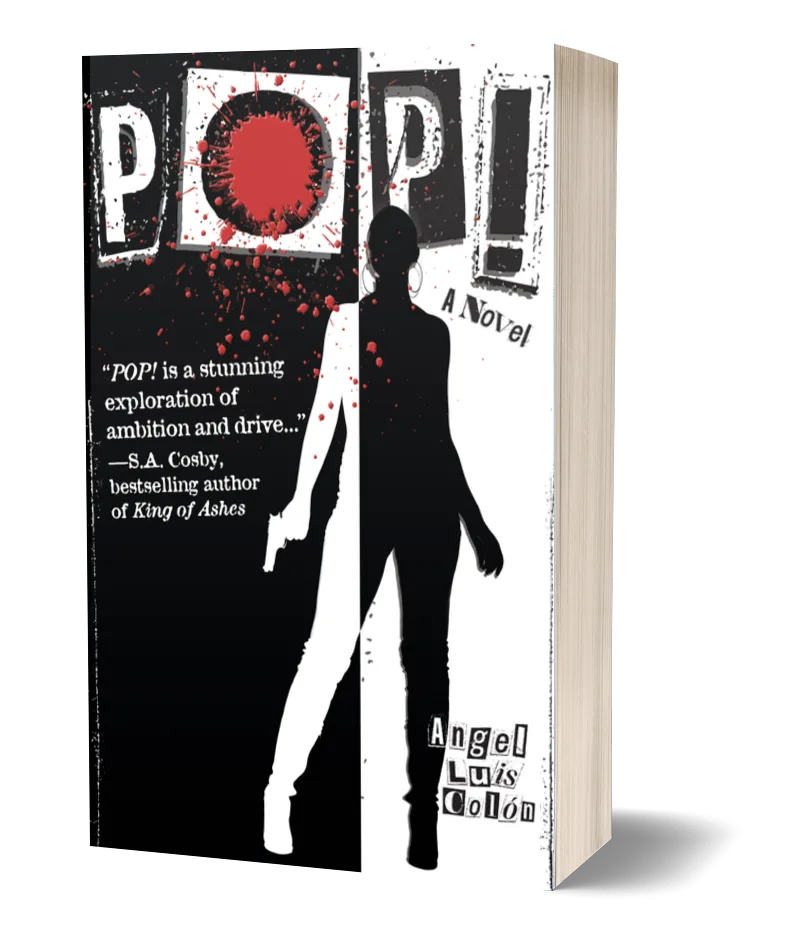
This made Poppy the perfect means of subverting not only the concept of a male-focused crime world, but also in taking back the very idea of a Latine crime villain. Poppy isn’t a collection of stereotypes. She doesn’t speak Spanish at all. She’s born and raised in New York City to family with some means. By most accounts, Poppy has her head together. The tragedy of Poppy is she has learned that the more she strips herself away from where she comes from, the more she’s found that previously defined success. With that in mind, what are the dangers of a system that allows us to win that way? What kind of monster do we become? And if we’re hyper competent; if we’re committed to these ideals as painted by late-stage capitalism and consumption, is there truly a way to stop and what is the shape of our comeuppance in that environment?
I can’t answer those questions without spoiling the story, but I can say that unlike Tony Montana, Poppy Leathers has yet to find a problem you couldn’t solve with much bigger friends than he had.
POP! is available for pre-order now!
***
Angel Luis Colón is the award-winning author of INFESTED and MINECRAFT: HOUSE OF HORRORS. His fiction has appeared in multiple web and print publications including Thuglit, Literary Orphans, and Shotgun Honey. His latest novel, POP! (Ruadán Books) is coming soon.
When he isn’t writing, he’s usually busy baking bread.
No posts
Comments
Nothing yet. Say the first thing.
Sign in to join the conversation.