
By Dory Benami
People died. Real people. Children who won’t grow up. Parents who won’t come home. Grandparents pulled from rubble. Soldiers who won’t see their kids again.
This isn’t a spreadsheet to me.
I watched this war unfold like millions of other people did. October 7. The funerals. The hostage videos. Families carrying photographs and counting days, then months, then years. I watched Gaza too. Buildings flattened. Families grieving. Children pulled from rubble.
There is nothing clean about any of it.
Which is why calling this piece War Math makes me a little uncomfortable. Human beings are not numbers. But once casualty numbers are used to make the accusation of genocide, we have to look at what those numbers actually tell us.
For almost three years, I have watched a legal accusation turn into a reflex.
The death toll rises. Another terrible photograph appears. Another neighborhood is destroyed.
Genocide.
I understand the emotional path. I don’t accept the conclusion.
Israel fought a brutal war in Gaza. Many civilians died. Israeli decisions should be scrutinized, and crimes should be prosecuted where the evidence supports them.
But Israel did not commit genocide.
That conclusion doesn’t come from pretending Gaza wasn’t devastated. It comes from asking what genocide actually means and then looking at the war that actually happened.
Start on October 7
Much of the argument about Gaza begins on October 8.
It shouldn’t.
On October 7, 2023, Hamas led an organized assault into Israel with other armed groups. Fighters crossed the border, attacked military bases and civilian communities, killed roughly 1,200 people and took about 250 hostages into Gaza.
Israel went to war with stated objectives that included dismantling Hamas’s military and governing capabilities and bringing the hostages home.
That doesn’t excuse everything that happened afterward. It tells us why there was a war.
Hamas was not a handful of terrorists hiding in apartments. It governed Gaza. It had an organized armed force, commanders, rockets, weapons and a vast tunnel system. After October 7, it also had Israeli hostages.
And October 7 matters when we talk about intent.
Civilians were not merely unfortunate people standing near military targets. Civilian communities were attacked. People were murdered in their homes, on roads and at a music festival. Others were abducted.
That is targeting civilians as civilians.
There is a difference between civilians dying while an army fights an enemy and civilians being the enemy.
The first can still involve terrible mistakes. It can be reckless. It can be disproportionate. It can involve war crimes.
But those things are not synonyms for genocide.
This Was Bigger Than Gaza
Another part of the story disappears when we draw a box around Gaza.
Israel wasn’t fighting on one front.
Hezbollah began attacking across the Lebanese border immediately after October 7. The Houthis launched missiles and drones from Yemen and attacked shipping in the Red Sea. Iran-backed militias in Iraq joined the conflict. Iran itself eventually launched direct large-scale attacks on Israel.
Israeli communities in the north emptied under sustained fire.
So while Israel was fighting Hamas in Gaza, it was also fighting or absorbing attacks from Hezbollah, the Houthis, other Iran-backed groups and eventually Iran itself.
That doesn’t excuse a dead civilian in Gaza.
But it matters enormously if we are trying to understand Israeli intent.
Israel did not understand October 7 as the opening move in an Israeli project to destroy Gaza’s population. Israel understood it as a massacre followed by a regional war involving Hamas and the larger Iranian network surrounding it.
You can believe Israel responded too aggressively. You can believe Netanyahu’s government made terrible decisions.
But you cannot understand the war while cutting most of the war out of the picture.
The Number Everyone Knows
By July 2026, Gaza health authorities were reporting more than 73,000 deaths since the war began.
It is an awful number.
It is also not 73,000 civilians.
The overall death toll does not give us a complete, independently verified division between civilians and combatants.
Israel has offered estimates of Hamas and other fighters killed. Those estimates have shifted and have not been independently audited well enough to settle the argument.
Then there is the Israeli intelligence database reported by the Guardian, +972 Magazine and Local Call. As of May 2025, it reportedly contained about 8,900 named Hamas and Islamic Jihad fighters listed as dead or probably dead, against an overall reported death toll then around 53,000.
That produced a powerful headline: roughly 83 percent of the dead were civilians.
There is a problem with that math.
The database tells us how many named fighters were recorded in that database. It does not prove that every dead person absent from it was a civilian.
Israel doesn’t get a free pass on its numbers either. If it claims substantially more fighters were killed, those claims require evidence.
So here is what I think we can say without pretending to know more than we do.
A huge number of people died.
Many were civilians.
Thousands were Hamas and other fighters.
We do not have a final, independently audited civilian-to-combatant ratio for the entire war.
That uncertainty matters because the body count has become the centerpiece of the genocide accusation.
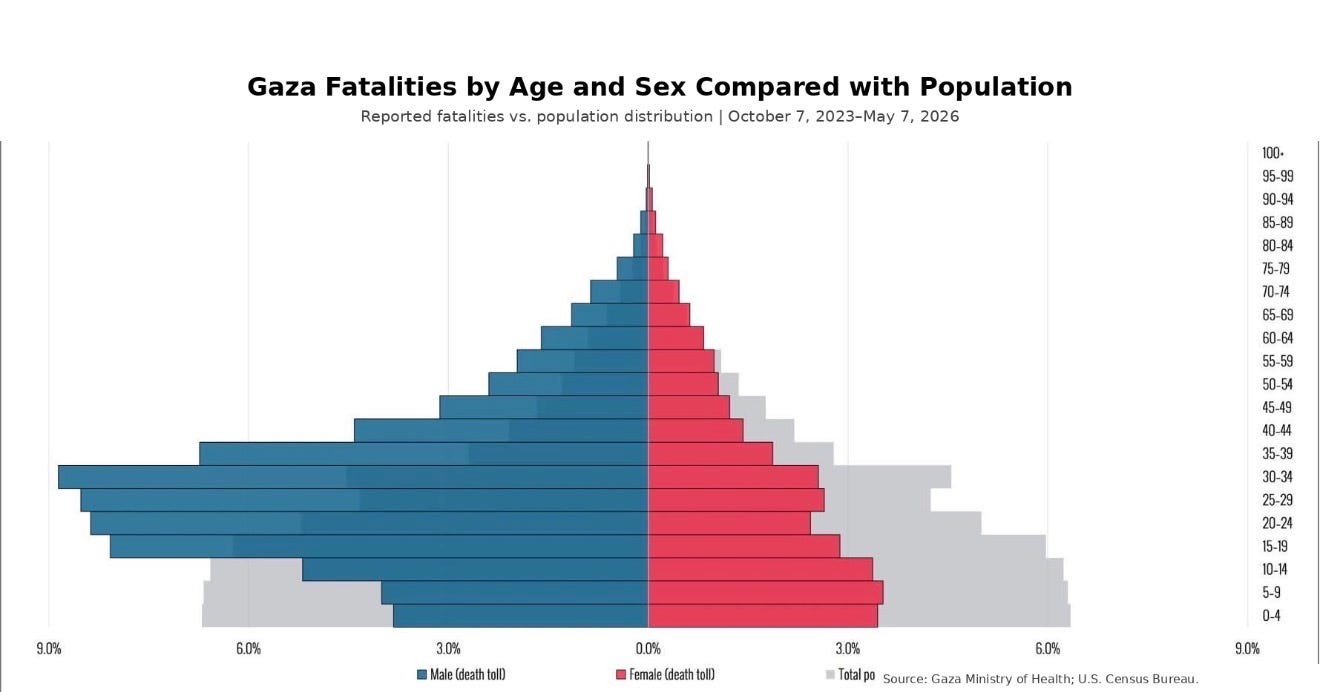
The key point is not that demographics prove the Israeli military’s conduct was lawful. It is that the demographic composition of the dead is evidence that has to be explained by anyone claiming the deaths demonstrate genocidal intent.
Expected Is Not Intended
Here is the hardest sentence in this piece.
Once Israel decided after October 7 that Hamas could no longer remain the military power governing Gaza, civilians were going to die.
I wish that weren’t true.
It was.
There was no plausible ground and air war against Hamas in Gaza that produced zero civilian casualties. Hamas operated in one of the most densely populated urban environments in the world, with fighters, weapons and an enormous tunnel system woven through civilian areas.
Israel knew civilians would die.
Hamas knew civilians would die.
The United States knew civilians would die.
Anyone who understood what this war was knew civilians would die.
Expected civilian death is not the same thing as intended civilian destruction.
That sentence is the heart of my argument.
It does not make expected deaths acceptable. It does not excuse an unlawful strike. International humanitarian law still requires distinction, proportionality and precautions.
Genocide asks a different question.
Was destroying the protected population itself the purpose?
A death toll cannot answer that question by itself.
War Against War
If Gaza’s casualty numbers are supposed to prove something extraordinary about Israel, we need something to compare them with.
Not peace.
Other wars.
From October 2016 through July 2017, Iraqi forces backed by the United States and its coalition partners spent nine months retaking Mosul from ISIS. An Associated Press investigation later estimated that 9,000 to 11,000 civilians died.
In Raqqa in 2017, Amnesty International and Airwars documented more than 1,600 civilians killed directly by coalition strikes during the campaign against ISIS.
Gaza is not Mosul. Gaza is not Raqqa. Different cities, enemies, militaries, tactics and methods of counting.
I’m not comparing them to decide whose civilians suffered more. There is no morally acceptable civilian casualty ratio.
The comparison tells us something much narrower and much more important.
Large numbers of civilians can die when armies fight entrenched enemies in cities without destruction of the civilian population being the purpose of the war.
So a large body count cannot itself prove genocide.
That isn’t an excuse.
It’s context.
And context matters when the accusation is genocide.
A War With Hostages Inside It
Gaza had another complication.
Hamas was holding roughly 250 people abducted from Israel somewhere inside the battlefield.
Children. Elderly people. Soldiers. Entire families.
Israel was trying to destroy Hamas while simultaneously trying to recover people Hamas was holding inside the territory Israel was attacking.
Sometimes that went horribly wrong.
On December 15, 2023, Israeli troops in Shejaiya shot and killed three Israeli hostages who had escaped captivity: Yotam Haim, Alon Shamriz and Samer Talalka. They were unarmed. They were waving a white flag. The IDF acknowledged that the soldiers violated its rules of engagement.
That was a catastrophic failure.
It also tells us something about the kind of war this was.
Hostages. Tunnels. Fighters. Civilians. Split-second decisions. Terrible mistakes.
That is not proof that everything Israel did was lawful.
It is evidence that reality was considerably messier than the word genocide allows.
The War Changed
Another problem with treating 73,000 deaths as one number is that nearly three years of war were not one battle.
Gaza City was not Khan Younis. Khan Younis was not Rafah.
Hamas adapted. Israeli intelligence changed. Tactics changed. Civilians moved. The intensity of fighting changed.
The casualty pattern changed too.
An Associated Press analysis published in June 2024 found that women and children represented 64 percent of fully identified deaths at the end of October 2023 and about 38 percent of identified deaths recorded in April 2024.
That does not give us a civilian-to-combatant ratio. Adult men are not automatically combatants, and women and children are not a substitute for counting civilians.
But the change matters.
If casualty patterns are evidence against Israel, changes in those patterns are evidence too.
The cumulative death toll tells us the scale of the tragedy.
It does not tell us the story of the war.
Hamas Understood the Math Too
Hamas understood what civilian casualties would do politically.
In leaked messages reported by the Wall Street Journal in June 2024, Yahya Sinwar described mounting civilian losses as “necessary sacrifices” while discussing the pressure those losses were putting on Israel.
That matters.
Not because it absolves Israel of anything. Israel remains responsible for Israel’s decisions.
It matters because civilian casualties were part of Hamas’s strategic calculation too.
Hamas fought from inside a civilian society while knowing that civilian deaths would damage Israel internationally. Its leadership understood that every photograph of a dead child would move public opinion in ways a dead Hamas fighter never could.
And they were right.
So when we look at the death toll, we cannot simply assume it tells us what Israel intended.
The same number can be the tragic consequence of one side’s military objective and the political advantage sought by the other.
That is exactly why intent cannot be inferred from the number alone.
What About What Israelis Said?
This is where the argument against Israel gets stronger.
Some Israeli politicians and officials said awful things after October 7.
There is no point pretending otherwise.
Some statements were inflammatory. Some were reckless. Some were disgusting. They belong in the evidence.
But they are not all the evidence.
If we are trying to determine the intent of a state and its military across a multi-year war, we have to look at what the military was actually trying to do.
Israel targeted Hamas commanders, fighters, tunnels, rockets and weapons infrastructure. Israeli soldiers died fighting Hamas fighters. Israel issued evacuation warnings before operations. It negotiated repeatedly to recover hostages. Its tactics changed over time.
The IDF also has a formal ethical doctrine that includes “Purity of Arms,” requiring soldiers to minimize harm to people not involved in fighting.
Does that prove Israeli soldiers always followed the rules?
Of course not.
A military code is not an alibi. Soldiers can violate orders. Commanders can make terrible decisions. Crimes can happen.
But we’re talking about intent.
If the ugliest sentence uttered by an Israeli politician counts as evidence, then military doctrine, orders, targeting patterns, evacuation procedures and actual conduct count too.
You cannot build an honest case by admitting only the evidence that points in one direction.
When I look at the whole record, I see overwhelming evidence that Israel intended to destroy Hamas’s ability to fight and govern.
I do not see evidence that persuades me Israel intended to destroy the people of Gaza as a people.
Yes, a UN Commission Called It Genocide
In September 2025, the UN Independent International Commission of Inquiry concluded that Israeli authorities had committed genocide in Gaza. It found four of the five underlying acts identified in the Genocide Convention and concluded that genocidal intent was the only reasonable inference from the evidence it examined.
I think it got that wrong.
I also have deep problems with the way parts of the UN system have treated Israel over decades. But simply saying “the UN is biased” isn’t an answer.
The Commission made an argument about intent.
So answer it.
Is an Israeli intention to destroy Gaza’s population really the only reasonable inference from this war?
I don’t see how.
Hamas invaded Israel and massacred civilians. It remained an organized armed enemy. It held hostages. Israeli soldiers fought and died against Hamas fighters. Israel targeted commanders, tunnels, weapons and military infrastructure while simultaneously fighting or absorbing attacks from Hezbollah, the Houthis, Iran-backed militias and Iran itself.
There were evacuation warnings. There were hostage negotiations. There were changes in tactics. There was also enormous destruction, civilian suffering, questionable decisions and allegations of serious crimes.
That record can support a lot of arguments about how Israel fought.
I do not believe genocide is the only reasonable one.
And the Commission is not the International Court of Justice. The ICJ has not issued a final judgment finding Israel responsible for genocide.
That distinction is not a loophole.
It is the difference between an accusation and a judgment.
What Genocide Actually Means
The Genocide Convention does not say that enough dead people eventually make a genocide.
It requires specified acts committed with the intent to destroy, in whole or in part, a national, ethnic, racial or religious group as such.
There is no genocide number.
Not 20,000.
Not 50,000.
Not 73,000.
The dead matter. The pattern matters. Statements matter. Military orders matter. Humanitarian policy matters. Conduct matters.
But eventually all of that evidence has to answer one question:
What was Israel trying to destroy?
My answer is Hamas.
Its military capacity. Its leadership. Its tunnels. Its weapons. Its ability to govern Gaza and repeat October 7.
Not the people of Gaza as a people.
I don’t need to defend Netanyahu to say that. I don’t.
I don’t need to claim Israel fought a perfect war. It didn’t.
I don’t need to pretend every strike was lawful.
War crimes, if proven, are war crimes.
They are not another word for genocide.
The People Who Already Decided
This is where the argument leaves international law and comes home to American politics.
Scott Wiener publicly called Gaza a genocide in January 2026. As of July, his congressional campaign was still using that characterization.
He isn’t alone.
I think they are wrong, and I think history is going to be rough on politicians who turned the gravest accusation in international law into a political identity marker before the legal and historical record was remotely complete.
Calling Gaza a genocide is not simply criticizing Netanyahu.
It is not saying Israel used excessive force.
It is not saying civilians suffered horribly.
It is not even accusing Israeli soldiers or leaders of war crimes.
It is saying Israel intended to destroy a people.
That accusation should require evidence equal to its seriousness.
Instead, in parts of American politics, “genocide” became something closer to a password. Say the word and demonstrate that you understand which side you are supposed to be on.
I watched people who should have known better do it anyway.
There is a cost to that.
Israel is a democracy that was attacked by an armed organization that deliberately murdered and abducted civilians, then fought a regional war against that organization and a wider network backed by Iran.
Being a democracy does not place Israel above the law.
Neither does being angry at Israel place its critics above the facts.
History will judge Israel’s conduct in this war.
It should.
History will also judge the people who announced the verdict while the evidence was still coming in.
War Math
There is no good civilian casualty ratio.
Zero is the only number any decent person should want.
But zero was never a realistic outcome of this war.
More than 73,000 dead tells us something enormous about the human cost of Gaza. It does not tell us, by itself, how many were civilians, how many were fighters, whether particular strikes were lawful or what Israel intended.
For that we need the whole record.
October 7. Hamas. The hostages. The tunnels. The fighters killed. The civilians killed. Hezbollah. The Houthis. Iran. The changing battlefield. The casualty patterns. Hamas’s strategy. Israeli rhetoric. Israeli military doctrine and conduct. The allegations against Israel. And finally, intent.
When I put those things together, I do not see genocide.
I see a country that suffered a massacre and went to war against the organization responsible for it.
I see an enemy that deliberately attacked civilians and then fought from inside a civilian population.
I see a regional war that eventually stretched from Gaza and Lebanon to Yemen and Iran.
I see enormous civilian suffering.
I see Israeli decisions that deserve scrutiny and, where crimes occurred, accountability.
I see a devastating war.
And I see an Israeli military whose central objective was destroying Hamas, not destroying a people.
Eventually historians will have information we do not. Military records. Cabinet discussions. Intelligence assessments. Targeting files. Better casualty data. Courts will finish their work.
There will be plenty to argue about.
There should be.
But I am comfortable making the distinction now.
Expected civilian death is not intended civilian destruction.
A terrible war is not automatically genocide.
And a 73,000-person death toll does not relieve us of the obligation to ask why those people died, who was fighting, who was targeted and what the people conducting the war were trying to accomplish.
That is the uncomfortable part of war math.
The numbers do not make war moral.
They make us confront what kind of terrible thing actually happened.
Gaza was a terrible war.
Israel did not commit genocide.
I believe history will bear that out.
Author’s Note
This essay makes a specific argument about genocide. It does not argue that every Israeli strike was lawful, every civilian death unavoidable or every Israeli policy defensible.
International humanitarian law separately regulates distinction, proportionality and precautions in attack. Israeli conduct that violated those rules should be investigated on the evidence.
Casualty figures remain contested, particularly the division between civilians and combatants. I have tried not to turn uncertainty into certainty simply because one number helps my argument.
In September 2025, the UN Independent International Commission of Inquiry concluded that Israel committed genocide and that genocidal intent was the only reasonable inference from the evidence it examined. I disagree with that conclusion. The Commission is an investigative body, not the International Court of Justice, which has not issued a final judgment finding Israel responsible for genocide.
The point of War Math is not that numbers prove Israel innocent. They do not. It is that the body count so often offered as proof of genocide cannot establish the specific intent the accusation requires.
Notes and Sources
1. October 7, 2023. Hamas led the assault into southern Israel with participation by other armed groups. Approximately 1,200 people were killed and roughly 250 taken hostage. Subsequent investigations documented attacks on civilian communities, killings of civilians and hostage-taking.
2. Israeli war aims. Israeli leaders publicly identified dismantling Hamas’s military and governing capabilities and returning the hostages as central objectives of the war. Stated objectives are evidence of intent, not proof by themselves. They must be considered alongside actual policy and conduct.
3. The regional war. Fighting across the Israel-Lebanon border began on October 8, 2023. Hezbollah subsequently became Israel’s principal adversary on that front. The Houthis launched missiles and drones toward Israel and attacked Red Sea shipping. Iran-aligned militias elsewhere in the region participated, and Iran later launched direct large-scale attacks against Israel.
4. Gaza casualty figures. By July 2026, Gaza health authorities were reporting more than 73,000 deaths since October 7, 2023. The aggregate figure does not itself provide a complete civilian-combatant classification.
5. The combatant denominator. The Guardian, +972 Magazine and Local Call reported in August 2025 that an Israeli intelligence database listed approximately 8,900 named Hamas and Palestinian Islamic Jihad fighters as dead or probably dead as of May 2025, when the overall reported death toll was approximately 53,000. The publications interpreted the figures as implying an approximately 83 percent civilian share. Absence from that database does not independently establish civilian status. Israel’s higher public combatant estimates likewise require substantiation.
6. Mosul. An Associated Press investigation estimated that 9,000 to 11,000 civilians died during the October 2016 to July 2017 battle to retake Mosul from ISIS. The comparison in this essay concerns the civilian consequences of urban warfare, not an assertion that Mosul and Gaza were identical conflicts.
7. Raqqa. Amnesty International and Airwars documented more than 1,600 civilians killed directly by U.S.-led coalition strikes during the 2017 campaign against ISIS in Raqqa. As with Mosul, methodologies, battlefield conditions and casualty attribution differ from Gaza.
8. The three hostages killed in Shejaiya. On December 15, 2023, Israeli troops killed Yotam Haim, Alon Shamriz and Samer Talalka after the three escaped Hamas captivity. The IDF concluded that the shootings violated its rules of engagement.
9. Changing casualty composition. Associated Press analysis published in June 2024 found that women and children represented 64 percent of fully identified deaths at the end of October 2023 and approximately 38 percent of identified deaths recorded during April 2024. Sex and age cannot be used as direct substitutes for combatant status. The data are cited to demonstrate that casualty composition changed over time.
10. Yahya Sinwar and civilian casualties. The Wall Street Journal reported in June 2024, based on leaked messages, that Sinwar described mounting civilian deaths as “necessary sacrifices” in discussing the political pressure the war was creating for Israel. The statements are relevant to Hamas’s strategic calculations but do not transfer legal responsibility for Israeli targeting decisions to Hamas.
11. Israeli rhetoric and intent. Statements by Israeli officials cited as evidence of genocidal intent are relevant. Their evidentiary weight depends on the authority of the speaker, context, connection to military policy and consistency with actual conduct. Such statements should be assessed alongside military objectives, orders and operations rather than in isolation.
12. IDF doctrine. The IDF’s published ethical code, The Spirit of the IDF, includes the principle commonly translated as “Purity of Arms,” requiring force to be used for military purposes and instructing soldiers to avoid unnecessary harm to uninvolved people. Formal doctrine does not prove operational compliance, but it is relevant when institutional intent is being assessed.
13. UN Commission of Inquiry. On September 16, 2025, the Independent International Commission of Inquiry established by the UN Human Rights Council concluded that Israeli authorities and security forces had committed four of the five underlying acts enumerated in the Genocide Convention and possessed specific genocidal intent. The Commission is an investigative body, not a court.
14. Genocide Convention. Article II of the Convention on the Prevention and Punishment of the Crime of Genocide defines genocide through specified acts committed with intent to destroy, in whole or in part, a national, ethnic, racial or religious group as such. The Convention establishes no numerical casualty threshold.
15. ICJ proceedings. South Africa instituted proceedings against Israel under the Genocide Convention in December 2023. The International Court of Justice subsequently ordered provisional measures. Those orders did not constitute a final judgment that Israel committed genocide. Former ICJ President Joan Donoghue later clarified that the Court’s January 2024 order had not determined that the allegation Israel was committing genocide was itself “plausible.”
16. ICC proceedings. In November 2024, the International Criminal Court issued warrants concerning Benjamin Netanyahu and Yoav Gallant alleging war crimes and crimes against humanity. Genocide was not among the crimes charged in those warrants. That fact does not amount to an ICC determination that genocide did not occur.
17. Scott Wiener. Wiener publicly characterized Israel’s conduct in Gaza as genocide in January 2026 and continued to use that characterization in his congressional campaign materials as of July 2026. My criticism concerns the conclusion he has chosen to make publicly, not his right to criticize Israel or its government.
Principal Sources
Convention on the Prevention and Punishment of the Crime of Genocide, Article II.
International Court of Justice, South Africa v. Israel, orders and case materials.
Independent International Commission of Inquiry on the Occupied Palestinian Territory, including East Jerusalem, and Israel, report concerning genocide, September 2025.
International Criminal Court, Situation in the State of Palestine, proceedings concerning Benjamin Netanyahu and Yoav Gallant.
Human Rights Watch, investigation of the Hamas-led October 7 attacks, July 2024.
Associated Press, investigation of civilian deaths during the Battle of Mosul.
Associated Press, analysis of Gaza casualty data, June 2024.
Amnesty International and Airwars, investigation of civilian casualties during the Battle of Raqqa.
The Guardian, +972 Magazine and Local Call, joint reporting on Israeli military intelligence casualty data, August 2025.
Israel Defense Forces, The Spirit of the IDF.
The Wall Street Journal, reporting on Yahya Sinwar’s messages concerning civilian casualties, June 2024.
UN reporting concerning the regional conflict and cross-border fighting beginning in October 2023.
Reuters, continuing reporting on October 7, Gaza casualty figures, the hostage crisis and the regional conflict, 2023–2026.
Scott Wiener for Congress, foreign policy materials, accessed July 2026
About the Author
Dory Benami is an Israeli-born American small business owner, former congressional candidate and Democratic political activist. He has worked in international business, law and entertainment and has spent decades involved in Democratic politics. He writes about Israel, antisemitism, American politics and what happens when political tribes become more important than facts.

No posts
Comments
Nothing yet. Say the first thing.
Sign in to join the conversation.