
As young girls, we lunge and leap into each day’s offerings until that afternoon when we are scolded for our boldness and directed to the corner to play with dolls.
In the classroom, girls outperform boys across measures, with the gap widening through the grades. Socialized to prioritize relationships and community cohesion, girls are more likely than boys to be compliant and self-sacrificing, both of which are praised and rewarded in the halls of school (Lehti & Laaninen, 2024; Parker & Hurst, 2025).
So it would follow that such successes would snag onto our heels and carry us into the boardroom, yet though the divide is slowly narrowing, women still hold only 10% of CEO jobs, where quiet compliance gets you nowhere (Hinchliffe, 2024).
Yet, speaking up will cost you, too.
Women who are assertive in the workplace are often penalized for breaking feminine norms, resulting in lower performance reviews and fewer leadership opportunities. A double bind for sure, because assertiveness is considered essential for top positions (LeanIn.Org & McKinsey & Company, 2025; Lin et al., 2025).
And there’s little middle ground in the quandary. Speaking out just a few times will pin a label on your lapel, one not easily removed, so women are charged with deciding whether to persistently self-silence or go for broke, risking the fallout to make their voices heard.
It is an inside inquisition, one Savala Nolan (2026) boldly takes on in her new book of essays, Good Woman: A Reckoning.
Already, I have texted the opening lines to the bold women in my life who have declined society’s whisper to shrink and comply:
I refuse to be good. This is a matter of survival, not inclination or mood. I refuse to be easy, and I refuse others’ preferences. I refuse to be amicable, and I refuse to appease. I refuse to go along, and I refuse to agree. I refuse to do what I was trained to do. Instead, I choose whatever lies beyond my social conditioning, even if I’m still looking for it, still spurring it into being.
I plan to use this book the next time I teach my senior seminar on Women as Disruptive Change Agents in Their Community.
So what can we do to loom large?
First, we can build and nurture a small circle of women, both inside and outside our organizations, who, like us, value and practice expressing their ideas and publicly leaning into their expertise. Research shows that whereas centrality, or being respected and connected across the organization, provides significant benefits to men, for women to match that benefit, they need to complement those loose ties with tight circles. This small group of sisters provides validation, serves as a practice arena for developing ideas, and acts as a gateway for collecting information not publicly shared. And the more diverse the circle, the better, inviting us to expand our networking into new communities while avoiding redundancy (Yang et al., 2019).
Second, we can commit to intentionally amplifying the voices of other women, for there is nothing more disheartening than speaking up at a meeting, while the other women in the room practice what Ballakrishnen et al. (2019) calls intentional invisibility, or remaining silent in order to minimize exposure. But when women know others have their back, they are more likely to make their voices heard. Amplification may sound something like this: “I want to build off the important point Rachel just shared, …” Such comments model support, normalize assertiveness, and ensure women’s ideas are heard and rightly attributed.
Lastly, when possible, seek out organizations that hire and support transformational leaders who elicit diverse and contrary opinions, provide autonomy, and encourage critical conversations while modeling innovation and intellectual risk-taking (Vinkenburg et al., 2011). In such spaces, leaders seek out and engage naysayers, welcoming not merely tolerating dissent. An effective strategy for this work is premortems, in which groups envision all the ways an idea might be wrong or a project might fail, and then backwards design to mitigate pitfalls (Fletcher et al., 2023). Such an approach makes sense, for research shows that the most innovative organizations engage critical discourse (Gaur et al., 2024; Heilman et al., 2024).
However, even if such leadership is absent, as it often is, keep your thoughts clear, your voice loud, and surround yourself with sisters who help you stay honest to the mission, taking up Nolan’s (2026) invitation:
Let me reclaim these gestures of refusal, repurpose them, imbue them with the grandeur of defiance, the thrill of noncompliance, and the steely spine of rejection not just as a matter of flighty, passing wishes but as a matter of politics, of life and death, of dignity and self-possession, of personhood. Let me be gutsy for whichever young women and girls are watching. I am not asking permission; I am summoning.
References
Ballakrishnen, S., Fielding-Singh, P., & Magliozzi, D. (2019). Intentional invisibility: Professional women and the navigation of workplace constraints. Sociological Perspectives, 62(1), 23–41. https://doi.org/10.1177/0731121418782185
Fletcher, B., Hartley, C., Hoskin, R., & Maor, D. (2023, February 15). Into all problem-solving, a little dissent must fall. McKinsey & Company. https://www.mckinsey.com/capabilities/people-and-organizational-performance/our-insights/into-all-problem-solving-a-little-dissent-must-fall
Gaur, D., Gupta, K., & Pal, A. (2024). Transformational women leadership: A road to sustainable development goal of women empowerment. Journal of Global Responsibility, 15(2), 193–214. https://doi.org/10.1108/JGR-04-2023-0053
Heilman, M. E., Caleo, S., & Manzi, F. (2024). Women at work: Pathways from gender stereotypes to gender bias and discrimination. Annual Review of Organizational Psychology and Organizational Behavior, 11, 165–192. https://doi.org/10.1146/annurev-orgpsych-110721-034105
Hinchliffe, E. (2024, June 4). Fortune 500 companies with women CEOs in 2024. Fortune. https://fortune.com/2024/06/04/fortune-500-companies-women-ceos-2024/
Lehti, H., & Laaninen, M. (2024). The gender achievement gap in grades and standardised tests: What accounts for gender inequality? Frontiers in Sociology, 9: 1448488. https://doi.org/10.3389/fsoc.2024.1448488
Lin S. J., Woodall J. P., Mitchell, M. S., Chi N. W., Johnson, R. E. (2025). The gendered nature of leader behaviors: Navigating stereotype threat from conservation of resources and gender role perspectives. J Appl Psychol. 110(8): 1083-1104. doi: 10.1037/apl0001263
LeanIn.Org & McKinsey & Company. (2025). Women in the workplace 2025. https://wiw-report.s3.us-east-1.amazonaws.com/Women_in_the_Workplace_2025.pdf
Nolan, S. (2026). Good woman: A reckoning. HarperCollins.
Parker, K., & Hurst, K. (2025, March 13). The gender gap in teen experiences. Pew Research Center. https://www.pewresearch.org/social-trends/2025/03/13/the-gender-gap-in-teen-experiences/
Vinkenburg, C. J., van Engen, M. L., Eagly, A. H., & Johannesen-Schmidt, M. C. (2011). An exploration of prototypical leadership and gender stereotypes. The Leadership Quarterly, 22(1), 10–21. https://doi.org/10.1016/j.leaqua.2010.12.003
Yang, Y., N. V. Chawla, & Uzzi, B. (2019). A network’s gender composition and communication pattern predict women’s leadership success. Proc. Natl. Acad. Sci. U.S.A. 116(6) 2033-2038.

This week I am reading Theo of Golden by Allen Levi.
One of my favorite quotes from Levi’s book: “A man who loves all women loves no woman. A man who loves only one woman loves all women. Do you agree?”
― Allen Levi, Theo of Golden
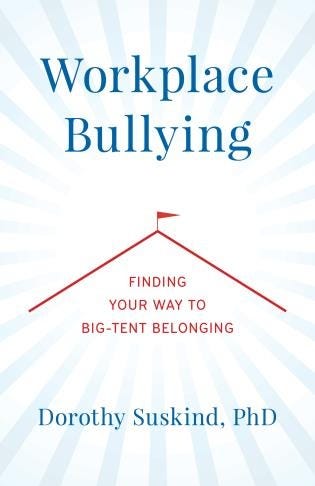
Workplace Bullying: Finding Your Way to Big Tent Belonging
From the Publisher: Workplace Bullying: Finding Your Way to Big Tent Belonging is a lifeline for people who have been targets of workplace abuse and are desperately trying to make sense of the trauma. It is a resource for partners trying to help their loved ones heal. And, it is a toolkit for managers and industry leaders inspiring to create inclusive cultures by proactively addressing toxic behaviors that stagnate innovation, fracture work communities, and drive out top employees. To simplify a complex topic and make the book readable and engaging for a wide audience, the author uses the elements of story to tell the tale of workplace bullying, zooming in on the characters, settings, and plotlines of cultures that allow and/or encourage workplace abuse.

I love hearing from readers, so please don’t hesitate to reach out to say hello or suggest topics for me to write about next ~ dorothysuskind@gmail.com.
No posts
Comments
Nothing yet. Say the first thing.
Sign in to join the conversation.