
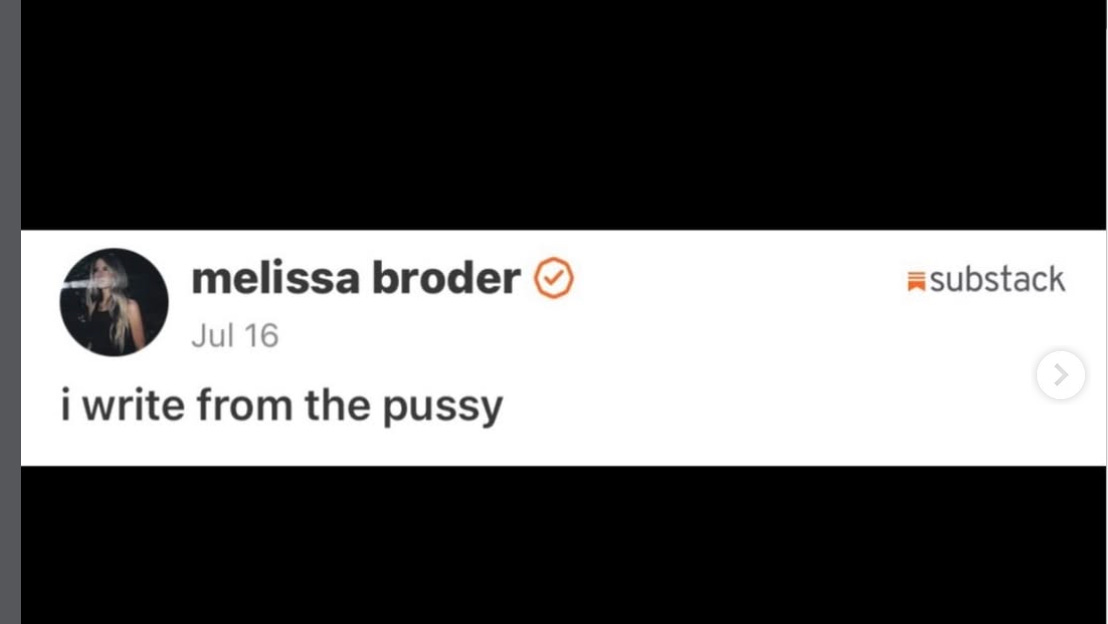
wrote Melissa Broder in a recent Substack note. I kept thinking about it, and so I thought interrogating the mechanics of that five word phrase might make an interesting Substack post. Here we go…
First, we momentarily hear the syntactic idiom, I write from the heart, which is a cliché we’ve heard hundreds of times before, but we’ve never heard of writing from the pussy. Immediately, the reader attends twice. The charge of it occurs in the interval between the two readings: that’s familiar and that’s strange.
You can’t literally write from the pussy (unless you have pretty superb pelvic floor muscles) but you can’t literally write from the heart either. Writing from the heart is a metaphorical claim about the location of authorship: writing supposedly originates from that inner, authentic self. So, to write from the pussy carries that load.
The substitution of the word “heart” to the word “pussy” forces us back into the literal body and the metaphor for genuine expression.
Pussy is an interior place and a threshold. (Where does writing emerge from then, inside the body, or the threshold?) Pussy is slang. It’s provocative. Now, the conventional metaphor and authorship itself is displaced by a sexual/gendered body, which carries with it (depending on your subjective taste) a curious vulgarity, intimacy, shame, pleasure, femininity. The register of the word is crude, potentially misogynistic, but importantly Broder (and not just Broder) has reclaimed those meanings along with the word.
Why did I feel the need to bring this particular phrase to anyone’s attention? By which I mean, why did I need to kill the joke?
Because taking a cliché and altering it is one of very easiest ways to surprise and delight your reader. We are caught in a contested space, our brain recognising something familiar at odds with the unexpected.
In the same IG post of her Substack notes, I enjoyed:
the true “artist’s way” is just staring into space
sorry but if you love my books you’re obviously a pervert, i don’t make the rules
“don’t text him” - tolstoy
still using the em dash like the punk i fucking am
never getting over shit has been good for my writing
I love that Tolstoy’s writing, in all his verbosity, might be reduced to “don’t text him”. I like that there is a faux putting down of her audience / readers as perverts — it’s probably true, and there exists an unspoken acknowledgement that her readers won’t mind being called perverts. The “artist’s way” has been reduced to staring into space suggesting a vapid, vacuous mind, rather than the notion of the complex literary mind that is always absorbing and observing and producing. And the last phrase taps into the idea that writing performs a therapeutic function, it recognises the emotional / mental struggle that might make a person need to order their experience as representational practice.
I encountered Broder during the years when Twitter was one of the most used platform for writers from 2010 until (whenever Musk took over) but truthfully it was already starting to become a cesspit before the takeover. But it was a great platform for delivering short fragments of text, a useful way of practising precision and concision, and additionally and it was a way of widening your reach and finding a community.
The particular poetic sensibility of Broder is charged with an absolute refusal to self-censor, saying what had previously been unsayable, a bit like Plath and Sexton in the 50’s writing openly about subjects that challenge social expectations e.g. motherhood, depression, sexuality, abortion, suicide, thus countering the popular suburban “American Dream”, the ideal nuclear family narrative, and the rigid gender expectations that accompanied it.
Alicia Ostriker wrote that the confessional writer ‘who attempts to explore female experience is dismissed as self-absorbed, private, escapist, non-universal’ and Deidre Heddon builds on the idea of the confession as a ‘feminised space’ where the feminine ‘continues to signify negatively’ and is ‘perpetually devalued’. Heddon quotes Irene Gammel: ‘the confessional mode is dismissed as ‘raw’, ‘narcissistic’, and ‘unformed’… A history of confessional readings has created the perception of women obsessively confessing their secrets, reinforcing stereotypes of the female psyche as fragmented and what is perhaps even worse as ‘needy’.
Broder’s sensibility sort of leans into that. It’s a new confessional that isn’t interested in just disclosure, it is charged by this extraordinarily alert, observational intelligence. It’s a sort of:
I don’t want to be alive, but look what I’ve noticed that is absurd about that experience.
Often, it captures a particular tonal doubleness, a type of “despair and attention”. The speaker can be depressed, traumatised, etc., but is still capable of noticing the ridiculous, grotesque, and banal in that experience. The observation doesn’t necessarily redeem the suffering, either.
I’m not suggesting that Plath and Sexton were simply “I will tell you the terrible truth about myself” but what’s different is the increasingly radical sense that almost nothing is excluded from poetic material — psychiatric language, medication, sex, bodily functions, shame, diagnosis, institutionalisation, domestic minutiae, the embarrassing thought, the politically incorrect thought, the thoughts you would ordinarily edit out.
It offers a vocabulary for experiences that previously might have been private, mysterious or unspeakable: diagnosis, symptoms, depression, trauma, disorder, medication. It says: look at what the clinical language cannot quite contain and that language is also something we shouldn’t necessarily trust.
Broder wrote from @sosadtoday which (I think) was also the title of her first book, but now she writes from here.
In 2016, Guardian Kathryn Bromwich writes about Broder’s mix of internet slang and intellectual despair in this article, and highlights these tweets:
it’s not my fault i was born: the musical
keep calm and disappoint your family
ruin something for someone you love today
thought of the day: no
I’m also reminded of Mira Gonzalez who wrote with a similar tone:
so, if I cant figure out a way to browse the internet in fetal position, does that mean i have to choose one or the other? bullshit
Yesterday, in a tribute to the loss of Dolly Parton and Tim Curry, Mira Gonzalez tweeted:
we cannot lose a third gay icon i will lose my fucking mind
I no longer tweet — very few poets still tweet, as far as I’m aware. Most moved onto BlueSky.
Anyway, following this Substack, I’ve just spent two hours going through my old tweets. Be warned, for the immediate future I’ll be (getting high on my own supply) posting them on here as notes and on IG. In no way am I suggesting they are as good as Broder’s. They consist of my [very important] thoughts, things my children have said, quotes from poets, lyrics. I’m not sure how long this behaviour will last, but it probably deserves an apology in advance.
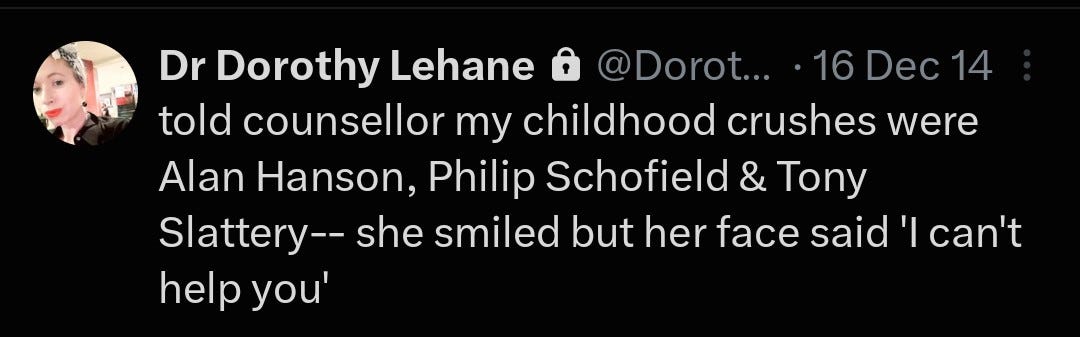
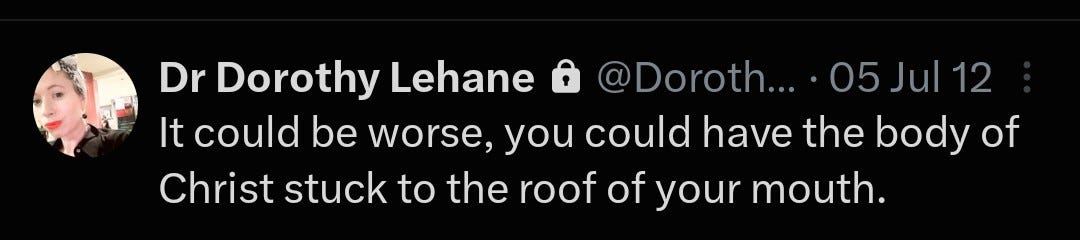
To kick off this series:



Comments
Nothing yet. Say the first thing.
Sign in to join the conversation.