
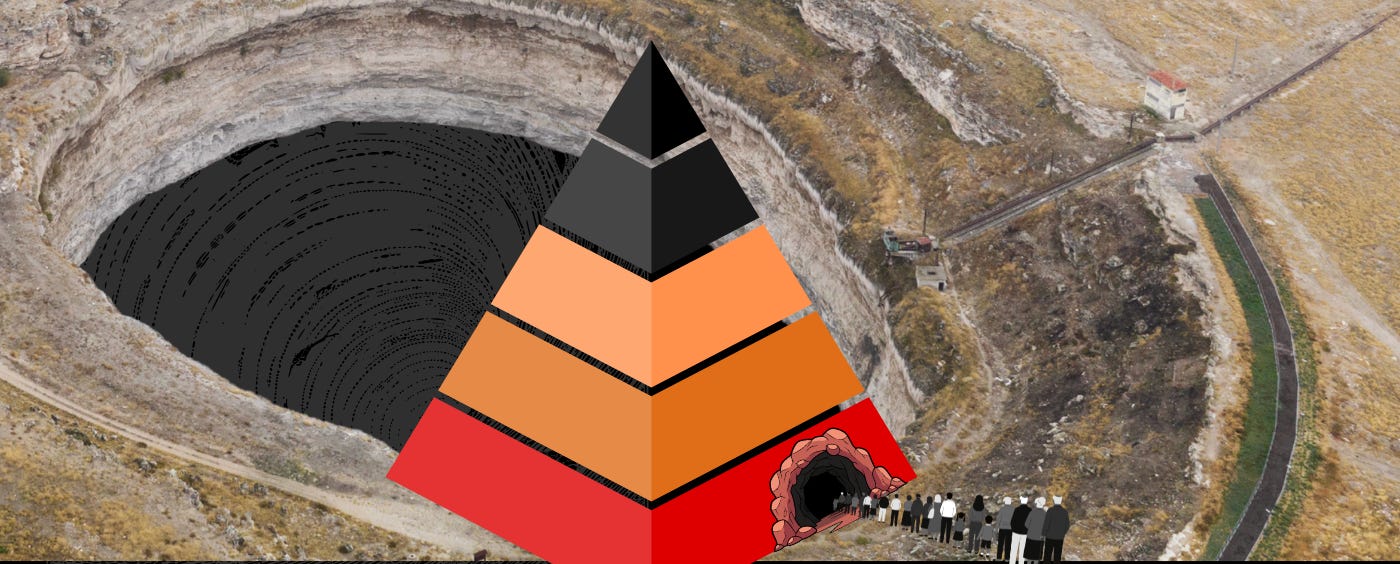
Over the past five years working in cult recovery, gang intervention, and other high-control environments, I’ve observed recurring structural patterns that, once recognized, can help us navigate these spaces with greater awareness and clarity.
The Praxis Wheel serves as a compass for orienting oneself within high-control and trauma-impacted spaces. The Facade Pyramid / Control Sinkhole model, by contrast, maps the architecture of those environments, revealing how they are structured, how people are drawn into them, and how dependency is maintained once inside.
Together, these concepts can provide survivors, clinicians, educators, and facilitators with a visual framework for understanding and navigating high-control systems.
Perceived Structure
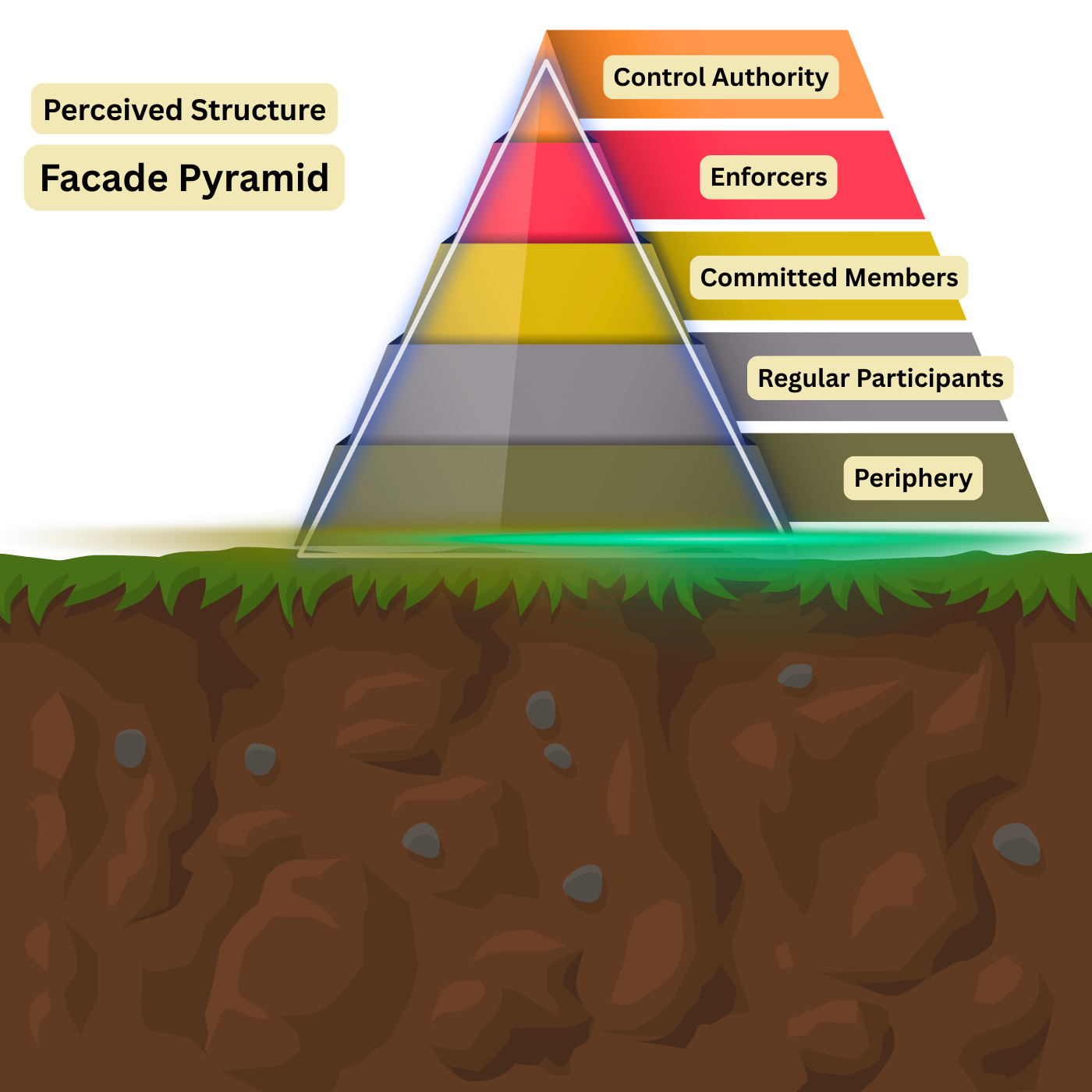
High-control systems are traditionally described as pyramid-shaped hierarchies, with individuals progressing upward from the periphery toward a central authority at the top. The pyramid implies aspiration: upward movement, advancement, reward, and earned status.
In practice, however, many such systems function less as aspirational hierarchies and more as dependency structures. They are organized to concentrate power, shield abusers from accountability, hoard resources, and manufacture human loyalty around a central authority, with dependency increasing the deeper one goes.
They follow a recognizable architecture:
Perceived Structure: Facade Pyramid (upward mobility)
Actual Structure: Control Sinkhole (downward dependency)
Within the perceived pyramid:
Periphery: Casual or occasional participants; lightly engaged affiliates; prospective recruits
Regular Participants: Routine participants begin identity alignment with the system
Committed Members: Individuals with substantial emotional, ideological, and practical investment
Enforcers: Those who maintain norms, police boundaries, and reinforce compliance
Control Authority: Central leadership directing the structure and concentrating power
The Control Authority—whether leader, guru, coach, kingpin, boss, abusive partner, or ideological figurehead—typically seeks increasing consolidation of material extraction, authority, bodily access, narcissistic gratification, and reality control while insulating itself from accountability.
Across many settings—churches, gangs, MLMs, yoga groups, large-group trainings, abusive relationships, authoritarian political movements, exploitative workplaces, and trafficking/criminal enterprises—the aesthetics and ideology may differ dramatically, yet the structural patterns remain strikingly similar.
This model is useful for identifying power hierarchies across diverse environments.
Its limitation, however, is that it still frames the structure as aspirational.
Hierarchy itself is not inherently abusive or controlling. Human communities often organize around differences in experience, responsibility, skill, trust, or temporary delegation of authority. Healthy structures may contain leadership, expertise, and coordination without producing coercive dependency. Likewise, ideological positions may range from mainstream to fringe without inherently constituting high-control dynamics. The distinguishing factor is not the presence of hierarchy or ideology itself, but the abuse of power, suppression of autonomy, and use of controlling or coercive behavior.
What distinguishes a high-control system is not the mere existence of hierarchy, but the concentration of unaccountable power, the suppression of autonomy, and the transformation of ordinary human dependence into systematic exploitation.
A healthy structure distributes power in ways that remain contestable, transparent, and accountable. A high-control structure centralizes power while insulating leadership from challenge, consequence, and reciprocity.
Actual Structure
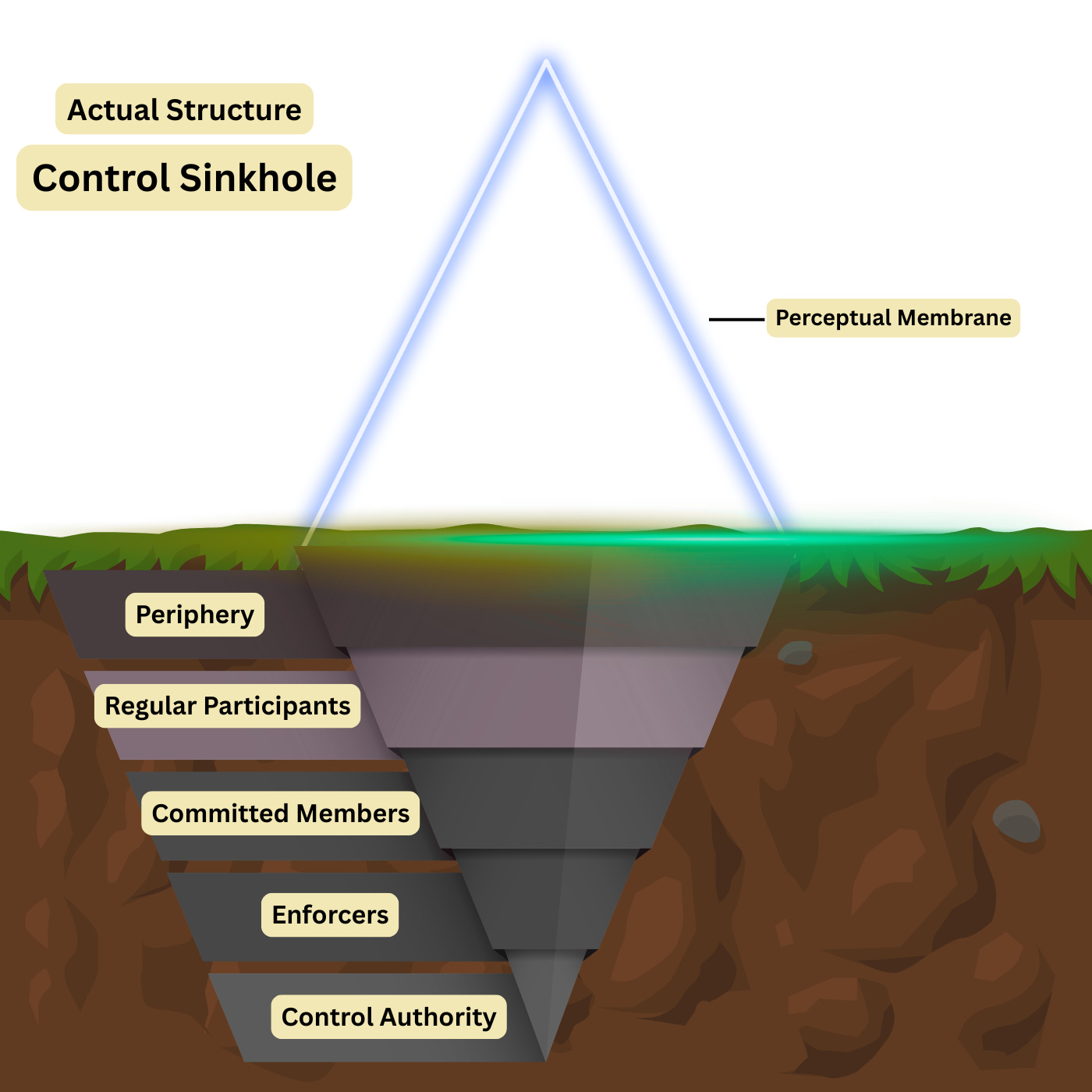
Beneath the facade lies the Control Sinkhole: the pyramid model inverted to reflect the lived reality of high-control systems.
What appears externally as upward advancement is, in practice, a downward progression into escalating dependency, reduced autonomy, and concentrated control.
The Control Sinkhole is an inverted social structure that pulls inward and downward, entrapping individuals while funneling power toward a controlling center.
Internal Enforcement Mechanism
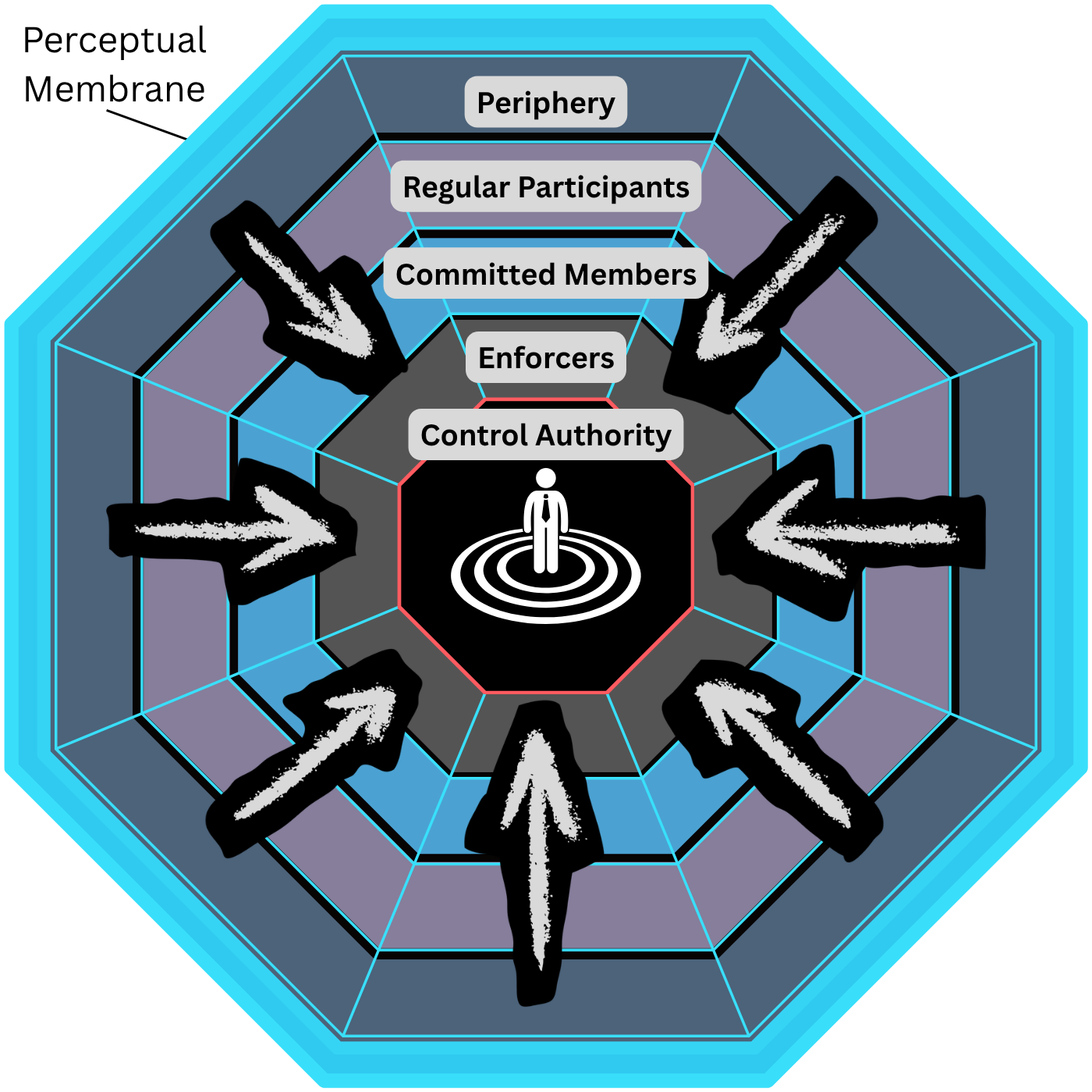
Viewed from above, the sinkhole reveals a Radial Control Web—the internal enforcement mechanism through which control is distributed and maintained throughout the structure.
Control flows:
Inward: Loyalty, labor, wealth, resources, bodily access, status, and devotion are funneled toward the Control Authority.
Laterally: Members monitor, pressure, and police one another through peer enforcement
Outward: Relationships, outside information, and perceptions of outsiders are tightly regulated.
At the center, the Control Authority defines reality, sets expectations, regulates access to belonging and status, and concentrates decision-making power.
The deeper function of this web is to insulate the Control Authority from accountability:
Responsibility for harm is diffused across the structure.
Criticism is intercepted before reaching the center.
Members are conditioned to defend, rationalize, and enforce authority.
The structure protects the abuser while amplifying their power, dependency, and social control.
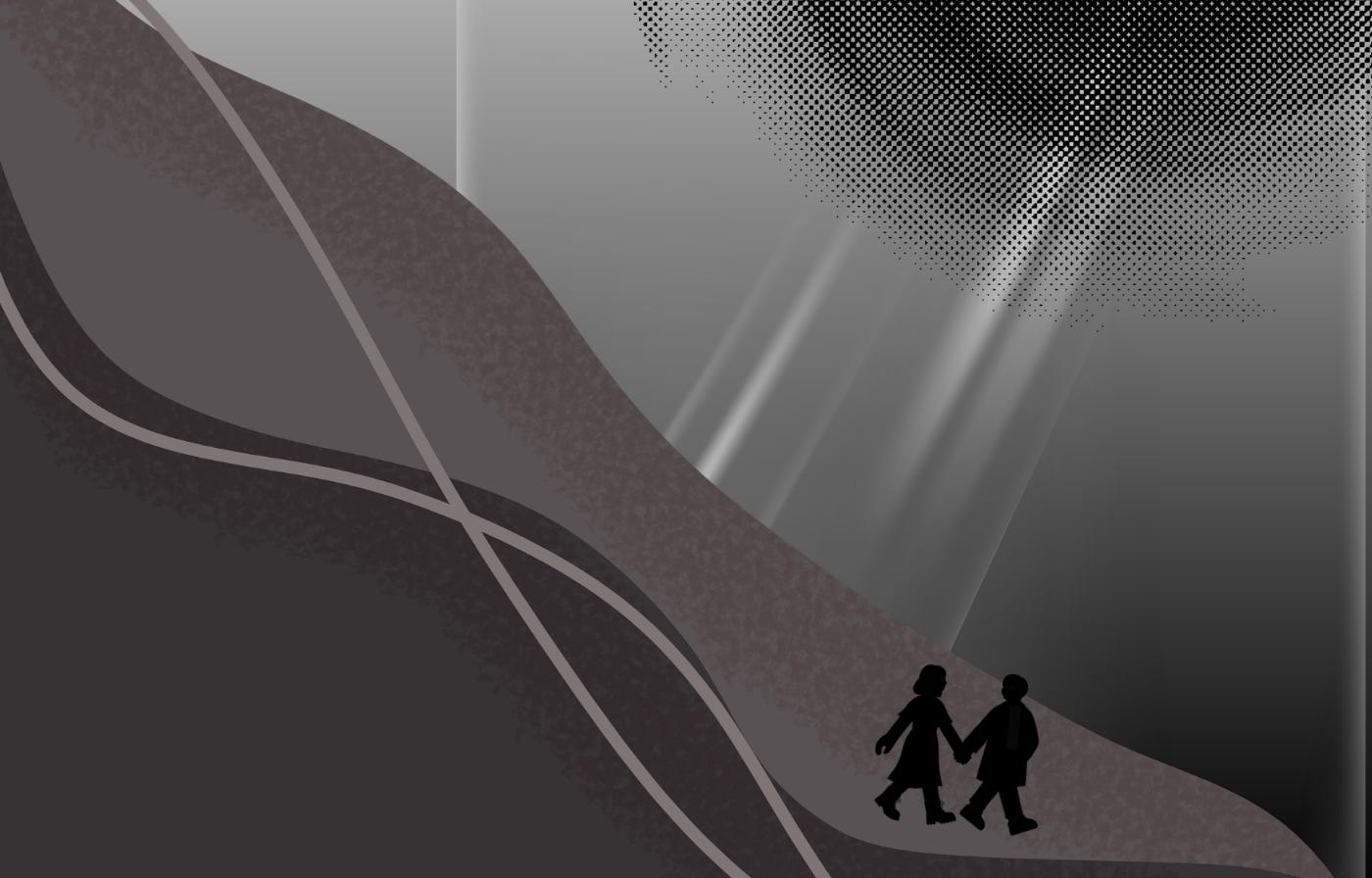
Loss of autonomy rarely occurs all at once.
Rather than feeling like a sudden drop, the descent into the sinkhole often feels like a gradual slope. Each step subtly reduces the likelihood of climbing back out. Individuals frequently move deeper without recognizing how far they have gone until orientation to life outside the system becomes difficult.
Most recruited individuals enter at the Periphery, gradually moving inward through increasing participation, commitment, and role consolidation.
Not everyone enters this way.
Some individuals are forcibly thrust deep into the sinkhole through violence, coercion, captivity, trafficking, kidnapping, forced criminal involvement, or violent intimate-partner entrapment. These individuals may be imposed into forms of dependency comparable to the Committed Member level without a meaningful opportunity to consent.
Others are born into the sinkhole. Children raised within high-control families, religions, political movements, gangs, or ideological communities begin life already embedded within the structure. Because the system is normalized from birth, they often occupy a position analogous to Regular Participants, while parents or guardians may occupy Committed Member or Enforcer roles.
Descent is sustained through layered patterns of manipulation.
At the periphery, systems often rely on:
Love bombing
False promises
Aspirational messaging
Manufactured belonging
As involvement deepens:
Trust in one’s perception erodes through gaslighting, propaganda, and disinformation.
Dependency increases through isolation, financial control, and suppression of independent identity.
Daily life becomes regulated through surveillance, micromanagement, labor demands, and, at times, food/sleep deprivation.
Control is further reinforced through recurring cycles of abuse:
Tension Building – Anxiety, pressure, criticism, or unpredictability escalate.
Incident – Abuse, punishment, humiliation, violence, or disciplinary enforcement occurs.
Reconciliation – Apologies, affection, reward, rationalization, or promises of change follow.
Calm – Temporary stabilization creates hope and reinforces attachment before tension rebuilds.
Members learn that safety, approval, affection, and relief from punishment are conditional upon obedience.
Cognitive freedom narrows through mechanisms that suppress independent thought.
Double Binds - No-win scenarios in which every available option reinforces control.
“If you leave, you prove you were never loyal.”
“If you question leadership, that proves your ego is the problem.”
“If you defend yourself, you are being abusive/disrespectful.”
Thought-Terminating Clichés - Simplistic slogans used to shut down reflection.
“The leadership knows best.”
“Everything happens for a reason.”
“That’s just your trauma talking.”
“Don’t be negative.”
Discrediting of Dissent - Framing criticism as proof of defect rather than legitimate concern.
Critics are labeled bitter, unstable, sinful, jealous, disloyal, or dangerous.
Former members are portrayed as traitors or cautionary tales.
Whistleblowers are pathologized rather than heard.
Dissent is reframed as evidence of weakness, impurity, or lack of commitment.
These levels represent functional depth and role strata within the sinkhole rather than rigid ranks. Individuals may enter, remain, or be forced into different levels depending on context.
Typical entry point for recruited individuals. Light exposure without full commitment.
Occasional churchgoer/holiday attendee
First-time yoga student
Seminar attendee
Routine involvement; early normalization and identity alignment.
Regular congregant/member
Employee integrated into workplace culture.
A child raised in a controlling household.
Strong identification; high emotional and social investment.
Devoted cult member
Ideologically committed activist
Partner in a coercive relationship
Maintain norms, police boundaries, and suppress dissent.
Cult elder/recruiter
Gang lieutenant / shot-caller
Enabling spouse / golden child
Central source of concentrated power and control.
Cult leader / guru
Gang leader / kingpin
Abusive partner / narcissistic parent / authoritarian boss
The Perceptual Membrane is the psychological filter through which reality is interpreted according to the worldview of the Control Authority.
Once inside the sinkhole, the membrane distorts perception in two directions:
Outward: The outside world is reframed as hostile, corrupt, dangerous, inferior, or deceptive.
Inward: Members are taught to view one another through suspicion, competition, and ideological scrutiny
This distortion deepens isolation, erodes trust, and reinforces dependence on the system itself.
Outputs of the Perceptual Membrane
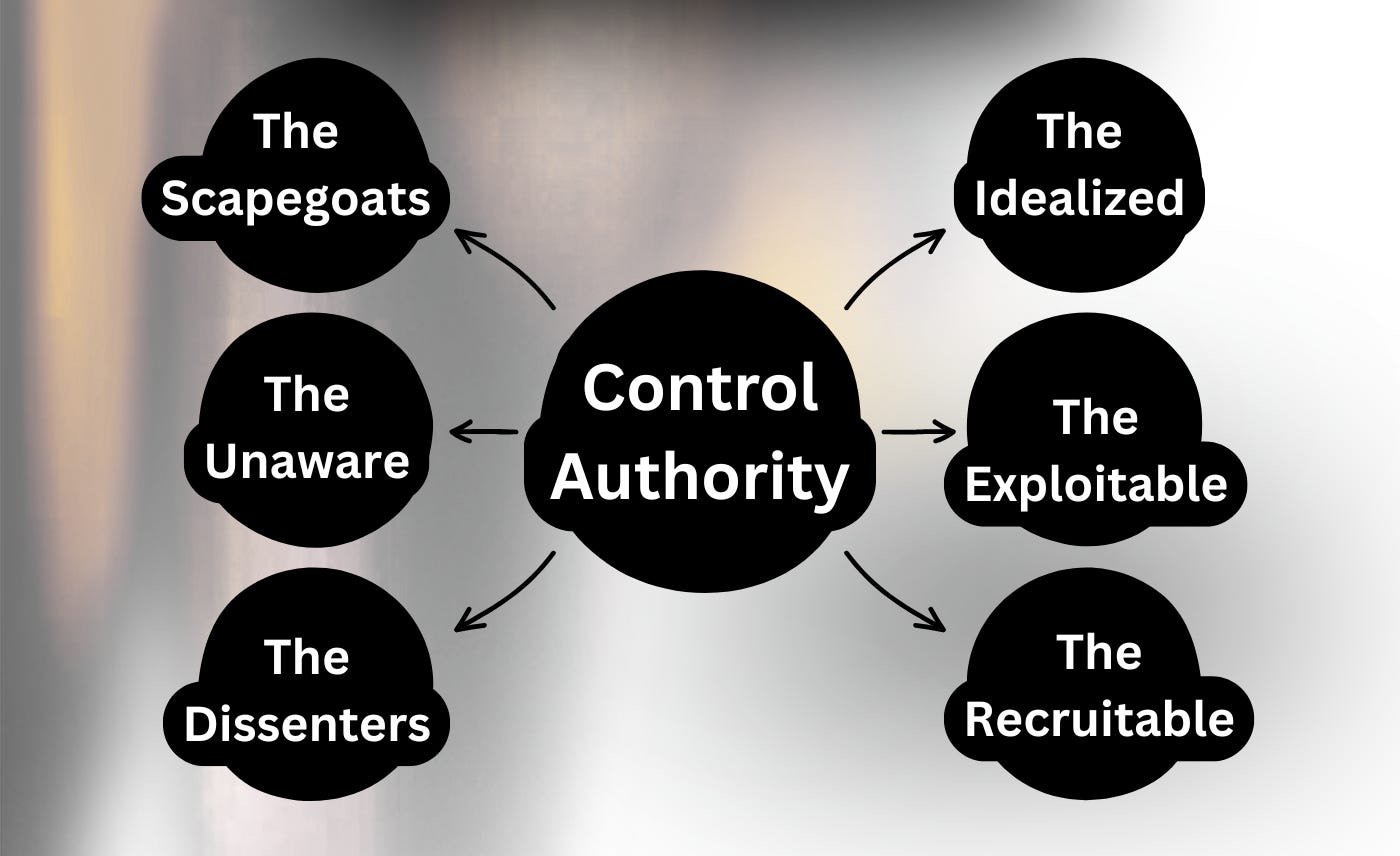
Within the Perceptual Membrane, the Control Authority projects recurring outsider archetypes that simplify, distort, and regulate social perception: the Scapegoats, the Unaware, the Dissenters, the Idealized, the Exploitable, and the Recruitable.
Each archetype represents a recurring perceptual category through which the Control Authority assigns meaning to others. Every archetype appears in dual form: projected outward onto outsiders and mirrored inward onto insiders. Though the target changes, the underlying control function remains consistent.
Those blamed for threat, harm, decline, corruption, or systemic failure.
External Form — Enemy: Dangerous outsiders threatening the group
Internal Form — Traitor: Members accused of betrayal or contamination
Those perceived as lacking awareness, enlightenment, or understanding.
External Form — Sheep: Outsiders viewed as ignorant or brainwashed
Internal Form — Empty / Hollow: Members seen as ideologically underdeveloped
Those who question, resist, criticize, or fail to conform.
External Form — Skeptic / Unconvinced: Outsiders rejecting the worldview
Internal Form — Problem / Disruptor: Members challenging norms or authority
Those elevated as aspirational models of worthiness.
External Form — Sanctioned Idol: Approved outsiders validating the worldview
Internal Form — Exemplar / Golden Member: Model insiders held up for imitation
Those are reduced primarily to their utility or extractive value.
External Form — Object: Outsiders treated as tools/resources/targets
Internal Form — Utility Role: Members valued for function over personhood
Those viewed as capable of assimilation or ideological capture.
External Form — Potential Recruit: Outsiders seen as recruitable
Internal Form — In Progress: Members still being shaped toward alignment

High-control systems rarely exist in isolation. They often develop within, alongside, or nested inside other high-control systems, forming a broader ecology of overlapping coercive environments.
These systems may reinforce one another psychologically, structurally, culturally, or institutionally. One system may normalize the dynamics of another, prepare individuals for future coercive entrapment, or mutually reinforce compatible forms of domination.
Individuals may move between such systems without recognizing recurring structural patterns, mistaking each experience as unique rather than structurally related.
The Broader Social Terrain
Taken together, these interacting systems form a broader High-Control Landscape: a social terrain populated by structures that may appear legitimate, healthy, or aspirational while functioning as disguised control sinkholes.
The central challenge of navigating this landscape is that not all groups are high-control, yet high-control systems are often deliberately designed to appear indistinguishable from healthy communities, organizations, relationships, or institutions at the point of entry.
Recognizing high-control dynamics, therefore, requires looking beyond aesthetics, ideology, or stated values and examining the underlying structure, power distribution, behavioral patterns, and mechanisms of control.
The purpose of this framework is not to encourage indiscriminate suspicion of all hierarchy, institutions, or collective organizations, but to provide a clearer lens through which coercive dynamics can be recognized, named, and navigated.
Coercive Control – Patterns of domination through surveillance, intimidation, and restriction of autonomy
Thought Reform (Robert Jay Lifton) – Methods used to reshape belief and suppress dissent
Bounded Choice (Janja Lalich) – How coercive systems are internalized as voluntary choice
Cycle of Abuse (Lenore Walker) – Repeating relational/systemic abuse dynamics
Propaganda Model (Herman & Chomsky) – Structural filtering of information and consent production
Comments
Nothing yet. Say the first thing.
Sign in to join the conversation.