
Major Jeffrey Smeriglio’s account of Charlie Company, 2d Light Armored Reconnaissance Battalion, operating under Joint Task Force Southern Border is not merely a useful after-action reflection. It is living proof that the principles of mission command and maneuver warfare—principles I have spent decades urging the American military to internalize—can still take root when the conditions of sustained operational responsibility are present.
From April through July 2026, Smeriglio’s Marines conducted more than two hundred squad patrols, nine platoon-level operations, and ninety days of continuous company-level effort across complex terrain in support of U.S. Border Patrol. The decisive insight he records is that mission command rests on discipline.
Standardized pre-combat checks, rigorous accountability of ammunition and equipment, trusted vehicle operators, deliberate terrain analysis, intelligence-driven tasking, and the purposeful employment of sensors and unmanned aircraft systems created the foundation that allowed decentralized execution.
When those foundations were strong, leaders could grant freedom of action. When they weakened, friction, lost equipment, and diminished readiness followed. This is not theory. It is the daily practice of Auftragstaktik under real operational demand.
I have argued for years that the United States military remains largely trapped in the cultural patterns of second-generation warfare: centralized control, attrition-focused processes, industrial-age personnel systems, and a preference for detailed orders and synchronization over initiative and adaptation.
Third-generation warfare—maneuver warfare—demands the opposite. It requires leaders who understand the commander’s intent two levels up, who can sense and decide faster than the opponent, and who are trusted to act within that intent when the situation changes.
Mission command is the American expression of that Prussian-derived culture. It cannot be taught solely in classrooms or scripted exercises. It must be lived inside a continuous operational rhythm of prepare, receive the situation, understand the mission, issue concise orders, move, observe, report, decide, coordinate, debrief, recover, and repeat.
Smeriglio’s rotation restored precisely that “old school” warrior battle rhythm:
At the individual level, Marines discovered that their personal competence—pace count, sector sketch, radio report, night-optics employment—directly affected adjacent teams and higher purpose.
At the team and squad level, sequential leader-owned accountability and a disciplined daily cycle of inspections, execution, debrief, and recovery built cohesion and tactical flexibility.
Vehicle teams retained mobility while establishing observation positions; terrain was occupied for influence over avenues of approach rather than mere elevation.
Platoons practiced converting intelligence into concise radio orders measured in seconds, creating a genuine command-and-control feedback loop: intelligence informed assessment, the platoon issued task and purpose, the squad executed within intent, and reports shaped the next decision.
Company leadership balanced standards and accountability with subordinate initiative, treating logistics and equipment issue as tactical enablers rather than administrative burdens.
Battalion contributions—shared operational graphics, intelligence-driven tasking, staff battlefield circulation, and purposeful unmanned aircraft system employment—enabled rather than smothered subordinate action.
These are not incidental benefits of a border-security mission. They are the measurable outcomes of placing Marines inside a persistent operational demand that cannot be fully replicated in garrison.
Training can introduce the concepts of mission command.
Sustained responsibility converts them into habits.
Junior leaders learn that disciplined initiative is not independent action detached from higher purpose; it is action grounded in shared understanding, adjacent-unit awareness, and a reliable feedback loop.
Senior leaders learn that decentralization is not the absence of control; it is the product of clear standards, timely intelligence, concise orders, trust, and continuous assessment.
The institutional value to the Marine Corps is therefore profound. Formations that have repeatedly practiced operational decision-making under real consequences carry that experience into future deployments, exercises, and combat.
Leaders who have owned the daily responsibility of small-unit decisions tied to commander’s intent are better prepared for the friction, uncertainty, and rapid tempo of third-generation and higher forms of warfare.
In an era when the military still struggles to escape second-generation habits, credentialism over character, process over adaptability, micromanagement over trust, JTF Southern Border offers a practical laboratory. Units can treat it as repetitive post coverage, or they can use it, as Charlie Company did, to forge disciplined Marines, tactically competent squads, decisive platoon leaders, responsive companies, and enabling battalion staffs.
The difference, as Smeriglio correctly concludes, is leadership.
Standardized preparation creates trust.
Intelligence creates purpose.
Concise orders create shared understanding.
Terrain analysis creates tactical advantage. Reliable accountability creates freedom of action.
Debriefs and assessments create learning.
When these elements are joined in a sustainable battle rhythm, Marines at every echelon practice the habits the Corps will require in future operations. Incoming leaders should therefore approach the mission as an operational leadership crucible: preserve junior-leader responsibility, strengthen the command-and-control feedback loop, exploit sensors and unmanned systems, integrate continuously with interagency partners, and remove staff friction that prevents timely action. Done well, the deployment leaves the Marine Corps with leaders who are not merely trained in mission command, but practiced in it.
This is the path I have long advocated: parallel evolution of culture, education, training, and personnel systems toward a genuine maneuver-warfare ethos. Major Smeriglio’s article shows that the path remains open wherever operational demand, disciplined standards, and trust in subordinates are allowed to coexist. The warrior battle rhythm is not nostalgia. It is the essential condition for developing the adaptive judgment required by the generations of war we actually face.
Donald E. Vandergriff, Adopting Mission Command: Developing Leaders for a Superior Command Culture (Annapolis, MD: Naval Institute Press, 2019); see also Vandergriff, The Path to Victory: America’s Army and the Revolution in Human Affairs, rev. ed. (North Charleston, SC: CreateSpace, 2013).
William S. Lind, Maneuver Warfare Handbook (Boulder, CO: Westview Press, 1985); on the generational framework, see William S. Lind, “The Changing Face of War: Into the Fourth Generation,” Marine Corps Gazette 73, no. 10 (October 1989): 22–26, and subsequent discussions in Vandergriff’s works.
Vandergriff, Adopting Mission Command; see also Donald E. Vandergriff, Raising the Bar: Creating and Nurturing Adaptability to Deal with the Changing Face of War, 2nd ed. (CreateSpace, 2012).
On the persistence of second-generation cultural patterns and the requirements of third-generation maneuver warfare, see Vandergriff, Manning the Future Legions of the United States: Finding and Developing Tomorrow’s Centurions (Westport, CT: Praeger Security International, 2008), and more recent analyses on Substack, including “Parallel Evolution to Move DoD to Maneuver Warfare and Mission Command” (2025).
The concept of a continuous operational battle rhythm as the crucible for mission command appears throughout Vandergriff’s writings, notably in discussions of outcomes-based training and education and the adaptive course model in Adopting Mission Command.
By Major Jeffrey Smeriglio Aug 18, 2026
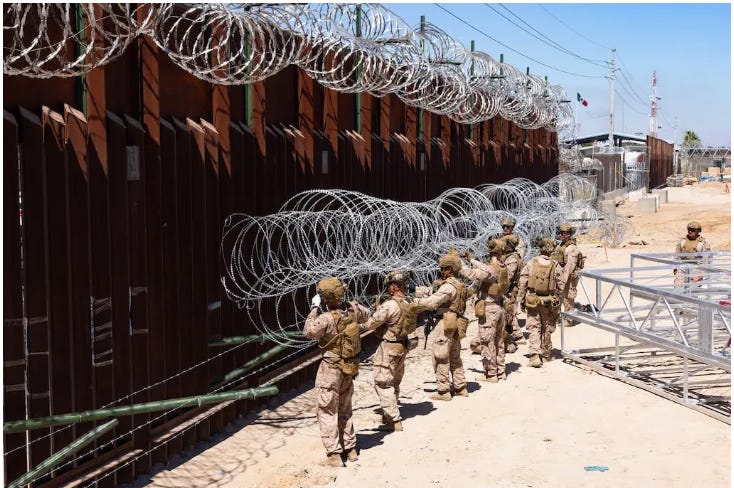
From April through July 2026, Charlie Company, 2d Light Armored Reconnaissance Battalion, supported U.S. Border Patrol at Brown Field Station in the San Diego Sector while attached to V17. During the rotation, the company conducted more than 200 squad patrols, nine platoon-level operations, and 90 days of sustained company-level operations across a broad operational area. Those repetitions made clear that the greatest benefit of the JTF Southern Border mission is not the number of posts covered or patrols completed. It is the sustained operational battle rhythm in which individual discipline and small-unit decisions matter every day.
The mission is not identical to combat, nor should it be described as one. Properly led, however, it is more than an extended security task or a collection of posts. Marines repeatedly prepare, patrol, observe, report, receive orders, make decisions within commander’s intent, account for weapons and equipment, coordinate with U.S. Border Patrol and joint partners, and accept responsibility for real outcomes. The persistent demand gives leaders at every echelon repeated opportunities to practice mission command, reinforce warfighting fundamentals, and improve the feedback loop between intelligence, orders, execution, and assessment.
The decisive insight from our rotation was that mission command rests on discipline. Standardized pre-combat checks and inspections, deliberate ammunition and equipment accountability, trained and trusted vehicle operators, consistent U.S. Border Patrol coordination, intelligence-driven tasking, purposeful use of terrain, and tactically employed sensors and unmanned aircraft systems enable decentralized execution. When those foundations are strong, leaders can give teams freedom of action. When they are weak, the unit loses time, equipment, readiness, and the ability to operate safely.
The institutional value of JTF Southern Border is restoring an operational warrior battle rhythm that cannot be fully replicated in garrison: disciplined Marines, cohesive teams, and leaders practiced in decentralized execution within the commander’s intent. This article describes the mission’s benefits at the individual, team, squad, platoon, company, battalion, and institutional levels; identifies the conditions that allowed those benefits to emerge; and offers practical recommendations for incoming units. For the broader infantry and reconnaissance communities, it also shows how sustained operational responsibility turns mission command from a concept into a habit.
Benefits to Individual Marines
The mission turns routine standards into operational habits. Marines see the direct relationship between preparation, fieldcraft, accountability, and mission success.
Operational Mindset and Ownership
The mission gives individual Marines a tangible sense that their daily actions contribute directly to an operational purpose. Unlike many garrison events, the consequences of preparation and inattention are immediate. Marines learn that they are not merely completing a shift; they are part of a continuous effort to detect activity, understand terrain, maintain contact, report accurately, and enable U.S. Border Patrol to act.
This mindset increases ownership. A Marine’s observation, radio report, sector sketch, pace count, equipment status, or decision to correct a deficiency can affect the team, the adjacent patrol, the watch floor, and U.S. Border Patrol. When leaders reinforce that connection, junior Marines begin to understand how individual competence feeds commander’s intent.
Repetition of Core Skills
The deployment provides repeated opportunities to refine individual and team-level tasks that can otherwise become episodic in garrison. These include movement techniques, halts, hand-and-arm signals, use of night optics, observation and reporting, sector sketches, terrain association, radio discipline, and reconnaissance fundamentals. Because these tasks occur in an operational context, Marines receive immediate feedback on whether their techniques are useful, understood, and sustainable.
Night operations are particularly valuable. Marines learn the difference between knowing how to operate a device and being able to execute a patrol, maintain control, observe effectively, and communicate under darkness. This benefit is lost quickly if PCCs and PCIs become inconsistent or if leaders allow batteries, mounts, optics, communications equipment, or other mission-essential items to go unchecked.
Confidence Through Competence
Confidence grew fastest when Marines entered the mission with realistic patrolling repetitions and then continued to receive close supervision from team and squad leaders. Before deployment, opposing-force patrolling exercises in which one element attempted to infiltrate across a designated boundary while another screened the avenue of approach provided useful repetitions. Training grounded in relevant adversary tactics, techniques, and procedures prepared Marines to recognize movement, use terrain, and understand the purpose of a screen.
Benefits to Teams and Squads
Discipline as the Foundation
Team and squad discipline is the most important determinant of success. PCCs and PCIs must be conducted the same way, every time, against a clear standard. Inconsistent inspections produced predictable failures: misplaced or lost ammunition, missing equipment, preventable injuries, and Marines arriving at night operations without the equipment or readiness required to execute.
The most effective accountability method was leader-owned and sequential. Squad leaders issued ammunition, communications equipment, and other sensitive or mission-essential gear one team at a time, maintaining positive accountability through issue, employment, recovery, and de-issue. This reduced ambiguity and made responsibility visible.
Cohesion Through a Disciplined Battle Rhythm
The best team and squad leaders established a sustainable daily rhythm. Although duty and rest cycles varied across the rotation, the pattern remained disciplined: PCCs and PCIs, movement to post, mission execution, debrief, return, physical training, recovery, and rest. Repetition reduced friction and made standards predictable. Time away from the mission was used to prepare for the next operational cycle.
This battle rhythm also created a coaching structure. Team leaders knew when to inspect, rehearse, correct, and capture observations. Marines knew what right looked like and could focus their attention on the tactical problem rather than improvising administrative processes every day.
Tactical Flexibility at the Team Level
Properly staffed vehicle teams offered a useful balance of flexibility and security. A vehicle team could establish an observation position while retaining mobility, allowing the element to observe, reposition, communicate, and respond without collapsing into a single static posture. This structure provided options that reduced teams did not consistently offer.
The mission also sharpened the relationship between observation and maneuver. Terrain is key because it enables observation of an avenue of approach, influence over that approach, freedom of maneuver to interdict activity, or the ability to screen effectively by detecting and reporting. This improved tactical judgment and reduced the tendency to occupy terrain merely because it was elevated.
Preserving Patrolling Fundamentals
Patrolling basics did not disappear immediately, but some small-unit habits began to erode late in the rotation: security at halts, pace and formation control, hand-and-arm signals, and deliberate movement control. The lesson is not that the mission degrades warfighting skills by design. Rather, repeated operations can normalize shortcuts unless leaders deliberately sustain standards through rehearsals, spot checks, and periodic tactical evaluations.
Benefits to Platoons
This mission provides repeated practice in converting intelligence into concise orders, enabling decentralized squad execution while retaining platoon-level oversight and assessment.
A Real Command-and-Control Feedback Loop
The platoon-level benefit increased substantially when watch officers and watch chiefs shifted from passive battle tracking to tactically employing the squad operating in the area. Instead of only moving icons or pins, the watch received an intelligence update, assessed current activity, developed a basic order with mission and tasks, and transmitted concise direction over the radio.
This change created a complete command-and-control feedback loop: intelligence informed an assessment; the platoon issued a task and purpose; the squad executed within commander’s intent; the watch maintained oversight; and reports informed the next decision. Squads already knew the terrain and made decisions, so they adapted quickly. They also appreciated the improved coordination because orders helped deconflict adjacent teams and linked local actions to a larger plan.
Concise Orders and Leadership
Platoon leaders improved by practicing concise combat orders and assessments over the radio. A useful standard (McBreen) was to deliver in approximately three transmissions, thirty seconds or less. The purpose of the time standard was not speed for its own sake; it forced leaders to identify the decision, communicate the task and purpose, state the relevant assessment, and avoid unnecessary narration.
Repeated radio orders benefited both the transmitter and the receiver. Officers and staff noncommissioned officers practiced making timely assessments and giving usable guidance. Team and squad leaders gained practice listening for intent, extracting what mattered, confirming understanding, and acting without waiting for a detailed script.
Leader Understanding of the Area of Operations
Incoming platoon commanders and platoon sergeants should spend their first days understanding the area. Daylight battlefield circulation allows leaders to see routes, terrain compartments, observation points, communications limitations, vehicle hazards, and distances. Night patrols reveal a different problem: reduced depth perception, altered traffic and activity patterns, optical limitations, and the practical difficulty of controlling teams in darkness.
When available and authorized, aerial orientation provides an additional perspective. It can help leaders understand the area’s geometry, the relationship between routes and terrain, and the general use of observation and sensing capabilities.
Benefits to the Company
Mission Command at Operational Tempo
At company level, the mission creates a persistent requirement to balance control and initiative. Company leadership must set standards, maintain accountability, coordinate with U.S. Border Patrol and higher headquarters, manage shifts, and preserve readiness, while allowing platoons and squads to adapt to activity in their sectors. The company becomes more effective when it provides a disciplined framework rather than attempting to direct every movement from the command post.
Logistics and Accountability as Tactical Enablers
Several actions have outsized effects on operational performance: ammunition handling, vehicle-key issue and de-issue, and communications-equipment issue and de-issue. These are not administrative details separate from tactics; they are key transitions. They determine whether teams depart on time, whether equipment is available and serviceable, whether custody is clear, and whether the company can identify and correct a problem before it becomes a mission failure.
The recommended model: assign squad leaders direct responsibility for sequential team-level issue and recovery; use standardized rosters; reconcile discrepancies immediately; and prevent informal pass-downs that separate custody from accountability. During relief in place, complete a deliberate, documented ammunition transfer or turn-in/issue process rather than relying on verbal handoff.
Vehicle Operations and Risk Management
Mountain and unimproved-road driving demands judgment, not merely licensing. The team leader does not have to be the assistant driver and may be the most appropriate primary driver when that Marine is more capable and experienced. Company leadership should identify early who has mountain-driving experience, who demonstrates sound judgment, and who is responsible and trustworthy enough to operate in the area. Billet or seniority should not substitute for demonstrated competence.
Integration With U.S. Border Patrol
Trust with U.S. Border Patrol was built through consistent leader presence. A Marine leader, platoon commander, platoon sergeant, or company staff representative should attend each U.S. Border Patrol shift muster or turnover. That touchpoint enables direct coordination with the watch officer or shift supervisor, clarifies current activity and priorities, surfaces friction early, and reinforces that the Marine unit is an integrated operational partner rather than a detached supporting element.
Attendance alone is not enough. The Marine representative should arrive prepared to exchange relevant observations, confirm responsibilities, understand changes in U.S. Border Patrol priorities, and carry information back into the Marine command-and-control process.
Employment of Sensors
Company personnel who operate persistent surveillance systems every day often develop the best practical understanding of how those systems can support the mission. When approval processes for routine repositioning are too slow, the unit can lose the opportunity to adapt within the operational cycle. Authorities should preserve accountability while allowing timely decisions at the appropriate level.
The broader benefit is leader development in tactical sensor employment. Company leaders learn to connect sensor employment to operational requirements, terrain, observation limits, and maneuver options. Higher headquarters should retain appropriate oversight while delegating routine decisions to the lowest level with the competence, information, and responsibility to act.
Benefits to the Battalion
Intelligence-Driven Operations
One of the most valuable battalion contributions was the transition to intelligence-driven tasking. A shared operational graphic highlighting priority movement corridors identified through available reporting gave companies a common picture and allowed missions to tie to assessed avenues of movement. This improved unity of effort and helped companies place squads and enabling systems with greater purpose.
The lesson is that intelligence must generate operationally useful products: clear priorities, relevant indicators, collection gaps, and recommended decisions. The battalion should then task companies against those priorities while preserving enough flexibility for local leaders to adapt based on what they see.
Battalion Staff Understanding of the Operational Area
Battalion staff sections should get into the area of operations with company leadership during the first thirty days. Staff officers and chiefs who have not seen the terrain and operational demands firsthand will struggle to appreciate the time and friction involved in meeting their requirements. Battlefield circulation improves the quality of planning, resourcing, approvals, and staff estimates.
This is especially important for intelligence, operations, logistics, communications, aviation/UAS integration, and force-protection personnel. The goal is not ceremonial visits. Staff members should observe a full operational cycle, ask company leaders what creates delay or risk, and return with specific actions to reduce friction.
Building UAS Competence
The mission offers recurring opportunities for unmanned aircraft system training and employment. Incoming battalions should bring as many qualified 7316 unmanned aircraft system operators as practical, prepare to employ approved systems where authorized, and train additional sensor operators before deployment. This creates immediate operational value and an opportunity to build unit-level competence in aviation-enabled reconnaissance and surveillance.
The battalion should connect UAS sorties to operational questions rather than treating flight hours as the objective. Missions should support terrain analysis, pattern development, cueing of ground forces, validation of observation points, or assessment of activity. The same intelligence-to-operations feedback loop used for ground patrols should govern aerial collection.
Institutional Benefit to the Marine Corps
The mission produces disciplined, confident leaders and cohesive units that have repeatedly practiced mission command in a live operational setting. That experience carries forward into future deployments, exercises, and combat preparation. The enduring institutional benefit is developing leaders who have lived inside an operational battle rhythm. Daily, team leaders, squad leaders, platoon commanders, platoon sergeants, and company leaders make decisions tied to commander’s intent and own the consequences of those decisions. Their choices are not theoretical staff exercises. They affect real patrols, real coordination, real readiness, and continuous mission execution.
This experience helps restore an “old school” warrior battle rhythm associated with sustained operational deployments: prepare, receive the situation, understand the mission, issue orders, move, observe, report, decide, coordinate, debrief, recover, and repeat. The rhythm develops practical judgment and resilience because the organization cannot wait for perfect information or a perfectly scripted training event.
The mission also offers a laboratory for mission command. Junior leaders learn that disciplined initiative is not independent action detached from higher purpose. It is action grounded in shared understanding, commander’s intent, adjacent-unit awareness, and a reliable command-and-control feedback loop. Senior leaders learn that decentralization is not the absence of control; it is the product of clear standards, timely intelligence, concise orders, trust, and assessment.
For the Marine Corps, the payoff is a formation with more leaders who have practiced operational decision-making, more squads accustomed to accountable decentralized execution, and more staffs that understand how to enable rather than smother subordinate initiative. Training can introduce these ideas. A sustained mission makes them habits.
Command Emphasis
The commander should repeatedly communicate that this is an operational mission. Marines must understand both the significance and the limits of their role. They are expected to think, observe, report, maneuver, coordinate, and act within commander’s intent and legal authorities. The mission becomes professionally valuable when leaders demand disciplined standards and then trust subordinates to execute.
Conclusion
JTF Southern Border offers a rare combination of persistent operational demand, frequent opportunities for reconnaissance and surveillance, interagency integration, complex terrain, night operations, and decentralized small-unit action. The mission’s value is not automatic. A unit can reduce it to repetitive post coverage, or it can use the same mission to build disciplined Marines, tactically competent squads, decisive platoon leaders, responsive companies, and enabling battalion staffs.
The difference is leadership. Standardized preparation creates trust. Intelligence creates purpose. Concise orders create shared understanding. Terrain analysis creates tactical advantage. Reliable accountability creates freedom of action. Debriefs and assessments create learning. When these elements are joined in a sustainable battle rhythm, Marines at every echelon practice the habits the Corps will require in future operations.
Incoming leaders should therefore approach the mission as an operational leadership crucible. They should preserve the daily responsibility placed on junior leaders, strengthen the command-and-control feedback loop, exploit the UAS and sensor environment, integrate continuously with U.S. Border Patrol, and remove staff friction that prevents timely action. Done well, the deployment leaves the Marine Corps with leaders who are not only trained in mission command, but practiced in it.
-----------------------
Major Jeffrey Smeriglio recently completed command of Charlie Company, 2d Light Armored Reconnaissance Battalion, and currently serves with II Marine Expeditionary Force Information Group.
No posts
Comments
Nothing yet. Say the first thing.
Sign in to join the conversation.