
Jonathan Pinchera is an artist based in Brooklyn.
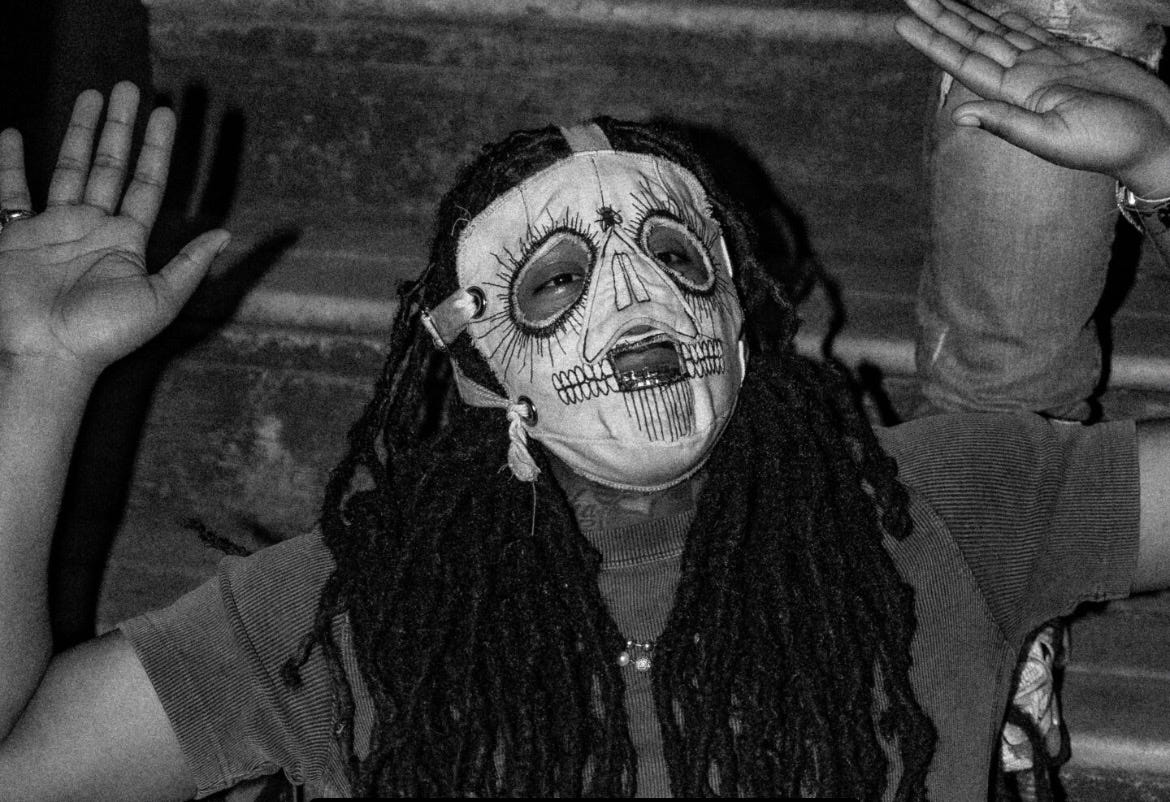
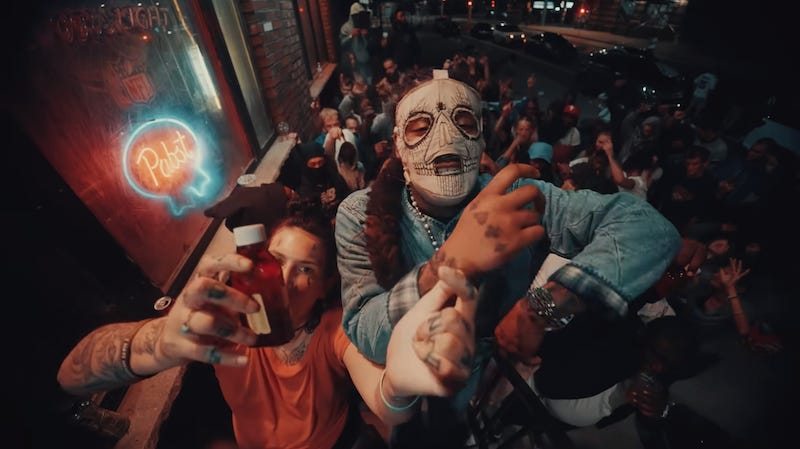
In the above image, rapper Skrilla wears “The Mask of Bobobja” which I designed and embroidered for the Philadelphia-based textile collective Chalk.Press in October 2022. After sitting largely untouched for nearly three years the mask was sold to a close associate of Skrilla, who later gifted it to him in the middle of 2025. Skrilla began wearing the mask incessantly in music videos, interviews, and instagram photos, transforming it into a symbol of his own identity.
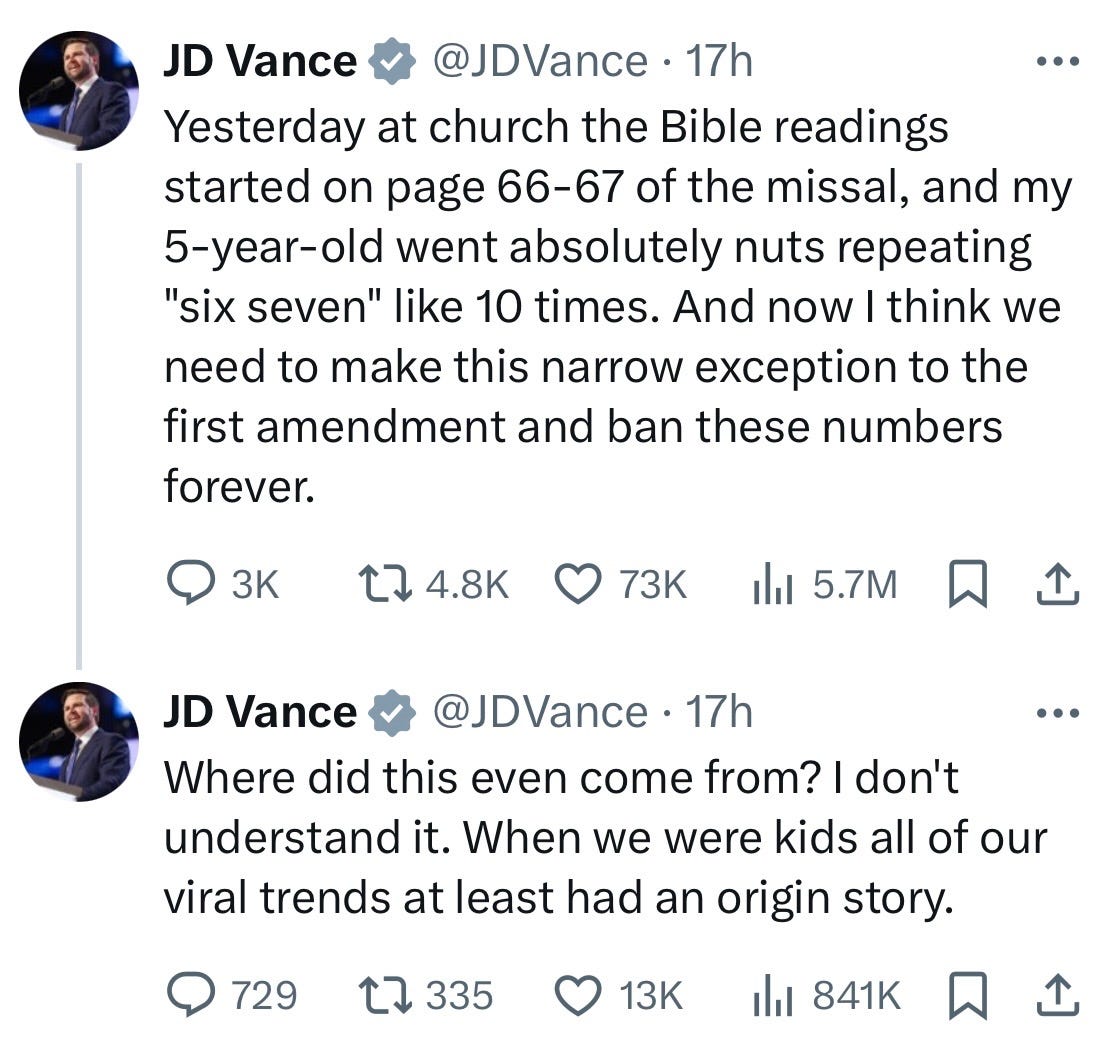
Skrilla, born Jemille Edwards in 1999, is a drill rapper born in Kensington, a neighborhood in Northern Philadelphia. Skrilla is also the father of the “6-7” meme which, at the time of this writing in December 2025, has reached a hyper-viral crescendo across multiple online platforms. The phrase originates from the song “Doot Doot” in which Skrilla drops the two numbers in quick succession. The meme has also spilled paroxysmally into the real world, where subjects (usually children) who encounter the numbers immediately yell them out loud. While the “6-7” meme is not unique in its absurdity or popularity, it is notable for its complete flight away from its original genesis: the children blurting out “6-7” in math class are not referencing Skrilla, the song “Doot Doot”, or any other individual meme. Rather, the two numbers have vaporized themselves into a floating body of non-meaning to be internalized and repeated via automatic response. Generation Alpha, undoubtedly the primary actor here, has pioneered a form of memetic signification that points only to itself .
This lack of a concrete genealogy has led to ample speculation as to what “6-7” truly means. Fans of Skrilla and drill music will point to 67th street in his native Philadelphia, the burying of a body 6’ 7” underground, or the Philadelphia police code for a homicide “10-67”. NBA fans would point to Lamelo Ball’s height and his early adoption of the meme. For a certain side of Christian TikTok, Skrilla’s practice of Santeria makes “6-7” a satanic chant. Conspiratorial numerologists arrive at a similar conclusion using gematria (Satanic = 67, “Doot Doot” reduced = 36 = triangle number 666, 6 + 7 = 13 = Judas). For the less online, casual media consumer, especially one older than gen Z, “6-7” is basically an inside joke among children. Finally, if you ask Skrilla himself, he will vaguely state that the meaning of “6-7” is “changing a negative into a positive”.
Because the actual use of “6-7” reaches such a high level of alienation from any one of these interpretations it produces an environment where they are all correct, a position which is aided by the meme consisting of numbers rather than an image. Unlike numbers, images can be definitively traced, analyzed, and deconstructed. Perhaps the best example of an adjacent number-meme would be the Numogram, which defies satisfactory explanation due to its completely self-contained mathematical function. The Numogram was created in the late 1990’s by the CCRU (Cybernetic Culture Research Unit), a loose group at Warwick University that included academics, writers, and artists and which concerned itself with how the oncoming computer age could be creatively engaged. The CCRU used the Numogram to generate a massive quantity of fictions, analyses, theories, conspiracies, ideologies, and coincidences in the space provided by its hermetical non-meaning, a process that closely resembles what has occurred with “6-7”. Both these number-memes are retrocausal: their own history is auto-manufactured within a void where prior meaning should exist. This slippery and fertile territory thwarts the domination of a single crystallized narrative, allegory, or myth while simultaneously creating a rich biome for their infectious production.

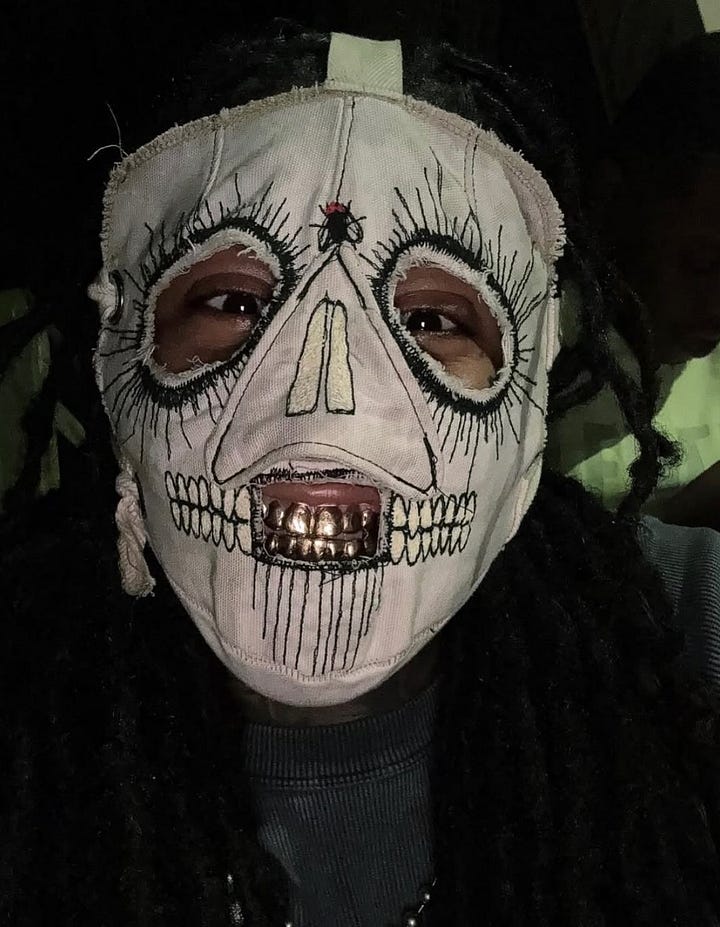
The ties between the Numogram and “6-7” go deeper. When I first embroidered the mask I placed a small fly between the eyeholes, a central position above the rest of the embroidery. After finishing the skeletal teeth, nostrils, and accents around the eyeholes and chin, I remember feeling that the mask needed some sort of unifying symbol. A fly seemed fitting: small yet striking and relevant to a skull, its inclusion on the mask was purely aesthetic. Coincidentally, the entity associated with the numbers 6 and 7 in the CCRU’s Pandemonium Codex (which assigns demonic identities to distances between numbers within the Numogram) is the “Lord of the Flies”, also known as “Beelzebub” or “Bobobja”. I only discovered this synchronicity this year, and had no knowledge of the CCRU when the mask was first made. The full entry from the Pandemonium Codex is transcribed below:
Mesh-27. Bobobja (Bubbles, Beelzebub (Lord of the Flies)). Heavy Atmosphere Pitch Cth-5 Net-Span 7::6 Amphidemon of Teeming Pestilence. 7th Phase-limit Decadology. C/tp-#5, Mj- [5S]. Rt-1:[7236] Strange lights in the swamp (dragonflies, ET frog-cults). [+1 sub-Rt]. Rt-2:[7256] Swarmachines (lost harvests).
Note: Net-Span notates the two numbers that the demon exists between, always starting with the higher number. Bobobja’s net-span is [7::6].
The mask, Skrilla’s song “Doot Doot”, and the Numogram seem to have collaborated independently without the presence of their creators, producing “6-7” as connective tissue. The virality of the meme becomes evidence of nervous communication between separate bodies and it is here that Skrilla transforms into more of a host than an author. After all, Beelzebub, or the Lord of the Flies, is depicted not as a singular being but instead as a swarm whose central locus is whatever corpse it is eating.
Philosopher and former CCRU member Reza Negrastani writes that “...the body of Beelzebub (ba’al zebub) insinuates a legion of flies, with their perverse collective enthusiasm to come together over a fresh deliquescing carrion or a yellowish lump of excrement...” (Negarastani, Reza, “The Legion: Warmachines, Predators and Pests”, Cyclonopedia: Complicity with Anonymous Materials, re.press 2008, p. 114). Similarly, the Lord of the Flies in William Golding’s novel of the same name is manifested by the decaying head of a pig on a spike that summons a “...black blob of flies that buzzed like a saw” (Golding, William, “Gift for the Darkness”, Lord of the Flies, Faber & Faber 1954, p. 138). Beelzebub exists as an activity or process in which the molar (corpse) both attracts and repels the molecular (swarm). This dialogue is mutually profitable as it allocates something to each party which it respectively could not achieve for itself. The corpse regains the movement of life at the cost of its static, peaceful mode of being and the swarm is given sustenance in exchange for its submission to the centrality of the One (pig-head). This positive feedback loop ends when the One is totally devoured, at which point the swarm must seek out a new carcass to devour. Beelzebub and memetics are both truly viral: they reproduce parasitically. In this context the mask becomes less of a stylistic choice and more of a tool to facilitate contact.
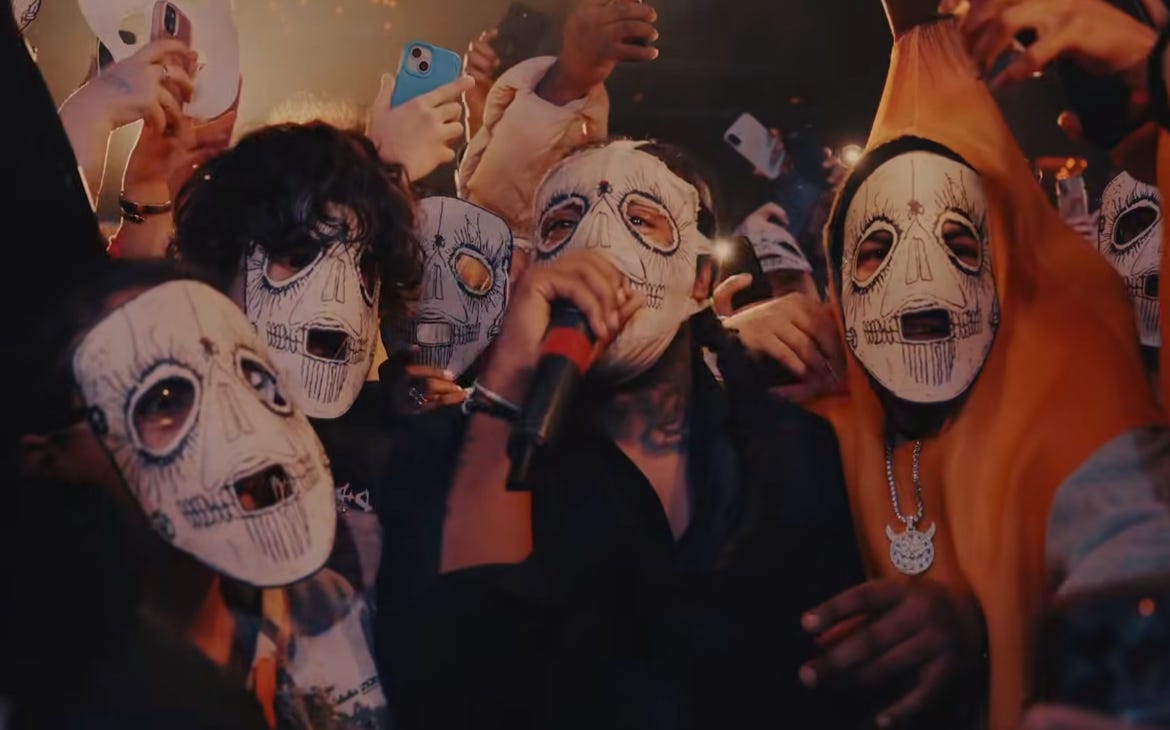
If you listen to the rest of Skrilla’s discography, it becomes clear that he intentionally fosters this relationship. Motifs of possession, sacrifice, revelation, divination, and, most importantly, zombification riddle his lyrics, usually placed within reference to Santeria. He has dubbed himself “the face of zombieland” in reference to Kensington, a neighborhood in Northern Philadelphia where Skrilla grew up and which is home to the East Coast’s largest open-air drug market. Skrilla raps frequently about Kensington, where he simultaneously sells and consumes opioids alongside fellow addicts. These addicts often appear as actors and hypemen in his videos, exhibiting a clickbaiting and intentionally inflammatory vibe that Skrilla certainly endorses. However, the actuality of a successful rapper presenting himself as someone similarly embedded in brutal addiction is rather atypical. In an interview on No Jumper, a rap-centric Youtube channel, Skrilla states “They’re [addicts] actually my friends... they watched me grow up... I’ve been serving 80% of them since I was a kid”. Self-recognition infiltrates and complicates the traditional dealer-addict binary relationship Skrilla is expected to have with Kensington. Usually, discussions around selling drugs in hip-hop are framed by the conflict that arises from providing for yourself at the cost of others given the absence of any other opportunity. This hyper-individualizes the drug dealer by biochemically, economically, and mentally othering the addict, who exists as part of a horde or swarm driven by mindless desire: a zombie. Skrilla subverts this dynamic by inhabiting both roles at once, becoming a zombie haunted by individual consciousness: “They be living walking dead and they be serving zombies/ I’m a zombie too addicted to them percocets” (Skrilla, “Block Hot”, Kutthroat, 2022).
In his book Undead Uprising, John Cussans coins the phrase “Zombie Complex” and uses it to dissect the modern zombie figure, tracing its philosophical and political history in relation to xenophobic Western depictions of Haitian Vodou:
The Zombie Complex then refers to a range of ethical, psychological and political thought-problems clustered around the central figure of the living-corpse which, though ostensibly fictional, stubbornly reminds us of the horribly actual limits (or lack of limits) of humanity, the individual and the human. (Cussans, John. “Preface: The Zombie Complex”, Undead Uprising, Strange Attractor Press, 2017 p. iv)
If the Zombie Complex concerns the articulation of the boundaries of the human, zombie consciousness emerges as a cooperative form of praxis that attempts to transcendentally blur the frontier. For Skrilla, the practice of Santeria and its religious appeal to spirits is the primary motor of this process. Santeria, developed under similar conditions in neighboring Cuba, shares many of the same beliefs, practices, and rituals (spiritual possession, animal sacrifice, ancestor veneration) as Haitian Vodou. These are distinct and syncretic religions, combinations of Catholicism and West African Animism, and though the zombi or nganga is originally a Vodou concept the ideas of soul-snatching, possession, and subjugation that it represents are equally present within Santeria. In many of his lyrics, Skrilla references and appeals to Orishas, or spirits, which speak and act through him: “Elegua gon’ live through me and Ogun gon’ live through my cutter” (Skrilla, “Soul Snatchin” 2025). Their veneration provides power and knowledge: “I don’t pray to God, I don’t fear Allah, Shouts out my Orishas, I know how ima die” (YoungBagChasers, Skrilla, Ybcdul, “YBC KTC”, Us Against The World 2023), “I don’t know why Ogun gave a rude awakening, but I’m awoke,” (Skrilla, “Chiraq”, Zombie Love Kensington Paradise UMG Recordings 2024). Elegua is the deity of choice and beginning, associated with crossroads and the opening of doors. Ogun represents metalworking, war, civilization, and technology. By allowing himself to be possessed by higher powers, representatives of the extra-human, Skrilla’s zombie consciousness escapes the vicious dialectic of identity enforced by racialized American narco-poverty. In being both consumer and supplier, swarm and individual, zombie and man, Skrilla transcends the limited economy of contradiction that violently asserts austerity, one which tranquilizes and polices entire communities like Kensington under the guise of natural market forces. When reality becomes foreclosed by cold financial logic then the only path of exit lies in submission to something spiritual, something alogical which surpasses a material framework. Thus the zombie figure possesses within itself space for new sentience, one that collides human interiority and exteriority without negating either.
Bobobja or Beelzebub is a warp-amphidemon, meaning it links the Time-Circuit of the Numogram (made up of numbers 1, 2, 4, 5, 7, and 8) with the Warp (3 and 6). Demons, in the CCRU cosmology, are not moralized in a theistic framework and have no implicitly negative or positive qualities. Rather, they exist as manifestations of relationships, associations, and gaps between numbers. Expanding this definition literally demonizes all systems that numbers touch; algorithms, networks, capital, etc. Amphidemons are identified as mediums of communication between the inside and outside of the Time-Circuit, trafficking with the incomprehensible, the inhuman. In donning the Mask of Bobobja, Skrilla seems to have opened a gateway of unknowing, one that can twist even the most basic unit of rationality - numbers - into bizarre aliens. While each theory about the origins or meaning of “6-7” might be correct, this is only the case because none of them ultimately matter. “6-7” is here, it works, it functions, and it easily evades any attempt to cage it with meaning. Eventually “6-7” will fade into irrelevancy; it will stop being funny like all memes do, probably well before the time this is published. This entropy death will likely be welcomed by many, those weary with confusion and nostalgic for a time when media felt more rationally digestible. Unfortunately for them, “6-7” leaves behind no antibodies, and novel infections are inevitable when it is impossible to understand what exactly is spreading.
Though I have never met or talked to Skrilla, I feel there is a shared experience in witnessing our respective creations collaborate on a scale that surpasses either of us. This is not to claim any sort of credit, influence, or ownership over Skrilla’s work or the meme. Rather, it has been incredibly striking to witness how releasing something into the world gives it complete autonomy: artistic intent is nearly irrelevant when connections between objects, media, narratives, and memes can form themselves without consent. This is especially easy in such an accelerated and ubiquitous digital environment, one that flattens the institutional barriers which traditionally dictated how work was disseminated. A consequence of this flattening is that previously exalted positions of artist or art object dissolve into undifferentiated content, information-fodder for the internet to relentlessly share. And though I enjoy Skrilla’s music, his use of the mask, and the hilarity of “6-7”, I cannot help but feel haunted by the omnipresence of a machine that erases any possibility of creating alone.
No posts
Comments
Nothing yet. Say the first thing.
Sign in to join the conversation.