
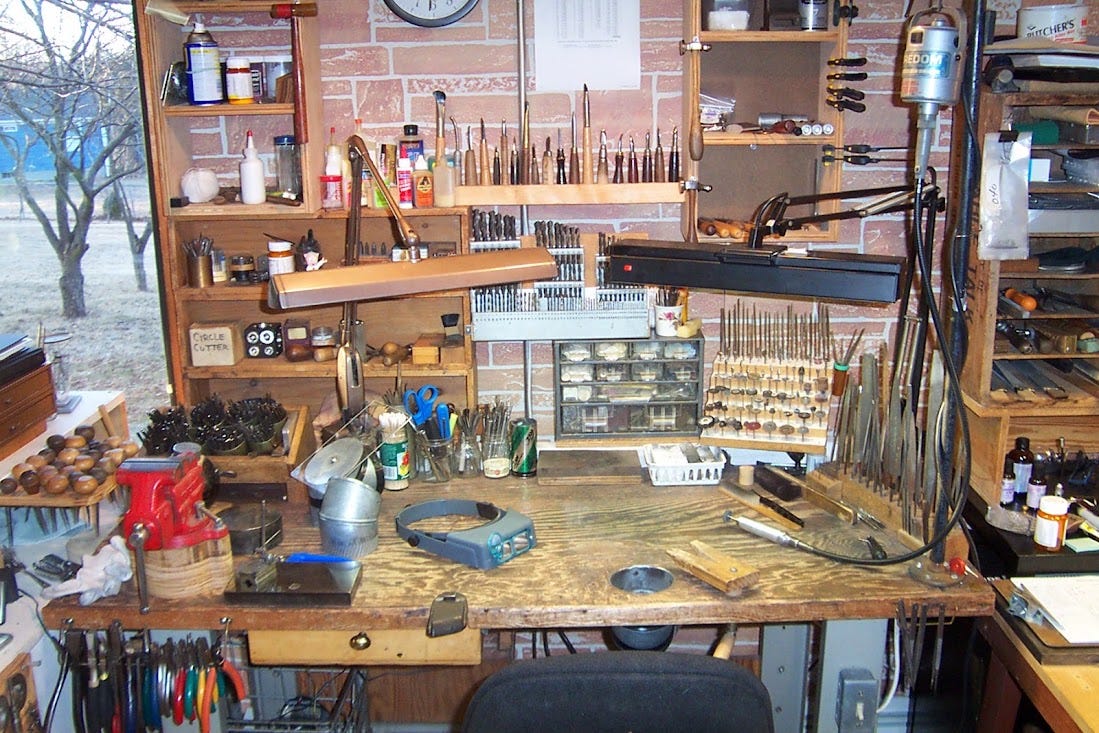
The Specialized tools of Jeffrey Herman, master silversmith (https://www.hermansilver.com/about.htm). This photograph and the one of hammers later in this essay were generously provided by him, with permission to publish. I originally published them in Living with Complexity (Norman, 2011, p 44).
I explore the fundamental distinction between knowledge and physical action, arguing that while Large Language Models (LLMs) have expert knowledge across many topics, making them both specialists and generalists, actions in the physical world require a different kind of knowledge: specialized skills for real-world execution. Evolutionary forces naturally specialize living things to learn the skills necessary to survive within specific environmental niches.
Humans are the generalists of the animal kingdom, physically inferior to animals, but with the unique capacity to invent millions of specialized physical and cognitive tools that expand their capabilities. Tools are specialized, and most tools require considerable experience, training and practice to be used effectively. In other words, mastery of many of these tools requires specialization.
In the artificial world of recorded knowledge, learned by our modern AIs, computers are better than any person. In the real, physical world, the story changes. Skills are a special kind of knowledge that cannot be learned by reading, listening, or watching. Not even by instruction. They can only be learned through experience, by trial and error, by practicing. Major components are ineffable, not describable, but learned through experience and practice. Having expert-level skills means being a specialist. Which is more important: Generalists or specialists? Neither. Both deep, narrow specialists and wide-ranging generalists are essential to surviving in the real, physical world.
In a previous post (Norman, 2026, July 5, “The New Intelligence: Beyond Human Categories”), I pointed out that generalists know a little about a lot of things, specialists know a lot about a few things. LLMs know a lot about a lot. They are simultaneously generalists and specialists.
This essay expands upon the earlier one, leaving the world that lives in the memory and computational structures of computers and venturing into the real, physical world we live in. My previous essay was about knowledge, things that are easily represented within the artificiality of computer technology. When I venture into reality, I must do things: take actions. But the ability to act requires knowledge that cannot be learned by reading, listening, or even instruction. It requires practice, trial by error, and considerable experience. These are skills. Ineffable, which means not explainable. Skills are specialties. (See Norman, 2026, June 26) and Rousse & Scapini, M. (2026).)
Knowledge is important, but action makes a difference in the world. All living things must be specialized to thrive in the environmental niche in which they live. When the environment changes, either the life form adapts or it dies
Many animals learn to create physical artifacts, such as nests, dams, and simple tools. Each artifact is, in essence, a tool that enables a new set of behaviors. Each tool changes the affordances available to an animal.
Most life forms adapt by modifying their bodies, including the foods they eat, to survive in a new environment. People invent new technologies as tools to survive: to control fire, to make tools for hunting, farming, harvesting, and cooking. Clothes plus control of fire enable people to live in cold climates. Most inventions are tools that enable us to travel more quickly, eat better, stay warm longer and lift heavier objects, the better to use them for building other artifacts. People do not restrict themselves to physical artifacts: they also develop cognitive artifacts (Norman, 1991 and 1993). Most cognitive artifacts are tools that aid us in mental activities. Today’s cognitive artifacts have gone beyond tools; LLMs are a new form of intelligence (Norman, 2026 July 5).
Most tools are specialized, some more than others. Consider one somewhat specialized tool: a hammer. There are many different hammers, each more specialized than the ones most homeowners purchase. Even nails come in hundreds of forms. Tools are the natural home of specialties.
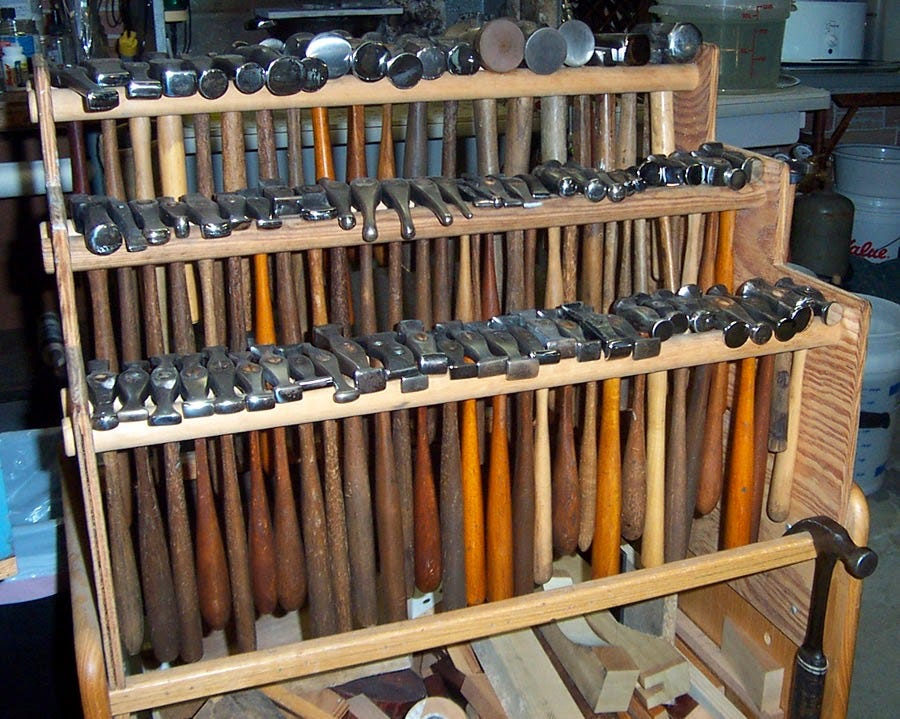
The specialized hammers of Jeffrey Herman. Note that only one of them, the one in the lower right, is similar to the everyday carpenter’s hammer. (See more in the legend for the opening photograph of this essay.)
Affordances of animals are determined by the shape of their bodies, their means of perception, movement, and manipulation. The shapes and forms of animal bodies dramatically impact their possible affordances. Similarly, in the world of robots, there is a wide variety of forms, each suited to its assigned tasks. Some are small, circular objects with wheels (e.g., vacuum cleaners and robots for carrying heavy loads), some look like vehicles, and some have legs, four or two, because wheels are efficient, but require a smooth, predictable terrain. In contrast, legs are much more flexible when moving across rocks, streams, and climbing stairs.
Today, in the world of artificial intelligence, we are entering the physical world through agents and robots that require specialists. Knowledge is independent of form. Action is highly dependent upon form. The laws of physics limit action.
Look at AI Agents: each is specialized for a task and often requires specialized tools. Some people use their LLMs to enable squadrons of specializes agents, each capable ofspecialized actions, the combination prodicing the desired result.
Nature produces highly specialized beings: multiple types of life, each adapted to its environment. Look at all the varieties of birds, animals, plants, each a survival specialist, some that can only survive in a narrow range of environments, some (for example, humans) that can survive in a wide range, but all of which are specialists at survival. Human beings are the most generalist of all living things, but even so, we have limits. Our bodies differ across environments, and, most importantly, we have invented tools and artifacts to make our survival possible: clothes to protect us from the environment, weapons to catch food and cook. Tools to enable us to live in homes that protect us from the elements.
Tools require people to use them, and most require considerable expertise. Skills are not easily acquired because they mostly require the ineffable, that is, the indescribable. Take the skills of an athlete, a painter, a writer. A chef. Yes, many books teach the principles for these activities. Still, they cannot explain the feelings, intuitions, and the way automaticity builds up, transforming conscious control (which can be taught) into subconscious control that marks excellence. LLMs can learn the rules and procedures, but carrying them out requires practice, trial and error, and, yes, good coaches. But the difference between knowing and doing is perhaps best illustrated by the difference between coaches and instructors and their students. Even the best athletes in the world need coaches. The best writers require editors. But note the paradox: the coaches can teach athletes, but they cannot perform as well as some of the people they teach. A great editor is often not a great writer. The skills of teaching and coaching are not the same as the skills acquired with a coach or instructor.
I could write a longer essay, giving multiple examples, but you can come up with them yourself. People have created millions of specialized tools that have dramatically expanded the range of affordances, many of which are for the physical world. Whether for pleasure or power. Whether to extend life and health or curtail them. So specialized that they make life so much improved that we can no longer live without them. Could you survive in a strange new wilderness, with no tools, no clothes, no technology, no artifacts?
What does the development of this new form of intelligence, new kinds of specialized tools and beings mean? What does it mean for the way that we live today? These are indeed the important questions, many of which do not yet have satisfactory answers. But the new tools are young, and it can take decades to understand new technologies. We cannot provide answers until we fully understand the new technologies, and we can’t do that while they are still being invented.
But I do predict one thing. Yes, we will have machines with more knowledge than any human being, but remember: knowledge is not the same as action. The physical world is extremely complex and often unpredictable. To live in this world, we need actors, specialists who can work with the complexity.
Note what is happening in Generative AI. Why do we need agents if we already have LLMs? To do things in the real world, each agent is skilled at some task. And who manages these skilled agents? Generalists. Managers. Sometimes people, but other times LLMs. Generalists are needed to manage specialists because managers need the ability to see the broader picture and understand how the units of each specialized agent fit together.
And that will become the major skill for people: to act as managers, supervisors, and directors. Many of the skills that people today are so proud of will be able to be done by specialized agents and robots and machines. But deciding what to do, deciding if it is appropriate or reasonable, or well-suited to enhance the quality of human life, can be determined by us. By human beings. By people.
Both specialists and generalists are essential.
In the realm of knowledge, few people are wide-ranging generalists; few are very deep and narrow specialists. But even fewer are both generalists and specialists.
Among physical and cognitive artifacts, most are specialized for a narrow range of skills.
In the physical world, knowledge is not of any use unless it is applied. And applications are best left to specialists, even if generalists develop the artifacts and then manage them.
I wrote and edited the essay. I used Grammarly’s AI to proofread both spelling and grammar, but I did not accept all of its recommendations. The abstract was produced by Gemini, slightly modified by me.
Norman, D. (1991). Cognitive artifacts. In J. M. Carroll (Ed.), Designing interaction (pp. 17–38). Cambridge University Press.
Norman, D. A. (1993). Things that make us smart. Cambridge, MA: Perseus Publishing.
Norman, D. A. (2010). Living with complexity. Cambridge, MA: MIT Press. (o.44)
Norman, D. A.( 2026, July 5). The New Intelligence: Beyond Human Categories Substack.com. https://donnorman1.substack.com/p/beyond-human-categories
Norman, D. (2026, June 26). Moving from human to humanity, design to action. Substack.com. https://donnorman1.substack.com/p/moving-from-human-to-humanity-design
Rousse, B. S., & Scapini, M. (2026). The fate of expertise in the age of AI. Journal of Expertise, 9 (2). https://www.journalofexpertise.org/articles/volume9_issue2/JoE_9_2_Rousse_Scapini.html.
Comments
Nothing yet. Say the first thing.
Sign in to join the conversation.