
Back in March I wrote about prediction platforms like Polymarket and Kalshi and their questionable connection to insider trading, their willingness to run markets on war and death, and the federalism quagmire they’ve created. What’s the update? So far, the federal government and the states can’t agree on what these platforms are; so they remain stalemated on how to govern them.
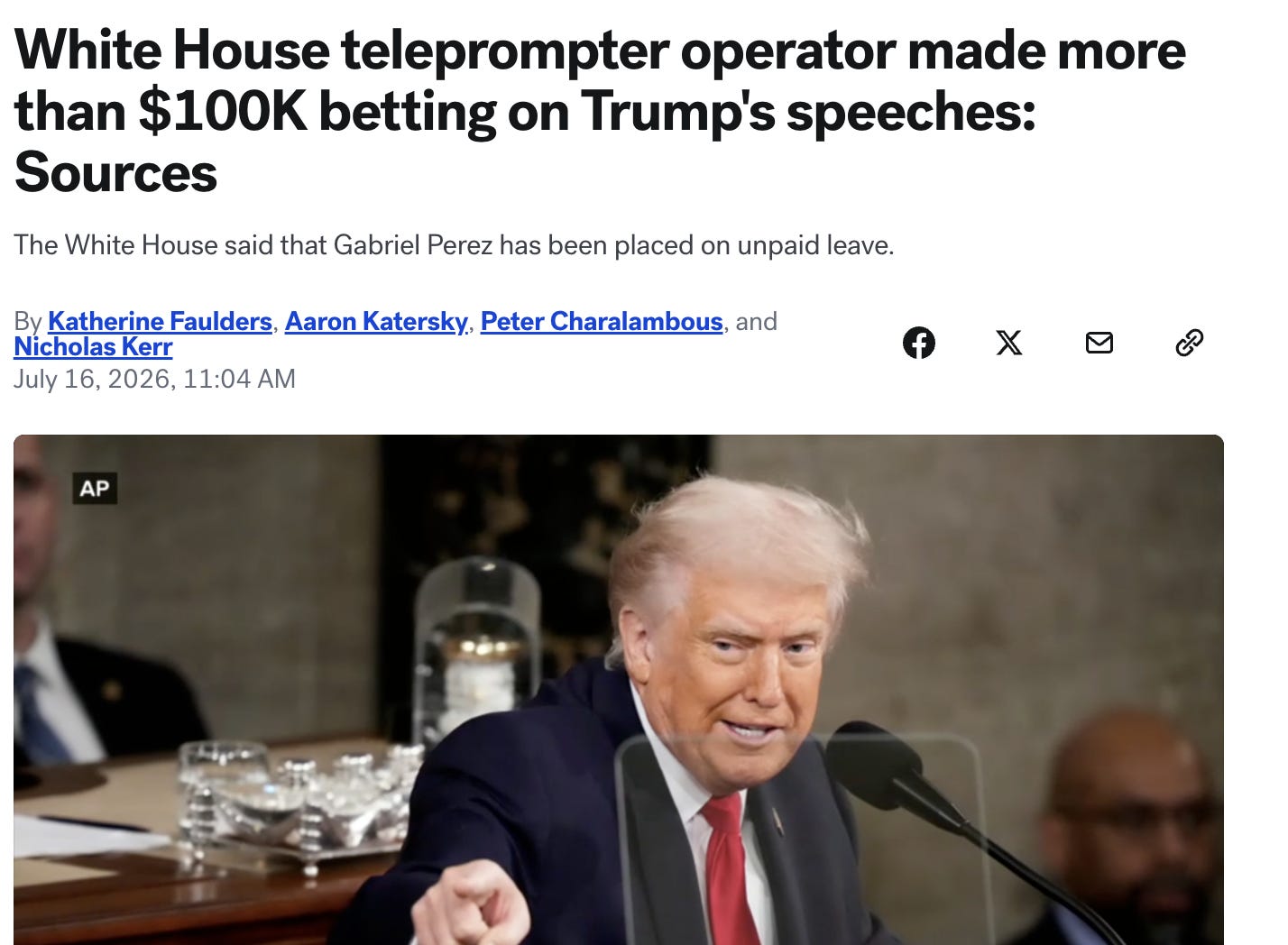
You’ve probably registered by now that prediction markets exist. Keeping track of why they keep producing scandals is another matter. Prediction markets, their users, and their would-be regulators have been busy. From the mundane — more than $200 million riding on the definition of a “suit“ — to the less mundane, like President Trump’s teleprompter operator getting arrested for allegedly placing bets on Kalshi about the speeches he was scrolling.
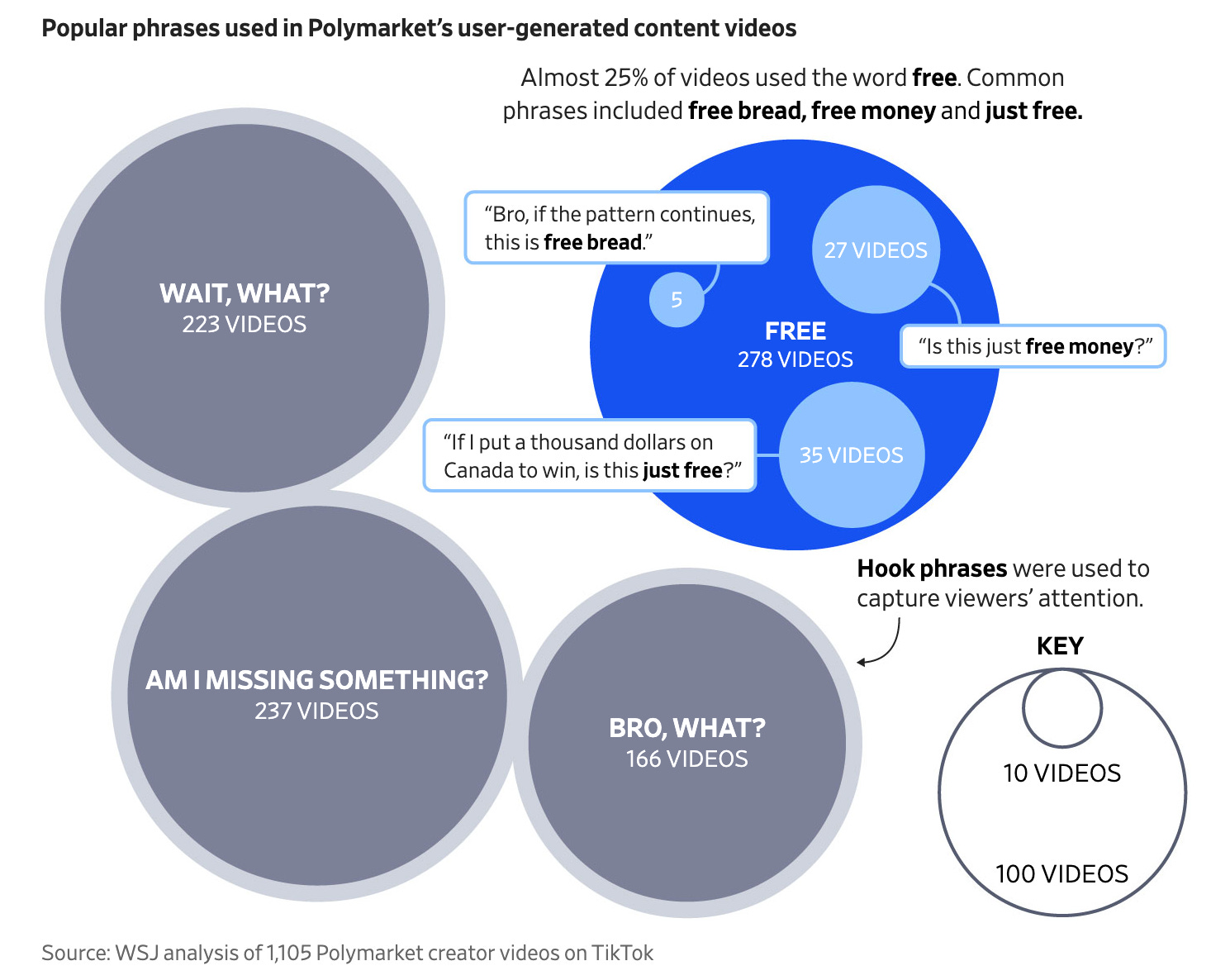
The Wall Street Journal also recently reported that Polymarket paid influencers to fake winning bets on their platform. The platform admitted to Politico that it does, indeed, pay influencers to mention the company. Most people wouldn’t take that to mean that, across dozens of videos, influencers “touted nearly $900,000 in fabricated winnings on positions that would have lost more than $166,000 in live markets.” The simulated bets included fake websites that influencers used to make false claims about their Polymarket success, and evidence that influencers shared the videos with Polymarket for approval before posting.
The Polymarket promotional videos are plentiful enough to represent a distinct genre, complete with their own language, according to the Wall Street Journal analysis.
Oh, and the Commodity Futures Trading Commission (CFTC), the federal agency regulating prediction markets, has been suing states.
It’s been an exciting time for anyone keeping tabs on prediction markets and how they’re (not) being governed.
Part of the difficulty in governing prediction markets is that there’s little agreement on what they are. The CFTC, Congress, and the states see them differently, and that has implications for which tools are available to manage them.
Over twenty pieces of legislation have been introduced. Exactly one has taken effect.
It didn’t need the House. It didn’t need the President’s signature. It doesn’t apply to Polymarket, Kalshi, or the average American.
It applies only to people sitting in the U.S. Senate.
On April 30, the Senate adopted S.Res.708, banning Senators, officers, and staff from trading on prediction markets. It passed unanimously, immediately, without drama because it’s a resolution, not a law, and the only people it binds are the ones who voted for it. The House has tried twice to do the same thing to itself (H.Res.1248, H.Res.1263) and hasn’t managed it yet.
The bills cluster into three groups and each says something slightly different about what a “prediction market” is supposed to be and how one is meant to operate.
There’s a bill to ban death and assassination contracts. A bill to affirm CFTC exclusivity. A bill that affirms the opposite. A bill banning members of Congress from trading on political outcomes. A different bill banning members of Congress from trading on political outcomes. A third bill banning members of Congress from trading on political outcomes, this one with disgorgement penalties. None of them have passed.
Here’s a non-exhaustive list of prediction platform bills introduced this year (note: some fall into more than one category):
1. Regulatory framework bills
2. Content-restriction bills
3. Insider-trading/officials bills
Public Integrity in Financial Prediction Markets Act of 2026
S.Res.708 (agreed upon in the Senate on April 30!)
H.Res.1248 and H.Res.1263 (House versions of the above Senate resolution, not yet passed)
The volume obscures a more basic problem: the bills don’t agree on what they’re regulating.
The framework bills can’t settle what a prediction market is. The Prediction Market Act of 2026 treats them as event contracts under the Commodity Exchange Act, with consumer protections layered on top: a commodity, in other words, and the CFTC’s to govern. However, the Prediction Markets Security and Integrity Act of 2026 seeks to “return regulatory authorities and oversight of online prediction markets to States.” It says the platforms offer services substantially the same as betting, and that states were never meant to be precluded from enforcing gambling law against them. One bill says commodity. The other says wager. Same chamber, same session, no answer.
The content-restriction bills can’t agree on the harm. The Prediction Markets Are Gambling Act and the Fair Markets and Sports Integrity Act say the problem is gambling, and go after sports and casino-style contracts. The content restriction bills DEATH BETS and BETS OFF say the problem is subject matter: war, assassination, and violence. Two very different theories of what’s wrong. Neither has passed.
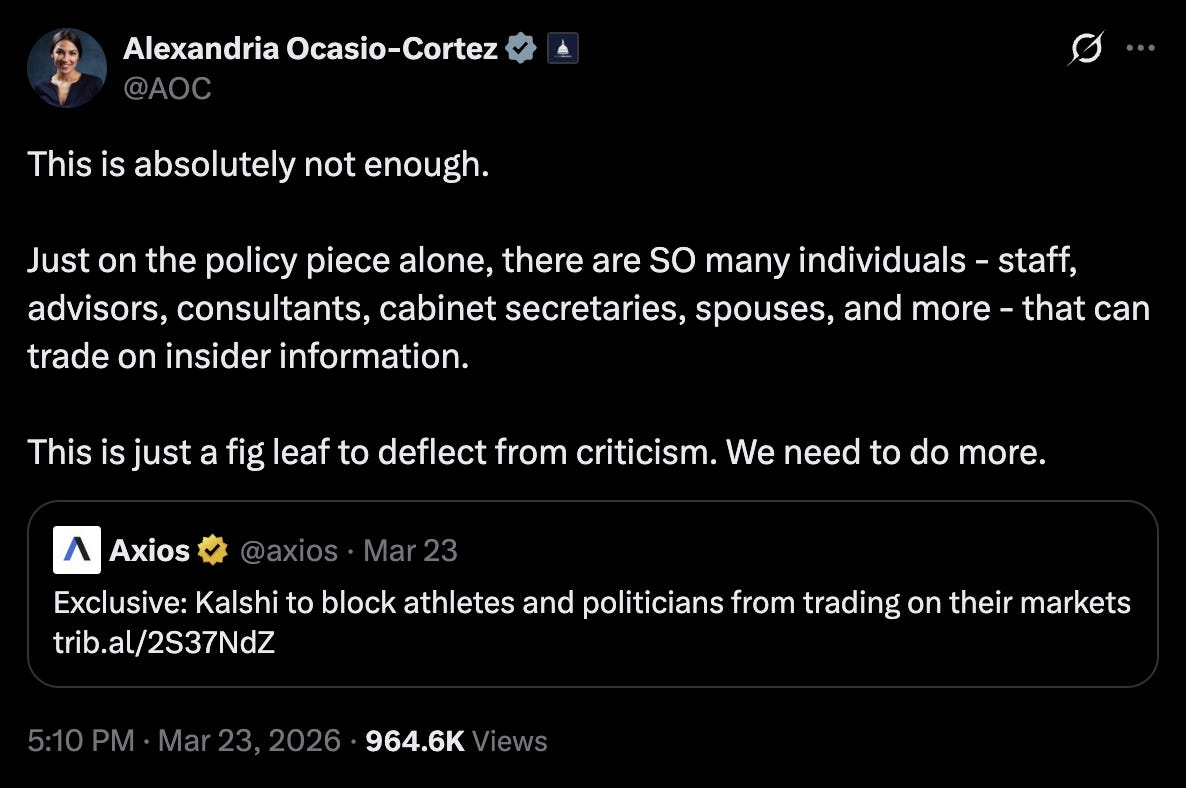
The insider-trading bills can’t settle who counts as an insider. Politicians, sure. Their spouses? Staffers? Bureaucrats? Consultants? In March, Kalshi and Polymarket rolled out their own rules blocking politicians and athletes from trading on markets they might influence. Alexandria Ocasio-Cortez called it “a fig leaf,” pointing out how many people (e.g., staff, advisors, consultants, cabinet secretaries, spouses) sit outside a list like that and can still trade on what they know.
Source: X/Twitter.
The same critique lands on the legislation. The PREDICT Act at least reaches members’ spouses and dependent children. S.Res.708, which is the only measure actually in effect, carves these groups out. The one rule on the books has the exact loophole AOC’s criticism was about, now with the force of a Senate rule instead of a platform’s terms of service.
While Congress has been introducing bills that haven’t come to pass, a constitutional fight has been happening somewhere else entirely. It’s a live federalism dispute, not a policy disagreement.
The federal CFTC has now taken legal action against nine states: Arizona, Connecticut, Illinois, New York, New Mexico, Minnesota, Rhode Island, Wisconsin, and Kentucky. Its argument in each is the same: it has “exclusive jurisdiction“ over event contracts under the Commodity Exchange Act, and state gambling law is therefore displaced entirely, no matter what a state legislature decides. Those nine are only the cases where the CFTC went on offense. Roughly twenty states are in active litigation over prediction markets. The CFTC’s nine is just the visible federal front of a much broader fight.
States, rather than prediction markets, are the ones who can expect federal lawsuits limiting their actions in this space. Michael Selig, the CFTC’s Chairman, has been blunt about the CFTC strategy for months: “To those who seek to challenge our authority in this space, let me be clear — we will see you in court.”
He wasn’t kidding, and he doesn’t wait.
The CFTC filed a lawsuit one day after Minnesota Governor Tim Walz signed a law making it a crime to operate, host, or promote a prediction market in the state. (This was after a Minnesota state senator admitted to betting on himself on Kalshi to win his own primary. He apologized. He’s banned from the platform for five years.)
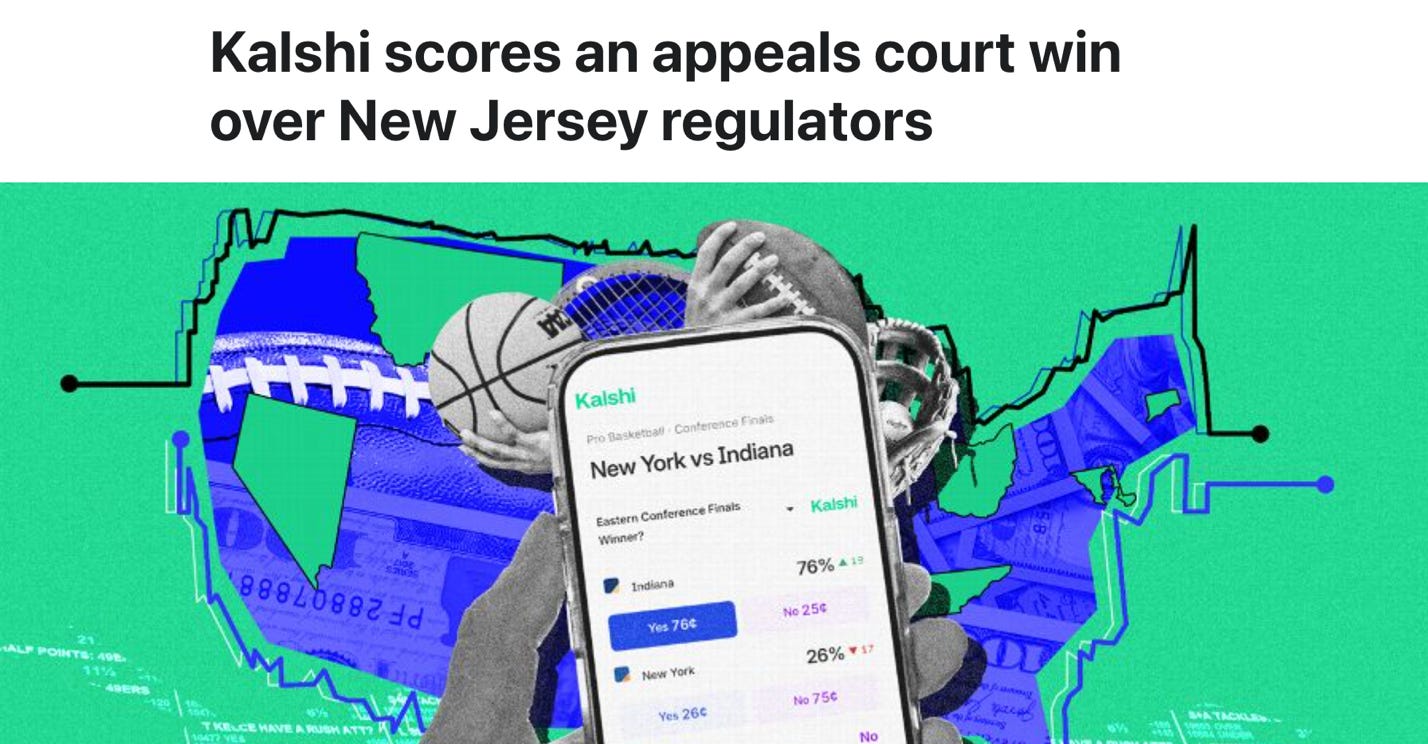
Kalshi won legal battles in New Jersey, where the Third Circuit upheld its injunction in April, and in Tennessee. It lost in Maryland, Nevada, Ohio, and, this month, in New York, where Judge Analisa Torres found the Commodity Exchange Act doesn’t preempt state gambling law as applied to sports contracts. Kalshi has appealed to the Second Circuit.
Not every state has picked a side in the fight-or-fold binary.
North Carolina’s Senate Bill 257, signed by Governor Josh Stein on July 7 and buried inside the state’s 2026 budget, does something neither the CFTC-suing states nor the platforms’ allies have tried. It explicitly recognizes the CFTC’s exclusive regulatory authority over prediction markets, requires no state license or registration, and then taxes them anyway at 6% of net trading fee revenue starting January 1, 2027.
Meanwhile, the CFTC has decided it isn’t waiting for further developments from courts or state legislatures. It has proposed a rule saying federal law governs and states don’t get a say, giving every judge currently hearing one of these cases something to eventually point to that’s firmer than the CEA’s apparently ambiguous text. For the CFTC, it’s better to walk into an escalating legal battle with a finished rule arguing one interpretation than with a pile of conflicting district court opinions. The comment period on this proposed rule closes July 27.
It would seem that many lawyers watching closely have converged on similar predictions. Pun intended.
Linda Goldstein, a partner at CM Law, says the split among lower courts makes Supreme Court resolution likely. Johnny ElHachem at Holland & Knight argues the litigation and enforcement actions are themselves accelerating the odds of review. Alexandra Fedotova, at White Stone, points out the chicken-and-egg problem between Congress and the courts: the only real fix may be legislation, but Congress won’t find the will to legislate until the Supreme Court rules on preemption.
A court can only construe the categories it’s handed. Congress could have handed it new ones. S.4469, for instance, defines an “event contract” (a contract for the sale of a commodity for future delivery, an option on one, or a swap) and builds a whole apparatus around it: public-interest review, marketing rules, an advisory council with state attorneys general on it. That’s a real answer to what these things are. As with the other bills, it hasn’t yet passed.
Congress has split the problem into three parts: what these things are, what they’re allowed to list, and who’s allowed to trade on them. It answered the third, for itself, and left the rest. The fight that’s actually deciding them is none of those — it’s jurisdictional, and that decision may ultimately settle all three at once. Until it does, a handful of venture-capital-backed platforms will keep setting the odds the public reads on what happens next, accountable to whoever blinks last.
No posts
Comments
Nothing yet. Say the first thing.
Sign in to join the conversation.