
A few years ago, I found myself in need of a replacement Social Security card. Without thinking about it all too much, I created a “my Social Security” account and, before long, I received my new card. But then, early last year, something weird happened.
I started getting a bizarre series of e-mails from the Social Security Administration––over the signature of the agency’s administrator––that read more like campaign literature. Among other things, they praised the Trump administration’s elimination of offices created under the Biden administration and applauded the passage of the president’s signature “One Big Beautiful Bill Act.”
The language of the emails was florid. The most recent of the e-mails I received gives a flavor of the thing. A recent message from the Social Security Commissioner Frank Bisignano, after wishing America a happy 250th birthday, informed me that “President Donald J. Trump and the Trump Administration” are delivering historic relief to seniors, that wait times are plummeting “under the leadership of President Trump,” and that, “put simply, America’s seniors are winning!”
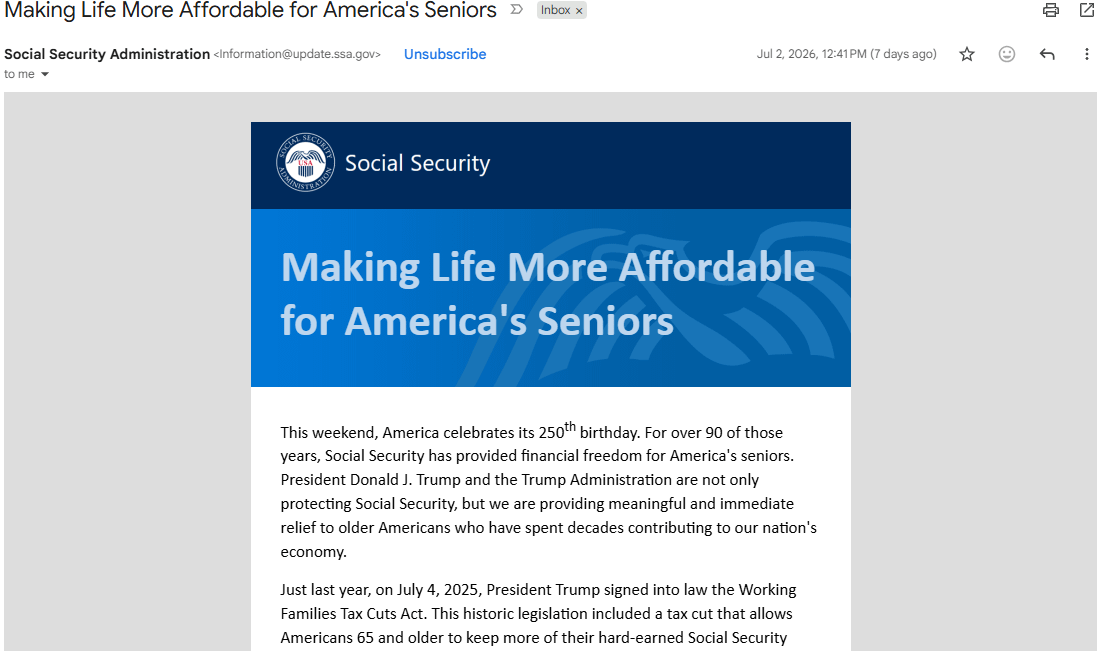
This is the sort of message the Social Security Administration has been blasting out for over a year to more than 70 million account holders. In a normal political environment, this would be a big deal. But in an era where the Trump administration has “flooded the zone” with daily scandals, the emails have attracted little attention.
The messages come in a context where SSA has seen mass layoffs that are undermining its performance. The Center for Budget and Policy Priorities report that:
agency leadership claims that SSA is “working better and faster than ever” seem readily undercut by press reports on customer service and processing strains at the agency. For example, phone wait times are much longer than publicly advertised; lengthy waits for appointments particularly harm widows and children who have lost parents; local offices often struggle to operate with shrinking staffs; and record-high processing backlogs create longer waits for needed help.
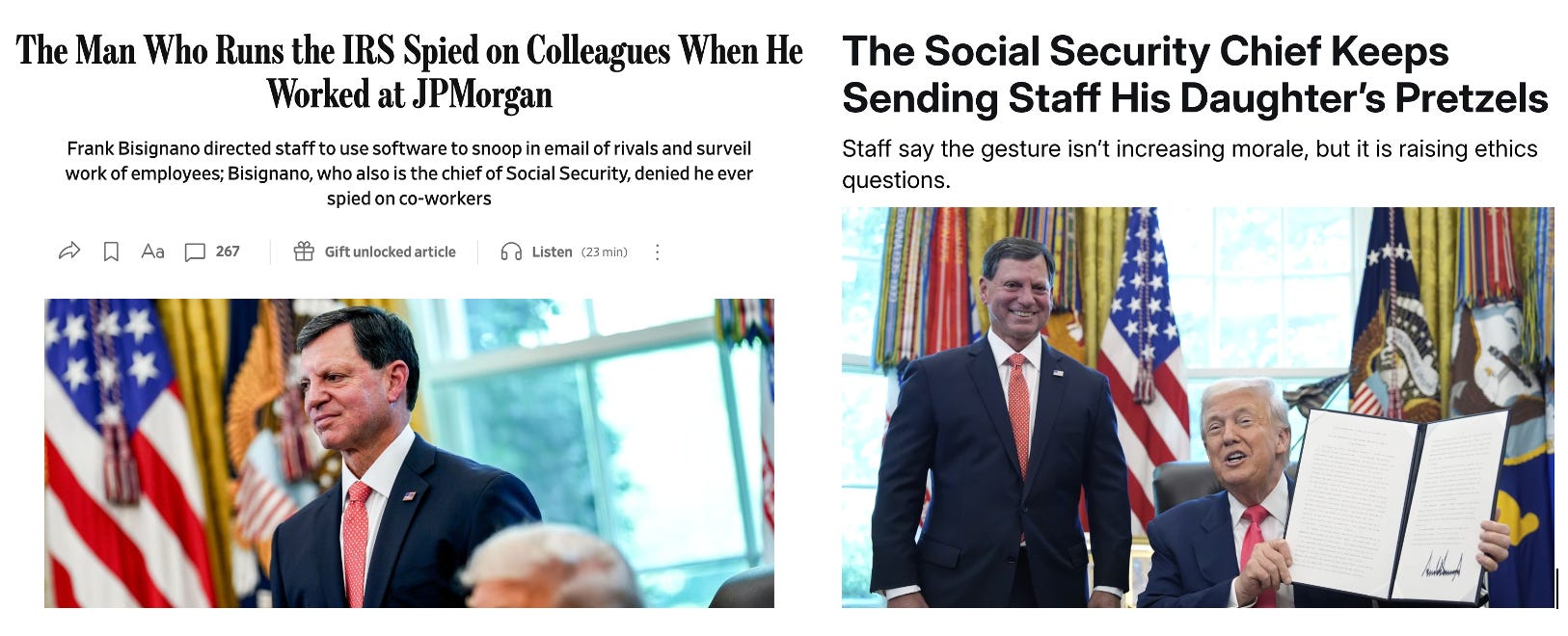
All of this has become a bit easier for Bisignano to lie about, of course, since the SSA removed customer service metrics from its website. Bisignano is lately under fire for spying on his colleagues when he worked at JP Morgan. And for handing out gift baskets from his daughter's pretzel company to raise Social Security staff morale after unprecedented staff cuts.
Last July, former SSA officials from both parties condemned the emails for using the voice of the SSA to make a blatant political statement, as did members of Congress, who demanded a factual correction in an email praising the OBBBA.
In the days that followed those initial blasts, I received emails and texts from family and friends with what has become a standard battery of questions: “What the fuck is this?”, “Is this a scam?”, and “Is this even legal?”
The story died down, but the emails kept rolling out.
The branding project has also expanded beyond emails to the issuance of Social Security cards themselves. SSA recently announced that every baby born between July 2 and December 31 will receive a Social Security card stamped with the logo of “Freedom 250”. This is not the congressionally chartered America250 commission, but a separate entity the Trump administration created to run its own semiquincentennial programming. It joins the passport now available with the president’s portrait inside the cover as one of the most blatant uses of the federal government to promote the brand of a single officeholder.
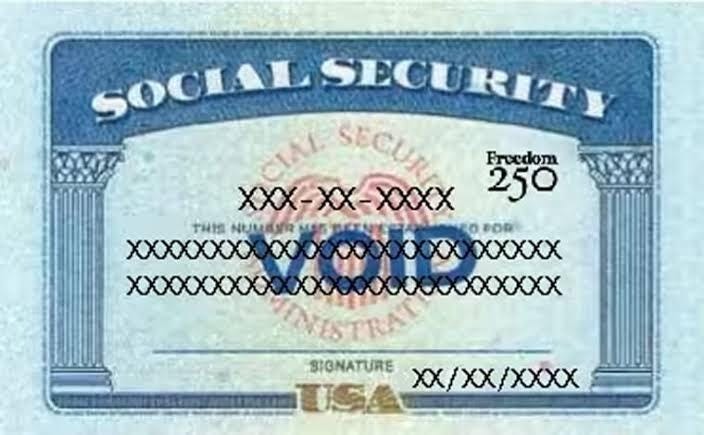
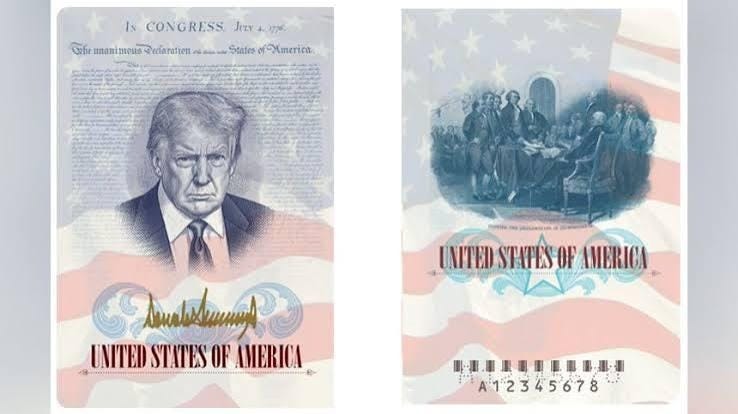
This iconography is just one example of how Trump and his proxies have transformed the executive branch into a tool for what Bill Resh has called “personalist consolidation,” which leverages public institutions as “instruments of personal or factional loyalty”.
But the fear that a president might use the power of an increasingly powerful executive branch to propagandize is as old as the term “propaganda” itself. As early as 1913, Congress has written into statute general prohibitions on publicity expenditures unless there are specific funds allocated to that purpose.
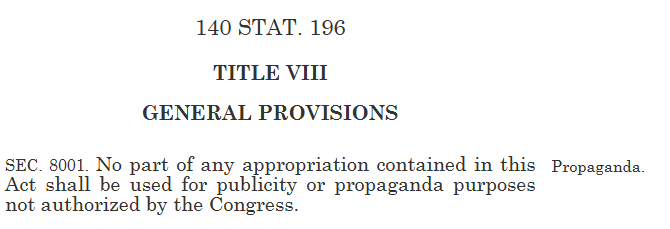
Since 1952, Congress’s annual appropriations acts carry a simple one-sentence rider declaring that no appropriated funds “shall be used for publicity or propaganda purposes not authorized by Congress.” The Consolidated Appropriations Act of 2026 is no different.
If this sounds simple – or simple enough to apply to the sort of egregious cases we’ve seen under the second Trump administration – the reality of implementing appropriations law is anything but.
First, what do the terms “publicity or propaganda” mean?
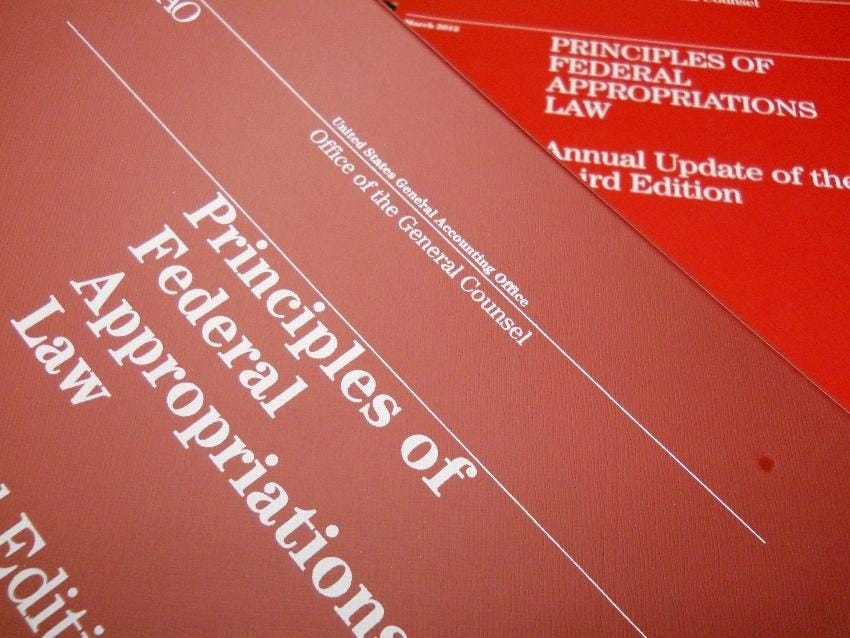
The Government Accountability Office (GAO), which adjudicates these matters, outlines its interpretation of Congress’s publicity and propaganda rules in the Red Book, its multi-volume compendium on appropriations law. As GAO conceptualizes it, there are three categories of “publicity or propaganda”.
First, there is agency “self-aggrandizement”, or “communications tending to emphasize the importance of the agency, its officials, or the activity in question”. In 1986, for example, an advisory commission “whose sole function was to advise the President and which had no promotional role, set up and implemented a public affairs program” of its own, triggering a GAO finding of a violation of appropriations law.
The second category is “covert propaganda”, or “communications that fail to disclose the agency’s role as the source of the information.”
One of the most common forms of covert propaganda is the use of prepackaged news stories. For example, in 1983, the Office of Public Diplomacy for Latin America and the Caribbean was established within the Office of the Secretary of State “to engage in a campaign to influence the public and the Congress to support increased funding for the Administration’s Central American policy. pursuit of its public diplomacy mission.” The newspaper articles and editorials placed by the office, as well as media visits by Nicaraguan opposition leaders, were all cited by the Comptroller General as a violation of appropriations law.
The third category is the distribution of “purely partisan materials”, which are those “designed to aid a political party or candidate.”
This category is particularly difficult to apply, the GAO notes, “because “the lines separating the nonpolitical from the political cannot be precisely drawn.” For example, in 2000, the Department of Housing and Urban Development disseminated a publication called Losing Ground: The Impact of Proposed HUD Budget Cuts on America’s Communities, which criticized “deep cuts” Congress had made to certain HUD programs which would have a “devastating impact on families and communities nationwide.” Given that this was a Democratic administration criticizing the decision of a Republican Congress, the case no doubt warranted scrutiny. Yet GAO determined that this was a “legitimate exercise of HUD’s duty to inform the public of government policies and that HUD had a right to justify its policies to the public and rebut attacks against those policies.”
A more concerning case arose in 2005, when the US Department of Education conducted a media analysis to gather information regarding “public perception of the Republican Party’s commitment to education. While the GAO issued an opinion stating that there were “no appropriations available for analyzing the media and public’s opinion concerning the Republican Party’s (or any other political party’s) commitment to education,” it ultimately concluded that “that there was no publicity or propaganda violation, given that other content of the analysis was acceptable, and thus there was minimal additional expense incurred by including the improper element.”
Indeed, the line between acceptable and purely partisan communication has proven so difficult to police that the last edition of the Red Book states that, to date, there are “no opinions or decisions of the Comptroller General concluding that an agency’s informational materials constituted impermissible publicity or propaganda by virtue of any purely partisan material contained therein.”
In short, where the GAO’s interpretation of the words “publicity or propaganda” is concerned, there are plenty of gaping holes for the Trump administration to walk through.
But the problem goes deeper than the ambiguity of terms like “publicity” and “propaganda”. As Kevin Kosar explained in a perceptive 2005 Presidential Studies Quarterly article, even keeping track of potential government publicity or propaganda efforts can prove difficult. Agencies’ budgets and federal procurement data provide only the fuzziest of details on public-relations expenditures, including how public employees spend their time on such efforts.
In a world where government is conducted not by press release but by social media posts, the challenge of tracking the appropriations to scan for appropriations-law violations becomes even more difficult.
So much for oversight. What about the enforcement of appropriations law? There, Kosar suggests, the problem gets even worse. It is GAO that is principally charged with policing appropriations law. But, as a creature of the legislative branch, it has no direct authority to sanction agencies or individuals who violate the law. It can only report its findings and refer violations to the Department of Justice.
“When it comes to propaganda,” Kosar notes, “the executive branch has demonstrated little interest in punishing wayward executive agencies.” At the time of publication, Kosar could locate neither a single opinion of the Office of Legal Counsel on the “publicity or propaganda” statute nor a single criminal prosecution under it.
If executive-branch agencies have made anything clear in recent years, it is that they do not much care what GAO has to say about appropriations law. In 2005, both the DOJ and the OMB issued memoranda stating that GAO’s interpretation of federal appropriations law does not bind them.
With an executive branch that has zero incentives to enforce appropriations law, the ball is firmly in Congress’s court. The problem, of course, is that only the DOJ can effectively act. Provided that Congress is not controlled by the President’s party, it can use its tools of oversight to expose violations of appropriations law. Though even here there are limits. Not only is oversight costly and, as noted above, difficult to do in a flooded zone, it is not entirely clear whether and how public attitudes on executive-branch propaganda—which reflect policy preferences and partisanship—can be moved sufficiently to alter agencies’ incentives.
Appropriations law is hardly the only tool Congress has created to police political activity by employees of the executive branch. The Hatch Act, passed in 1939, limits political activities by nearly all federal civilian executive-branch employees. Among many other things, it prohibits all covered employees from using their “official authority or influence for the purpose of interfering with or affecting the result of an election” and “engaging in political activity while on duty; on federal property”. To enforce the Hatch Act, the US Office of Special Counsel (OSC) renders advisory opinions and can investigate and prosecute alleged violations.
In May of last year, for example, the OSC found that the Biden-appointed Social Security Commissioner, Martin O’Malley, violated the Hatch Act during a radio interview in October of 2024, in the midst of a presidential election campaign, when he said that Donald Trump’s policy proposals would “quickly deplete Social Security”. This statement, the OSC determined, was a clear-cut violation of the law. Despite framing his remarks as commentary on a policy proposal and emphasizing that he “could not tell anyone who to vote for”, the OSC concluded that O’Malley had made an “express message to voters that they had a responsibility to vote against President Trump.” Yet even in this relatively clear-cut case, discipline proved elusive. By the time that OSC issued its report, O’Malley had already left office.
It may be even more difficult to use the Hatch Act to police emails like the ones sent out by Trump’s Social Security Commissioner. True, a string of misleading official e-mails crediting the sitting party leader by name for purported policy benefits is arguably political activity performed “on duty or using government resources” under Section 7324. Indeed, even content that looks merely promotional can be a Hatch Act violation if there is evidence of electoral purpose. The record of what was said internally about the emails sent over Bisignano’s signature has never been publicly examined.
But enforcement is highly unlikely in the present circumstances. In February of 2025, Trump fired Hampton Dellinger, Biden’s Senate-confirmed head of the OSC. Since then, the OSC has had no Senate-confirmed leader. Wherever the line is, the present OSC will not be the one to decide whether SSA’s recent emails have crossed it.
And so, the reality is that the Trump administration is using public resources and the trust people have in public organizations like the Social Security Administration to send partisan and misleading messages in an election year with no meaningful constraint. Even as headlines portray a Social Security Administration struggling to recover from DOGE-era cuts, the administration is filling our inboxes with the claim that things are better than ever.
The broader picture is that the legal institutions meant to police political corruption in the United States are failing us. From pardons of political supporters to naked quid pro quos for large donors to the most mundane of official emails, Trump has leveraged the federal government for personal and partisan gain.
Amidst a hotly contested 2026 midterms, we should not be surprised to see the administration use the voice of federal agencies to interfere with the democratic process. Even when enforcement is unlikely, however, documenting and broadcasting the extent of this corruption still matters. While federal agencies should be able to tout actual achievements, they should not become publicity arms of a personalist regime.
No posts
Comments
Nothing yet. Say the first thing.
Sign in to join the conversation.