
In the late 1930s, L. Ron Hubbard was a struggling writer, churning out pulp fiction for a penny a word. He boomeranged between feelings of crushing self-doubt and soaring dreams of messianic glory. “I have high hopes,” he wrote in a letter to his wife, “of smashing my name into history so violently that it will take a legendary form.”
In the aftermath of World War II, Hubbard was on leave from the Navy, living in Pasadena with a house full of people brought together by their interest in science fiction and the sexual black magic of Aleister Crowley (1875-1947), the English sorcerer and leader of the Ordo Templi Orientis (OTO).
One of Hubbard’s roommates, a young reporter named Nieson Himmel, was the most skeptical listener to Ron’s many tall tales of adventure. “I can’t stand phonies and to me he was so obviously a phony, a real con man,” Himmel recalled. “He was always broke and trying to borrow money. That was another reason he didn’t like me — I would never lend him a cent. Whenever he was talking about being hard up he often used to say that he thought the easiest way to make money would be to start a religion.”
Hubbard did exactly that. It’s called the Church of Scientology. Those tidbits cited above were unearthed by biographer Russell Miller in Bare-Faced Messiah — The True Story of L. Ron Hubbard. That ground-breaking work was published in 1987, the year after Hubbard died while hiding out on an isolated ranch on the central California coast, where he’d been living under the alias “Jack Farnsworth.”
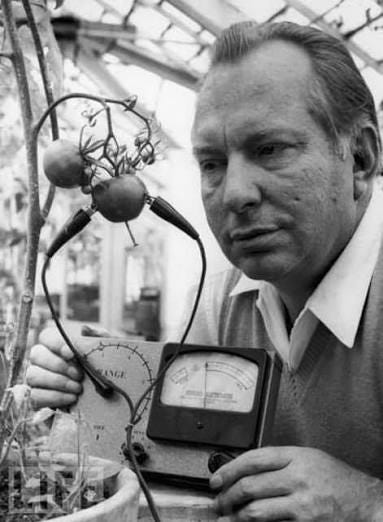
After making a name for himself in science fiction circles, Hubbard shifted gears in 1950 with a best-selling self-help book titled Dianetics: The Modern Science of Mental Health. His theories about the “reactive mind” laid the foundation for his Church of Scientology, first incorporated in December 1953.
His church blended concepts from Eastern religions and occultism with a sprawling “space opera” cosmology first envisioned in Hubbard’s fiction writing. It became one of the wealthiest new religious movements of the twentieth century by selling increasingly expensive “auditing” sessions with an E-meter that promised nothing less than superhuman powers and eternal life.
Scientology fought a decades-long, take-no-prisoners battle with the Internal Revenue Service to obtain its tax-exempt status, while marketing itself through celebrity endorsements by some of Hollywood’s biggest stars. It targeted critics in government and the news media, but was especially vicious in pursuit of high-level defectors who publicly revealed its secretive “technology” and more esoteric teachings.
Depending on one’s point of view, it was the most dangerous cult or the most persecuted religion of the twentieth century. And riding atop that wave was the mad messiah himself, born in 1911 in Tilden, Nebraska, Lafayette Ron Hubbard.
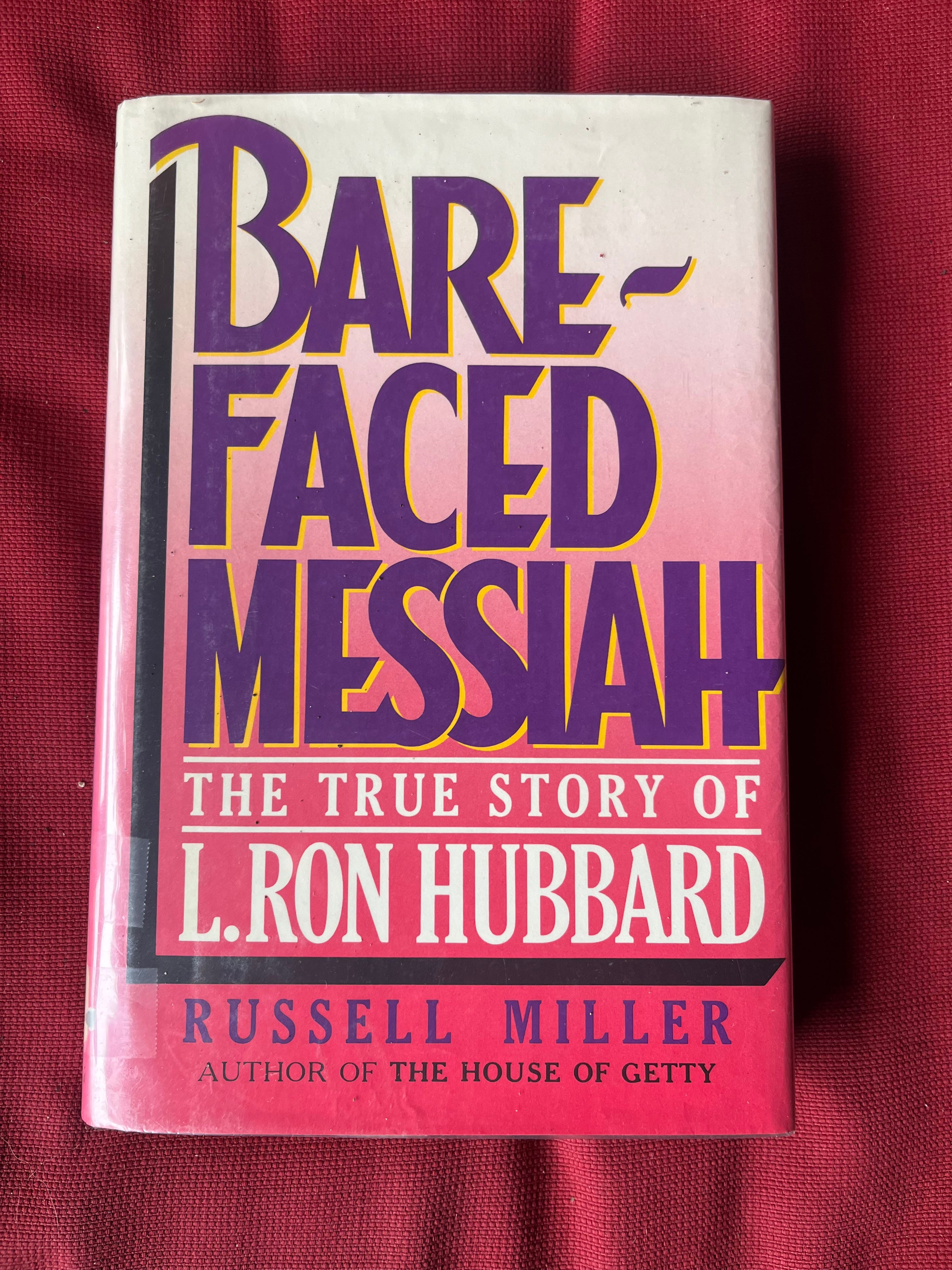
No space here to get into the details of this sprawling saga. There are a number of book-length exposés and memoirs by former members, independent journalists and religion scholars —all of them brave enough to pull back the curtain on the Wizard from Nebraska. Among them: A Piece of Blue Sky by defector Jon Atack; Going Clear — Scientology, Hollywood & the Prison of Belief by journalist Lawrence Wright; and The Church of Scientology: The History of a New Religion by sociologist Hugh B. Urban.
No one has come close to matching the 2013 masterpiece by Wright, the Pulitzer Prize-winning reporter for the New Yorker. He focused on the hardball tactics of the current Scientology leader, David Miscavige, who grew up in the church and wrested control in a fierce leadership battle around the time of Hubbard’s death. Going Clear was also the basis of a 2015 HBO documentary. Wright’s work also revolves around the defection of Paul Haggis, a top Hollywood screenwriter, and the life of Tom Cruise, the mega-star and Scientology stalwart.
My main effort to tell a piece of the Scientology tale came in early 2001, when the San Francisco Chronicle published my four-part series on children who grew up in four religious cults. Part Two profiled Astra Woodcraft, then 22, who was raised in the church and had recently defected from the cult’s elite “Sea Org.” That unit dates back to the late 1960s and early 1970s when Hubbard was living in exile and running Scientology aboard the Apollo, his 320-foot-long flag ship, with a crew of 200 true, mostly young, believers.
(There will be more on Astra’s story in the Part 3 of this retrospective.)
Active church membership — which according to Wright may have peaked in the mid-1990s at around 100,000 active members — was already declining when Going Clear was published in 2013. He notes in Going Clear that thanks to rich donors in Hollywood and elsewhere, the wealth of the church was continuing to grow. Wright and former Scientology insiders estimate that the church now has assets of between $1.5 and $3 billion.
At the same time, the ranks of Scientology’s Sea Org have remained relatively stable, with estimates of between 3,000 and 7,000 dedicated full-time troops, now mostly ground-based in Los Angeles, Clearwater, Florida, and at smaller centers around the world. There have been a number of tell-all memoirs published over the last five decades by Sea Org defectors, who sign a billion-year contract promising to serve Hubbard in this and future lifetimes.
One of particular relevance to our “Messiahs I Have Known” series is My Billion Year Contract by Nancy Many, a former member of the Sea Org. She describes a Hubbard project in the late 1970s known as the “Messianic Project.” It sought to figure out why people are drawn to messianic figures, and then “create the image of L. Ron Hubbard as the next messiah.”
Many devotes a chapter in her book to how she was brought into this top-secret project, which included public opinion surveys to assess what people were looking for in a messiah. “I suddenly saw that the direction Hubbard wanted to go with the organization was that of his being the next spiritual messiah, the savior of mankind.”
“Hubbard truly did believe he was as great as Jesus, Buddha or Mohammed,” she writes, and “had plans and programs in place and in motion to create that image of himself in the world.”
It’s unclear exactly how much of that campaign was actually deployed, but it worked well enough to get the old man included in this rogue’s gallery.
(Next week: A look at the actual family life of L. Ron Hubbard.)
Thanks for reading Don ! This post is public so feel free to share it.
No posts
Comments
Nothing yet. Say the first thing.
Sign in to join the conversation.