

No matter what unit is used to set a price for society’s goods and services, each individual measures product value subjectively by considering how long they would need to work to earn that price. Regardless of the unit of exchange, people already use time to measure value… so switching to a pricing system that measures value in increments of time would make a lot of sense.
Everything produced could be measured in time values quite easily. Labour costs would simply be the total contribution time of all workers along the chains of supply and production. Unequal income for identical working hours could be achieved using “paid rest” to compensate highly skilled or dangerous occupations. Higher salaries could be converted into hours by multiplying actual work times by the “paid rest” premium… so a professional with a “paid rest” premium of 200% who worked 8 hours would earn the 8 hours worked, plus 16 hours of “paid rest” for a total income of 24 hours. This amount would be input into prices.
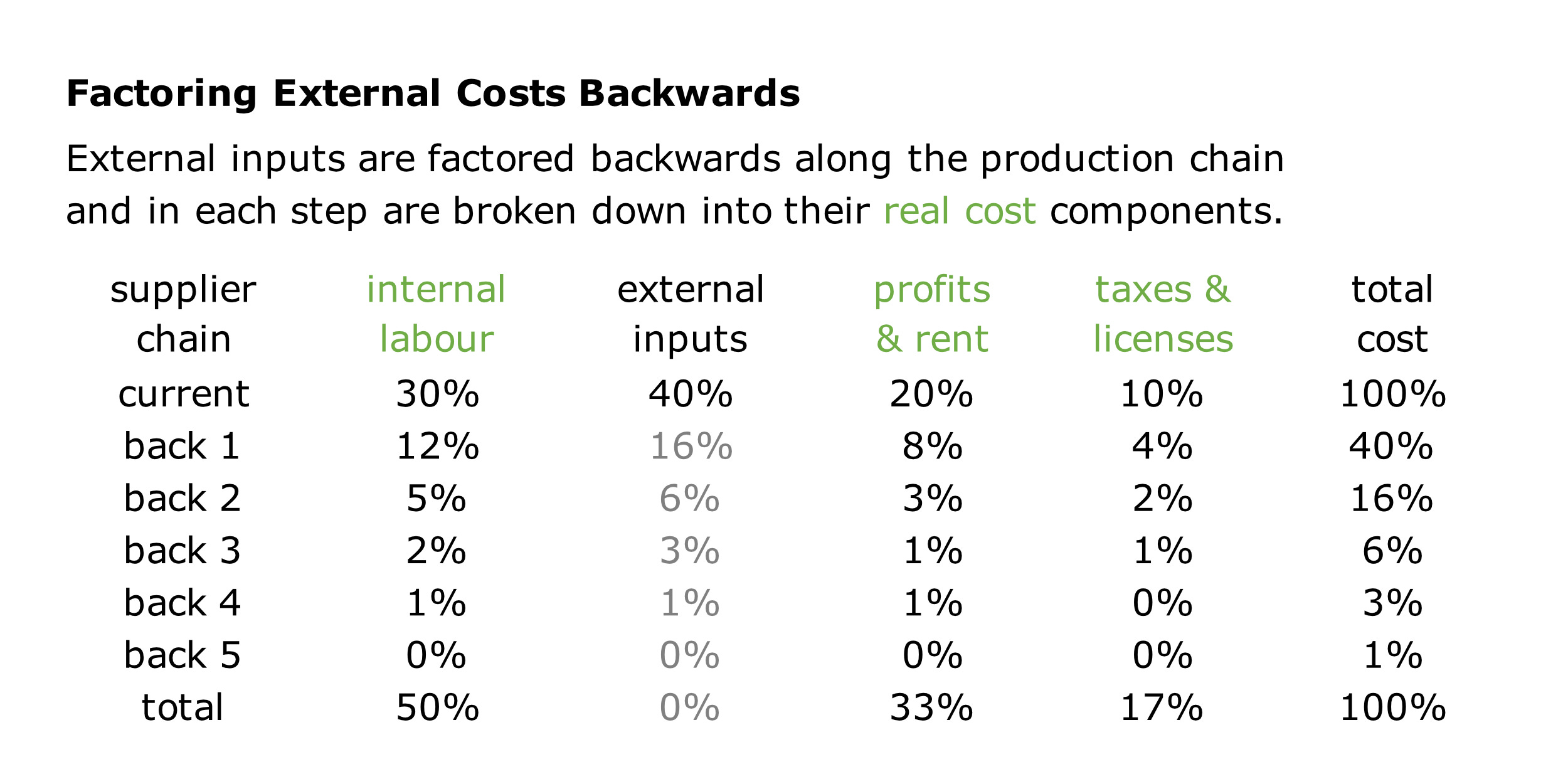
Now here is the fascinating part. When every other current supply and production cost is factored backwards to the original source of the component, only a labour cost exists. For example, if the current cost of a commercial building valued at $10M is broken down into its component costs, the construction company’s own internal labour might be 30%, another 10% may be professional fees, 40% might be raw materials, supplies and components, 10% may cover equipment rent and depreciation and 10% may be transportation, fuel, energy and utilities. Labour and professional fees were already covered in the previous paragraph. The 60% that remains for everything else can be broken down into the same combination of input costs. So 40% of the remaining 60% are labour costs, that’s 24% more added to the labour cost total, leaving only 36% left as other costs. These “non-labour” costs of the construction company’s suppliers can also be factored backwards to their own supply chains where 40% of that 36% (14.4%) was the labour cost to produce those production inputs. This brings the total labour cost now to 78.4% (40% + 24% + 14.4%). Factoring back each supplier’s own cost of purchased external goods and services adds another labour cost to the total and it should be obvious by now that when traced backwards to the source there is nothing except labour and natural resources in the whole supplier production chain network.
The only exception to this is the imaginary and arbitrary class of inputs that include profit, interest and taxation. A sound monetary and economic system will reject the legitimacy of these inputs. All three are simply an involuntary confiscation of individual property imposed by an institutionalized corporate/government oligarchy. There is no reason to allow extortion and graft in an honest money system. It is anti-social, anti-family and morally corrupt. An honest time-based money system would prevent these power tools of greed and violence from destroying Creation and the limitless value and potential of every living soul on the planet. Creation provided the Earth’s natural resources, our Common Wealth, as a free gift to all species both here now and yet to come, so the only true cost of everything made is human labour. This fact alone justifies why a sound economic system should measure value using time.
* * *
To help visualize what factoring backwards actually looks like, here’s a simple Excel file that factors external inputs backwards along a chain of production. For each step back, supplier external inputs are reallocated into their real cost categories using the current cost ratios. After excluding profits and taxes, internal labour is the only real remaining cost.
.
No posts
Comments
Nothing yet. Say the first thing.
Sign in to join the conversation.