
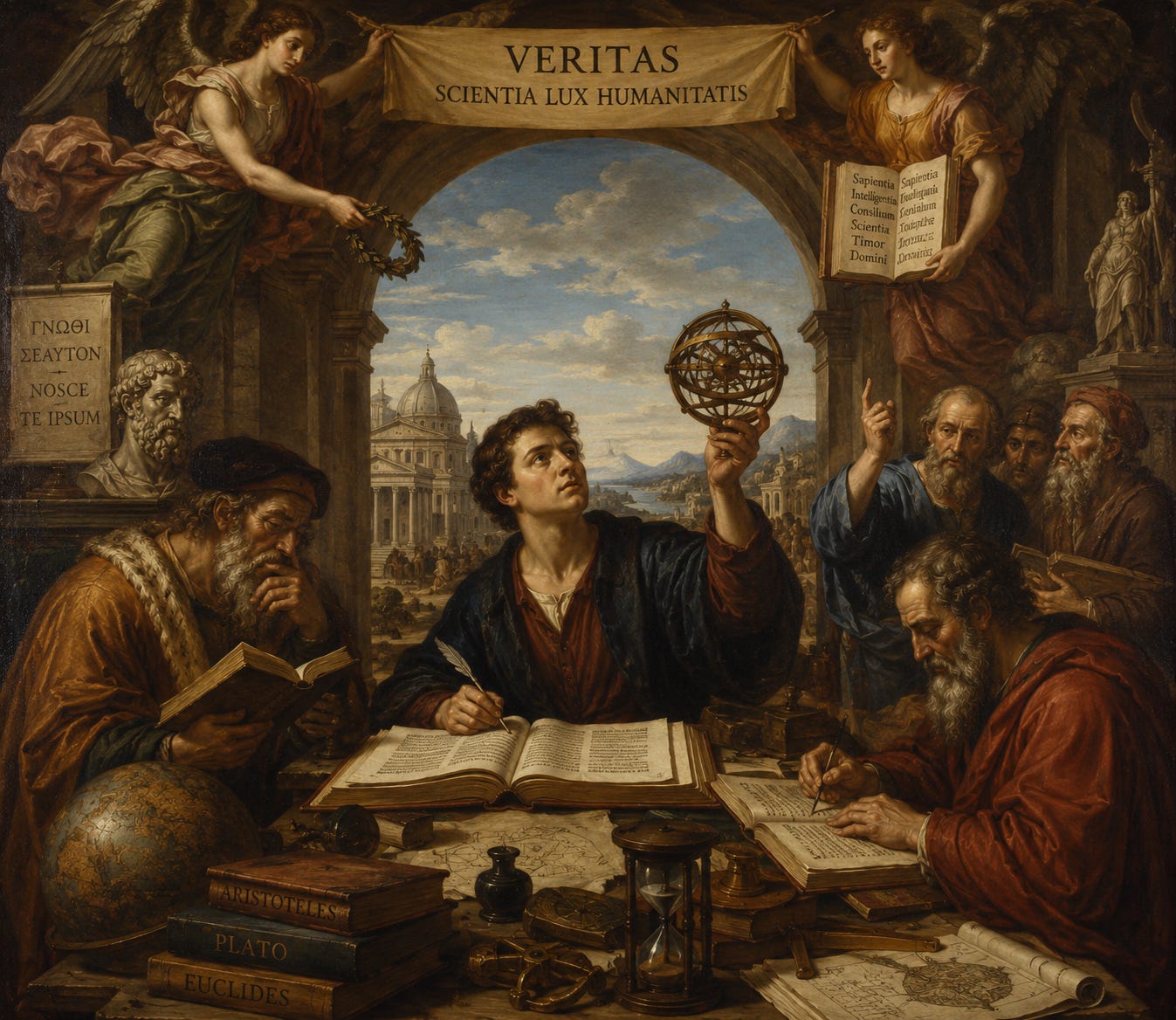
The pursuit of knowledge is as old as humanity itself. In the Genesis account of creation, Adam and Eve were tempted by the prospect of divine knowledge, desiring to be like Elohim, the God who fashioned humankind from the dust of the earth. Likewise, the Hebrew wisdom tradition is replete with exhortations to seek wisdom, knowledge, and understanding, recognizing them as gifts that enrich and empower the human soul. One might argue that a defining characteristic of humanity is intellectual curiosity—the innate desire to grow in rational understanding of ourselves, the world, and the cosmos.
The ancient Greeks also held strong convictions regarding humanity’s propensity for knowledge. Malcolm Heath, in his English translation of Aristotle’s Poetics, observes:
“All human beings by nature desire knowledge.” This opening sentence of the Metaphysics states a fundamental premise of Aristotle’s understanding of what it means to be human. As evidence for this claim, Aristotle points to the pleasure we take in perceiving things and assimilating information through our senses.[1]
As sensory beings, our experience of the world naturally awakens curiosity. This curiosity motivates us to examine, research, and understand the reality that surrounds us. Aristotle viewed this rational activity as central to human flourishing. Unlike animals, which function primarily according to instinct, human beings possess the capacity for reflection, deliberation, and intellectual inquiry. Through reason, we seek truth, pursue understanding, and cultivate wisdom.
The biblical account of creation offers a profound theological explanation for humanity’s rational nature:
“So God created man in His own image, in the image of God He created him; male and female He created them” (Genesis 1:27, NASB).
The Hebrew word for “image” is tselem, referring to an image, likeness, or representation. In the ancient Near Eastern context, the term often carried royal connotations, signifying a visible representation of a ruler’s authority. Thus, to be created in the image of God means that human beings reflect aspects of the divine nature. Among these qualities are rationality, morality, creativity, and the capacity for virtuous living.
The rational activity of the soul is therefore not accidental; it is intrinsic to what it means to bear the image of God. Human beings possess a remarkable capacity to reason, create, imagine, and discern moral truth. These attributes reflect Elohim, the Creator of heaven and earth, who endowed humanity with the ability to know, understand, and steward creation.
Humanity’s inclination toward intellectual growth is further celebrated in the Book of Proverbs:
“My son, if you will receive my words
And treasure my commandments within you,
Make your ear attentive to wisdom;
Incline your heart to understanding.
For if you cry out for insight,
And raise your voice for understanding;
If you seek her as silver
And search for her as hidden treasures;
Then you will understand the fear of the Lord
And discover the knowledge of God” (Proverbs 2:1–5, NASB).
In this passage, the reader is exhorted to pursue wisdom with diligence and determination. Wisdom, understanding, and insight are portrayed as treasures more valuable than silver or gold. Such knowledge is not acquired passively; it requires discipline, study, reflection, and perseverance.
For the biblical writers, learning is far more than the accumulation of information. It is the cultivation of the soul. Knowledge nourishes the rational faculties that God has implanted within humanity and enables us to live wisely, virtuously, and faithfully. The quest for understanding is therefore both an intellectual and spiritual endeavor. To seek truth is, in many respects, to seek the One who is Truth itself.
The human longing to learn, discover, and understand ultimately reflects our origin in God. As bearers of the divine image, we are drawn toward wisdom because we were created by the God of wisdom. Intellectual curiosity is not merely a human trait; it is a sacred gift that invites us to grow in knowledge, virtue, and communion with our Creator.
[1] Malcolm Heath, trans., Aristotle: Poetics (London: Penguin Books, 1996), ix.
No posts
Comments
Nothing yet. Say the first thing.
Sign in to join the conversation.