
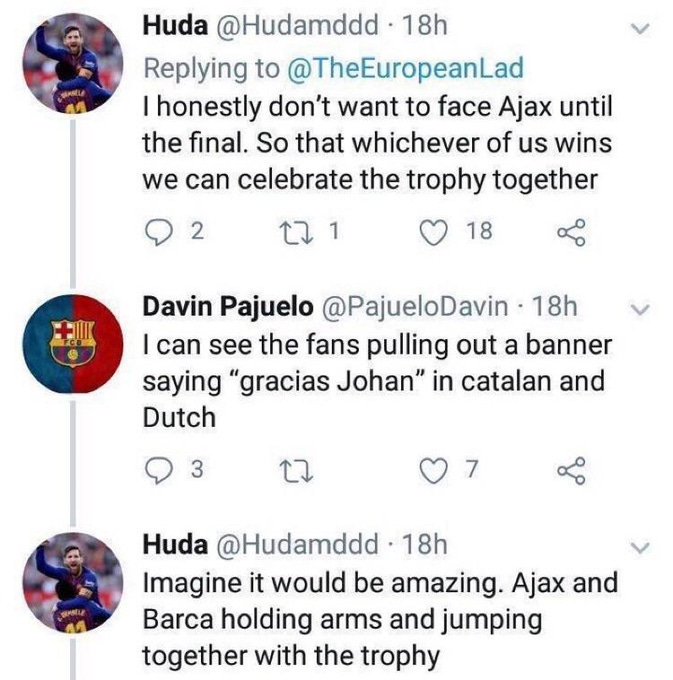
Do you know that meme from ages ago where two Barcelona fans on X discuss how beautiful it would be if Barcelona and Ajax ever met in a final? They go on to say that whoever won that fictional final, the fans would be able to celebrate it together, pulling up a banner and saying ‘Gracias Johan’ in both Dutch and Catalan, referencing Cruyff’s connection to both. Then, they would hold hands and jump with the trophy. Oh man, those were the days.
Even if you have no clue what I’m talking about, you can imagine how it used to be the biggest meme out there and a common tool used by rival fans to mock Culers for this incredible and cheesy fantasy. Well, fast forward to 2026 and this meme has become reality.
Only, it’s Barcelona and Messi fans holding hands and jumping with the trophy. Well, kind of.
You know I jest. There is always just one winner in a final and Spain were head and shoulders above Argentina. And Messi’s tears tell you enough about this supposed ‘win-win’ scenario. No such thing in football.
That being said, the absurdity of this is tough to believe. With this article, I have now published a total of 14 pieces on Dom’s Tactics Lab which focused on the World Cup. From Messi’s cognitive aging and permanent automaticity, Lamine Yamal’s flow state in Spain’s team to La Roja’s architectural consistency and Argentina’s cultural embedding. And now, the literal Passing of the Torch.
Spain vs Argentina in a World Cup final, with eight Barcelona players on one side and football personified, Lionel Messi, on the other. I never planned for it to happen but I did tell you throughout this series, these two teams are my favourites. So the archive on DTL was slowly building towards it anyway.
This final represented the two most analytically interesting teams at the tournament, the two most culturally embedded footballing nations confirmed as the summer’s exceptions and the two players who have defined Barcelona’s past and future on opposite sides of the biggest game in football.
Coincidence? Perhaps. But if so, it’s a bloody incredible one.
Us Barcelona fans often pride ourselves in the fact that we support a club that enjoys the finer things in football. You know what I mean, the ‘we want to win but we also want to win playing beautiful football’ thing. Barcelona are literally the club of the people, the club of the fans whose buttocks were perched on top of the exterior walls they sat on, just to watch the team play when all the other seats were sold out.
And love them or hate them, the Blaugrana gave the world some of the best football and best players, including the literal deity and sport personified in Messi himself. And Spain? Well, Spain have historically been at their very best when their core was nigh-exclusively Barcelona loaded. Last night was just one in a long series of confirmations of this thesis.
This time around, there were a total of eight Barcelona players in Luis De la Fuente’s squad, even though not all eight were prominent pieces of the puzzle. But even so, this is a portrait of what La Masia and the Barcelona system have produced and deposited into the juggernaut that is La Roja.
But Pedri, Lamine, Pau Cubarsi, Dani Olmo and Ferran Torres were significant contributors to the squad’s overwhelming success, especially the latter with that screamer that sealed Spain’s second World Cup win ever. And just on this Substack alone, together we have covered so much of what makes them special and what makes them almost indispensable.
One way or the other, winners or losers in the final, it did not really matter. Barcelona’s football philosophy was on one side of the pitch last night. Messi, who built that philosophy across 20 years of his career, was on the other. This is football heritage.
It was also quite intriguing, to be honest, because despite their Barcelona connection, Spain and Argentina could not be further apart in terms of what they produce on the pitch. Yes, they are two teams that most closely mirror what top clubs bring to the table but they do it in drastically different ways.
Of course, their cultural embedding runs deep and the shared vocabulary is their most unique trait at the World Cup. But they still sit on the opposite ends of the tactical spectrum. And that’s exactly what made this final so special, even if the football was… well, bad.
Sure, the other part was the win-win scenario for people like myself. It’s not often that you watch a final of any tournament, let alone the biggest one on the bloody planet, and you’re happy with the outcome no matter who wins. But that too, is Barcelona’s doing. So if you’re one of those people, count yourself lucky.
But you know what? Even if football does not always reward the best, and it did reward the best team last night, it still produces stories that stick with you; stories that matter.
This was a canon event that marked a whole era. And we were alive to witness it.
Let that sink in for a moment.
Analytically speaking, Spain and Argentina are two sides of the same coin. They are cut from the same cloth but are direct opposites at the end of the day. How is that even possible, you may ask yourself. Well, it’s quite simple, really: cultural embedding plus architectural alignment.
Lionel Scaloni, who coached Argentina to both the 2022 title and the 2026 final, sat in Luis De la Fuente’s UEFA Pro-Licence class at Las Rozas and argued with him about football from the front row. This means that the coaches who delivered this 2026 Dream Final share direct educational roots in the Spanish federation’s coaching programme, the same institution that produced Pep Guardiola, Mikel Arteta and Unai Emery. One coin. Two sides. Do you see it, now?
That’s why I’m banging this drum of the two most analytically interesting cases of cultural embeddedness at recent World Cups being products of, and in dialogue with, a coaching education tradition that has spent decades thinking explicitly about tactical evolution, team building and how football cultures transmit their vocabulary. De la Fuente taught those exact subjects at Las Rozas. And bloody Scaloni of all people sat in his class and in true Argentinian manner probably challenged his every claim. How insane is that?!
Of course, the tactics are… different.
Spain’s insistence of protagonism and possession-based principles are a far-cry from anything Argentina have produced in the last decade or so. The double 10 mechanism with Olmo and Oyarzabal dropping between the lines to create a decisional dilemma for the defenders and the overlapping full-backs with both Marc Cucurella and Pedro Porro being crucial parts of the attacking machinery are unique artefacts that define La Roja.
But also, remember, 1.84 xG conceded in seven games building up to the final and one goal conceded. Spain never panicked, even after the Cape Verde scare, which, funnily enough, mirrors Argentina’s start to the 2022 tournament against Saudi Arabia. Again, two sides, same coin. And Spain never wavered from their identity and now finish the World Cup as the most consistent team in this tournament by a significant margin.
Argentina, on the other hand, are a team with cultural embedding and a special Messi flavour sprinkled across it. They’ve had three consecutive games where Scaloni’s Plan A failed and the backup was Leo changing his own role and, in turn, changing the game. This was a 39-year-old doing things the science of the Messi piece predicted and the tournament confirmed. Link below.
But then there’s also La Nuestra, which makes Argentina the psychologically strongest side here. These players would literally die for football and die for Messi in particular. They are not tactically the best or physically the strongest or fastest. And yet, they are here once again. Messi is here once again.
So the contrast could not be clearer: Spain have the system that asks no single player to carry everything. Argentina have the system where one player has carried everything when it mattered most. Last night, those two philosophies met directly.
And there was always going to be just one winner.
I would hate for this section of our analysis to just turn into a simple players-versus-player comparison. It’s not in the Dom’s Tactics Lab ethos. So let’s make it a passing-of-the-torch reflection more than anything else.
To think that this story started almost 20 years ago in a photoshoot in which Messi’s touch of god transferred a bit of his magic onto Lamine is genuinely unbelievable. And you may not believe in the supernatural, neither do I really, but this? It does send a little shiver down my spine, to be honest. In a good way, of course.
My own Lamine and Messi comparison, however, started with the Flow piece, which you can find below as well. In it, I argued Lamine is visiting the state Messi mastered and then I cheekily dubbed it the ‘Ultra Instinct’ of football, referencing Dragon Ball, my childhood anime.
Since then, Lamine obviously reached and won World Cup final at 19 while Messi attempted and failed to defend one at 39. 20 years between them and the player who set the benchmark was standing on the other side of the pitch from the player the benchmark was applied to. Again, I’m not really a believer in powers to be but this is some serious scripting from above.
I know the final has already been played but look what had been at stake for each of the teams:
An Argentina win would’ve meant Messi has defended a World Cup title. No player since Brazil in 1958 and 1962 has done this. In my Messi paid piece I claimed that permanent automaticity at his cognitive level makes the implausible repeatable. In this scenario, he retires as the only player in history to have both won two World Cups and scored in six consecutive World Cup games. It wasn’t to be. Not even close, even. But Messi? Messi is still football.
Now, a Spain win means Lamine Yamal at 19 beat the greatest player in the history of the sport in a World Cup final. So the claim that his flow signatures suggest a player still building toward the state Messi mastered closes the summer with a result that makes the comparison more necessary, not less. Flow is real. Lamine’s tapping into it is real. And so is the Passing of the Torch.
Either way, regardless of who won, this specific narrative of these two giants facing each other exists because at Dom’s Tactics Lab, we wrote the piece that connected them back in March when I first (re)started this blog.
I’m quite proud of that.
Before the game, I claimed that ‘football had won’ with this final. This was largely misunderstood as people quickly pointed out the final itself was atrocious. And they were not wrong. The final was, indeed, horrible. At least football-wise.
Argentina could not cross their own half and registered their first shot on goal late in extra time. For all intents and purposes, this was perhaps the most one-sided final in a very long time. But football still won.
Football won because there was a rightful winner. Football won because Messi got his swansong in a World Cup final. And football won because the passing of the torch is now complete. The King is Dead. Long Live the King.
Analytically speaking, and I’ll keep this short, this game proved that Spain’s architectural consistency proved more durable than Argentina’s Messi-adaptive genius over 120 minutes of a World Cup final.
Now we know that systemic sophistication combined with cultural embedding produces the most reliable tournament football. Spain proved that. And as a result, eight Barcelona players just won the World Cup.
Our boys are world champions.
Glorious.
What a summer this has been for football and for me personally. I wanted to expand and experiment a little bit, deviating from my usual Barcelona niche and reaching readers beyond the little world I had created for myself and my subs. I think when everything is said and done, it was a success.
But the summer was also always more of a detour rather than a full departure. Lamine Yamal has had the tournament that either confirms everything or begins to demand it at club level. Pedri was the most analytically documented player at the World Cup. Frenkie de Jong showed precisely what he needs to function. Luka Modrić’s farewell confirmed what happens when a conductor outlasts his orchestra.
Now, August is almost upon us and there is no time to rest. Pre-season is just weeks away and the architecture Barcelona build this summer, from who they sign, how Flick integrates the returning players and all the way to whether the midfield balance question gets answered, will be the thing Dom’s Tactics Lab (re)turns to next.
If you’ve followed me so far, thank you. If you followed me and subscribed, thank you. If you were just here to pass the time, thank you.
I will keep building this. Brick by brick. And if you support me in that while I chase a dream that’s been over five years in the making… well, it will mean the world.
But my heart is content. Because last night, football won. As it always does.
See you on the other side.
No posts
Comments
Nothing yet. Say the first thing.
Sign in to join the conversation.