
Hi everyone,
Just a quick note on AI use on Dom’s Tactics Lab. I don’t know if you care about this sort of thing or if you ever check my pieces but sometimes, some of my articles will get flagged like below and I can’t seem to get them to 100% no matter how many times I rewrite the whole bloody thing.
It’s become increasingly frustrating and I don’t want to be reshuffling my own words dozens of times and spend hours to satisfy an AI checker who keeps saying my style is ‘too AI’.
So I’ve turned it off for the last few articles. Apparently, the structure of my pieces and the fact they are not exactly narrative-based but analyses with data and science, make the AI checker think I’ve not done this myself.
Hopefully it doesn’t bother you but I wanted to be upfront on why the checker is disabled. If you have any questions on this, let me know.
Thank you for understanding.
Dom

Do you know that moment when a father looks at his son and realises he’s no longer the strongest guy in the household?
I haven’t experienced it myself just yet but that must be how Ronald Araujo must have felt watching a literal kid take his spot in the starting XI and make it look absolutely easy.
Of course, Pau Cubarsi himself is an S-tier talent, which should, in theory at least, soften the blow. But I bet it didn’t. At all.
Araujo is 27 years old and in the prime of his career. Sure, you could argue that centre-backs mature somewhat later in their careers as they grow in confidence, experience and yes, even wisdom. But Araujo is already quite experienced with more than 300 appearances for Barcelona. He is also, however, a very specific kind of centre-back. That last bit is the key bit, by the way.
I don’t think it would be fair to him or the club to just plainly state he’s failed at Barcelona.
I also don’t want to explain his departure by (re)stating how gigantic of a supertalent the lad who replaced him is. This is true, of course, but it does nothing to explain the architecture of this fall from grace.
It is, by the way, a fall from grace as Araujo was once touted the future of the Catalan backline.
But now?
A season-long loan to Liverpool, a non-mandatory option to buy at approximately €55 million and his wages fully covered. And most important of all? Hopefully a reset for the Uruguayan, mentally and physically.
This is what made that reset necessary.
If you posed this question to (probably) most Barcelona fans out there, they would be rapid with their answers.
And sadly, (probably) most of their answers would be filled with criticism.
You can’t really blame them, though.
Araujo, for all his strengths, of which there are actually quite a few, does an inexplicable number of mistakes caused by, and excuse my French, brain farts. Sorry mate, I had to.
Yes, an analyst who takes himself a bit too seriously describing a player’s flaw as ‘brain farts’. Lovely.
But again - it’s true.
Let’s rewind for a bit first, though.
Araujo is still elite at the core functions of a traditional centre-back. ‘But Dom, what does traditional even mean these days?’ Great and valid question, random but valued person in the back.
What I mean is that he is physically incredible with top-end speed, explosive acceleration and a 188-centimetre frame with long legs that nigh-guarantees exceptional ground coverage. In other words, my friends, this is indeed a guy who eats ground for breakfast, second breakfast, elevenses, luncheon, afternoon tea, dinner and supper, for those of your Lord of the Rings fans out there.
Statistically, that looks a little bit like this:
Aerial duels won: 97th percentile.
Defensive ground duels: 95th percentile.
Tackles plus interceptions: 93rd percentile.
One-on-one win rate: 81.3%.
They don’t make them like that these days anymore! Or very few at the very least.
But here’s the kicker, though. And most of you are probably well aware of what I’m going to say next: Araujo is quite limited on the ball.
I don’t need to tell you that being ‘quite limited on the ball’ is a bit of a red flag for a Barcelona centre-back that plays in a system that heavily relies on that exact function. Of course, context is key here as well.
Araujo’s in-possession output when compared to other European centre-backs reads something like this:
58 passes per 90 at 91-92% accuracy.
Progressive passes: 3.12 per 90, below average.
Progressive carries: 0.62 per 90, below average.
Now, while these figures are far from ground-breaking, they are still decent and they describe a player who clearly prefers circulation and lateral passes to risk-taking and line-breaking on the ball.
What I want you to understand is that I’m not stating this to criticise the Uruguayan.
At the end of the day, that’s his positional identity more than anything else. And it simply means that his profile is… straightforward.
Some centre-backs are built to carry the ball forward and find the aggressive progressive actions with flashy passes. Araujo, on the other hand, is literally built differently. He wants to defend first, circulate second and advance rarely but still fairly accurately when the opportunity is obvious.
Unfortunately for him, though, that identity was wrong for Flick’s system.
Being a defender in Flick’s system is probably the most unenviable job on the whole bloody planet.
And the strangest thing is that Araujo’s profile should fit… on paper.
He’s big, strong, fast, athletic and aggressive. These are all traits that Flick would love to have in a system that is built on risk-taking and then, if things go wrong, and they inevitably do at times, it requires tremendous physical feats to extinguish the fires.
So why did Araujo end up as the odd man out?
Well, a number of things went wrong for him, some of which, granted, were not necessarily in his control at all. Like injuries, for example.
However, while Flick’s system is complex by nature, it does follow clear guidelines and outlines its conditions plainly.
A Flick centre-back needs to be able to step up aggressively to press between the lines, it requires technical quality and bravery in possession to either pass or carry out of pressure and finally, and most importantly, it requires understanding of the whole structure and synchronisation with the rest of the high defensive line.
At his best, Araujo only ticks one of those three boxes.
Now, ticking two out of three could already land you in trouble but ticking only one? For a system as complex and, yes, often as fragile as this one, it makes all the difference.
Rodri will soon be announced as the new Barcelona player. And let me tell you, this is the signing that changes EVERYTHING.
And below is the most unique analysis on him you’ll read.
Go check it out!
Rodri: The Midfielder Who Changes Everything
·
Aug 13
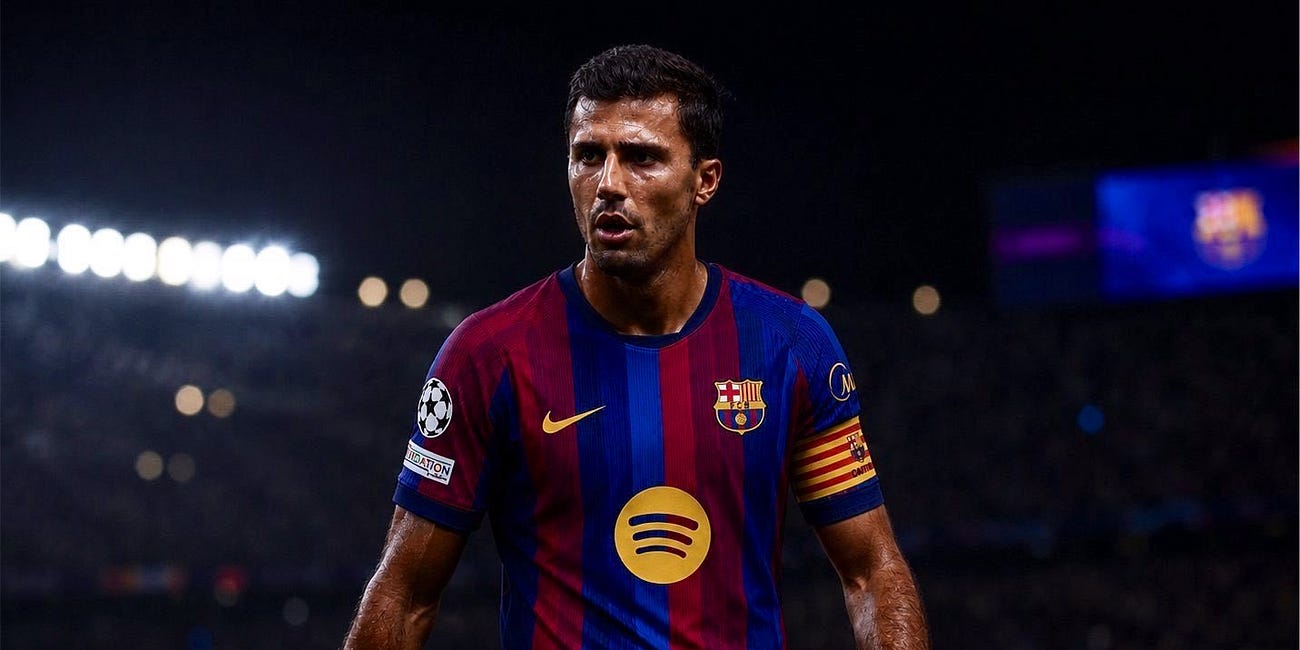
You know, I’ve watched Rodri play football countless times over the past, well, almost decade or so and I can’t tell you how many times I thought to myself: ‘Wow, I wish he played for my club.’
Again, I want to reiterate that this does not mean Araujo is a flawed centre-back.
The first function I outlined above is exactly what Araujo does excellently. His recovery pace, his aggression in duels and his aerial dominance make him suited to the aggressive defensive step the system asks.
I would go as far as to say that he was built for a high-line system. His athleticism alone is the correct instrument for a system that deliberately leaves acres of open space to defend. This is the definition of channel defending.
But… The second and third functions are where the mismatch appears. And sadly, the gap becomes far too big to overlook.
His progressive carry rate (0.62 per 90) and progressive pass rate (3.12 per 90) are both below what Flick's system produces from its preferred starting centre-backs. I don’t need to tell you that Cubarsí's progressive passing from deep is elite as he finds the interior pass under pressure with composure that takes years for most players to develop. Araujo under pressing tends to circulate to safety. In best-case scenarios.
Do you see the difference?
I don’t want this analysis to become too much about Cubarsi.
If you want to read more about what makes him so special, don’t fret, I’ve done several pieces on the centre-back boy wonder that will be worth your time!
But it is also quite important to at least touch on his profile in regards to Araujo’s situation.
Now, if Araujo had simply declined, or if his injuries had simply cost him his place, the story would be straightforward and that would be all she wrote. In fact, we would probably not be here writing thousands of words to explain the whole narrative.
But when has anything regarding Barcelona been simple, eh?
However, the fact remains that Cubarsi at 17 provided what the system needed at the position better than Araujo at 27. I’m not saying the former is better than the latter at every facet of the game. Because he’s clearly not. We know as much.
But in the specific metrics the system values most? Yep, absolutely.
Ironically enough, I would argue that (almost) any system in the world could use a physical defender who circulates safely and wins duels without breaking a sweat. This ‘traditional’ profile we speak of will never go out of fashion. At least not fully.
Hansi Flick, however, is building Barcelona toward a specific profile at centre-back: the line-breaking passer who reads the game with composure, is fully mentally in sync with the highline and advances the ball aggressively from deep.
In other words, Araujo never stood a chance.
I do want to touch on the mental health issues here, albeit briefly.
Mental health is important. We need to normalise talking to others if we need support and the stigma of asking for help should be eradicated entirely.
But I also think Araujo's absence in late 2025 and early 2026 was not what ultimately cost him his spot in the squad.
The starting position he lost in this system was already Cubarsi's before that absence.
Either way, mental health matters.
Take care of it.
Araujo’s transfer to Liverpool will hopefully be the reset he so desperately needs.
And I also think he should not see this as some sort of consolation prize. Because this is really not what this is.
Going from Barcelona to probably any other club on the planet is going to be seen as a downgrade. At least from my very personal and oh-so-obviously subjective view. But Liverpool are titans of English football.
And they are also in the process of an exciting rebuild that is showing a lot of promise.
But that’s not even the best piece of news for our resident Uruguayan.
Andoni Iraola's Liverpool asks centre-backs to do almost exactly what Araujo's profile was built for. Of course, the caveat is that we haven’t seen that much of them just yet.
But what we have seen in the pre-season is enough to hint at certain principles.
Iraola wants his centre-backs to step out aggressively when the press activates, win aerial duels in both boxes, cover large distances at top speed, dominate one-on-one situations, communicate loudly to organise the defensive shape and finally, defend a high line with physical presence rather than necessarily with neat ball-playing sophistication.
You see? Perfect for good ol’ Ronald.
Add to that the potential partnership with Virgil Van Dijk and you get quite a good match overall, actually.
If Araujo can stay fit and he feels the support from this Liverpool environment, the Reds might just get their Ibrahima Konate replacement.
At least for the short-term.
I genuinely want Araujo to rediscover himself at Liverpool.
Obviously, I’m speaking for myself here but there is no malice in my assessment of who he is, was and can become. There is also no hard feelings, neither for his tenure as a Barcelona player nor the way he’s leaving now.
Again, he could have and perhaps even should have been a lot more than he was in the end.
But football is a funny wee sport. You never know what it has in store for you.
Good luck, Ronald.
No posts
Comments
Nothing yet. Say the first thing.
Sign in to join the conversation.