
I was thirteen when my family decided who I was. Nobody sat me down and told me. I just noticed, one Sunday lunch, that whatever I said got a slightly different reception to whatever my brother said. Same table. Same rules. Same roast potatoes going cold in the middle. Two completely different verdicts on offer, depending on which end of it you were sitting.
They were never really about what they were about. A disagreement over something small would turn into a referendum on who I was, and I’d already lost that vote years before, so there wasn’t much point fighting fair. Looking back, most of it was unnecessary. Not because the things we argued about didn’t matter to somebody, but because by then, nothing I said was ever really being heard for what it was. It was being heard as more evidence.
By the time I was sixteen, I’d had enough of proving them right. That’s the joke of it, looking back. Most of those arguments probably didn’t need to happen at all. But once you’ve been told often enough who you are, you start auditioning for the part, and I gave it everything I had.
I want to be honest about something before I go any further... I can’t remember the exact words of the argument that finally did it. Not really. What I remember is the shape of it. The way it started small, over something that shouldn’t have mattered to anyone, and swelled into something much bigger within about ninety seconds, the way these things always did in our house. There was a rhythm to it by then. We’d done it so many times that we all knew our lines before we said them.
What I do remember, properly remember, the way you remember a smell or a temperature rather than a sentence, is the exact moment it stopped being an argument and became something else. Every room like that has a pitch it reaches, just before everyone gives up on being reasonable. A sort of hum. That night, we hit it.
Somebody said something. I honestly couldn’t tell you who, or what. What I can tell you is that it wasn’t really about the thing it was about. It never was. It was about the same tired verdict getting read out again, in slightly different words, and me sitting there at sixteen thinking, with a clarity that surprised even me at the time... that’s it. Not in anger. Not even really in sadness. Just a very quiet, very final sort of arithmetic. This isn’t going to change. I need to stop waiting for it to.
Here’s the forethought, if you can call it that, because there wasn’t much of it. I’d love to tell you I sat down and weighed the decision properly, wrote a list of pros and cons, slept on it. I didn’t. What I’d actually done, without ever quite admitting it to myself, was spend the previous few weeks quietly building an exit while telling myself I was just being sensible. The room, cheap and grim and mine, wasn’t a reaction to that night’s argument. It was already there, waiting, like I’d known this particular row was coming even before it arrived. Which tells you something rather uncomfortable about the nature of forethought at sixteen. It isn’t wisdom. It’s instinct wearing wisdom’s coat.
So when people ask, now, whether I was right to leave that night, in the heat of it, over an argument I can’t even fully recall... the honest answer is that “that night” wasn’t really the decision. That night was just the moment the decision I’d already made stopped being theoretical.
I went up to my room. I don’t remember choosing to leave so much as noticing, somewhere in the middle of standing there, that I already had. The decision had made itself while I wasn’t looking, and I was just catching up with it.
And here’s the bit that still makes me laugh, all these years later, in the way you laugh at things that weren’t funny at the time but have gone slightly absurd with age. I stood in my room working out what a sixteen year old actually needs to face the world, and the answer turns out to be almost nothing. A change of clothes. Some questionable pride. No plan for the cold. I remember holding a jumper and thinking, quite seriously, will I need this, as though I were packing for a fortnight somewhere sunny rather than for the rest of my life.
I didn’t have much of a plan that night, but I want to be fair to myself here, because I had more of one than most people probably assume. I’d already sorted somewhere to live, in the loosest possible sense of the word “somewhere”. One room. Literally one room. Not a one bedroom flat with a room attached to it, just the room itself, on its own, doing all the jobs a home is meant to do. No running water in it. A bathroom I shared with whoever else was living along that corridor, the details of whom I mostly chose not to think about too hard. No cooking facilities, which meant that for longer than I’d like to admit, my diet was whatever could be eaten cold, straight from a packet, standing up. It was a twenty minute walk from the town centre, where the job I hadn’t got yet was waiting for me to go and get it.
I want to be clear that none of this struck me as bleak at the time. That’s the strange thing about being sixteen and newly free. A room with no water and a shared loo down the hall doesn’t register as hardship. It registers as headquarters. Mine. Nobody else’s name on anything. Nobody else’s verdict waiting for me when I got back to it.
I went to a friend’s for the first night. You always need a night like that... some sort of airlock between the life you’re leaving and the one you’re about to fall into. And then, a few days later, I got the job. Stacking shelves and standing behind a till, twenty minutes away on foot, in all weathers, usually carrying something. Nothing glamorous. Nothing anyone would call a future. But something. A door that was at least technically open, in a world that otherwise felt entirely closed to me at that particular table. Nobody was more surprised than me. I remember thinking, absurdly, that it felt like getting away with something, being handed a till float and a name badge, as though the world hadn’t yet noticed I wasn’t supposed to be allowed in on my own yet.
My family noticed, of course. Just not in the way you’d expect.
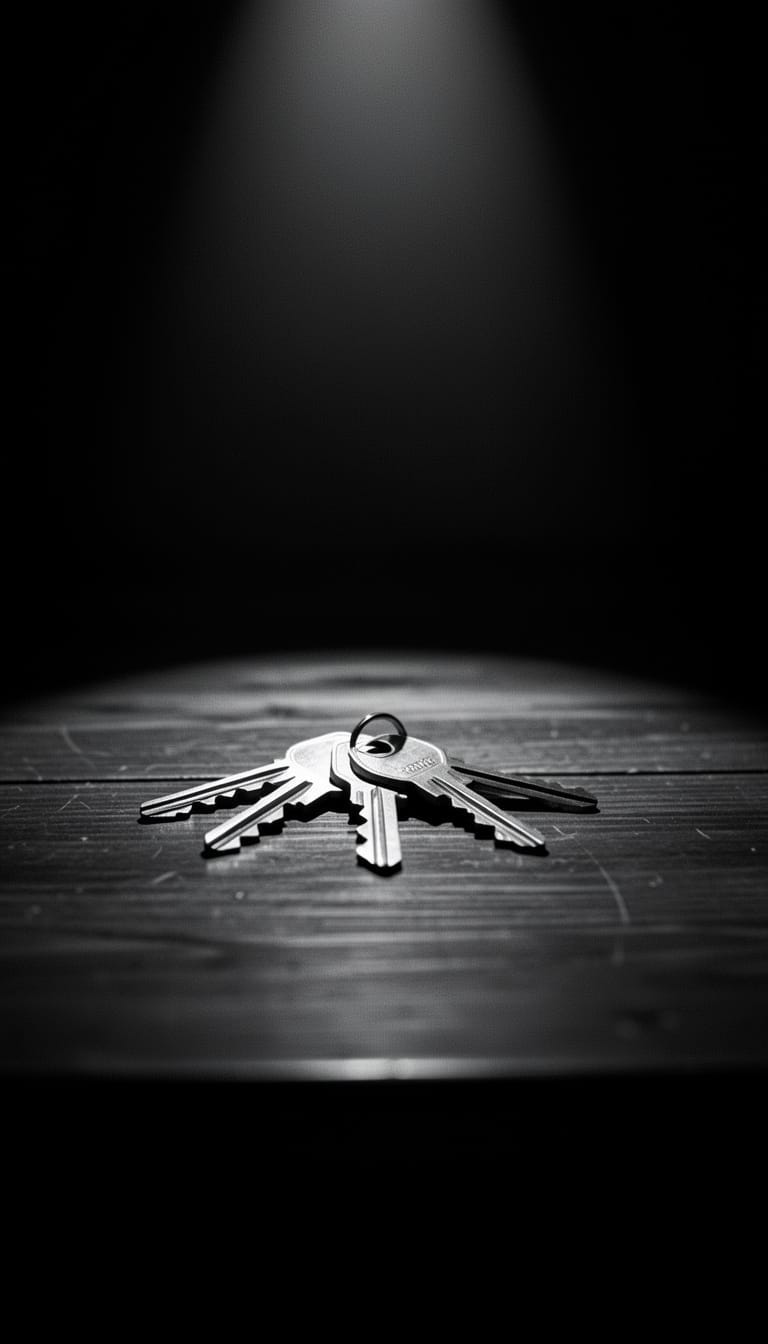
There was no phone call demanding I come home. No ultimatum, no scene, no grand reconciliation attempt. What happened instead was smaller, and colder, and somehow said far more than shouting ever could. My dad took back the keys to the house. Not for a week, until things had calmed down. Not for a month, until we’d talked. Until I turned twenty one. Five years, handed down without a hearing, for an offence that was never actually named out loud.
And this is where the afterthought comes in, because I’ve had a long time to sit with it, and the answer isn’t as clean as I’d like it to be.
There are days I think I was completely right. Not right in the sense of blameless, but right in the sense that staying would have cost me something I couldn’t have got back. Whatever I might have gained by remaining under that roof, patience, family, the illusion of stability, I’d have paid for it with a version of myself that learned to shrink to fit the space available. And I don’t think that version would have thanked me for the trade.
Then there are other days, quieter ones, usually late, when I think about a sixteen year old holding a jumper and asking himself if he’d need it, and I wonder how much of that decision was genuine clarity and how much was just a child mistaking exhaustion for certainty. Sixteen year olds are not, whatever they believe at the time, reliable narrators of their own lives. I was one of them. I don’t get to pretend otherwise just because it worked out.
What I’ve settled on, for what it’s worth, is that the leaving was right, but the reasons I gave myself for it at the time probably weren’t the real ones. I told myself I was choosing freedom. What I was actually choosing was an end to the arithmetic, to the daily business of being weighed and found wanting at the same table, by the same people, for a verdict that had been reached long before I ever opened my mouth. Freedom was just what that ending happened to look like from the outside.
As for the keys... I’ve thought about those a lot too. Not the leaving itself, which I understood completely, even at the time. But the keys. Because keys aren’t really about locks. They’re about who’s allowed back in, and on whose terms, and it turns out mine had already been decided before I’d even worked out where I was going to sleep on any given Tuesday. Five years is a strange sentence to hand a boy who hadn’t been charged with anything. But it did, at least, answer a question I hadn’t quite dared ask out loud. It told me, more clearly than any argument ever had, exactly which room I’d actually been standing in all along. And it wasn’t the one everyone else thought we shared.
Until Next Time
Dominus Owen Markham

Comments
Nothing yet. Say the first thing.
Sign in to join the conversation.