
Today I want to speak about something that often creates confusion, even for experienced engineers: nonlinear finite element analysis (FEA).
Most of us begin with linear analysis. It’s fast, efficient, and works well for many everyday problems. But in real-life applications, structures don’t always behave linearly - and ignoring that can lead to misleading results.
Mathematically speaking, a nonlinear system is one whose behavior is not equal to the sum of its parts. Therefore, the behavior of a nonlinear system does not satisfy the principle of superposition. In a linear analysis, it is assumed that the response of the structure (deformation, internal loads, or stresses, etc.) is linearly proportional to the applied loads. However, in real life, this response may not be linearly proportional to the applied load and then the structure must be analyzed using nonlinear assumptions. In linear static analysis, the stiffness [K] of the analyzed structure is assumed to be constant.
In the real world, it is very likely that a structure will behave in a nonlinear manner, for geometrical, material, or boundary reasons. Indeed, the stiffness of the structure is based on its geometry and material properties. In a linear analysis, these parameters are assumed to be unchanged while the loading is applied. In a nonlinear analysis, these changes are taken into account, and the stiffness matrix is updated using the deformed structure’s configuration, after each incremental load application
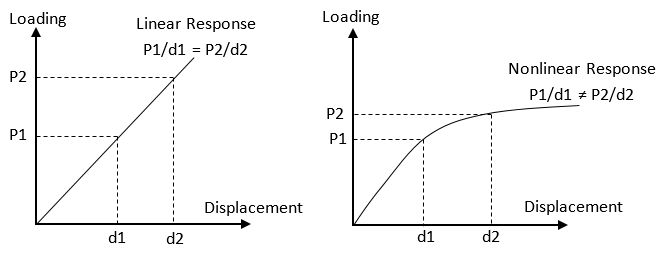
LOAD-DISPLACEMENT RELATION
The stiffness of the analyzed structure is not constant and varies with the applied loads. The displacements are large (translations and rotations) and are not related to the original stiffness of the structure.
STRESS-STRAIN RELATION
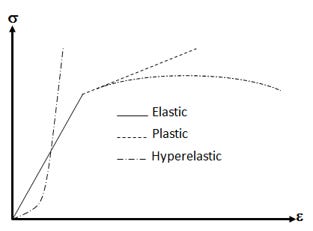
Stresses and strains are not related to a linear function.
SCALABILITY
The results of a nonlinear analysis cannot be scaled.
SUPERPOSITION
The principle of superposition cannot be applied. If a load P1 produces a displacement d1 and a load P2 a displacement d2, then the load P1 + P2 will not cause a displacement d1 + d2.
INITIAL STATE OF STRESS
The initial state of stress (residual stresses, temperature, pre-stressing) may be extremely important in the overall response.
LOAD HISTORY
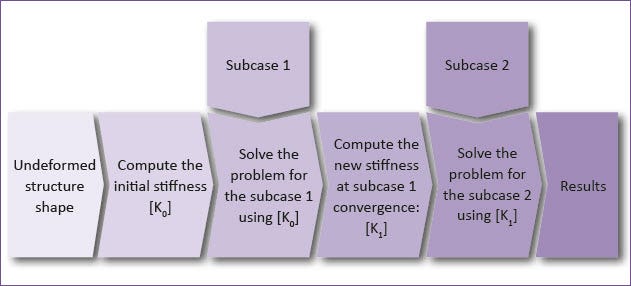
The structure’s response is related to the load history: it is influenced by the loading sequence. When several subcases are applied in sequence in the structure, the end of a subcase is the initial condition for the next subcase.
REVERSIBILITY
The deformation of the structure is not fully reversible once the applied loads are removed.
SOLUTION SETTINGS
The external loads are applied in small increments, and iterations are performed to ensure that equilibrium is satisfied at each load increment. Solution monitoring by the user is required to ensure convergence. The computing time is usually large. While linear problems always have a unique solution, a nonlinear problem might not. In fact, the iterative and incremental processes used to solve nonlinear problems may not converge and may even produce an incorrect solution at convergence.
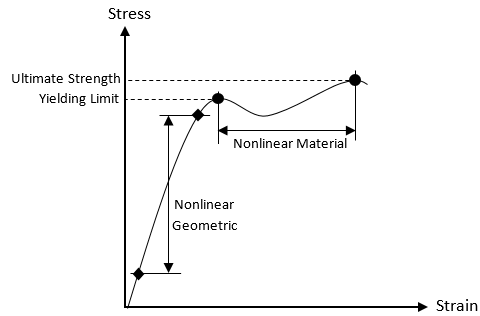
In structural analysis, a nonlinear effect can occur because of three types of nonlinearity:
Geometric nonlinearity: if a continuous body undergoes large deformations, the strain-displacement relations become nonlinear. Moreover, under large deformations, the stiffness of the system will change with deformation, making the problem nonlinear.
Material nonlinearity: if a material does not follow Hooke’s law, nonlinear material models must be used.
Boundary nonlinearity: the most frequent boundary nonlinearities are encountered in contact problems.
Under large deformation, the deformed structure has a different geometry, implying a changing stiffness. The stiffness matrix [K] is a function of displacements {u}.
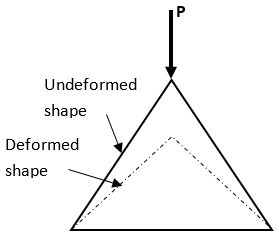
Under large deformation, the deformed structure has a different geometry, implying a changing stiffness. The stiffness matrix [K] is a function of displacements {u}.
The fundamental question is: when do displacements become large enough that the deformed geometry differs meaningfully from the undeformed geometry?
The Classic Rule of Thumb
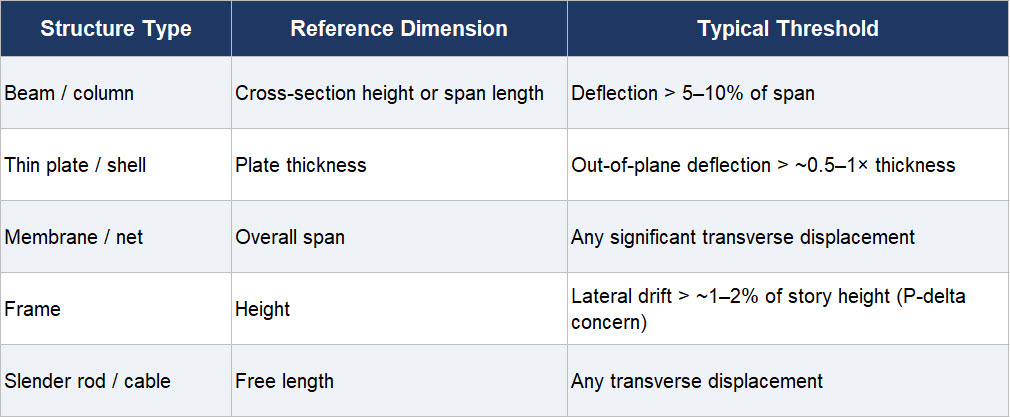
If the maximum displacement exceeds roughly 5–10% of a characteristic structural dimension, geometric nonlinearity should be considered.
However, that characteristic dimension is context-dependent. Let’s see in detail how it works.
Linear (small displacement) theory assumes:
The equilibrium equations are written on the undeformed geometry.
Strains are approximated as infinitesimally small (Green-Lagrange tensor reduces to engineering strain).
The stiffness matrix K remains constant throughout loading.
Geometric nonlinearity becomes significant when one or more of these assumptions breaks down:
Membrane-bending coupling - out-of-plane deflection induces in-plane membrane forces that stiffen or soften the structure (e.g., drum skin, pressure vessel).
Follower forces - applied loads rotate with the structure (pressure on a curved shell).
P-delta effect - axial load acting through a lateral displacement generates a destabilizing moment.
Stress stiffening / softening - pre-tension stiffens, compressive load softens (buckling precursor).
Rather than a single displacement ratio, experienced analysts watch for:
Rotation angle > ~5–10° - the small-angle approximation (sin θ ≈ θ) degrades beyond this.
Strain > ~1–2% - although this is often the material nonlinearity trigger, it coincides with geometry effects in metals.
Load-deflection linearity check - if doubling the load does not roughly double the deflection in a linear run, geometric nonlinearity is active.
Proximity to buckling - if the applied load is more than ~10–20% of the linear buckling load (eigenvalue from SOL 105), geometric nonlinearity must be included.
Slenderness - very slender members (high L/r or L/t ratios) are inherently displacement-sensitive; the threshold drops significantly.
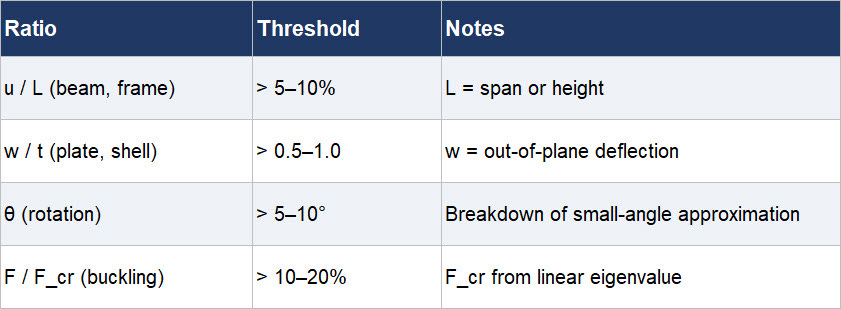
No single ratio is universally authoritative. The 5–10% of span rule is a screening criterion, not a physics boundary. The actual transition is gradual, and the correct approach remains the sensitivity study: if activating the large displacements option changes your peak displacement or stress by more than your required accuracy tolerance, the linear assumption was invalid regardless of what ratio you computed.
What matters most is developing the instinct to ask the question early, before post-processing, based on structural topology and loading type.
The stiffness response depends on deformation. The stiffness matrix [K] is a function of displacements {u}.
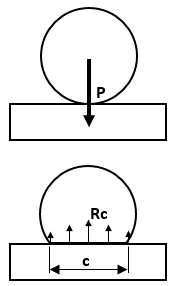
Boundary conditions changing with deformation: the size c of the contact surface and the contact load Rc depend on deformation and load. The stiffness matrix [K] and loading {P} are functions of displacements {u}.
Nonlinear analysis demands more computing time and expertise, so it’s important to know when it’s truly required.
If you answer “yes” to one of the following questions, you should go with a nonlinear analysis:
Does the structure deform significantly?
Does the structure exhibits stress stiffening (tension-bending coupling in a membrane under pressure for example)?
Do the stresses exceed the proportional limit?
Does the stiffness of the structure change when a loading is applied?
Do you expect to capture contact conditions (engaged or disengaged) between some components of you model?
If one of the five questions above made you hesitate about a model you are running right now, that hesitation is worth investigating. In the comments, I would like to hear which nonlinearity gives you the most trouble: geometry, material, or contact.
No posts
Comments
Nothing yet. Say the first thing.
Sign in to join the conversation.