
AI After 50 — Week of April 27, 2026
AARP dropped a number this month that stopped me cold.
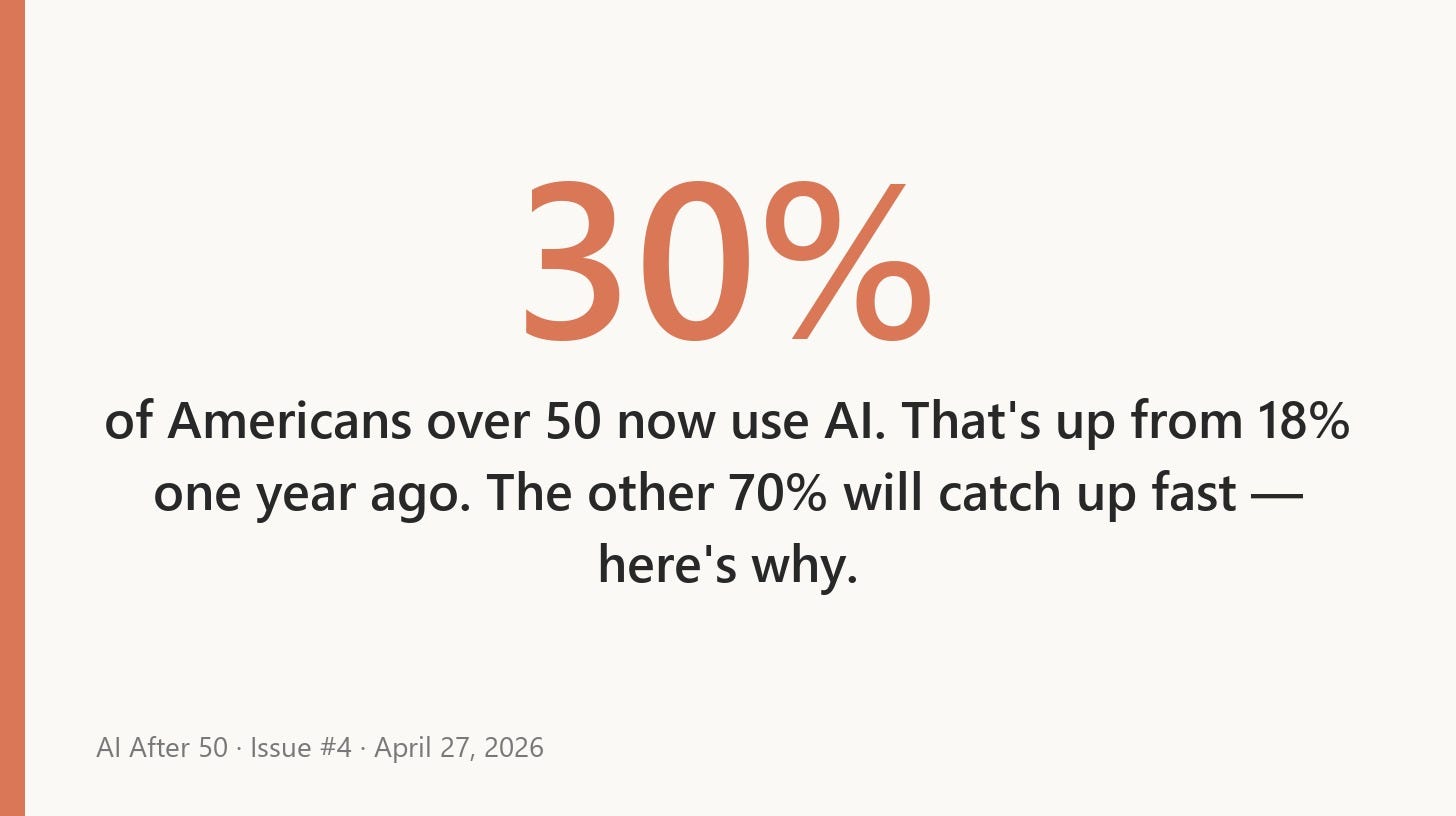
30% of Americans over 50 now use AI tools regularly. That's up from 18% the year before. In one year, our demographic nearly doubled our AI usage.
I'm in the 30%. And I'll be honest — I think the other 70% are going to join us a lot faster than anyone expects. Because the three things that tipped me over are the three things waiting for them too.
Let me show you what they are.
Last year I had an ophthalmology appointment that should have taken 30 minutes. It took 90.
Not because anything was wrong. Because I walked in with a one-page summary I'd built with AI the night before. I'd pulled together my OCT eye scan results, my recent blood work, my supplement list, and my symptom journal — and asked AI two things:
"Cross-reference these two reports. What connections would a specialist make if they had time to sit with all of this?"
and
"What supplements have published clinical evidence for my conditions? Cite the studies."
The answer wasn't a guess. It came back with specific markers in my blood that correlated with the nerve thinning in my retina. It pointed me to two supplements backed by clinical trials. My ophthalmologist confirmed both of them at the appointment.
The 30-minute visit became a real conversation. Not "here are your numbers, see you in six months." A conversation about why my eyes feel the way they feel, and what to do next.
The 70% are walking into appointments the way I used to — passive, rushed, hoping the doctor has time. AI doesn't replace the doctor. It gives you the questions that turn the appointment into something useful.
Here's something most people my age have never done: sat down and run three different retirement-income scenarios side by side in 30 seconds.
A few months ago I had a conversation with AI where I described a realistic situation — savings spread across a few kinds of accounts, a monthly income target, a time horizon — and asked it to model three different approaches and show me the tradeoffs. Growth-focused. Income-focused. A blend. Projected monthly cash flow, rough tax impact across a traditional IRA vs. a taxable brokerage vs. a Roth, what happens in a flat market vs. a recession.
It ran all three in less time than it takes to pour a cup of coffee.
A good financial advisor can do this — but it's a $500 conversation, and you have to know to ask for it. AI will do it for free, as many times as you want to tweak the inputs. For someone trying to figure out whether to retire at 62 or 65, whether to take Social Security at 67 or 70, whether to convert a chunk of an IRA to a Roth — being able to model the math yourself, before the advisor conversation, changes what you walk in with.
You stop being the passenger. You start being the navigator.
Note: every dollar figure I use when I write about investing is an example, not my exact numbers. The muscle is running the comparisons — not anyone's specific balance sheet.
This is the one most people haven't tried yet, and it's the one that changes day-to-day life the most.
I run a lot of small decisions through AI every morning. Not big strategic ones. Small ones. "Here's my calendar, here's my task list, here's what my eyes feel like — what should I prioritize today?" Or "I'm going to Knoxville this weekend. Here's the route. What's the best RV-friendly dump station along the way?" Or "Draft a short reply to this recruiter."
None of these are life-changing in isolation. But when you're over 50 and you've accumulated 30 years of decisions, commitments, medical records, family context, and financial history — having a patient, tireless assistant who can hold all of that at once is a quiet revolution.
My wife jokes that I talk to my AI more than I talk to her some mornings. She's not wrong. But here's what she misses — the AI remembered her sister's birthday last week when I almost didn't. That's a small thing. But that's also the point.
The 70% are running their lives out of their heads and their notes app. That worked at 35. It gets harder at 55. AI is the thing that takes the cognitive load off without asking anything back.
Three reasons, and I think all of them kick in within the next 12 months.
First, the tools got easier. A year ago you had to know how to "prompt." Today you can have a conversation. That's a huge barrier gone.
Second, privacy fears are being addressed. The biggest objection I hear from friends my age is "what happens to my data?" Legitimate concern. But the major AI providers now offer settings where nothing you share trains future models. That fact isn't widely known yet. It will be.
Third, the results are too good to ignore. Once a friend shows you a real example — a medical summary, an investment comparison, a travel plan — you stop asking "should I try this?" and start asking "how do I get set up?"
If you're in the 70% and curious, don't try to learn "AI" in the abstract. Pick one real problem. Start one conversation. Here are the three I'd start with:
1. Your next medical appointment
"I have an appointment with my [specialist] next week. Here's my condition, here's my recent lab work, here's my current medication list. What questions should I ask so I get the most out of a 30-minute visit?"
2. Your retirement income
"I'm [your age]. I have savings spread across [types of accounts]. My goal is meaningful monthly income in the years ahead. Show me three different approaches I could research, including tradeoffs and what to ask a financial advisor about each one."
3. The decision sitting on your desk right now
Whatever it is — a home repair quote, a Medicare supplement choice, a trip to plan, a difficult email — paste the details in and ask "what should I be thinking about that I probably haven't thought about?"
You don't need to be technical. You need to be curious. The tool is patient. It's not going to judge you for asking basic questions.
The AARP number — 30% of us — is going to be 50% by this time next year. Maybe higher. This isn't a tech story. It's a quality-of-life story. And the people who adopt first are going to have noticeably better medical visits, better financial decisions, and frankly, less stress.
You don't have to be early. But you don't have to be last, either.
I'm Dominic. 30 years in IT, in my 60s, using AI every day to find what I've been missing. If this was useful, forward it to a friend in the 70% — they'll thank you. And hit reply if you want me to walk through one of these three conversations in more detail. I read everything.
New here because someone forwarded this to you? This lands free in your inbox every Monday — subscribe at dominicferrara.substack.com so you don't miss the next one.
Next week: the exact prompt I use to prep for a doctor's appointment — and how my ophthalmologist reacted the first time I walked in with one.
No posts
Comments
Nothing yet. Say the first thing.
Sign in to join the conversation.