
In global markets, long-term interest rates are higher, oil prices are higher, and inflation (and inflation expectations) is higher. A series of isolated shocks—COVID, the Russian invasion of Ukraine, the Adventures of Tariff Man, and the oil shock from the US-Israel-Iran conflict—have successively caused inflation to be persistently higher than central bankers’ 2% inflation target over the past five years.
In the Dominican Republic, the BCRD telegraphed that it would miss its 5% inflation ceiling by withholding publication of—then finally releasing—a 5.1% inflation number on Thursday. Headline inflation has been close to the 5% ceiling for a while, but mostly because of a few items with specific stories, mainly crop damage from storms in September-October. But this month was different. There was a month-to-month increase of 0.5%, almost all of which was energy costs.[1] So our measure of trimmed-mean inflation jumped:
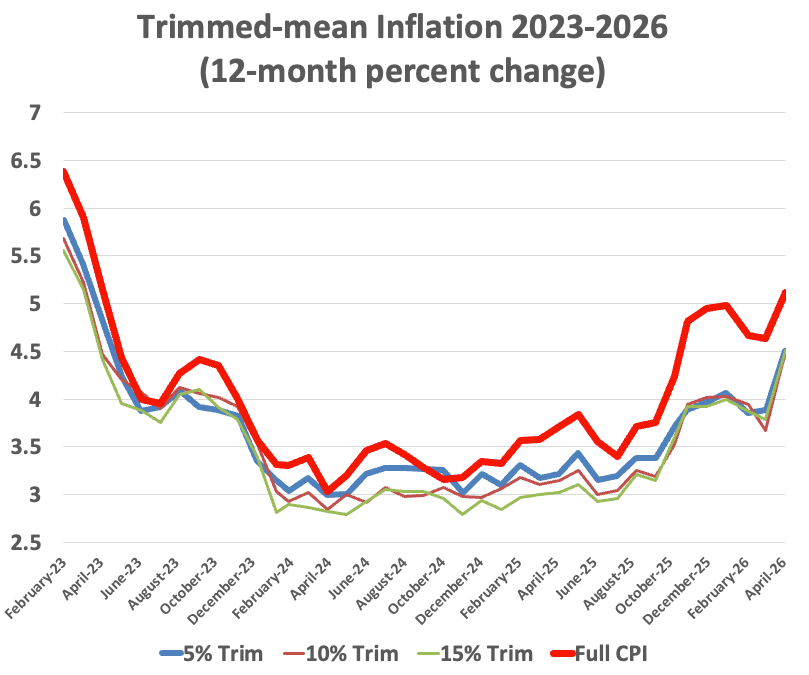
While the month-to-month rise in the overall index was 0.5%, the measures of trimmed-mean inflation rose by up to 0.8%, closing the gap created by the items with specific stories not reflective of inflation trends.
The policy responses around the world to the effects of the US-Israel-Iran conflict have been very different, reflecting country circumstances and policymaker preferences. The Dominican government has taken the position that it can limit the impact and protect the population. I think that’s wrong; here’s why:
Oil Prices, Interest Rates, and Inflation will stay high
Why am I convinced that this is true?
· Interest rates. Most G7 economies are on an unsustainable fiscal path, with little appetite for deficit reduction. The UK and the US are perhaps the most exposed, but Euro area economies—especially France and Italy—will also lose of the ability to regain control of their public finances, even with the ECB helping to keep interest rates lower on government bonds. Even Japan is coming under pressure, with its government debt of 200% of GDP: the yen has been falling at the same time interest rates have been rising. Markets are already demanding higher interest rates, which makes their deficits worse, which will in turn push interest rates still higher.
· Inflation. Without any willingness to curb runaway fiscal deficits, central banks will buy up excess government debt, increasing money. Inflation will be the only solution left to avoid debt defaults, since government revenues rise with inflation, allowing them to meet obligations on maturing debt.
· Oil prices. With some important oil infrastructure already destroyed, further destruction is possible. Moreover, the uncertainty regarding passage through the Straits of Hormuz, even if there is a détente between Trump and Iran, will remain. Moreover, I see a formal agreement as unlikely, given the (very justified) low levels of trust between the parties. This will contribute to keeping prices higher than before the conflict began. Another factor that will keep prices higher than in the past is the consumption of global inventories over the past couple of months. Finally, the increasingly successful Ukrainian strikes on Russia’s oil infrastructure will further limit global supply. Prices may well come down from the $100/barrel we have seen since the conflict started, but the drying up of global inventories, with less oil entering global markets, will keep them from falling far.
What this means for the Dominican Republic
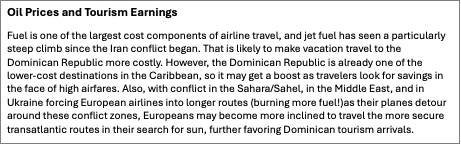
The full impact of these developments will be hard to trace, and I do not yet have a clear view of what these trends mean for global output. Recession? Maybe, maybe not. But global output is, of course, a stand-in for disposable income available for the Dominican Republic’s chief sources of foreign currency: remittances from the Dominican diaspora and tourism spending. It is not clear what will happen, but risks are elevated: the case of tourism spending illustrates nicely how hard it is to figure out the impact of these global developments on the Dominican economy (see box).
At the level of policy, however, I do not see a serious effort to prepare for lasting shocks. The government has announced that this week it is providing a subsidy of US$1 per gallon for gasoline and US$1.30 for diesel fuel. Now, gasoline taxation runs about $1.50 per gallon, so there should still be some tax revenue coming in on gasoline, but some of this is likely to be going back out the door to fund cash subsidies on the more lightly taxed diesel fuel.
The government has said that it has the situation under control, that it is reallocating RD$40 billion in spending from the budget to provide for these subsidies. It has recently been providing subsidies of over RD$1 billion per week, and has announced that, so far this year, the subsidies total RD$15 billion. If prices come down a bit in international markets, and the government continues to raise pump prices slowly, they might just get through the year on the RD$40 billion.
But where will the RD$40 billion come from? So far, the government has spoken only in generalities, except for a 50% reduction in subsidies for political parties (a move which favors the PRM, which has other funding opportunities and a natural source of publicity from being in office). But a number that big is serious, and the kinds of belt-tightening being publicly discussed will simply not produce savings at that level.
There is one “easy” source of funding, however. It is the least visible part of the entire budget. The government continues to devote a sum equivalent to 0.6% of GDP each year to recapitalizing the central bank. This is a holdover from the 2003 banking crisis: it is enough to stabilize the financial condition of the BCRD, but not enough to solve the problem. The government cut that transfer in 2020 and 2021, during the pandemic, and could do so again. I think that’s likely.
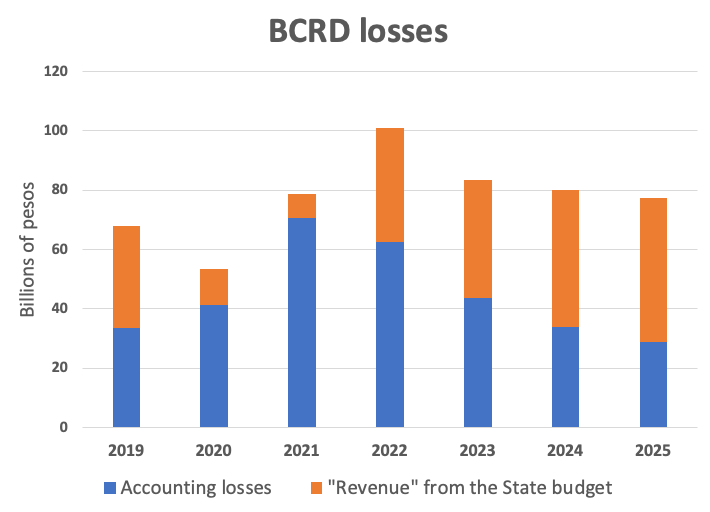
The question is the impact. Without infusions from the budget, BCRD losses have been running at RD$80 billion per year:
With the transfers taking place, the BCRD has been able to slow the bleeding, but is still in a worsening situation (I consolidate the BCRD accounts with its financial relations with the government to create a virtual “Monetary Authorities”):
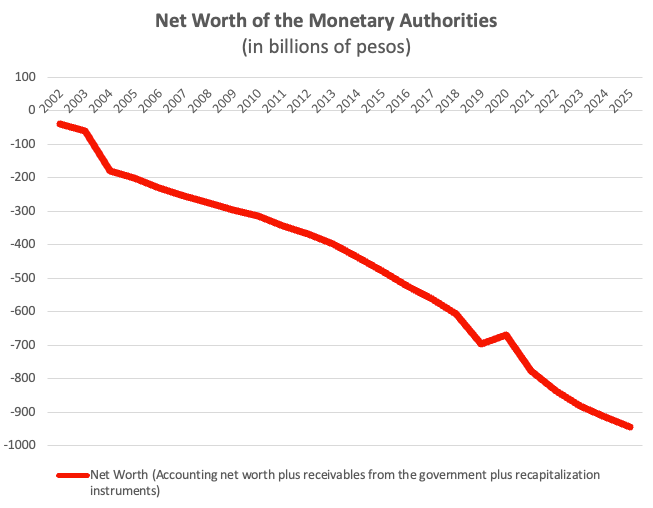
Without that infusion of cash from the government, the blue bar in the chart above will swallow the orange one. In response, the BCRD can either issue its own bonds to cover the losses or expand money in circulation. The first solution will increase pressure on interest rates; the second to pressure on inflation. Realistically, there is no way the Bank will allow money to expand. That means more interest expenses for the Bank, which means higher losses—and then even more bond issuance. Will it snowball out of control?
The BCRD recently published its audited accounts for 2025. I hope to do a deep dive into the accounts to be able to talk about these scenarios in more depth. But in the current environment there may be worse outcomes than raising fuel prices and making drivers pay the real cost of their gasoline.
[1] Fuel prices represent 4% of the index and rose by 7%, and transit prices, another 1% of the index, rose by 10%, reflecting those fuel prices. All other items together give a month-to-month increase of only 0.1%.
No posts
Comments
Nothing yet. Say the first thing.
Sign in to join the conversation.