
For the past three days, the BCRD-published market exchange rate has stood at 58.4 Dominican pesos to buy a U.S. dollar.
This is the strongest rate in over two years, and represents a 10.8% appreciation from the peso’s late-2025 lows. At the same time, the country’s international reserves fell by US$578 million in July. What’s going on?
The Dominican peso oro was fixed to the U.S. dollar from the end of the U.S. occupation in 1924 (when the dollar was legal tender) until the Dominican peso that we know today was introduced in 1947. Then, and until 1985, the exchange rate was kept at 1:1 through a variety of controls: on imports, on capital movements, on foreign exchange. Between 1985 and 1991, though, it fell to 12.5 per dollar, and we have seen steady, and usually gradual, depreciation since then.
2026 is different. The peso has strengthened before, notably after the 2003 banking crisis and after COVID. But these were post-crisis events. The current exchange rate of RD$58.4 brings us to a 10.8% appreciation from the lows of late 2025—but without a crisis scenario preceding it.
Respected commentators, such as Jaime Aristy Escuder and Andy Dauhajre (with his version of The Economist’s “Big Mac Index”), have recently emphasized the overvaluation of the peso. By contrast, however, the IMF’s annual analysis over the past 15 years has consistently been that no overvaluation exists, suggesting instead a 5% undervaluation in its latest report.[1] The IMF’s own data, however, show that the peso exchange rate adjusted for inflation (the “REER” in red below) has weakened fairy steadily (except for the post-Covid recovery and them period of tight monetary policy to fight inflation that followed). The peso decline amounts to about 20% over the past 15 years.
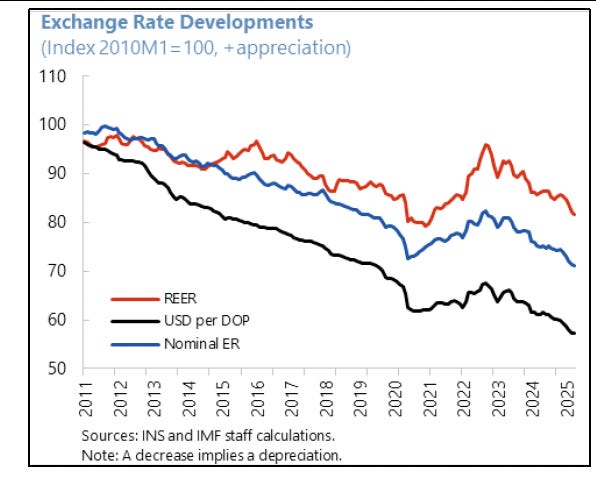
I don’t believe that the IMF has simply gotten it wrong each time. Rather, there is a very plausible explanation, but one that the IMF itself has never made. That is, at each point in time, the exchange rate was broadly correct, but the economic fundamentals evolved against the Dominican Peso to justify a small depreciation each year. Certainly, most Dominicans expect regular annual depreciation, even when inflation is no higher than elsewhere. This implies an implicit belief that the peso will be weaker going forward.
There is a principle in economics that, in the long run, exchange rate changes reflect differences in productivity growth between a country and its trading partners, a concept known as the Balassa-Samuelson effect. [2]
The hourly productivity of workers in the United States has risen by 40% in the last 20 years. And in the Dominican Republic? With its large informal sector, and with the low-skill/low-productivity nature of free zone exports and tourism services, I believe slower productivity gains may indeed be driving the downward trend in the exchange rate.
Government and central bank officials argue that the current strong peso is driven by high foreign exchange inflows. But they focus on gross inflows, much of which do not add to dollar availability in the foreign exchange market. I would highlight two areas in particular where the majority of dollar inflows recorded do not reach the market:
· Foreign direct investment includes spending on imports like machinery and equipment that are needed for investment projects. It also includes profits on earlier foreign investment that has simply not (yet) been taken out of the country. Typically, about 60% of announced FDI consists of new capital injections.
· Exports, and especially exports from the Free Zones, include an important share of their value in imported raw materials. In the first half of 2026, for example, Free Zone imports were 60% of Free Zone exports.
Other inflows, such as tourism earnings and remittances from abroad, may of course also be spent directly on imports, but these are the two main areas where published numbers may be a much-reduced share of true dollar inflows to the foreign exchange market.
Where does that leave us? Probably, as others have also noted, the rate needs to depreciate in order to stimulate exports, protect domestic industry for imports, and reduce overall demand for imported goods.
But the government.
The stronger exchange rate helps keep inflation in check, and reduces the cost in tax revenue of external debt service and of subsidies to the fuel-importing state electricity distributors. The spike in fuel costs since the outbreak of the Iran War makes this issue even more important than usual. A strong exchange rate is good for the budget.
So there are important issues of public policy involved here, in addition to the overall macro impact of the exchange rate. Also, simply returning to the exchange rate of late last year risks triggering a downward spiral in exchange markets, as people rush to buy dollars ahead of further depreciation. In that sense, the government may find itself painted into a corne with no obvious way out.
This leaves us to examine the role of the BCRD, as the institution charged with day-to-day management of the exchange rate and the foreign reserves. I will take up its role, and what is known about its recent actions, in Part II next week.
[1]Dominican Republic: Staff Report for the 2025 Article IV Consultation, IMF Country Report No. 25/305, p. 58.
[2] I talked more about the Balassa-Samuelson effect, and what to do about it, a bit more last September, in Dominicanomics #117.
No posts
Comments
Nothing yet. Say the first thing.
Sign in to join the conversation.