
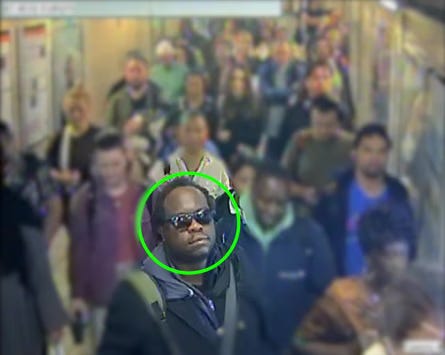
Rapist and murderer, Simon Levy, on the London Underground.
Simon Levy was recently convicted for rape and two murders. In 2021, he was first jailed for sexual offences and released (in line with the UK’s ridiculously soft sentencing laws) in 2023. As such, he became an “RSO” or Registered Sex Offender. This meant Simon was monitored in the community under what are known MAPPA - as we shall see, Simon’s world involves many euphemistic acronyms - or Multi-Agency Public Protection Arrangements. MAPPA suggests the panoply of law enforcement, probation and social service resources were directed towards protecting women from Simon’s appetite for sexual violence. Yes, of course he should’ve remained in prison, but I don’t make the rules.
Perhaps unsurprisingly, MAPPA failed miserably. After Simon’s release he continued offending, as many sex offenders tend to do. The only panoply of anything offered by police, it would be seem, consisted of mistakes and missed opportunities. When Simon lost an eye, allegedly in retaliation for one of his sexual assaults, police decided his disability justified lowering his case from high to medium risk. Now, the Met accepts one of the murders was almost certainly preventable. The British Transport Police are on the hook too, for a botched ID parade process.
I don’t intend to offer a forensic examination of the errors made by police, the CPS, courts, probation and social services. It’s a familiar catalogue of errors, some of which echo cases involving human time-bombs like Axel Rudakubana and Valdo Calocane. The themes, for the UK’s criminal justice elites, are deeply uncomfortable: mental Health, resources, human rights and race. They also involve tricky (for the career progressives running the system) questions of justice and fairness. Then there are questions of competence: why are police forces increasingly incapable of public protection? Then of course, there’s the inevitable public inquiry, where senior leaders lawyer-up while tossing underlings under buses. In short, it’s a process driven by naive optimism and bound together with duct-tape. Not to worry, though: the mandarins, quangocrats, penal reform activists and monstrous regiments of do-gooders get a warm fuzzy knowing they’re keeping people out of prison. Because prison is bad.
Today, then, I’ll attempt to examine how the police fit into this engine of naive optimism and duct-tape. Warts and all, without hiding behind acronyms and social work jargon. It’s another piece of the slow-motion car crash that is the UK’s criminal justice system. The buses are revving up though: a Metropolitan Police constable and a sergeant have been placed under investigation for their role in the Simon Levy affair. To me, this is like blaming the stewards on the Hindenburg for not using soda siphons as a fire control measure.
One of my last police jobs was with the UK Protected Persons Service (UKPPS). My work involved monitoring, as opposed to managing, offenders posing a potential risk to protected persons. As such, my work interfaced with the Met’s “Jigsaw” teams. These were locally-based police officers responsible for high-risk offender management, including cases like Simon Levy’s. This involved, to deploy yet another public protection acronym, MOSOVO, or “management of sexual or violent offenders.” Click on the link for some especially chewy College of Policing word salad.
So, while I’m by no means a MAPPA expert, I’m familiar with the system in practice. Furthermore, my bread-and-butter was intelligence-led risk assessment processes. So, without giving away specific operational tactics, this is my take on managing the Simon Levys of the world. None of these tactics can mitigate the real problem with offender management, though: the progressive-coded rehabilitative bias in criminal justice in general and in probation specifically. As Rory Geoghegan wrote in The Telegraph:
The ideology centres the offender as a vulnerable individual with “criminogenic needs” which the state must understand and address. Government guidance on managing prolific offenders says that decisions about enforcement and investigative surveillance should be made “carefully”, balancing public protection against “the offender’s current needs”. Even enforcement, it said, should “best support rehabilitative aims”.
That’s right. Poor Simon might be a predatory sex-case, but he’s still an individual with agency and all that jazz. How dare Old Bill harass him? Which is what offender management is, really. Gentle harassment, with a smile and a cup of tea.

This meme has a degree in Criminology and all the “lived experience” of a vegan pancake. Penal reformers exert too much influence on offender management outcomes. “What about Simon’s rights, eh?”
My favourite offender management story involved an incorrigible pedophile who, upon release from prison, was put under surveillance by his local CID. The pedophile was released from Wormwood Scrubs, whereupon he was tailed by an SO11 team to an internet cafe (remember those?). His licence conditions stipulated he wasn’t allowed inside internet cafes, you see. He was always trying to chat-up kids and contact other nonces. Three hours after his release from prison? He was back inside.
I know. I’m a dinosaur. For sex offenders, though? That’s my idea of offender management. You see, there was no public inquiry for the post-release rape fuck-up because the bloke was banged up. QED, he couldn’t contact children so he could sexually abuse them. This is diametrically opposed to the "criminogenic needs” approach Rory Geoghegan describes.
This stuff, dear reader, isn’t the art of missile telemetry. It does, however, involve prison capacity. How’s that going, by the way, Mister Burnham?
As I mentioned earlier, the hard-pressed police officer working in offender management has a limited toolbox at his or her. The hammers and nails involve sanctions when an offender breaches their licence, meaning they can be returned to prison. Except, of course, the thicket of treacle-coated processes officers are expected to comply with (a) are deeply interested in the offender’s rights and (b) involve a prison system with no bloody cells.
The rest of the time? The police write reports on how an offender engages with the MAPPA regime. Their demeanour. Their life circumstances. Are they complying with probation? You know, the one where…
32% of probation appointments with very high-risk offenders, such as child abusers and rapists, did not take place between 2023 and 2025 because staff had unmanageable schedules - amounting to tens of thousands of cancelled appointments.
One probation officer told the BBC that missed appointments could lead offenders to break the law again because “crucial information isn’t gathered and shared”.
“If someone is a domestic abuser and they have a new girlfriend, for example, we might need to tell the authorities - but if we don’t have the appointment, we don’t get that information and that could lead to someone being hurt or even killed,” they said.
Now, I’m not criticizing the poor sods working on police MAPPA and MOSOVO duties. As I’ve said, their job is virtually impossible. I once met a Dc on an east London borough whose JIGSAW team (four people) was managing 600 high-risk RSOs, not including the medium-risk “clients” they were obliged to monitor too. Yes, you read that correctly. London has 32 boroughs. Do the maths. Like I said, it’s naive optimism and duct-tape.
I’ve also seen JIGSAW teams performing outstanding work, providing actionable intelligence putting prisoners where they belonged. Prison. Nonetheless, I’d invite you to look at the numbers of offenders versus the resources devoted to the problem. And, for the avoidance of any doubt? We’re talking about the State’s responsibility for protecting women and children from serious sex offenders.
I’m all for it, but the Yin of rehabilitation demands the Yang of punishment. That, to me, is justice. I also believe it isn’t the police’s job to rehabilitate offenders, a process they’ve been sucked into at the behest of the UK’s all-powerful Juristocracy. Which means there are now too many police officers performing a hybrid role - that of social and probation service bouncers. Furthermore, the social and probation services pull in a different direction from Old Bill - remember, they’re fully signed-up to that “criminogenic needs” snake-oil, right? Although, nowadays, its possible a few coppers have too.
I was a career policeman. My lived experience (for what it’s worth) was that, generally speaking, serious sex offenders don’t change. Hey, I’m not a criminologist or psychologist, but I spent my working life around criminals of virtually every persuasion. Sex offenders are a special breed. Even “decent honest criminals” tended to agree.
On the other hand, I’ve met ex-offenders (who were, but are no longer, criminals) who’ve changed. I’m mates with a few. I have no problem with people who’ve made mistakes in their lives: we all have feet of clay and there for the grace of God go I (etc). I reckon I’d have made a half-decent Christian.
But the Simon Levy types? No. Fucking. Way. If you get convicted for predatory rape you should have a target on your back ad infinitum. Is my view too extreme? I don’t care, to be perfectly honest. I’m simply as passionate about victims as the criminal justice elites are about “oppressed and marginalized” offenders. I believe the rights of women and girls trump those who’ve demonstrated bad faith and a propensity to offend.
That’s the starting point. Fairness builds from there. Anything else is perverse. A system which invites, almost by default, sexual re-offending. Which is the system we have now.
The perennially violent and perverted walk among us and probably always will. The former prison governor and academic Ian Acheson believes there’s scope for a national risk management service. This would manage all potentially violent offenders, including the ideological, psychotic and sexual. I don’t think it’s a bad idea (Acheson is a genuinely interesting thinker in this area), but I occasionally wonder if we’re risking falling into the “forming a squad” trap. When I did my old job with the UKPPS, I was sat behind a desk. If I identified a threat, I still needed boots on the ground to help manage it.
Which, as ever, is the problem. Until local police are properly resourced to deal with referrals, we’re back to square one. And, of course, the best control measure? People with the minerals to consider an offender’s case and say “you’re staying in prison.” And, of course, having the cell capacity to return that person to prison too. Multi-agency working? Yes. But render unto God what is God’s and unto Caesar what is Caesar’s, which is to say “stay in your lane.” Probation and social services should be carrots, the police the stick. Both sides should respect the other’s role, realising they’re actually complimentary. Good cop, bad cop, right?
The system is broken, not breaking. If it doesn’t change, soon people will credibly demand capital punishment - not public inquires and finger-pointing. I’m reminded of a passage from the Thomas Harris novel “Red Dragon”, where Hannibal Lecter ponders the unique cruelty of life imprisonment. He says to the FBI profiler Will Graham:
“We live in a primitive time—don’t we, Will?—neither savage nor wise. Half measures are the curse of it. Any rational society would either kill me or give me my books.”
I’m getting to the point where, as far as the Simon Levys of the world are concerned? I wouldn’t give them back their books.
No posts
Comments
Nothing yet. Say the first thing.
Sign in to join the conversation.