
If you subscribe to this Substack, you might have noticed that I recently turned on the option to pay for a subscription. The extra money helps support me in writing every month during the in-between. If you’d like to financially support my writing, feel free to do so—but at the same time, if you aren’t in a position to do so, don’t feel pressured. I won’t be paywalling any articles because I write these for fun, and people not being able to read them isn’t fun.
What is the distinction between A and B? When do the conditions for doing this change and become the conditions for doing that instead? What is the exact line at which it becomes necessary to make a different decision?
These sorts of questions fascinate me, both because of their metaphysical import (is there something fundamentally essential about me that makes me different from you?) and because they make up the conceptual infrastructure of our world.
Although it’s impossible to describe all of contemporary economics with just one concept, you could do worse than marginalism. Marginalism is a (very broad) school of economics that identifies the value of an item with the marginal utility. The value of a commodity, for marginalists, is not located in the labor it takes to produce it (as Adam Smith or Karl Marx suggested), but rather in the extent to which a rational, predictable consumer (all humans are, in the world of Classical and Neoclassical economics, rational actors who will always make choices to maximize their profits) might perceive the value of one specific thing over something else.
For example, when I’m trying to decide whether to buy fruit snacks or potato chips one night at the game store, I (rational actor and not indecision-ridden wreck that I am) will base my decision on which purchase will add more satisfaction to my existing supply of satisfaction. In this way of framing it, the value of the fruit snacks or the potato chips is separate from the human labor required to synthesize chemicals, dilute fruit juice, harvest potatoes, produce logos, stock them at the store—it has only to do with which one, at that moment, I rationally determine to be more additive to my satisfaction supply.
Importantly, marginalism is deeply invested in the sensorial and psychological. Marginalism emerged at the same time as certain psychological and para-psychological researchers were interested in the threshold at which individual perceivers could perceive physical stimuli. They were interested, in other words, at the highly minute threshold—the margin—at which a consumer’s sensorium registered that something was there or not there, that a product was worth it or not worth it.
Whether marginalism is a good theory of how to run a world is another question entirely. I can think of at least one guy with a big white beard and at least one guy from Chicago who wears funny hats who might ask whether human beings are actually deeply emotional in their decisions rather than rational and whether, indeed, it might be possible to run the world on the basis of human concern rather than marginal value.
Nonetheless, you can probably still recognize that decisions based on minute phase-change proliferate among the people and organizations who control the flows of money, resources, and ideas. And whether you know it or not, marginal decision-making has everything to do with Magic—not just in economics, but in play itself.
Marginal thinking’s place in Magic is borne out in the long history of writing on deck construction and play strategy.
What’s striking about such writing is that it creates a funny liminal space for marginal advantage to occupy: it’s essential enough that it has to be explained but also unintuitive enough that writers have to explain it. This bears out in an article by Brian Weissman in The Duelist #14 entitled “Taking Card Advantage” (whose visual design, I might add, resides in another liminal space: that between 80s soda cups and Y2K computer graphics).
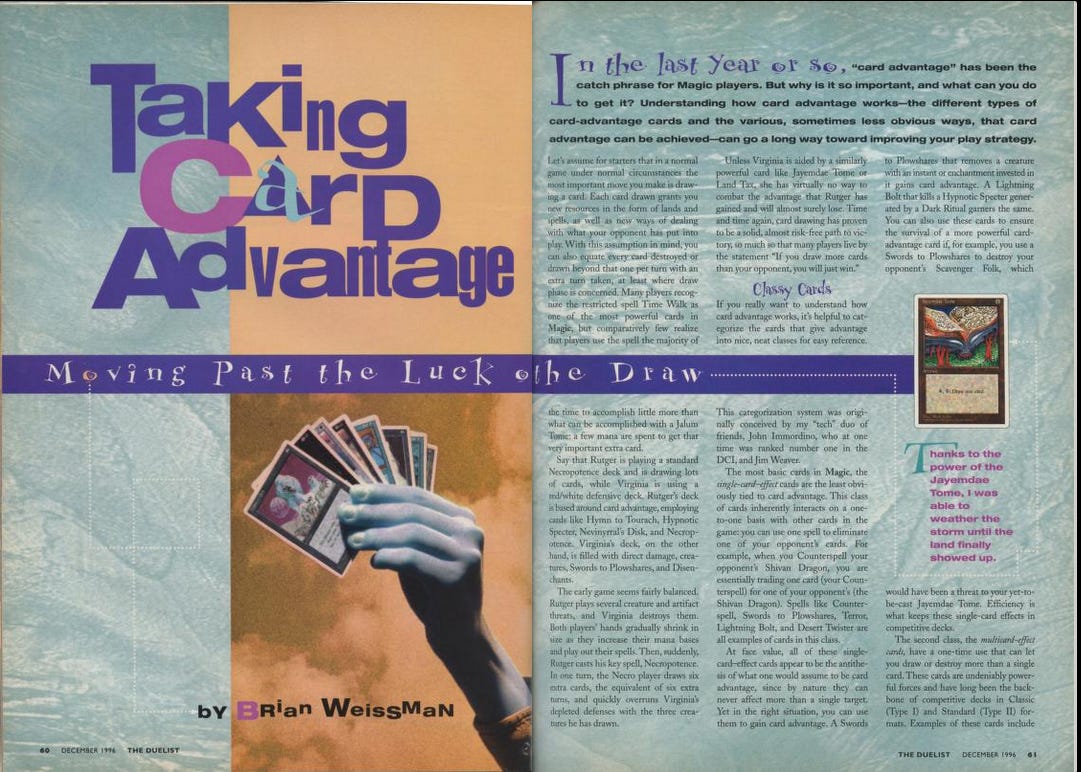
The first paragraph of the article features one of those astonishing moments that makes someone in 2026 feel like they’re seeing an ancient tablet with early gossip about this neat technology called the wheel. Weissman writes: “In the last year or so, ‘card advantage’ has been the catch phrase for Magic players. But why is it so important, and what can you do to get it?” As he goes on to explain:
Let’s assume, for starters, that in a normal game under normal circumstances, the most important move you make is drawing a card. Each card drawn grants you new resources in the form of lands and spells, as well as new ways of dealing with what your opponent has put into play. With this assumption in mind, you can also equate every card destroyed or drawn beyond that one per turn with an extra turn taken, at least where the draw phase is concerned. Many players recognize the restricted spell Time Walk as one of the most powerful cards in Magic, but comparatively few realize that players use the spell the majority of the time to accomplish little more than what can be accomplished with a Jalum Tome: a few mana are spent to get that very important extra card.
This is, in essence, a philosophy of marginalist theorycrafting. Drawing a card, in Weissman’s framing, is not a neutral act but a form of gathering resources, with every single card drawn equaling an advantage in resources. It doesn’t matter, in this framing, what you draw: the act of drawing a card has enough marginal utility that doing it enough can, seemingly by itself, mathematically aggregate into a win.
Weissman goes on to give a multi-paragraph example of a game between two players, one of whom has effective threat removal and the other of whom has excellent card-draw. As we might imagine, the player with strong removal does well early on, but quickly runs out of resources, while the player with strong card draw can resupply with a single copy of Necropotence and overrun their opponent. It’s simple mathematics, says Weissman: “Time and time again, card drawing has proven to be a solid, almost risk-free path to victory, so much so that many players live by the statement ‘If you draw more cards than your opponent, you will just win.’”1
It’s a compelling point, and one that surely made decent players into good players when they read it in 1996. And yet it’s still worth highlighting the basic knot in Weissman’s rhetoric: for some, the power of marginal card advantage is so self-evident to be an axiom (“If you draw more cards than your opponent, you will just win”), but for the article’s implied reader, it’s such a counterintuitive idea that to suggest it is equivalent to rewriting their most basic assumptions about Magic (in this case, correcting a misunderstanding about what makes Time Walk a good card). Card advantage is real from a mathematical perspective, but from an experiential perspective—at least the experience of a certain kind of player, a certain kind of person—it doesn’t feel real.

I make this point because it helps notice the weird and uneven ways that marginal thinking shows up in real Magic play, especially casual play. While marginalist and data-driven thinking inform Magic at all levels, casual play is the place where we might be least inclined to expect super-precise instrumentalist thinking. And yet, there it is
We can take Commander—the most famously casual format, though of course not exclusively so—as an example of how marginal thinking proliferates in casual play. There’s no better index of marginal thinking than EDHREC. I’m an especially great fan of Benjamin Nicol’s work for the site, which emphasized how to mathematically determine the exact threshold a deck might need to cross to support its theme.
But even more obvious is the same site’s focus on data—aggregating cards on the basis of popularity, “synergy” and “lift,” calculated to tenths of percentage points and printed in bold text below each displayed card.
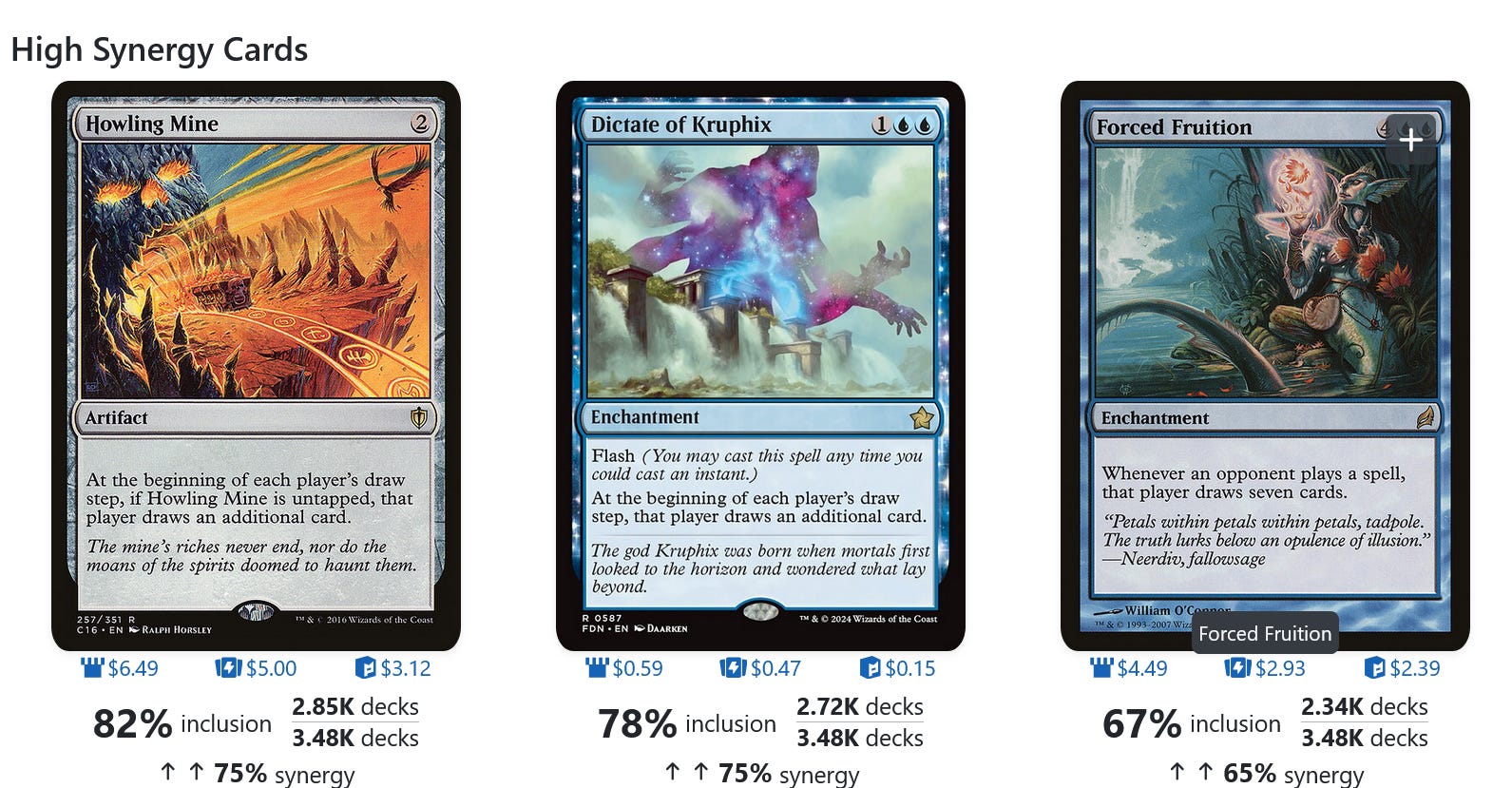
In using EDHREC, the user—presumably a casual Commander player, though theoretically a cEDH player as well—is led to think of their own deckbuilding process as a matter of marginal calculation and advantage.
It’s worth noting, of course, that EDHREC’s statistical emphasis is a little illusory. Unlike 17Lands, whose data is aggregated from Limited players on Arena who voluntarily share their game logs and which calculates “qualitative” data about the win rate associated with a given card or deck, all of EDHREC’s data is basically quantitative. The numbers we see on the site are derived exclusively from the number of times cards are added to Commander-tagged decks on Archidekt and Moxfield. And this makes sense: it’s nigh-on impossible to calculate card-associated winrates in EDH, by the very nature of the format’s casual ephemerality—nobody but a numinous world-spirit of data could know such numbers.
Yet this fact makes EDHREC’s style even more interesting: it works by giving players in Magic’s most casual format the impression that they can wield knowledge of marginal advantage, even when they don’t.
Of course, as I’ve hinted before, marginal thinking often falls through. Humans are not rational beings; we often struggle to perceive the minute differences between things; the strange, uncountable vicissitudes of experience often deny calculation.
If we need non-experiential evidence of this fact, we can refer to any number of guides on making cuts from an EDH deck. Many of these guides, we should note, offer incredibly thorough suggestions for making your first 20 or 30 cuts—but things become much more ephemeral as you remove the final slice of fat.
In one especially interesting article on making cuts, EDHREC’s DougY—after offering an incredibly thorough process for categorizing cards in order to determine which area needs cuts—suggests that a deckbuilder might have to “organize and reorganize [their decklist] several times” as they get down to the last few cuts. In essence, he’s describing a kind of uber-marginalism: a deckbuilder, in this framing, needs to look and categorize and look and categorize until they notice that just-noticeable difference that renders a card inessential.
We’re back again at that moment when the perceiving mind becomes the economic mind, discerning the minute differences that organize their world and their system of values. And yet it’s telling that this process can only be described in such vague terms. Despite the article’s rigorous guide on categorizing cards to assess their synergy, despite EDHREC’s own glut of data, there is no perfect strategy for finding these just-noticeable differences—precisely because it’s impossible to describe such a thing. That process belongs in the strange vicissitudes of consciousness, which, ultimately, aren’t all that rational.
Indeed, the collision between the marginal and the uncountable shows up in another EDHREC article: Roman Milan’s guide for new players on making cuts. The last step in Milan’s thoroughgoing guide is, crucially to play the deck: “Getting it out on the table is the only way you’ll be able to evaluate which cards should stay or go.” Here, again, we see an appeal to empirical experience to discern just-noticeable differences, with the sense that such experience must ultimately reside outside the boundaries of the article.
In principle, this makes total sense: you can’t have a one-size-fits-all guide to deckbuilding; you need to get a deckbuilder to place their deck in dialogue with real life.
Except: it might be even more difficult to calculate marginal advantage during real-world play.
I can’t speak for all Magic players (I’m only okay at EDH and pretty terrible at pretty much everything else). But I wager that I’m not the only one for whom there’s a fog of war when I’m sitting at the LGS table, surrounded by my friends, sipping on a drink, getting excited for my next play, getting hungry for dinner, thinking more about how excited I am for my friend to play Blood Artist so I can yell out “PAUL BLARTIST” than about game strategy—and so on.
It’s not an environment that’s conducive to clear marginal thinking. I make miscalculations all the time when I’m sequencing my plays or picking what to draw off Brainstorm. I might feel in one moment that there’s definitely not enough removal in my deck simply because I’m not drawing it, or I might think I need to commit the cardinal sin of EDH and cut lands simply because last game I got flooded. When you’re staring down a deck of 99 cards, how can you possibly assess the marginal value of just one?
The same is true of game strategy. One of the most fascinating articles I read in researching for this essay was a piece by longtime Magic writer Mike Flores called “Virtual Card Advantage.” The article’s thrust is that card advantage, the aforementioned direct-path-to-winning, is actually more complicated than it might seem. As Flores details across seven hypothetical play scenarios, card advantage is almost always involves more variables than cards-in-hand—like the value of cards in hand, a player’s decision of whether to actually use those cards (tempo, basically), and the state of the board.
Flores’ article is implicitly speaking to the same hypothetical ur-player who read Weissman’s article on card advantage—the one who has to be disabused of the notion that the content of cards matters more than their numerical advantage. Flores is drawing that player back in, saying, Well, in fairness, it’s a little more complicated… It’s pointing to the way that attempting to recognize marginal advantage gets maddeningly complex, if not infeasible, in real-world play.
This is to say nothing of the interpersonal calculation in a game as overtly social oriented as EDH. I chatted about this topic recently with Magic writer and all-around great guy Mike Carozza, who writes a column for EDHREC (and elsewhere) called “Am I the Bolas?” As its name suggests, Mike’s column has to do with the often-touchy social economy inherent to Commander’s bombastic multi-person play. As he remarked to me:
We all want to do the cool thing. We also want to see our pals do the cool thing. Some people want to get ahead of feel-bad scenarios and hedge themselves to accommodate others so they can continue to enjoy the game in a way that works for them. I think the very nature of a multiplayer format having seemingly two speeds (casual and competitive) is at play here, too. If folks look at it as a binary, they’ll find themselves making plays that they believe feel closest to those molds…. As long as someone is aware of something, they’ll be affected by it.
Mike is gesturing to the way that players—not universally, but noticeably—have to calculate not just the mechanical strategy of their cards but also whether to play the cards they have, whether to run the strategies they have in mind, and whether to take things seriously. And as the very existence of Mike’s column reflects, there isn’t a clear answer: every situation feels like it overflows with gossamer nuance, and it’s not easy to know the margin between socially felicitous fun and outright jerk moves. (And that’s if you care to figure out the difference, which, of course, some folks don’t).
There is, in other words, an epistemological struggle happening at the game table. The basic absurdity of marginal thinking in a casual format, so easily contained and repressed during deckbuilding, bursts into view. Immersed in the flux of experience, it feels at once like you’re compelled to economize your actions but also constantly struggling to do so, striving fruitlessly in the absurd task of extracting an actual marginal value out of anything.
And that’s a great thing.
It is easy and perhaps often right to shake one’s head at Commander, or at casual play in general. The former exerts an outsized influence on Magic products themselves, and it rewires both the gameplay machinery and the social machinery that makes the game function.
And yet I find something intensely, deeply beautiful about kitchen-table Magic. I love that it often wears the garb of marginal min-maxxing but is actually messy and subjective—that it allows you to play around with tinkering and tweaking but also leads you to forget said tinkering and tweaking almost immediately. I love that it becomes impossible to search for marginal advantage.
There’s something that is, in some small and insignificant way, freeing about such an anti-marginal form of play. We live in a world governed by calculation (or more accurately, by people who wield it), who have mastered the arts of logistics and economization in order to capture as much profit as they can while eliminating anything that dips below—even approaches—that margin. This is the cold, abstract commonsense that says that so long as arbitrarily coded tokens can be arranged in a good-enough order that they hallucinate sentences and images, they’ll be marginally valuable enough to replace a human being at the work of existing.

But when you sit down at a game for which there is no purpose other than fun, the cold gets a little warmer, the commonsensical becomes a little less sensical, the abstract becomes a little more personal, and the messy encounter with impossible margins can actually give rise to something beautiful.
I’m reminded of something Mike said to me when we chatted—that the best kinds of playgroups, the ones that really get “💫the vibe💫,” are those that have built up trust with one another.
Trust is what allows the players to play their removal or make the “mean” play if it’s the best move for them—if people know that their playgroup or their pod will continue to play and vocalize their worries, these hesitations play into things less.
What Mike’s describing here is a genuine human connection lingering behind the appearance of marginal play decisions. More than economic advantage, it’s the wispy-warm-fuzzy stuff of seeing another person, however fragmentarily.
In a world full of calculation, it’s quite freeing to make mistakes.
Thanks for reading Dominarian Plowshare! This post is public, so feel free to share it.
Interestingly, this framing of card advantage contradicts an important marginalist idea: diminishing marginal utility. Marginalists tend to suggest that the more additional units of a thing you acquire, the less their marginal utility becomes; for every pack of fruit snacks I buy, I’m less and less likely to buy another one and more and more likely to get an alternative commodity instead. The rhetoric of card advantage would seem to suggest the opposite: there is never a downside to drawing another card. Of course, this doesn’t bear out in real-world play.
No posts
Comments
Nothing yet. Say the first thing.
Sign in to join the conversation.