
When I first left the country, at age 17, I was glad to be gone. Abroad, the first Gulf War had recently concluded, decisively vanquishing “Vietnam syndrome” in the court of American public opinion and establishing, according to President George H.W. Bush, a “new world order” in which the U.S. would serve as the world’s policeman. At home, the economy was transitioning from the “Bush recession” into a “jobless recovery,” the difference between which required an advanced economics degree to discern.
My dreams of becoming a rock-and-roll star had collapsed, leaving me with just the shitty fast-food job I had taken to support myself while pursuing them. I was living in a depressing basement apartment with my soon-to-be-ex drummer, and had broken up with two girlfriends in fairly quick succession. So I jumped at the chance to fly to Europe, where the rest of my family was living for a semester, while my father exchange-taught at the University of Vienna.
When I had gone looking for a job the summer after I graduated from high school, there weren’t a lot on offer. (It was a recession, after all.) I ended up working at the same fast-food restaurant as the drummer in my band, no doubt thanks to him recommending me. I made four dollars an hour, twenty cents above minimum wage; when the federal minimum wage was increased to $4.25 on April 1, 1991, that differential disappeared. (Of course, $4.25 in 1991 works out to $10.53 in 2026 dollars, well above the current federal minimum wage of $7.25.) I slung burgers and fried fries, wiped down tables and cleaned bathrooms, took orders and made milkshakes, and dispensed gallons upon gallons of colas sweetened with high-fructose corn syrup into 32-ounce plastic cups.
I could not say, when I showed my newly-acquired passport to customs officials at Heathrow en route to Austria, that I was especially proud to be an American.
Last weekend I went to my first, and probably my last, multi-day outdoor rock-and-roll music festival. Organized by the band Wilco, Solid Sound is held every other year at the Massachusetts Museum of Contemporary Art (MASS MoCA) in North Adams, Massachusetts, and lasts for three days. What enticed me to make the schlep to Western Massachusetts, spend more money than I am comfortable with, and endure the logistical hassles that come with this kind of event, was the promise of a once-in-a-lifetime performance: seeing Wilco and the British singer-songwriter Billy Bragg perform songs from their series of Mermaid Avenue albums.
In 1995, Nora Guthrie, daughter of the legendary American folk singer Woody Guthrie, approached Bragg about (re-)setting to music the lyrics of songs that her father had written but never recorded; since all he had written down were the lyrics, any melodies and accompaniments he might have composed for them are lost to time.1 Bragg then recruited Wilco — who, at the time, had only put out two albums — as collaborators, presumably to give the songs a more American feel, and they wrote and recorded what ultimately became three album’s worth of songs in 1997 and 1998, in Dublin and Chicago.
There are certainly some political songs on the albums: “All You Fascists,” from Vol. II, is exactly the kind of lyric you might expect from a songwriter who famously wrote “This machine kills fascists” on his guitar. Most of these are sung by Bragg, whose commitment to socialist politics can occasionally seem to overwhelm his music.
But the majority of the lyrics are far more quirky and personal than Guthrie’s most famous songs, “This Land Is Your Land” and “Union Maid,” might lead you to think. They show off his penchant for wordplay and humor, contain a not insignificant amount of sexual innuendo, and are often suffused with the kind of poetic yearning — for a lover, for a landscape, or for a better future — which made them a particularly good match for Wilco’s brand of impressionistic Americana.
The albums won all kinds of recognition, but Wilco and Bragg had never performed the songs together live. They are both among my favorite artists — prior to last weekend, I had seen each of them perform four times, separately — so I was not going to miss this show.
During the months I lived in Vienna, I read a lot. I had, to be honest, little else to do. The law professor in whose apartment we were staying — the exchange program included an exchange of domiciles as well as teaching positions — was fluent in four languages, so there were a fair number of books in English on the bookshelves that lined the walls of her apartment. I had also brought some books with me, and I think we might have had access to an English-language library of some kind as well. (Austria is one of the most English-fluent countries on the European continent, with everyone mandated to study it for something like six or eight years in school. I was completely unable to use my high-school German because when I tried to speak it, people would just respond in English.)
One of the books I read while in Vienna was Woody Guthrie: A Life, written in 1980 by Joe Klein, then a contributing editor at Rolling Stone. It was the first full-length biography of the singer, and the only one that had been written at that time.
Klein’s account of Guthrie’s life was my first introduction to what Vivian Gornick famously called “the romance of American communism.” The general consensus is that Guthrie never actually joined the Communist Party (CPUSA),2 but he was certainly a fellow traveler — his songs usually supported the party’s political positions, and for the better part of 1939, he wrote a column for the party’s paper, the Daily Worker.
Guthrie joined the Communist orbit, if not the party, in the mid-30s, at the height of the “Popular Front.” During this period, the CPUSA, and communist parties around the world, sought to build the widest possible coalition against fascism, uniting not only with other socialists and leftists but with mainstream liberals as well. In the American context, this meant supporting the New Deal, and indeed Communists and others close to the party were important to the intellectual, cultural, and political currents which shaped the New Deal; some even served in government.
Perhaps most importantly, though, Communists played a key role in building the great industrial unions of the CIO — not only the ones that would come to be seen as “left-led” like UE and the International Longshore and Warehouse Union, but also the Mineworkers, the Steelworkers, the Auto Workers and dozens of smaller unions. CPUSA members were dedicated and skilled organizers, and were at least begrudgingly accepted in most CIO unions until the onset of the Cold War in the late 40s.
My politics were already firmly socialist by this point (I think I joined DSA in 1989 or 1990), but until I read Klein’s book I had no idea that socialists and communists had played any significant role in U.S. history. My cultural-historical allegiances began to shift from the 1960s counterculture, which had informed a lot of my teenage years, to the Popular Front and the New Deal, where in many ways they still lie.
MASS MoCA opened in 1999 on the site, and in the buildings, of the former Sprague Electric factory in North Adams.3 Nestled in among the Berkshire Mountains, which rise like slumbering giants in all directions, North Adams was once a booming mill town. Its population at the 2020 census was 12,961, but a hundred and twenty-five years ago, in its heyday, it had a population of almost twice that, at a time when the overall U.S. population was less than a quarter of what it is now.
The whole Hoosac Valley, in which North Adams sits, is filled with old brick mill buildings, most of them old textile mills. Some have been repurposed for housing or commercial uses but many are still abandoned. The 27 buildings which makes up MASS MoCA were originally built in the last quarter of the 19th century to house a textile printing business, which grew to become the largest in the country. When the textile industry abandoned New England in the middle of the 20th century, Sprague Electric, a manufacturer of capacitors, took over the sprawling complex.
Sprague Electric closed its doors in the mid-80s, which proved a devastating blow to the local economy. The museum and, arguably, the every-other-year festival, have brought a certain measure of economic vitality back to the town, but it still bears the telltale marks of deindustrialization. It has a Dollar Tree and a Dollar General within a couple of blocks of each other, not on the edge of town but right on either side of the city center. I don’t remember seeing any empty storefronts downtown, but there were at least two occupied by what were essentially junk shops, and two others which were being rented as galleries for the art department of the Massachusetts College of Liberal Arts, a public college with an enrollment of under 1,000. Charming, but not exactly the sign of a healthy local economy.
For about two months, I lived with my parents and my sister in a small but gracious apartment near the center of Vienna, sipped espressos and cappuccinos (then barely known in the States) in elegant cafes, and went to the opera. We took trips to Salzburg, to Prague, to Italy. Then we ended our European spring with another month traveling around Europe on a Eurail pass — Switzerland, Germany, Denmark, the Netherlands, Belgium, France, Ireland, Wales, and England.
And as the days and weeks passed, I found myself actually missing my home country, and not just the cities I was excited to visit as a teenager, Chicago and New York and San Francisco, but the Midwest I had grown up in, its vast plains and big sky, its spaciousness and plainness and slower pace.
And also its openness, its optimism, its wildness, especially as compared to Europe. The fact that it could produce a Woody Guthrie. I doubt I knew the phrase at the time, unless it was mentioned in Klein’s book, but I was coming around to the idea, popularized by Earl Browder, chair of the CPUSA during the Popular Front period, that “Communism Is Twentieth-Century Americanism.”
The Solid Sound headline performances take place on a stage set up in “Joe’s Field,” which abuts the railroad tracks which once, presumably, brought in raw materials to the factory and carried out capacitors and other electronic components.
About halfway through the Mermaid Avenue set, a train came rattling along the tracks. Pausing in between songs, Wilco’s singer, songwriter and front man Jeff Tweedy came to the microphone and said something to the effect of “Woody would have wanted us to stop and listen.” Bragg stepped up to his microphone and said, “No, Woody would have jumped the train!”
On Sunday morning, walking from the campsite to the museum for the last day of the festival, I saw a couple of the town’s current residents stumbling aimlessly across the railroad tracks, the way one often sees people in the thrall of drug addiction or untreated mental health issues crossing city streets against the light, as if daring the transportation system to simply take them out of their misery. Along the chain-link fence meant to keep pedestrians off the tracks was what looked like the kind of informal memorial often created at the site of fatal accidents, with homemade crosses, flowers, handwritten notes, and stuffed animals.
The performances were stellar. The band was looser than they usually are at a regular Wilco show, less art-rock intensity and more bar-band exuberance. They played all but one of the tracks from the first Mermaid Avenue album, six from the second, and three from Vol. III. (Unsurprisingly, the best songs from the sessions were selected for the first release, and there was a bit of diminishing returns with the subsequent volumes — though both Vol. II and Vol. III each contain some gems.) Tweedy and Bragg more or less traded off song-by-song, which made for a nice balance between Tweedy’s aching folk-rock voice and Bragg’s brassier one, with his thick East London accent. They sound completely unlike each other, and unlike Woody Guthrie, which is probably what makes the chemistry work so well.
They also brought out guests. Natalie Merchant, in the 80s the lead singer of the band 10,000 Manicas and my one teenage celebrity crush, came out to sing backup on “Way Over Yonder in the Minor Key” and lead on “Birds and Ships,” as she did on the first Mermaid Avenue album. On “Hoodoo Voodoo,” the penultimate song of the regular set, Merchant returned to just dance to the song’s funky, upbeat blues-rock, and Nora Guthrie came out on stage as well, playing a cowbell and theatrically going up to kiss Tweedy and Bragg on the cheek after every time Tweedy sang the lyric, “Kissle me now.”
Just prior to the final song of the regular set, Tweedy asked “are there any Mekons around?” and Jon Langford and Sally Timms from that storied British punk band, who delivered a fantastic politically-charged acoustic set as “Mini-Mekons” the next afternoon, came out on stage. (The festival was also my fifth time seeing Langford live.) They joined Tweedy and Bragg in singing “all you fascists are bound to lose,” a song which Tweedy introduced with, “Sadly, this song is wildly appropriate once again.”
They did five encores; for the last two — “California Stars,” the only song from Mermaid Avenue that Wilco regularly plays in concert, and Guthrie’s “This Land Is Your Land” — they invited any other festival musicians who wished to join them on stage, along with a large crowd of Guthrie’s great-grandchildren. There must have been thirty or forty people on stage. Sarah Lee Guthrie, daughter of Woody’s son Arlo, sang the first verse of her grandfather’s anthem, Nora sort of declaimed the last verse in a kind of sangsprach, and of course everyone joined in on the chorus.
Tweedy introduced that final song of the night by saying, “To me, this is the best part of our American shared heritage, or American history. You know, caring about other people, feeling about other people, taking care of each other.” Turning to Nora Guthrie, he added, “Your father represented that, thank you so much for sharing his music with us.” I might have teared up a little.
As the musicians were leaving the stage and the audience was heading for the exits, Guthrie came up to the microphone, which was still on. She thanked Bragg and Tweedy and Wilco once again, spoke briefly about her father’s legacy, and left us all with the charge, “Let’s get to work.”
After the show finished, I walked back to the festival campground, which is about a mile down the road from the museum. Getting there a bit before midnight, I opted to just sleep in my car.
I woke up around 5am, as I am wont to do, even when I stay up late.
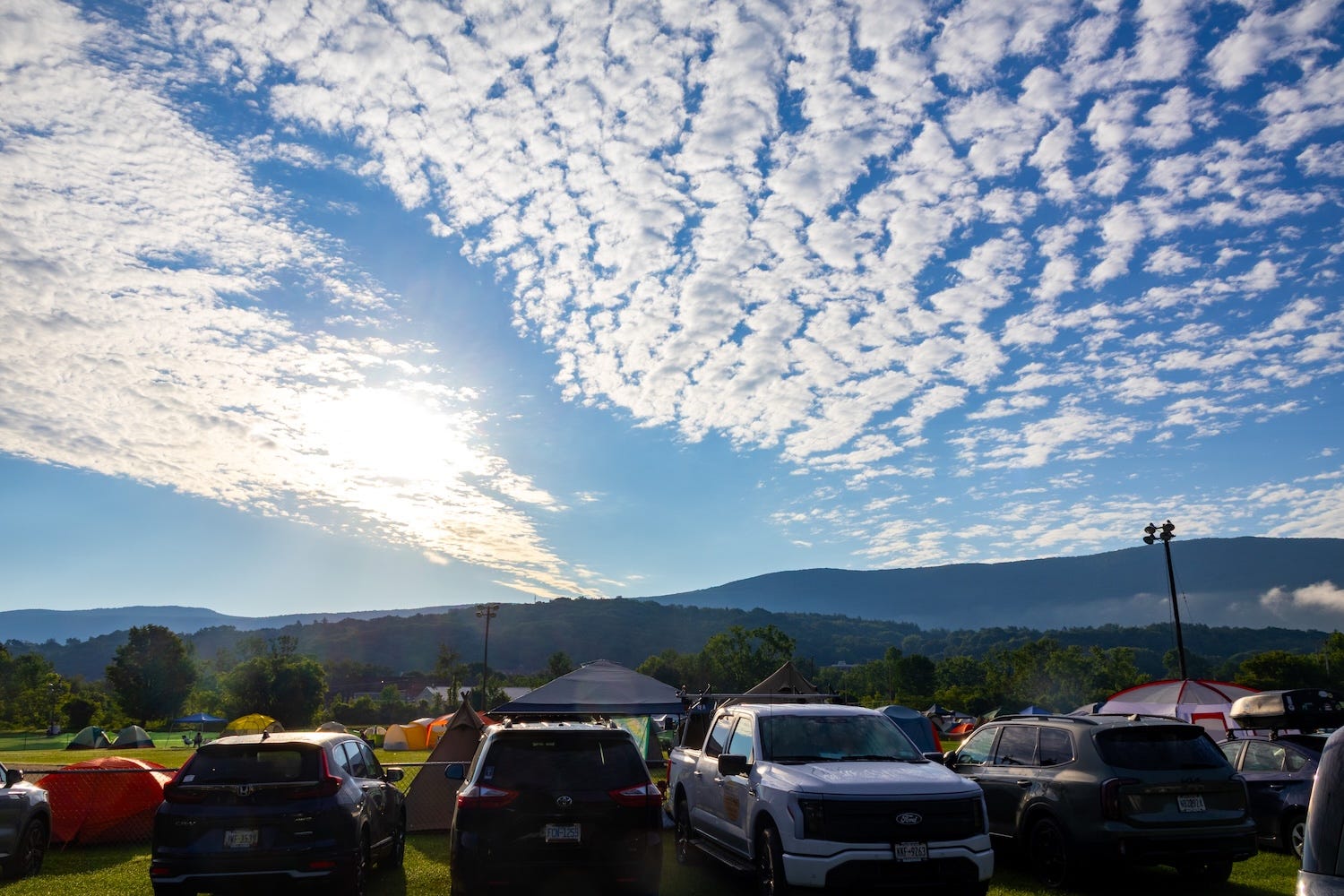
To the east, hundreds of small puffy clouds were strewn like pebbles across the sky, and the sun, still behind the mountains, was coloring them a deep red. I took a stroll down the road, past a sign shop, a vape shop, a weed dispensary, a carpet store, and a used car dealer, to the “Craft Food Barn,” which wouldn’t open for two more hours. I walked back to the campsite, got in my car and drove past the Dollar General to a Dunkin’ Donuts, got a French cruller and a coffee. The sun had come up, turning the sky a bright blue and the clouds a brilliant white.
For a moment, I felt a strange euphoria, a sense of possibility, like the ambient despair of the last year and a half, the last decade, maybe the last quarter-century, had lifted. It didn’t last, but it’s good to remember that I can still, sometimes, feel that.
Filed under: Music

Through July 9, you can listen to a recording of the concert on the New England Public Media website. The music starts around 5:40.
Spotify user arthurberriman has thoughtfully put together a playlist of Mermaid Avenue songs that matches the setlist:
And way back for Domestic Left #3, I made a Spotify playlist of 4th of July songs. As I noted in that post, although it’s not my favorite, Independence Day has probably inspired more songs that I like than any other holiday:

Some previous 4th of July posts:
Domestic Left #117: A history of repeated injuries and usurpations
·
July 4, 2025
Even if you happen to already be in the far northeast corner of California and have set out to find it, it’s easy to miss the Tule Lake National Monument. It lies right off of state Highway 139, a straight, flat, and uncrowded two-lane road which runs through the farms and grain silos of Modoc County, the third-least populous of the Golden State’s 58 co…
·
July 5, 2024
One empire begat another. They fought, in the manner of headstrong sons and controlling fathers, but soon reconciled. Together, they vanquished the bad guy, and there was dancing and singing and sparkling confetti across the known universe.
Though I believe recordings of some of these songs eventually surfaced and were included in a set of music released last year.
Though accounts differ, including his own. He is said to have said both “the best thing that I did in 1936 was to sign up with the Communist Party” and “I’m not a Communist, but I’ve been in the red all my life.”
For the UE members and labor nerds among my readership, yes, Sprague Electric was part of the industry in which my union — the United Electrical, Radio & Machine Workers of America — was originally formed. We had an organizing drive there in the late 1940s but were unable to dislodge the company union (known as the “Independent Condenser Workers Union”). At some point the ICW either affiliated with or was replaced by another industrial union, the IUE, and there was a bitter, ten-week strike in 1970. I learned all of this by leafing through a copy of Maynard Seider’s book The Gritty Berkshires: A People’s History From the Hoosac Tunnel to MASS MoCA in the museum bookstore.
Comments
Nothing yet. Say the first thing.
Sign in to join the conversation.