

Last month, one of the top podcasts in the world welcomed a guest who was introduced as the world’s preeminent dog trainer. That trainer was Cesar Millan.
Nineteen years ago, I was working as a reporter but I had the vague idea that maybe I’d like to become a professional dog trainer; I would’ve been excited to listen. Today, all I could do was shake my head at how little things have changed.
Back then, my vocational daydreaming led me to the Bureau of Labor Statistics website, where I discovered that the number of dog trainers in the United States had nearly tripled since 2000. This statistic led me to pitch a reported story to The New York Times about dog training as an increasingly popular Plan B career. This seemed especially interesting to me since it was (and still is) a completely unregulated field. You can become a professional dog trainer by… just telling people you’re a professional dog trainer.
Almost all of the newly minted “professionals” I spoke to cited the television show The Dog Whisperer as their inspiration.
The program, then three years into its run on the National Geographic channel, starred Millan, who announced in the opening credits that he “rehabilitated dogs” using a special dog knowledge he said was born with.
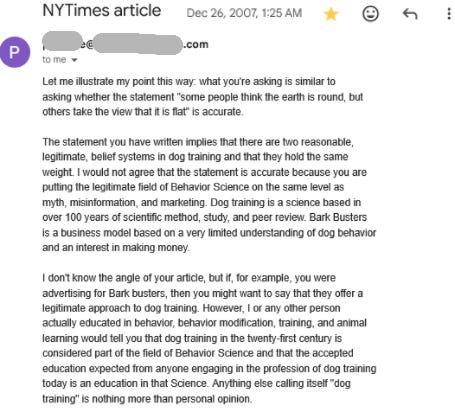
For the story, I had some questions about the types of methods trainers used—a minor part of the piece. So, I emailed the Certification Council for Professional Dog Trainers and asked if it would be fair to say that some trainers favored behavior-modification theories relating to how all animals learn, while others favored a Millan-esque approach that involved channeling the energy of a pack leader. The difference between the two approaches seemed esoteric to me: a trained dog was a trained dog, and how you got there didn’t seem to me like it mattered that much.
The CCPDT’s head wrote back and said my question was like asking whether it would be accurate to say that some people believe the Earth is round while others believe it’s flat.
Was she saying that Cesar Millan was peddling snake oil? He’d just been profiled by Malcolm Gladwell in The New Yorker! He’d been on Oprah!
I forwarded the email to my editor with a note:
“Sounds like some serious insider baseball,” I wrote.
Little did I know that I’d end up spending the next two decades in the dugout.
It’s from that vantage point that I now see so many well-intentioned people making the same dangerous assumptions I made.
It’s easy to assume that dog training is like cooking or interior design: a field with competing philosophies, strong personalities, and no objective answers.
It’s also easy to fall for any charismatic underdog who swoops in and fixes people’s life problems in under thirty minutes, with big life lessons baked in: This is what the reality genre is all about: Change your kitchen cabinetry, change your life!
In this context, Millan made (and still makes) for an irresistible protagonist. A diminutive-but-forceful Mexican mystic giving Malibu dog owners their comeuppance for letting their Maltipoos run the show.
His message: Dogs can be saved if their owners simply fix themselves by projecting “calm, confidence, love and joy.” He reduces both problem and solution to a single word: energy.
What kind of energy? Not the energy that powers the grid… Not caloric energy… Not atomic energy…
It’s the kind that exists because Cesar Millan says it does.
The genius of this word is that it borrows from the language of science without submitting to the rules of science.
The whole charade wouldn’t be possible if more people had an awareness that behavior is not a pseudoscience. There’s been more than a century of experimental science devoted to understanding how animals learn, and decades of development of technologies of teaching methods with results that can be replicated— methods that are used with service animals, zoo animals and even with humans. The best animal trainers and the most successful designers of addictive apps both use methods stemming from work born from BF Skinner’s Harvard lab in the mid-20th century. (Fifty years ago, he was on the cover of Time; today, some of the smartest people I know associate his name only with a character named for him: Principal Skinner on The Simpsons).
The email I deemed “insider baseball” was written to help me shine light on the science behind dog training. But I couldn’t look away from the shadows on the cave walls.

Charlatans Finish First
It’s tempting to dismiss all of this as an esoteric disagreement among dog trainers. Dogs love us no matter what, right? And our bond with them is different, so it’d be reductive to liken the way they learn to the way any other animal learns, no?

I no longer think so.
The study of animal behavior and the laws of learning are not species-specific. “Dog psychology,” as Millan uses the term, is not a distinct scientific framework. It has resulted in a brand of woo that can end up worsening the very problems it’s meant to solve—fear, aggression, and avoidance among them. This can result in people getting bitten and dogs euthanized. His own dog allegedly mauled a teenager visiting his office (I interviewed the lawyer who represented the plaintiff); in the United States, where there are no laws in place about who can or can’t call themselves a professional dog trainer; trainers using similar techniques have been arrested for using methods that have been deemed animal abuse.1
The Real Technique
Today, I see the dog-training world as divided less by personalities than by ethics.
I am on the side of trying to change canine behavior through methods that are as minimally intrusive as possible: this involves careful observation of body language, environmental management, precise use of positive reinforcement, and an understanding of the laws of learning. Trainers like me usually avoid using negative reinforcement and punishment, and sometimes call themselves “Positive Reinforcement” trainers.
On the other are trainers who might sometimes use positive reinforcement, but also might suggest punishment and negative reinforcement while generally paying little attention to the fallout these methods can produce. These trainers often refer to themselves as “Balanced” trainers, as they see themselves as using a “balance” of punishment and reinforcement-based training methods.
Millan lives in the latter space, but sells it with his own New Age-y self-help verbiage that masks methods which rely heavily on intimidation. This can produce dogs that appear calm because they’ve basically given up on trying to escape a bad situation: it’s referred to in psychology as Learned Helplessness.
There are countless episodes of Millan kicking dogs, hanging them by their leashes, or pinning them to the ground by their necks. He sells his own line of shock collars and choke collars.
But it’s all wrapped in language that sounds almost spiritual.
Suppressing behavior becomes “calm surrender.”
A frightened, shut-down dog becomes a dog in a “good state of mind”—good, apparently, meaning whatever isn’t inconveniencing the human.
When something goes wrong, it’s usually because the person failed to project the right energy.
Reality television rewards simple explanations and dramatic transformations. “Change your energy” is a much better television premise than “systematically reinforce desired behavior while carefully managing antecedents and consequences.”
One sounds like homework.
The other sounds like magic.
And that’s what makes it so persuasive.
This compilation of clips from The Dog Whisperer shows some of the many moments of abuse that get labeled as training (or “calm assertive energy”). In my book, I dissect the content of several of episodes in detail.
Smart People Get Duped, Too
I thought about my Times story earlier this month while listening to Andrew Huberman interview Cesar Millan.

Huberman is a Stanford neuroscientist whose enormously popular podcast, Huberman Lab, promises “science-based tools for everyday life.” After introducing Millan, Huberman tells listeners they’re about to learn about dog biology and psychology. Then he begins describing walking his dog and silently sending the dog what he called “approval energy.” He did this just by thinking approving thoughts. The dog looked up at him.
Huberman found this remarkable.
Correlation isn’t causation—but hey, I’m not the one with a PhD.
Millan tells Huberman that dogs should follow what’s in a person’s mind and that one way to make this possible is to literally pray before engaging with your dog. Huberman responds by saying his relationship with his dog improved “an order of magnitude” once he embraced this way of thinking, then extends the idea to human relationships as well.
One man’s interpretation of one dog’s glance becomes a theory of communication.
Two decades ago, I would’ve accepted this unthinkingly.
Now, I felt like he was endorsing a flat-earther to head up NASA.
What Is “Energy”?

Whenever a dog trainer online criticizes Millan, they’re met with comments from his defenders who insist that we just don’t understand energy. My response is usually: It’s true! Please enlighten me.
How is it measured?
Heart rate?
Cortisol?
Infrared goggles?
Those are variables that can be observed and studied.
If you mean invisible vibes, good luck designing that experiment.
Going deep into his oeuvre through the years, I found Millan recommends cultivating the right “energy” by emulating figures like Oprah Winfrey and Cleopatra, and studying method acting and judo. He also suggests just adopting a ramrod posture, as he does at some point in most episodes.
His most telling advice on how to improve your energy comes from his book Cesar’s Way: “Fake it till you make it,” he writes.
Indeed.
Hope…?
After listening to the Huberman interview, I sent him a message.
He wrote back almost immediately.
“Ultimately,” he wrote me, “I think we all want what’s best for animals! I certainly do!”
He seemed genuinely curious about how someone could question Millan’s expertise.
He asked what parts of the episode I took issue with.
My knee-jerk reaction was to write “All of it!” But then I hesitated.
I didn’t want to insult him.
I know it’d be too easy to dismiss reason… as I had once done when someone wrote me thoughtfully on the same topic long ago.
Millan has become so intertwined with many people’s idea of what dog training is that criticizing his ideas can feel like a betrayal. But changing your mind in the face of evidence isn’t a betrayal — it’s how science and learning are supposed to work. If this essay spoke to you, please consider sending it to a dog lover you know or sharing it on Substack or your preferred social media platform.
A few examples of trainers charged with cruelty for using what they claimed were legitimate training methods.
In 2022, two Louisiana trainers were charged with aggravated animal cruelty after a video appeared to show them striking a Cane Corso with a riding crop during a training session. Attorneys argued the technique was a legitimate training method. (Fox 10 Phoenix)
In 2011, a Ontario trainer was charged with more than dozen counts of animal cruelty for allegedly kicking dogs and hanging him by leashes during training sessions. (Globalnews.ca).
Comments
Nothing yet. Say the first thing.
Sign in to join the conversation.