
Social media is a funny place.
We get to put our opinions out into the world and see how they land. We also get hit with the opinions of friends, family and millions of people we’ll never meet in the run of a lifetime.
One of those opinions strikes close to home. It usually sounds like:
“Stop calling your dogs fur babies. They’re not babies.”
“You can’t possibly love your dog as much as you would a baby.”
Blah blah blah.
I see it a lot on Threads these days. Threads, the place I thought would be kinda like Twitter back in the old days. When people were still kind and understanding of another person’s perspective. Well before Elon Musk. Well before Obama’s revolutionary campaign that used Twitter to its full extent. Well before Ashton Kutcher and Oprah Winfrey launched their first-to-a-million-followers challenge, which – in my opinion – is really what ruined it all.
That’s when, I think, blasting opinions into the ether really took off.
That’s when, I think, the trolls started coming out from the shadows and tracking their muddy boots and throwing cigarette butts and banana peels all over the living room.
And the fights.
Just like the “dog vs. baby” fight.
Last week I posted this on Substack:
“In some realms of society, I’m told I could never know true love because I didn’t reproduce.
Except …”
With a photo of Bella and me, just being in love with each other.
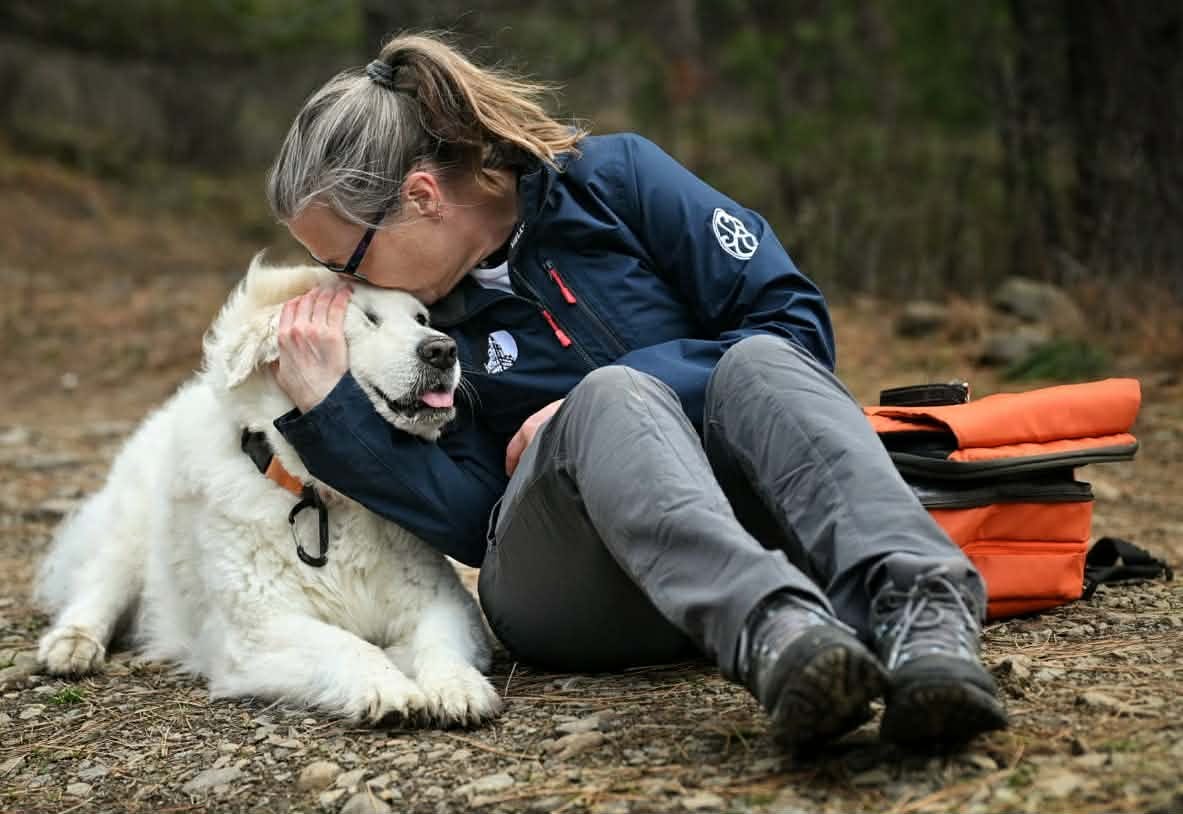
99% of the people who responded were supportive.
“My husband and I were unable to have children. We rescued a kitten. Within a year we rescued 3 more. They brought us so much love. Our life and home has been filled with kitties for 36 years.”
~ Diane
“Dogs will love you more than your kids. No comparison.”
~ Mike the Red
“In some realms I would shove all of these 🌶️🌶️🌶️🌶️🌶️ up their ass”
~ Pink Elekks
Aaah, but there’s always one, isn’t there?
Joel felt the need to interrupt our little “love is love” fest to remind me that the love we have for our pets isn’t real enough. Four paragraphs.
“While I agree with you that you do not have to share blood or even be of the same species to love or to know love, the intensity of the love is different. Ask anyone who has and sees the blessings of both children and pets.
“I love and adore our pets. I would take a bullet for them. But I would literally tear a man’s arms off with my bare hands to secure the safety of my children. In fact, I would do this for any child.
“It’s different.
“IMO if you truly love your pet equally to your child, you have an issue. It may be warranted, but it’s still an issue.”
Joel could have scrolled on past. Instead, he felt the need to drop his thoughts.
And maybe it should be easier for me to scroll past Joel. Maybe even block him. I mean, who gives a shit what this rando says?
It’s just one of those things. Like Vivian said in Pretty Woman, “The bad stuff is easier to believe.”
All of the support gets a bit derailed by that one negative comment.
Why is that?
There’s actually a name for part of it: negativity bias. Our brains tend to give more weight to the shitty thing than the lovely thing. Ten people can tell you you’re wonderful and one person can tell you you’re an asshole and guess which one gets invited to move into your head, rearrange the furniture and eat all the good snacks?
But I think there’s something else happening here too.
Joel wasn’t simply telling me how much he loves his children.
I have absolutely no reason to doubt that he loves them ferociously. Tear-off-a-man’s-arms love? Sure. Go nuts, Joel.
And Joel, if you think I wouldn’t have torn a man’s arm off, beaten the living shit out of him with it and then thrown him off a cliff in defense of my doghter, you are all kinds of insane.
That isn’t proof your love is greater than mine.
It’s proof we both love someone enough to become temporarily unhinged at the thought of somebody hurting them.
Which, frankly, seems like more common ground than you intended.
What Joel was doing was telling me that his experience of love is the measuring stick for mine.
And that is where I get off the train.
Because why are we so obsessed with ranking love?
Why does the love between a parent and child have to defeat the love between a person and a dog in some imaginary championship bout?
Why does one have to be realer?
Why does one have to be more intense?
Why does somebody have to stand on the podium while somebody else’s relationship gets handed a participation ribbon?
It’s fucking weird.
I chose not to have children. I didn’t want them. That means I will never know what it feels like to love my own child.
And you know what? I’m perfectly comfortable admitting that.
I don’t know that love.
But Joel doesn’t know mine.
He didn’t know what it felt like to wake up every morning and find Bella beside me.
He didn’t know what it felt like to plan vacations around whether she could come, to choose trails based on what her body could manage, to watch her age and quietly start recalculating the future.
He didn’t know the language we built together over 12 years. The looks. The routines. The negotiations. The way she could tell me exactly what she wanted without saying a word.
He didn’t know what it felt like when her body started failing her.
He wasn’t there when I held her face in my hands while she died.
And he sure as hell isn’t here now, in the space she left behind.
So perhaps we can stop pretending love becomes legitimate only when someone else recognizes its magnitude.
This is one of the strangest things we do with relationships with animals.
We celebrate the loyalty of dogs. We tell stories about them saving people from fires and finding lost children and sitting beside hospital beds.
We call them family. We photograph them at Christmas. We put their names on stockings. We bring them into our beds.
We rearrange our homes, schedules, vacations and bank accounts around them.
And then, the moment somebody loves one too much for everyone’s comfort, out comes the ruler.
Well, obviously it’s not like loving a child.
According to whom? And why the hell does that distinction matter so much to you?
Maybe you love your child more than your dog. Great.
Maybe someone else doesn’t. Also great.
Maybe somebody has no children and the deepest relationship of their life is with an animal.
Still great.
Maybe we don’t need a hierarchy.
I’ve been thinking about that word – hierarchy – because we do the same damn thing with grief.
We rank losses.
We decide which ones should hurt the most. Which ones deserve the casseroles and sympathy cards and bereavement leave. Which ones warrant months or years of grief and which ones should probably be wrapped up by Monday because, after all, it was only a dog.
“There is no hierarchy of grief that can accurately say that a particular loss is worse than all others.”
Because grief comes out of a particular relationship: its history, its intensity, its meaning and the two individuals who created it. Friedman argues that those relationships are unique, which makes comparing one person’s grief with another’s fundamentally useless.
And really, what is the point? Who wins?
If my mother dies and your mother and father die, do you win?
If your spouse dies and my dog dies, do you win?
If somebody loses a child, do they become the gold-medal griever and everyone else packs up their sorrow and goes home?
Of course not.
There is no trophy for hurting the most, and there shouldn’t be one.
Comparing grief doesn’t make anybody less devastated. It just gives us another opportunity to tell somebody that the relationship they lost didn’t matter quite as much as somebody else’s.
Friedman describes that comparison as stripping dignity from the person whose loss has been declared lesser. The point isn’t that every loss creates identical grief. It plainly doesn’t. The point is that nobody standing outside a relationship gets to assign its value.
And there it is.
The relationship.
Grief isn’t determined by the category we put beside somebody’s name – mother, husband, child, friend, dog.
It comes from the meaning of that particular relationship to that particular person.
So why would love be any different?
If ranking grief is pointless because every relationship is unique, ranking the love that created that grief makes just as little sense.
I don’t need my love for Bella to beat your love for your child. You don’t need your love for your child to beat mine.
Nobody has to win.
Because love isn’t made more meaningful by diminishing somebody else’s.
There is no finite supply.
Your love for your child does not become more profound because you convinced me my love for Bella was lesser.
And my love for Bella doesn’t require me to argue that dogs are better than children.
That would just be the same stupid contest wearing a different jersey.
What matters to me is much simpler.
Did you love?
Were you loved?
Did this relationship change you?
Did another living being become part of the architecture of your life?
Did their presence make the world different?
And when they were gone, did the world have to rearrange itself around their absence?
If the answer is yes, I don’t particularly care what species they were.
Call them your dog.
Call them your pet.
Call them your fur baby if that makes you happy.
Call them your family.
Call them the love of your life.
Nobody gets to audit the relationship and decide whether you’ve exceeded your emotional allowance.
Bella was my dog.
She was also my companion, my adventure partner, my ride-or-die, my responsibility, my family and one of the great loves of my life.
Those things can all be true at once.
They remain true whether Joel understands them or not.
And maybe that’s the part I need to remember the next time some random stranger wanders into a conversation about love carrying a clipboard and a ranking system.
He can keep his hierarchy.
I had the love.
That’s the part that matters.
Editor’s note: I’m taking a little August hiatus. Partly to step away, partly to go have an adventure, and partly because I think we could all use a breather from the grief-heavy territory I’ve been living in lately. I’ll be back after vacation, still writing about love, loss and dogs because obviously I am who I am, but with a little more room for the other stuff too: adventure, photography, ridiculous ideas, dog stories and whatever else wanders across my path.
Thanks for reading Cameras and Canines! This post is public so feel free to share it.
Comments
Nothing yet. Say the first thing.
Sign in to join the conversation.