
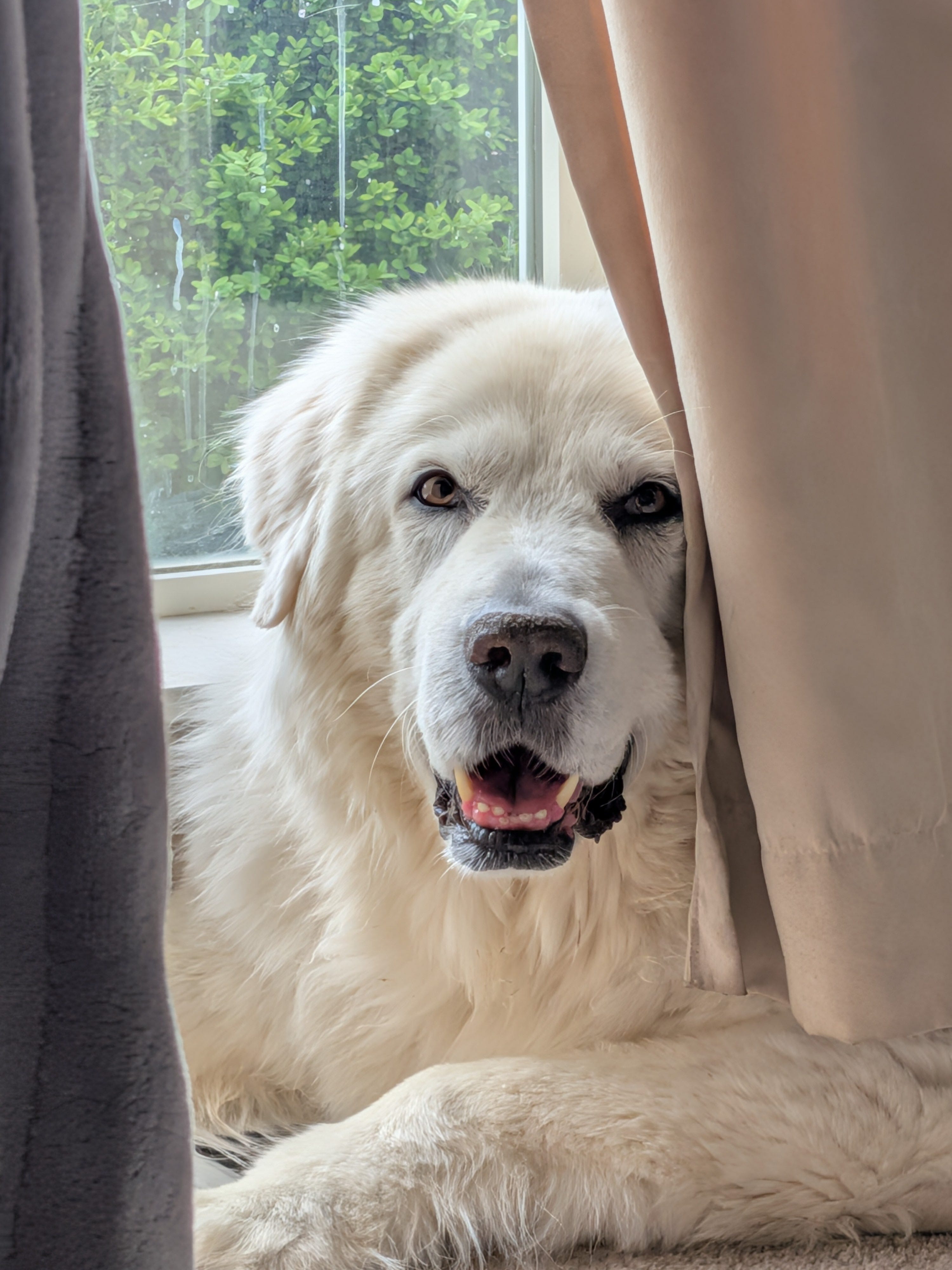
Her right eye is smaller than her left, and I forget that sometimes when I’m positioning her for my camera.
Her nose takes a bit of a turn at the end.
Since TPLO surgery, her right hind has a noticeable sway.
She has imperfections.
She is still perfect.
I’ve deleted probably hundreds of photos where she doesn’t look like the stunning example of a Maremma sheepdog that she really is.
And now I wish I could have them all back.
A photographer friend told me once that grief changed the way she edits images.
Before loss, Courtney Bryson was ruthless. A foot cut off in the frame? Gone. Motion blur? Gone. Focus not tack sharp? Gone. The rules were the rules, and she’d come up in a tradition that didn’t tolerate exceptions – sports journalism, prom photography, work where every hair had to be placed and every prop set down to the millimeter.
I feel that so hard. I come from the world of newspapers and sports photography. One of my editors called them “ghost” parts: a disembodied skate at the border of an image, the ball or puck missing from the frame, no faces visible. It was a lot to remember when we were still manually advancing the film in our cameras.
But life has a way of intervening with a pop in the chin, like a bad one-hopper off a hard infield. You never see it coming the same way twice.
For Courtney, it came when her horse died, then her grandparents. All while running a rescue and sanctuary, and being in a constant state of anticipatory grief as she managed medically sensitive dogs.
Somewhere in all of that, she noticed she was looking at photographs differently.
Now she sometimes saves the image with the cut-off foot, the one that’s a little soft on focus, the one that breaks the rules. Because those images contain something harder to name: feeling.
And feeling, she discovered, survives technical imperfection just fine.
Anticipatory grief does the same thing. It changes what we see – or maybe it changes what we value.
For most of Bella’s life, I’ve been chasing the big moments.
Mountain summits.
Sessions that looked like they belonged somewhere worth seeing.
Stories worth telling and photographs worth remembering.
But something strange happens when time starts to feel finite. The spotlight shifts, and it doesn’t land where you expect.
The things that suddenly matter are not the things you thought would matter.
I don’t spend much time thinking about the perfect portrait we made on a mountaintop five years ago.
I think about the sounds she makes when she’s asleep. The way she groans as she lowers herself to the floor. The way she blocks doorways like a furry traffic cone because she has decided that nobody is passing without her approval. The way she purrs like a cat, a sound so uniquely Bella that I cannot imagine another dog ever making it quite the same way.
None of these moments is remarkable. Nobody would put them in a brochure. And yet they are becoming some of the most precious moments of my life.
That feels a little unfair, honestly. Why does it take the possibility of loss to make us notice what was always there?
A lot of us respond to anticipatory grief by looking for more.
More adventures.
More bucket-list moments.
More experiences, more photographs, more memories.
More time.
I understand the impulse because I’ve been doing it myself – part of me wants to squeeze every possible drop from whatever time remains. Take the trip. Book the session. Go to the lake, visit the trail, do something, anything, as if enough activity might somehow outrun what is coming.
But another part of me has started to suspect that anticipatory grief is asking something different.
Not for more.
For attention. For presence. For the willingness to sit quietly enough to notice what was already beautiful.
A few weeks ago I sat beside Bella while she slept. No adventure. No camera. No grand memory being built. Just an older dog sleeping beside me, her right hind twitching the way it does, her nose doing its little turn.
My mind did what it always does and leapt ahead. One day she won’t be here. One day this spot will be empty.
The tears came.
Maybe the point isn’t that loss is coming. Maybe the point is that this moment mattered – that this ordinary, completely imperfect moment was already worthy of my full attention, and I’d almost missed it because I was too busy grieving a future that hasn’t arrived yet.
Dogs have always understood this better than we do.
They don’t wait until life becomes extraordinary before they participate in it.
They don’t postpone joy until conditions are ideal. They don’t need the perfect hike or the perfect photograph or the perfect day.
They inhabit the one they have.
Bella has never once looked in a mirror and decided she needed to lose 10 pounds before she deserved to be photographed. She has never delayed a walk because the light wasn’t right. She has never stood at a doorway she wanted to block and thought, “Maybe I should wait until I’m more myself.”
She just shows up. Imperfections and all. Right eye a little smaller. Nose taking its turn. Hind end swaying the way it does now.
Still perfect.
Maybe that’s what grief is quietly trying to teach us – not to see perfection, but to see value, and to understand that those are often very different things. The moments that become priceless are rarely the ones that looked like much while they were happening. They’re blurry around the edges. A little messy. Easy to overlook.
The photographic equivalent of a cut-off foot in the frame.
And somehow, because they’re real, because they’re honest, because they belong entirely to the dog you love, they are everything.
Take photos of your dog today. Not a session. Not a plan. Just your phone, wherever you both already are.
Photograph the way they sleep. The angle of their ears. The spot on the couch they’ve claimed as non-negotiable. The look they give you when you open the fridge.
The imperfect, unremarkable, completely ordinary moments that your future self will search for and not find if you don’t make them now.
Don’t wait for better light. Don’t wait until they’re positioned well or looking at the camera or doing something worth remembering. They’re always doing something worth remembering. That’s the whole point.
And if you find a photo that’s a little soft, or their foot is cut off at the edge, or they’re midblink and it’s technically a throwaway – keep it anyway.
The moment is more important than the imperfections.
The Ache of Anticipatory Grief arrives free in your inbox every Sunday. Paid subscribers receive midweek stories on dog photography, pet loss grief and the beautifully messy experience of loving dogs through every stage of life. You can also support Cameras and Canines at buymeacoffee.com.
Comments
Nothing yet. Say the first thing.
Sign in to join the conversation.