
Recently, I’ve felt a sense of hopelessness I’ve never felt before. As a millennial, I’ve lived through more ‘once-in-a-lifetime’ events than any lifetime should experience. Old enough to have watched 9/11 unfold in real time, graduating from college around the 2008 economic crisis, working in healthcare during the COVID-19 pandemic, just to name a few. These and many other major events have affected me profoundly, but nothing has ever made me feel as powerless as the current state of the world.
Like many others, I’m asking myself, what is my role in all this? How do I make an impact? I feel like I’m just watching history go by without doing anything meaningful. I’m a science comedian for goodness sake - what does my deep knowledge of the microbiome and a knack for making people laugh do for anyone when people are being abducted from their homes and shot in the street for exercising the most American of rights, as huge swaths of the population cheer?
And I realized science has a lot to do with the breakdown of society. Right now, America doesn’t have a shared sense of truth. What is a fact? We are all presented with the same set of data and somehow end up with wildly different versions of the truth. And that’s not how facts work. Facts are objective. It doesn’t matter where your moral compass points, your opinion - those shouldn’t influence facts. Someone cannot be pointing a gun at an officer while also holding their hands up. Someone cannot be driving their car away from a scene and also using that car to run someone down. We have videos of these events - what should be undeniable facts. People may have differing opinions about the politics that have led to protesting, but what should not be up for any amount of debate are the actual facts of an event. And yet, in today’s world, the denial of those facts, the changing of facts, is being shouted by the people who are supposed to be our leaders, the people with the loudest microphone. I feel insane, which makes sense because I’m being told that the objective facts I am seeing aren’t true.
When we no longer have the ability to agree on facts, we no longer share a reality. And when we no longer have a shared reality, then there are no guardrails for operating in society.
So how did we get to a place where we no longer live in a fact-based reality? This is where science comes in. Science is a field based on the search for objective truth. Observations are used to collect data to make an educated conclusion. While the interpretation of data, the meaning of it can be individual, those interpretations are always based on a set of agreed-upon facts.
In my lifetime, I have seen a growing rejection of science - the field of fact gathering. Here are a few of the major scientific incidents that have contributed to our society’s denial of facts:
Late 1980s: As data on humans’ negative impact on the climate entered public awareness, climate denial immediately jumped into action. Climate change denial has relied on framing facts as opinion, normalizing the concept of debating facts, rather than debating the interpretation of facts.
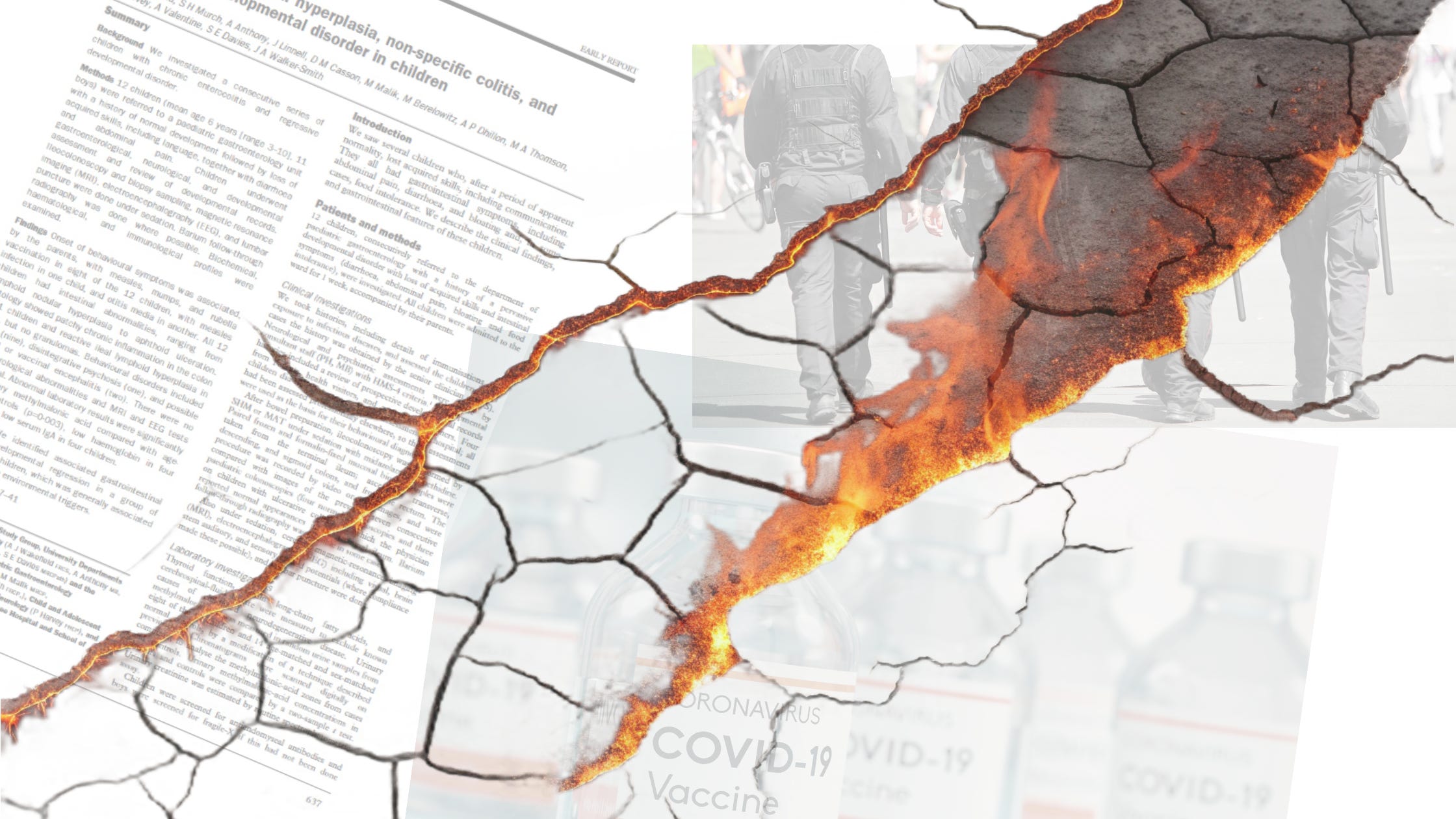
1998: Anti-vaccine rhetoric that was fueled by the publication of an article containing falsified data and authored by a scientist clearly driven by financial incentive. The ability for lies to be published as fact in a reputable journal was a major incident leading to a world where it is normal to choose which reality you want to believe. The paper wasn’t retracted until 12 years after its publication despite immediate skepticism and proof of its inaccuracies.
2020: And of course, COVID. The speed of science around COVID was neck-breaking. That means that the accumulation of new facts was also rapid. And, as with all good science, more facts resulted in new, more informed conclusions. But when that process took place live on the public stage, the speed of learning, coupled with poor communication, resulted in the message that facts aren’t actually true. Better scientific education and communication could have helped people to understand that truth wasn’t changing - it was evolving. Imagine a grainy picture becoming clearer. The pixels of the picture weren’t wrong; the resolution simply improved. As the image became clearer, the interpretation also improved. But to society, it seemed that with every improvement in resolution, the previous image shown was a fabricated lie. This was an accelerant on the fire of scientific fact denial that had been building over the last 30+ years.
I’m not saying people shouldn’t question what they are told. Unfortunately, science has become deeply influenced by greed and power. Facts have been deliberately ignored or twisted to make bad people rich. The opioid epidemic was a consequence of withholding facts to make the Sackler family rich. They used doctors as pawns to spread lies, seeding mistrust in a profession that believed they were acting on facts. AI growth at any cost has created tools that give people the power to create what appear to be facts with minimal regulation. People are rightfully questioning the ‘truths’ they are being told to accept.
Yet, after decades of growing distrust in science, it’s snowballed from questioning what we are being told to outright denial of pure fact. While it’s a long road between those two behaviors, as I look back on the last few decades, it makes sense. We live in a time where we learn about our world through 30-second social media clips and are only exposed to information that confirms our beliefs, all of which is created to drive engagement, not education. How can we start from a basis of fact when we rarely even see them?
I’m not claiming that the current rejection of direct observational evidence is the direct result of society’s rejection of scientific facts. I remain fundamentally confused and bewildered how two people can watch a video of someone getting murdered and not agree that’s what happened. I do not understand how someone can accept that a person being taken into custody based solely on the color of their skin or their accent is acceptable. That takes a deep erosion of our compassion, empathy, and decency. But the road that’s led people to be capable of denying the fact of our fellow humans’ humanity, I do believe that the beginning of that road was, in part, paved by the ability to deny scientific facts.
So, back to my original question? What do I do? It means I’m more committed than ever to improving science communication, engagement, and literacy. And I can’t think of a better way to do that than through laughter. Any amount of real, unadulterated truth we can bring to the world, we get one step closer to reentering a society where we have a shared reality. As our government continues to promote lies as facts, and corporations continue to act in their financial interest above all, we can resist by committing to speak truth. We can agree to learn and educate so that we can debate interpretations, not facts. We cannot talk to each other without committing to a shared reality. If we can get people to agree on the facts of science, perhaps we can eventually get back to agreeing that shooting and killing someone without cause is wrong. Caging people is wrong. And eventually, we can get to an agreement that every human is valid.
Sadly, I don’t know if we can do this. While I think the road to disregarding facts of science, to disregarding the facts of humanity, is slippery and quick to travel down, I think the road back is much steeper and much harder. The leap from not believing in COVID to not believing a verified video doesn’t feel that large to me, but moving in the opposite direction feels nearly impossible. And, as I wax academically on the erosion of fact, people are dying. People are being physically harmed. In total honesty, talking about science and science communication while society falls apart feels inconsequential and borderline ignorant. Yet those are the skills I have, and so that’s what I’m going to bring to the fight to heal society.
No posts
Comments
Nothing yet. Say the first thing.
Sign in to join the conversation.