
There is something happening to this generation of kids that frightens me, and I don’t think we are talking about it nearly enough.
Amid the endless scrolling, texting, swiping, liking, and consuming, we are slowly abandoning one of the most important human habits we have ever cultivated: the habit of reading.
To me, this extends far beyond the cliched comparisons of ‘phones bad, books good’, and it isn’t about nostalgia for another era or a longing for the way things used to be, either. Personally, this is about something far more profound: when we, along with our children, stop reading intentionally, we begin to lose our ability to think critically, and feel deeply.
Reading asks us to do something that very little in our modern world requires of us anymore: it asks us to be patient, and it asks us to be critical. It asks us to stay with complexity instead of rushing toward certainty, to imagine lives beyond our own, to wrestle with ideas that don’t fit neatly into a headline, and to sit quietly enough that another person’s thoughts can mingle with our own and leave us changed.
When was the last time we asked that of our children?
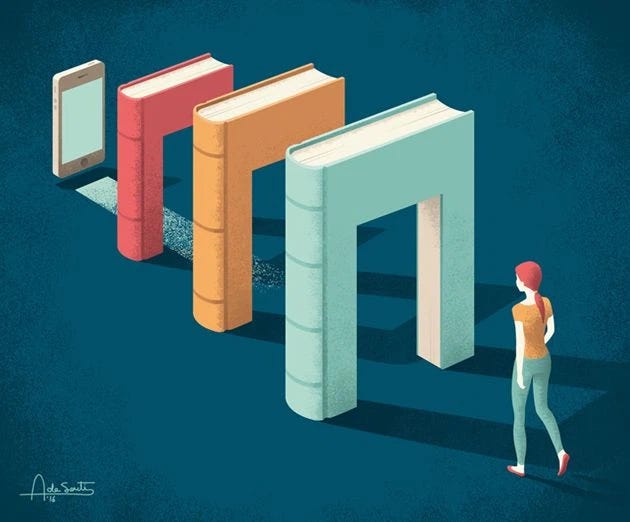
Unfortunately, the endless scroll teaches the opposite, conditioning us to move on before we have absorbed, to react before we have reflected, to consume without digesting. Our attention becomes fractured, our thinking becomes shallower, and without even realizing it, we lose our tolerance for nuance, ambiguity, and wonder.
I wish I could tell you this was simply a feeling I had, a hunch formed from decades in a therapy room watching families come apart at the seams of their own distraction. But the numbers back up what my gut has been telling me for years, and I think it’s worth sitting with them for a moment rather than rushing past them the way we rush past everything else now.
Researchers at UC Irvine have been tracking something they call sustained attention on a screen since 2004. Back then, the average person could hold their focus for roughly two and a half minutes before their mind wandered or their hand reached for something else; by 2012, that number had fallen to about 75 seconds. Today, it’s under a minute.
And it isn’t only attention that’s eroding. Actual literacy and comprehension has been quietly declining for over a decade.
The most recent national reading assessments in the United States put scores at their lowest point since the early 1990s, and researchers are clear that this didn’t begin with the pandemic - it started years before.
So we have a generation of children reading less, understanding less of what they do read, and holding their attention for less time than at any point we’ve been able to measure. Doesn’t that worry you?
I think about what this means for the world our children are about to inherit.
Attention is not a small casualty; it is the raw material of everything that matters, the ability to sit with a hard problem instead of abandoning it, to listen to another person long enough to actually understand them, to hold two conflicting ideas in your mind without needing to collapse them into something simpler. A generation raised on fragments will not automatically default to the same depth of thought previous generations did, and I don’t think we can afford to assume otherwise. The future we are so anxious to prepare our children for, one that will ask more of their patience, their empathy, and their capacity for nuance, not less, is being shaped right now by whether or not they ever learn to sit still with a page.
Attention is what children need - from us as parents, from their teachers, and the larger communities they interact with everyday. The need this presence and focus, with serious and intentional consistency, in order to practice and develop connection.
And there is a more urgent reason still, one I don’t think we can afford to look away from.
Our children are coming of age in a world flooded with information, and very little of it arrives free of an agenda. They will need to tell the difference between a fact and a well-dressed opinion, between a source and a script, between a real photograph and one that was never real at all. We call this media literacy, and we treat it like a new subject for a new era, but I want to be honest with you: media literacy has no foundation to stand on without actual literacy underneath it.
You cannot teach a child to detect bias in a sentence she cannot fully read. You cannot teach her to question a source if she has never developed the patience to read past the headline. Discernment is a skill, not an instinct, and like every skill it has to be built somewhere. It is built one page, one paragraph, one difficult sentence at a time, in exactly the kind of reading we have been slowly asking our children to do less and less of. This is not a ‘someday’ problem. It is already here, in every feed, every article, every convincingly written lie waiting to be believed.
If we do not hand our children the tools to read closely, we are handing them a world they will not be equipped to see clearly.
As someone who has devoted her life to consciousness, I can’t help but see this as more than a cultural shift. I see it as an erosion of our inner lives. And here is where I think we, as parents, need to pause and look at ourselves too, because this was never only a children’s problem.
This is where I think conscious parenting and literacy actually become the same conversation.
So much of what I teach in this work comes down to one repeated idea: that we cannot raise a child to know herself if we have never taken the time to know ourselves first.
Reading, the kind that asks something of you, is one of the oldest and most reliable ways human beings have ever found to do that work; in many ways, it’s the entire foundation of consciousness itself: the capacity to be curious about your own inner world instead of anesthetized to it. I really don’t think our children need more content, but what they do need is more invitation; an invitation to explore their own curiosity through active creativity instead of passive consumption.
Engaging with long-form written content reminds us how to be still long enough to hear our own thoughts instead of endlessly consuming everyone else’s. I don’t think that’s a small, quaint idea in a world like ours.
Reclaiming our attention is one of the most radical acts of our time. Perhaps, for us, it begins with reading again.
Thanks for reading Raising Conscious Children with Dr. Shefali! This post is public so feel free to share it.
Comments
Nothing yet. Say the first thing.
Sign in to join the conversation.